Thursday, 1 February 2007

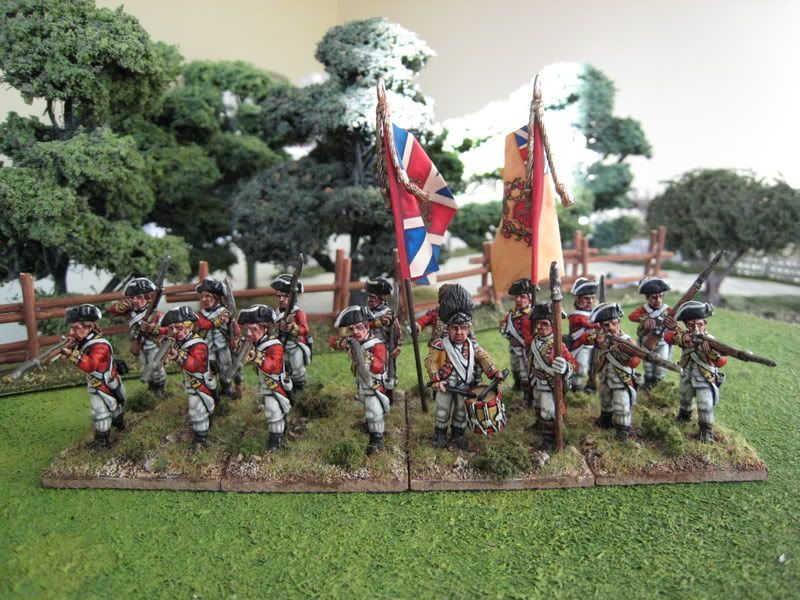
1st Grenadier Battalion


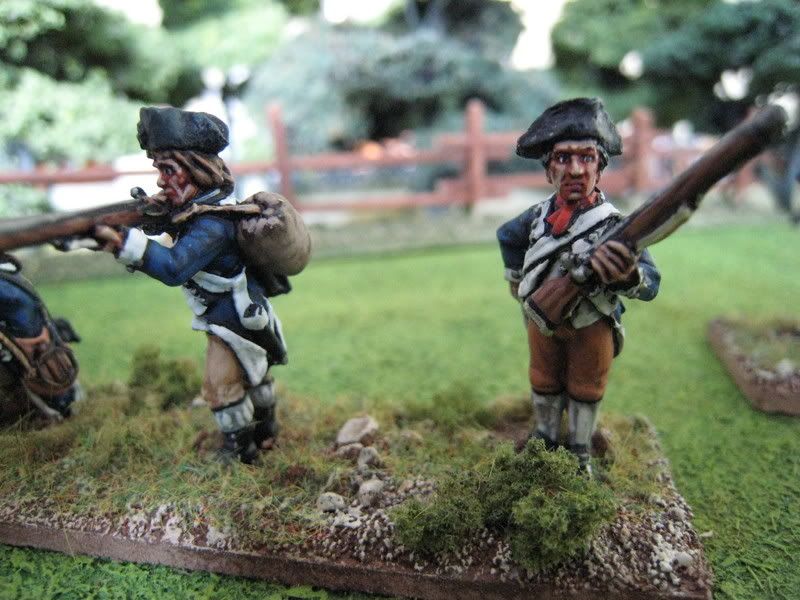
The British army formed composite battalions from the grenadier companies of various line regiments. Such units were of "elite" grade as they consisted of some of the best troops in the army. Two such grenadier battalions served in the AWI. I call this the first simply because it is the first one I have finished. That said, it is not quite finished as eventually I will add 8 more figures to bring it up to a total of 32. The Monmouth scenario for "British Grenadier" calls for two grenadier battlions with 32 figures each. Brigaded together under Cornwallis, those units combined would have made a terrifyingly efficient opponent. Other scenarios require battalions of 20-24 figures.

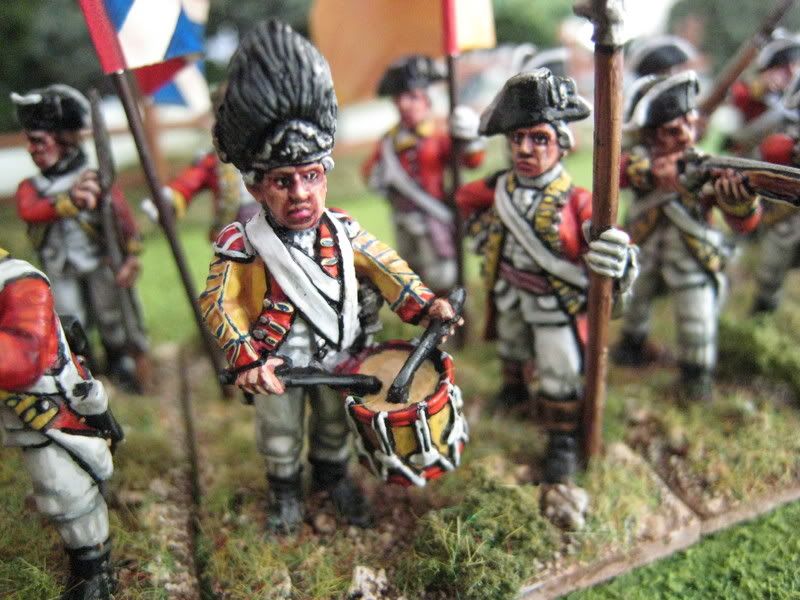
I painted this battalion quite early in my AWI career without much attention to the facings. I simply picked facings that I liked rather than trying to work out which regiments would historically have contributed troops, athough the regiments that fought at Bunker Hill are mostly represented here (such as the buff-faced 52nd Foot on the extreme left of the line), since the unit was painted primarily for that scenario. The command figures were painted with blue facings on the basis that they are formed from the most senior regiment in the unit, which would probably have had the royal facings. I will adopt a far more methodical approach for the second battalion, which will be in a "charging" pose as opposed to the "marching" pose shown here. These figures are a mix of Foundry and Perry. The Foundry figures have backpacks and longer coats, whilst the Perry figures have cut-down coats. Painted at various times in 2004. 24 figures.

Wednesday, 31 January 2007

Napoleonic French infantry


Every wargamer has a list of projects that are sitting around half-finished or which fall into the "I'd really love to do that one day" category. I have over a dozen. On the "half-finished" list (which in some cases means "barely started") are Alexander the Great, Julius Caesar and the Roman Civil Wars, English Civil War, American Civil War, Darkest Africa, Russian Civil War, the Punic Wars, Vikings, 1066, 1812 and several I've forgotten. As I write this, I'm also drooling over the new WAB "Age of Arthur" supplement and have concluded that this period must also go on the list.
A long-term ambition is to work on an 1815 project using the marvellous figures produced by Perry Miniatures. Loughton Strike Force's Waterloo game at Salute in April gives me an excuse to leave the AWI for a couple of months and paint up Dutch-Belgian cavalry and Napoleon & co. This year I also want to finish a French line infantry brigade using the Perry 1815 French figures. The picture shows the beginning, some "test" figures I painted last year but which I only based the other week. The painting and colour schemes I used need some refinement, but these are lovely sculpts and I'm looking forward to watching Alan Perry's range develop.

Tuesday, 30 January 2007

Hartley's Additional Regiment

.

"Additional" regiments were units raised regionally but not adopted by any particular state or assigned numbers on the regular Continental establishment. Sixteen such regiments were raised in January 1777, all named after their commanding officers. Thomas Hartley's Additional Regiment took its recruits from Pennsylvania, eastern Maryland and Delaware. It was assigned to Anthony Wayne's brigade and fought at Brandywine and Paoli before being posted to the Pennsylvania frontier in 1778 to guard against Iroquois incursions. In January 1779 the regiment was incorporated into a new 11th Pennsylvania Regiment, along with the remnants of Patton's Additional Regiment. A May 1777 edition of the Pennsylvania Gazette refers to a uniform of blue regimentals faced white.

This regiment is listed in the "British Grenadier" Brandywine scenario as a skirmish unit. In the "British Grenadier" rules, Continental regulars rate as second class (i.e. non-elite) skirmishers and when firing roll one set of dice per 3 figures. Therefore I have based this unit on 3 bases of 3 figures each, base size being 25mm x 75mm. The figures are my usual mix of Foundry, Perry and Eureka and include a couple of Perry hunting shirt types. Painted February 2006. 9 figures.

Sunday, 28 January 2007

Queen's Rangers Hussars


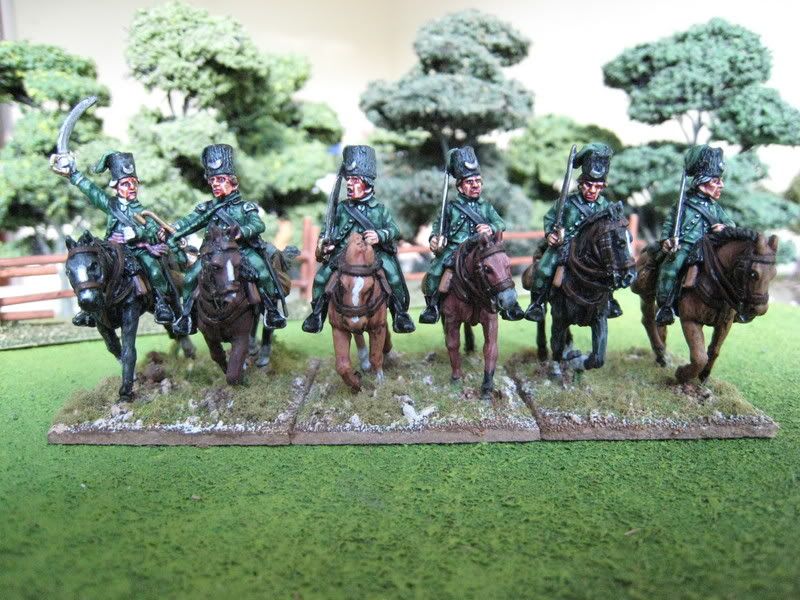
The Queen's Rangers was a loyalist regiment, originally raised by Robert Rogers of French & Indians Wars' fame but commanded during the AWI by Major Simcoe. Initially an infantry unit, a Hussar troop was added to the Queen's Rangers in early 1778. Three troops of light dragoons were raised a couple of years later, but the cavalry arm remained relatively small (although irregular units of loyalist horse seem to have been attached to the Queen's Rangers at various times). The hussar troop seems to have averaged between 30 and 80 men. The hussar cap was apparently adopted when a Hessian rifleman shot a Queen's Ranger after mistaking him for a Continental cavalryman on account of the similarity in their respective headgear. The Hussars fought at Monmouth in 1778 and then throughout the war up to Yorktown.
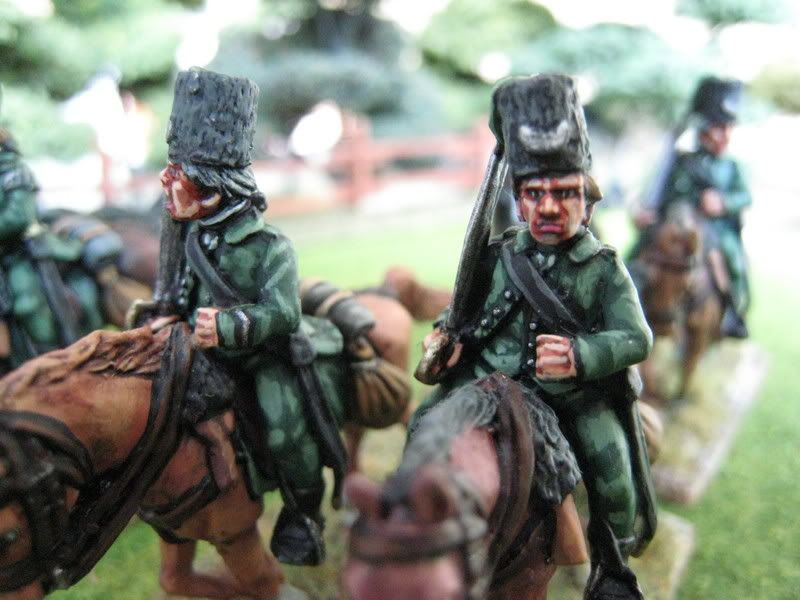
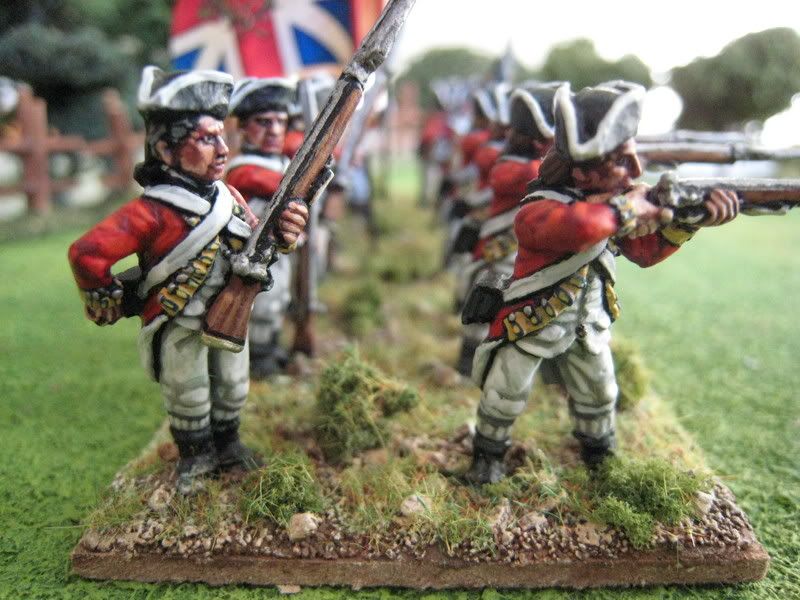
The second photo above shows one of Alan Perry's "self-potraits", that pop up in his AWI figures (and no doubt in other ranges too). I painted these Perry Miniatures figures a couple of years ago and my method for painting faces was very different to what it is now. I used to use the Foundry 3 colour flesh palette with a chestnut wash whereas now I use a mix of 4 to 5 Games Workshop/Foundry and Coat D'Arms flesh tones with a dark brown wash. This latter method gives more subtle results I think.

6 figures. Painted October 2004. 

Saturday, 27 January 2007

Current wip


The sun came out earlier and brighter than expected this morning which means I had to stop taking photos (you can see the rather odd lighting effects this causes in some of the shots in previous posts). Consequently I have a slight shortage of photos, although next week will see posts on the Queen's Rangers Hussars, Hartley's Additional Regiment, some British Grenadiers and a few Indian chiefs. In the meantime, here's a work in progress shot of Sherburne's Additional Regiment which is currently taking a back seat to my Napoleonic commitments and may or may not be finished any time soon (I also need to order the figures for the rest of the regiment from Foundry).
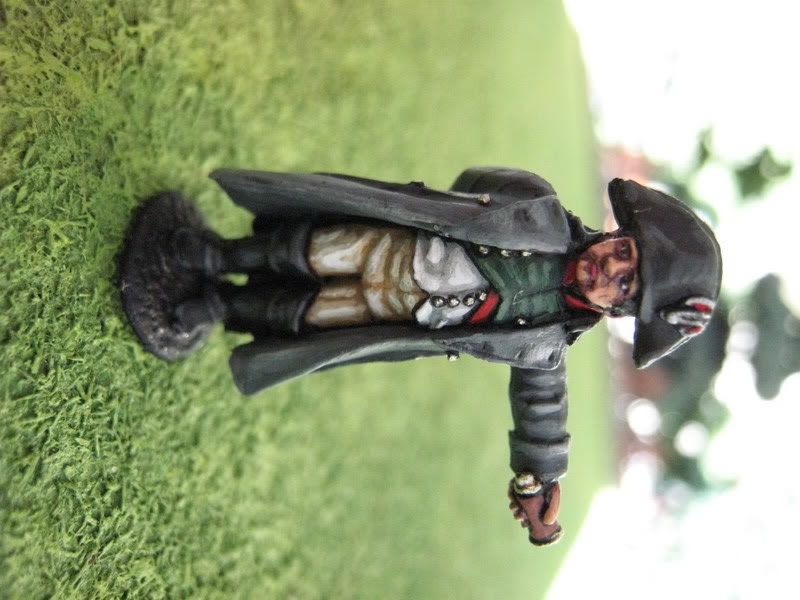
Below is a shot of the Napoleon figure from Perry's 1815 French range, which I painted this morning and isn't even varnished or based yet! I'm working on the rest of the pack this weekend, although I won't be basing them until I see the latest Perry releases, as they include several more packs of high command and staff figures. Putting all these figures together into 3 or 4 interlocking vignettes will take careful planning.

Thursday, 25 January 2007

28th Foot


Before Perry Miniatures came along with their packs of Brits in various types of "campaign dress", 25mm manufacturers tended to stick to making Brits in the 1768 Royal Clothing Warrant "full dress" (although most companies made various light infantry figures in slouch hats). So nowadays the wargamer can choose between the classic look of white-laced tricornes or the new orthodoxy of slouch hats, roundabouts and cut-down coats. Although there is evidence that soldiers began modifying their uniforms as soon as they reached America (and sometimes during the voyage over), I think it is acceptable to use the full dress look for regiments engaged in the early battles of 1775 and 1776. Therefore, I have modelled those regiments that were present at Bunker Hill, Fort Washington and White Plains largely according to the 1768 warrant. All consist of Foundry figures.

The 28th was raised in 1694 as Gibson's Regiment of Foot and fought at Ramillies and Fontenoy. It was in the vanguard of Wolfe's attack on Quebec in 1759. Arriving in America in 1776, the regiment saw action at Brooklyn Heights, White Plains and Germantown before leaving for the West Indies in 1778.

Painted May 2006. 16 figures. Flags by GMB. The fact that the drummer looks a bit like Gordon Brown is pure coincidence, given that these boys are from Gloucestershire and not Fife.

Monday, 22 January 2007

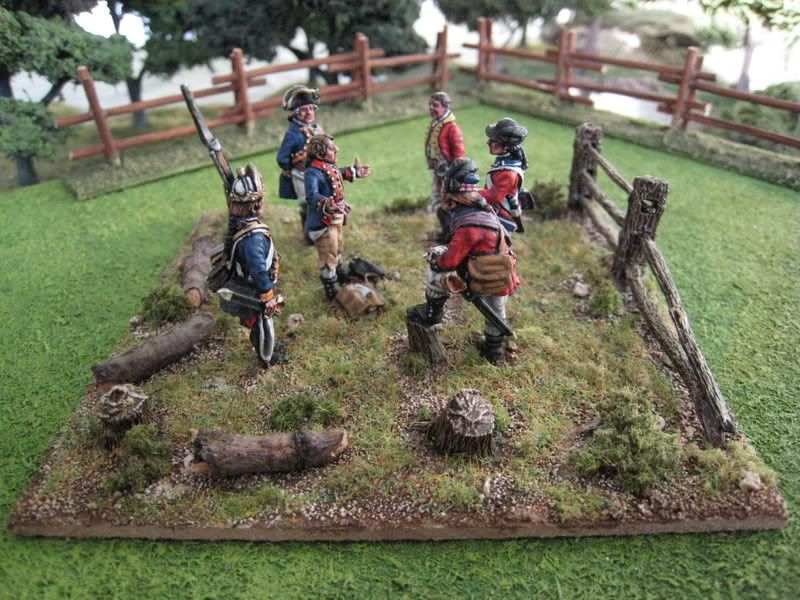
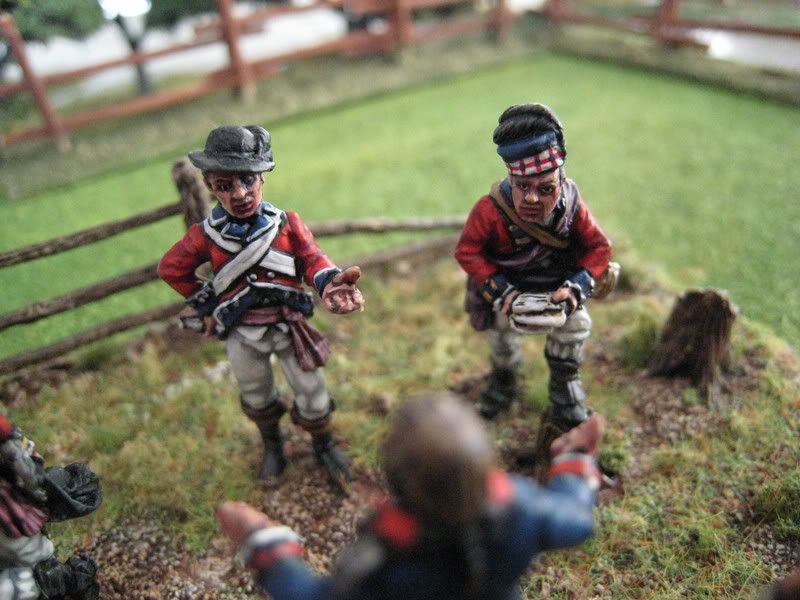
Interrogation vignette


For a few years now Dave Brown and Eclaireur, respective authors of the "General de Brigade" and "British Grenadier" rules sets, have organised large games that take place over a weekend at London's National Army Museum. As well as granting us the space for larger games, the National Army Museum provides an inspiring venue and gives the museum's visitors a chance to see what wargamers do (although this also induces spasms of nervous twitching when youngsters start manhandling and playing with models that are sitting around off-table).

In 2004 and 2005 these wargaming weekends featured both a Napoleonic and an AWI game (in the case of the latter, 2004 saw the battle of Monmouth and 2005 the battle of Brandywine). Alan and Michael Perry came along for the AWI games to demonstrate their uncanny ability to throw nothing but double-sixes for prolonged periods. It was noted that Alan's AWI range was nearing the magic "100 packs" mark. Shortly afterwards, I suggested on the TMP forum as a joke that a suitable way of celebrating this landmark would be for Alan to do a "National Army Museum characters" pack. It was then suggested (I'm not sure by whom, perhaps Eclaireur or Alan himself) that a suitable vignette might be a group of British/Hessian officers interrogating Alan, as an allegory of the pestering that Alan has to put with from those of us who are always demanding that he makes specific packs of obscure AWI troops.

And so pack AW100 was born. Mug-shots and measurements (our heights, obviously...) were sent to Alan early in 2006, there was a bit of discussion about what uniforms the various, er, "personalities" should be wearing and then in July I received an email from Alan with a picture of the greens he had finished. The likenesses that he has captured in such a small scale are absolutely incredible. The Perries together with other Games Workshop designers have already demonstrated their superb skill as portrait artists through their "Lord of the Rings" figures, so I suppose we should not really have been surprised at how well these figures turned out. But many thanks to Alan for being so game and taking on this capricious idea!

In front of Alan are a gesticulating Eclaireur (in the uniform of a Guards officer; of impeccable breeding is EC), Dave Brown in the yellow facings of the 44th Foot (which became the East Essex Regiment in 1782) and myself reading the captured despatches, dressed as an officer in the Black Watch. Behind Alan are two Hessians in the orange facings of the von Lossberg regiment. The tall officer is AWI expert and guru Supercilius Maximus (as he is known on TMP) whilst the sentry is a chap I think is called Norbert. I also painted a set of masters for Alan's own collection which he's put up on his site. Painted November 2006. Tree stumps and fence from Redoubt Miniatures. Base size: 100mm x 100mm.