Showing posts with label Artillery. Show all posts

Thursday, 24 October 2024

American artillery (8)


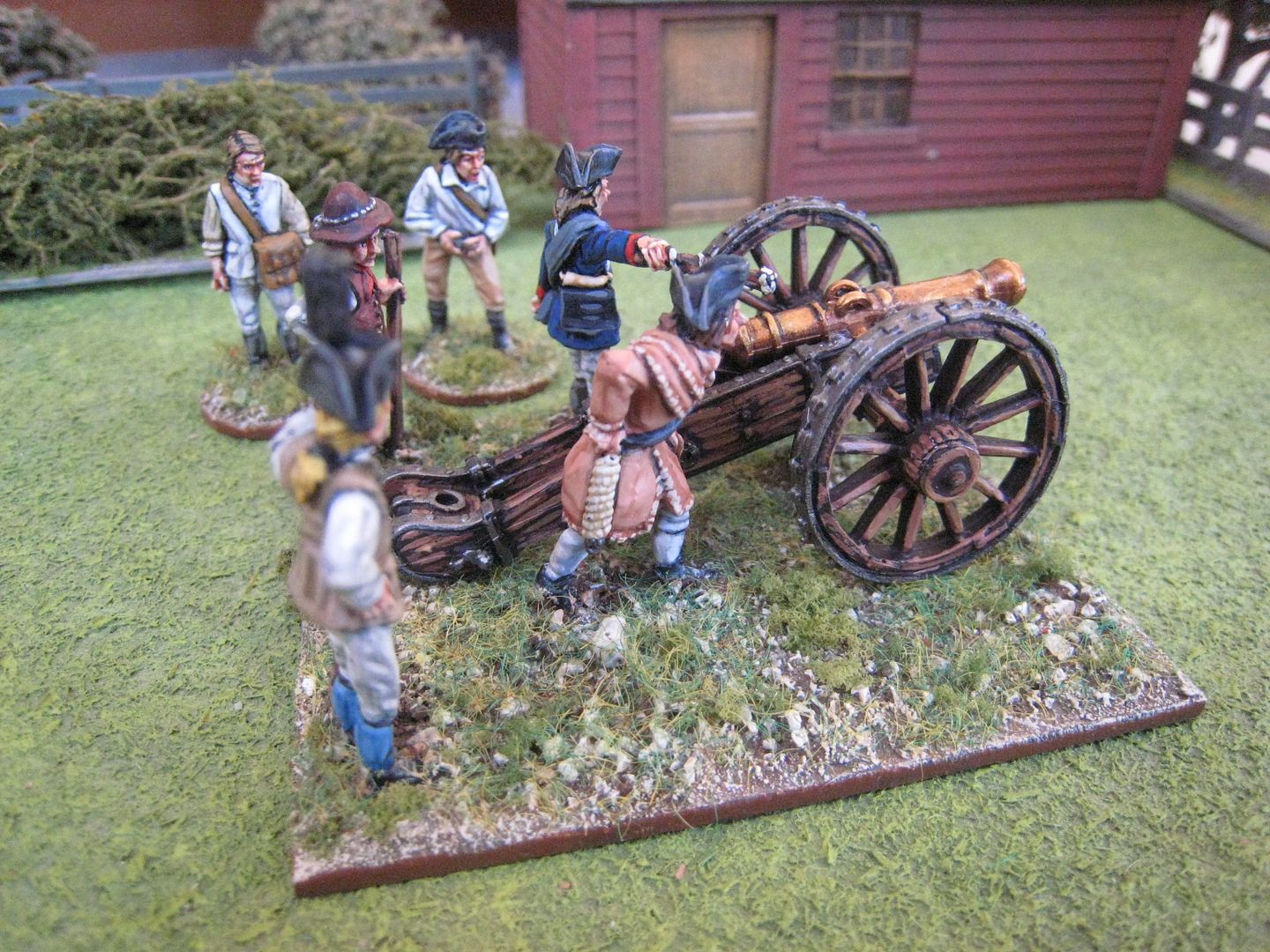
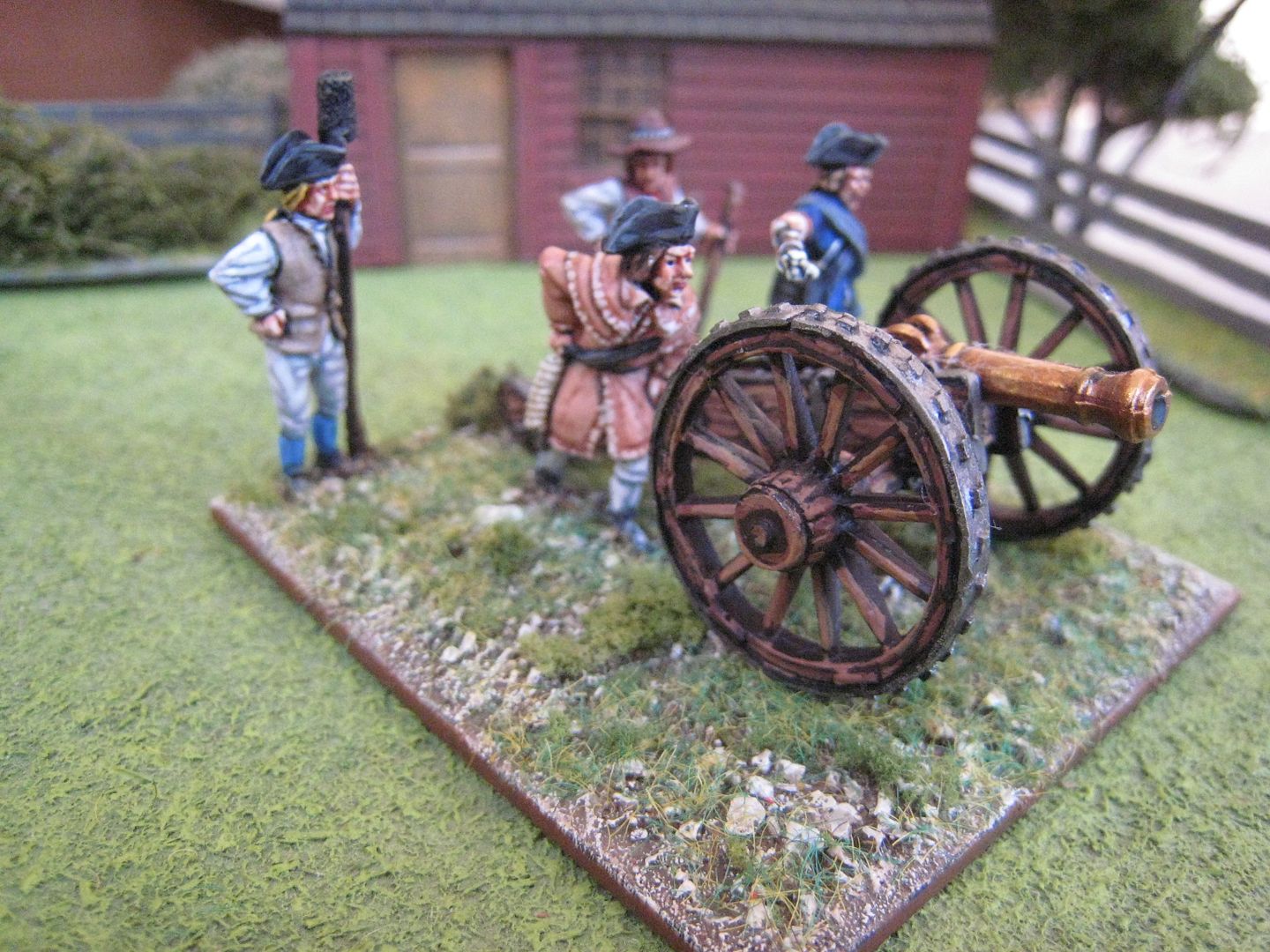
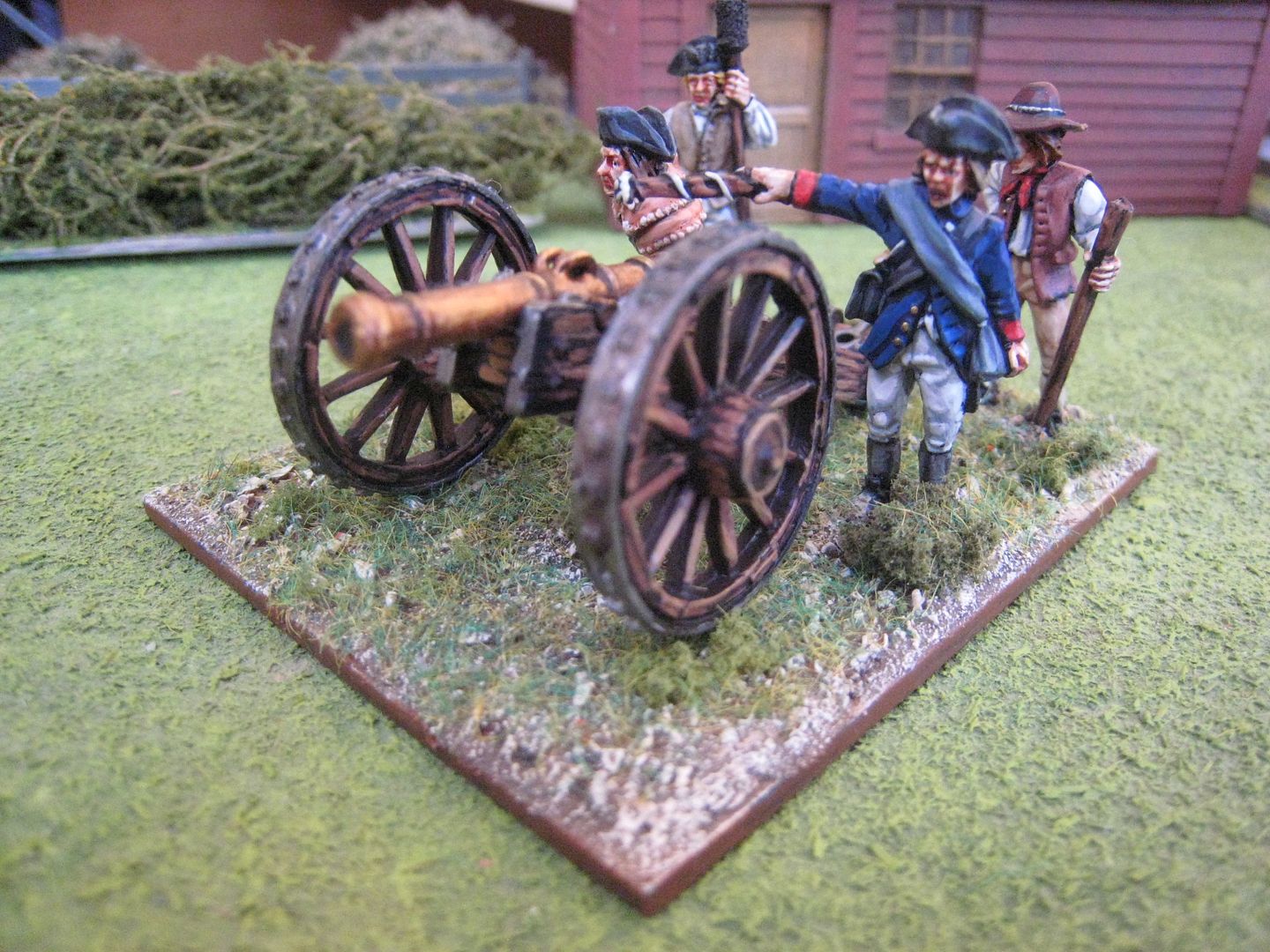
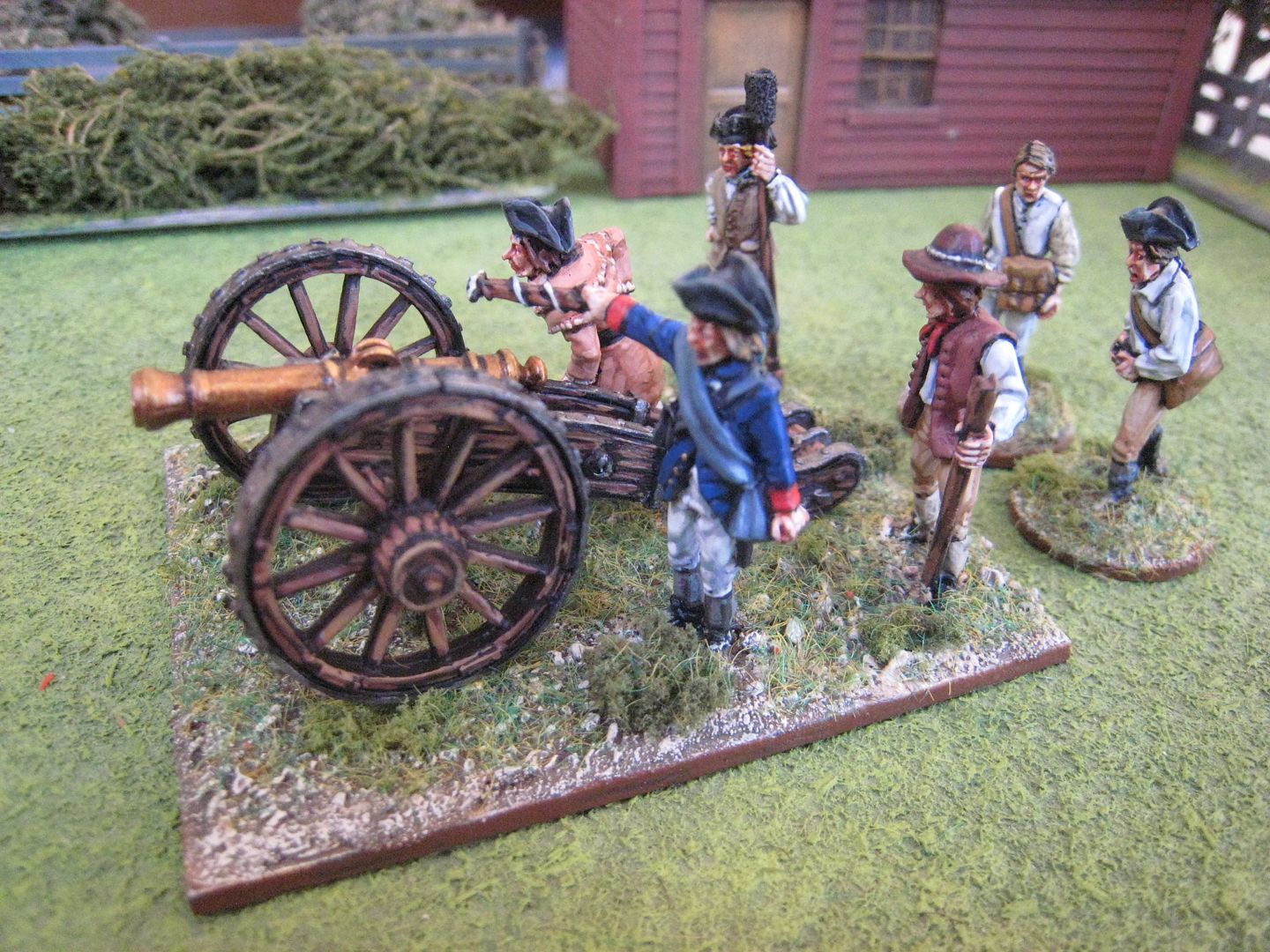
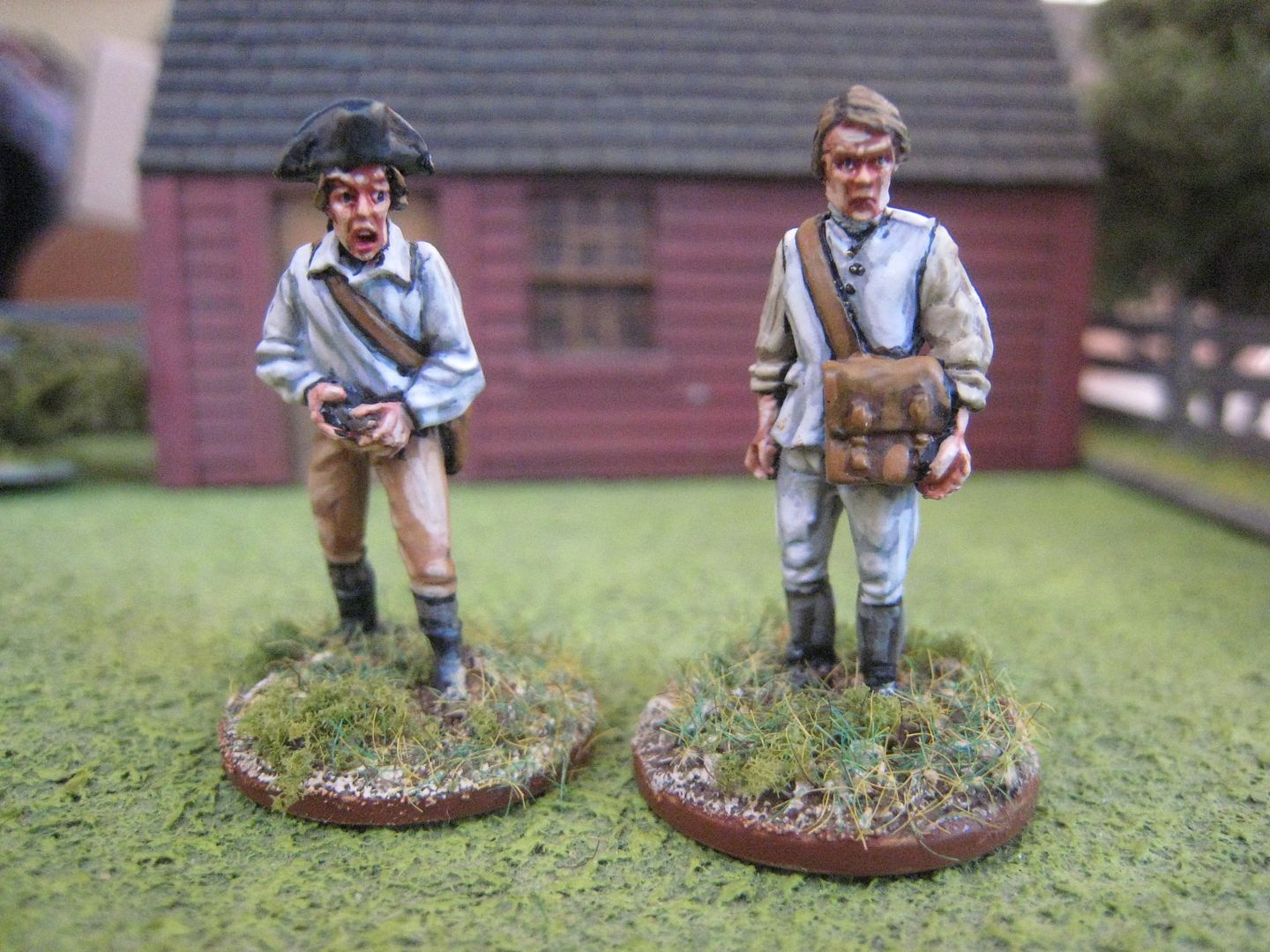
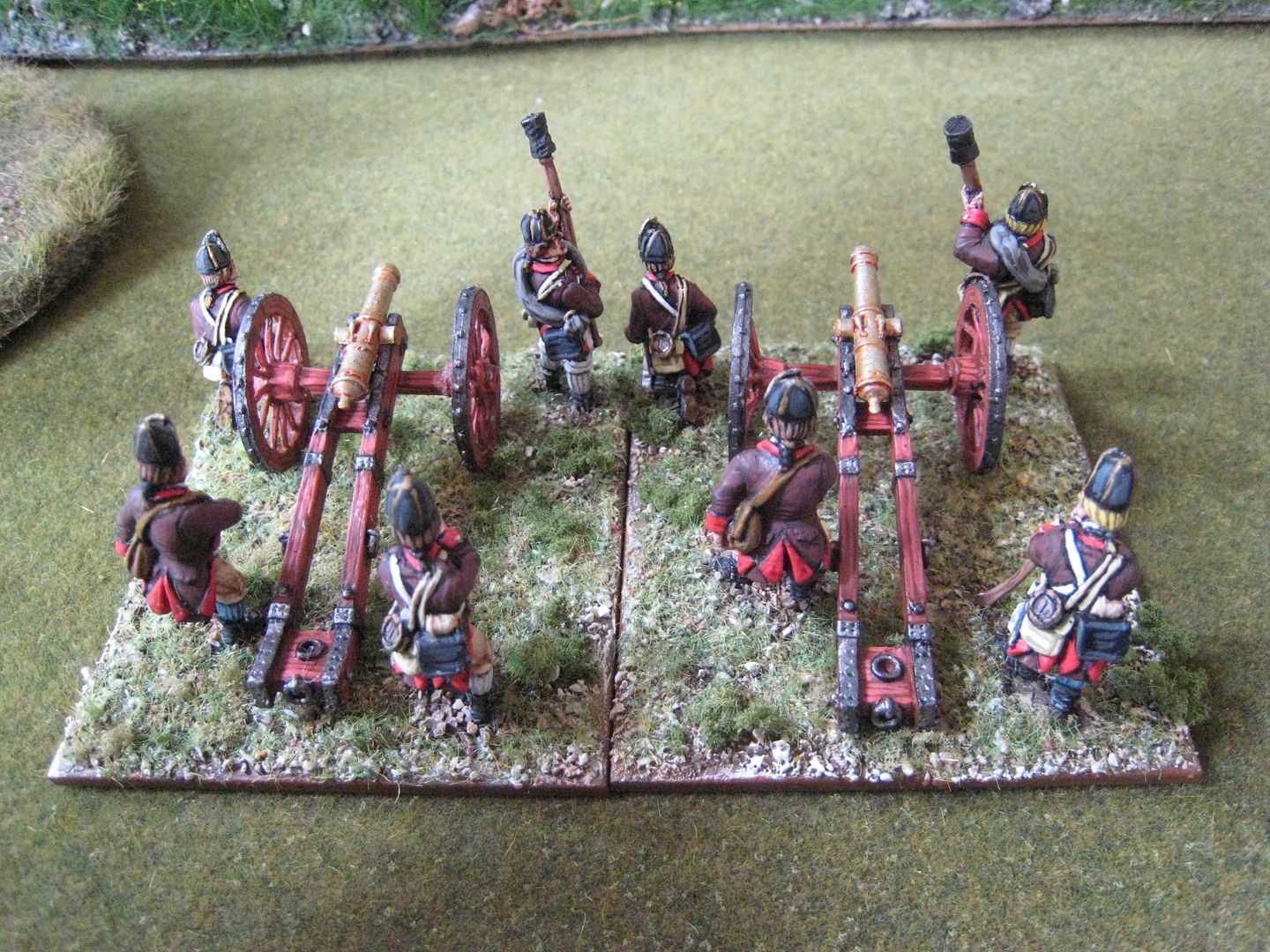
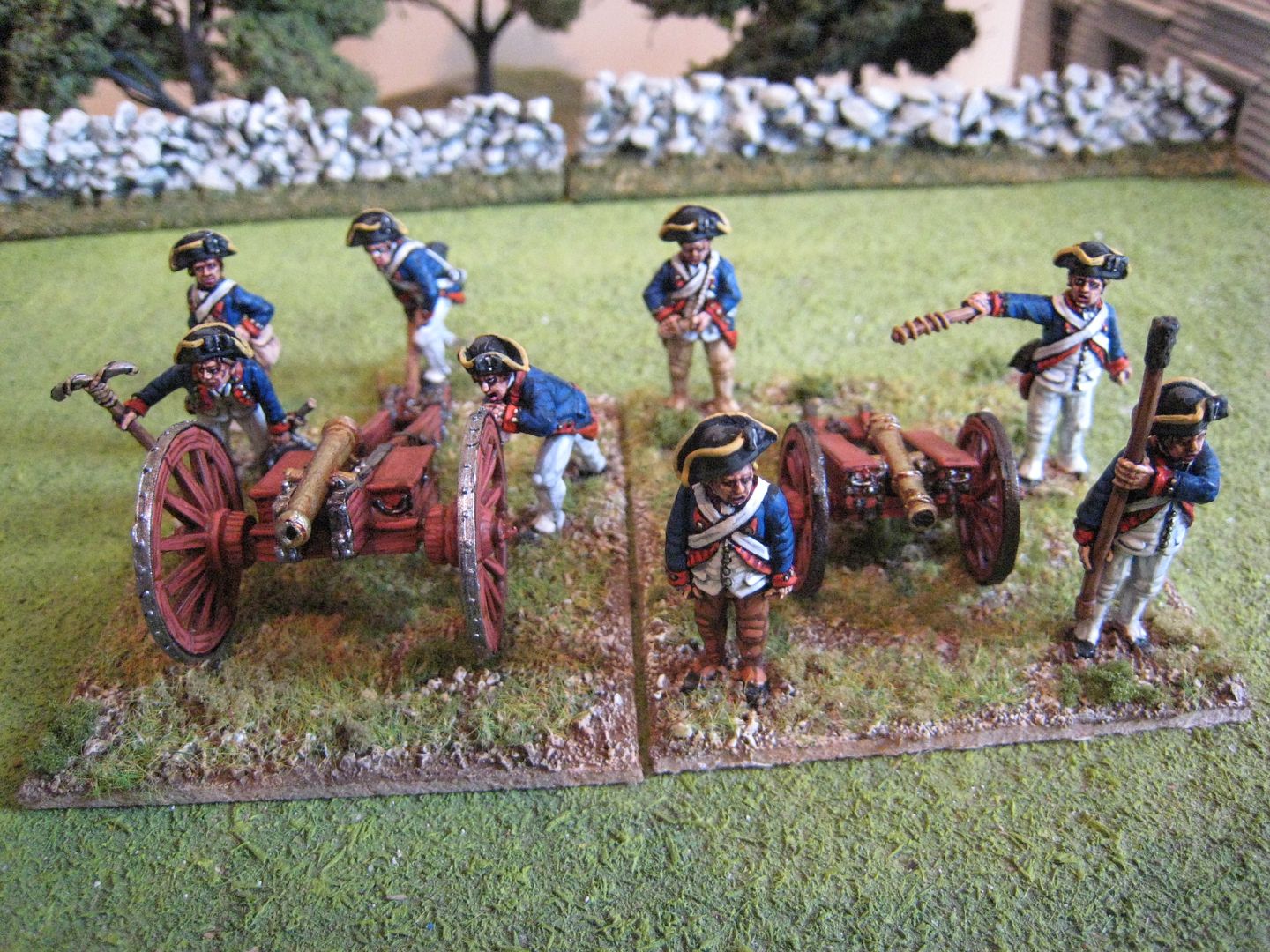
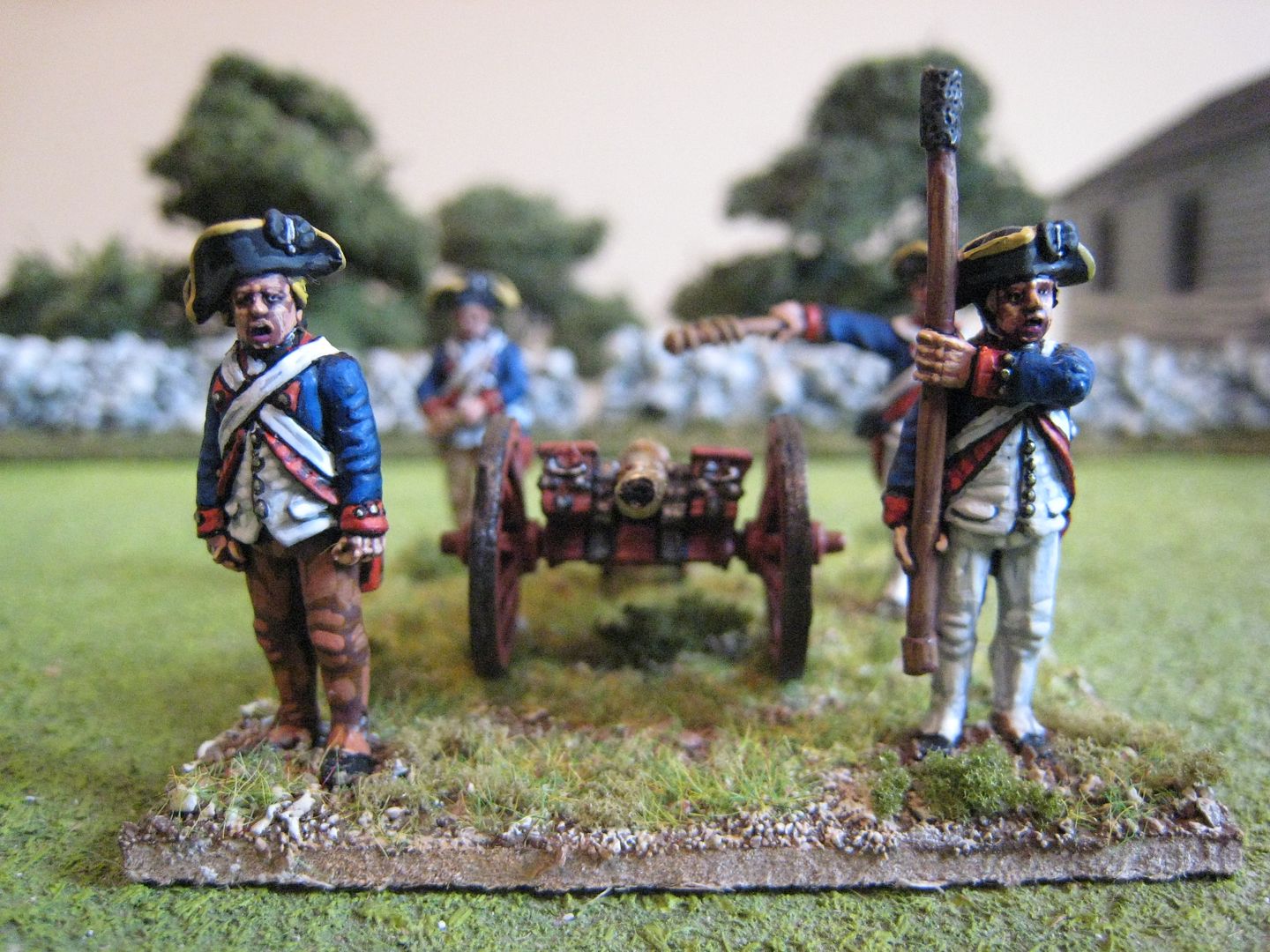
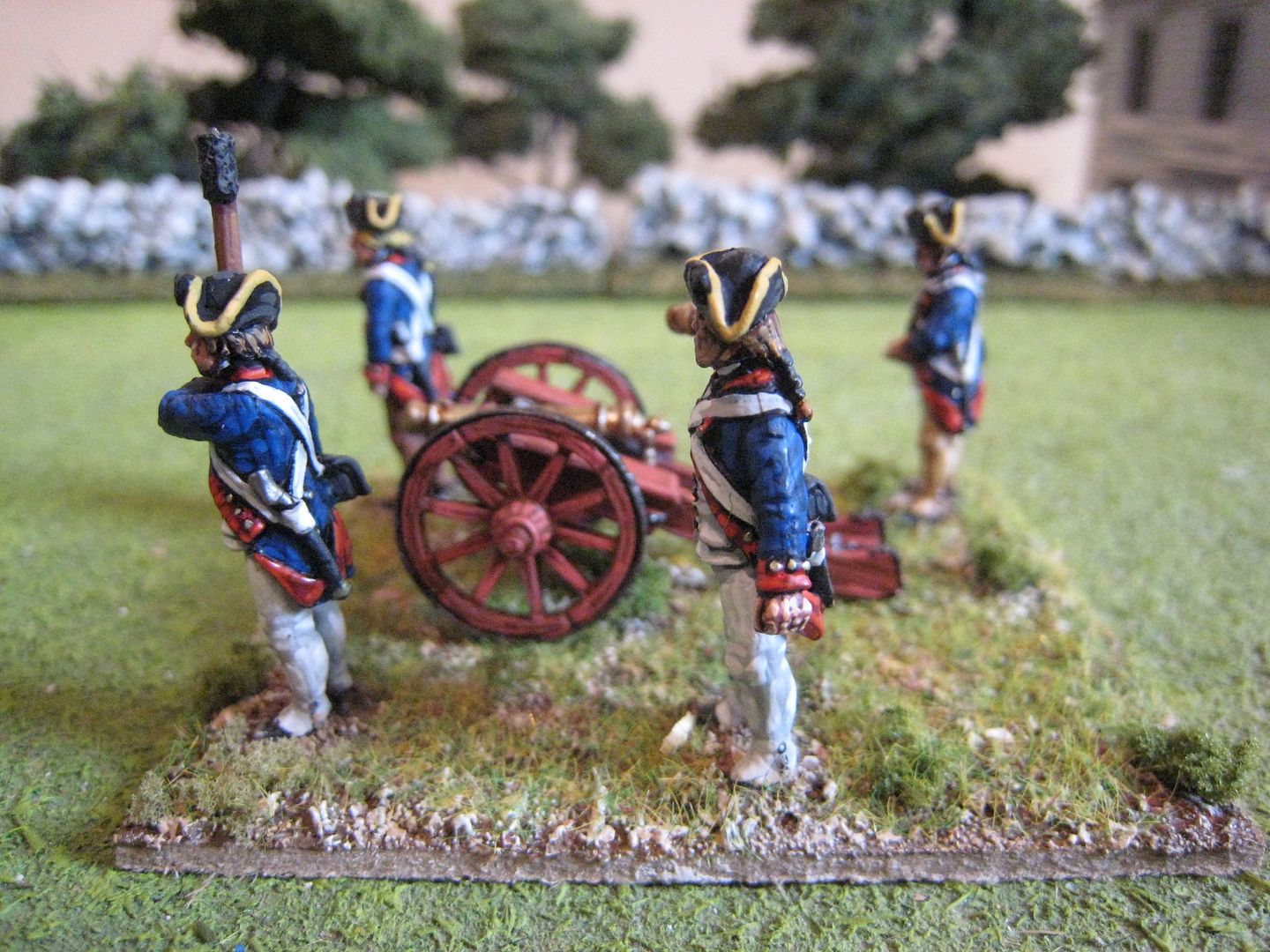
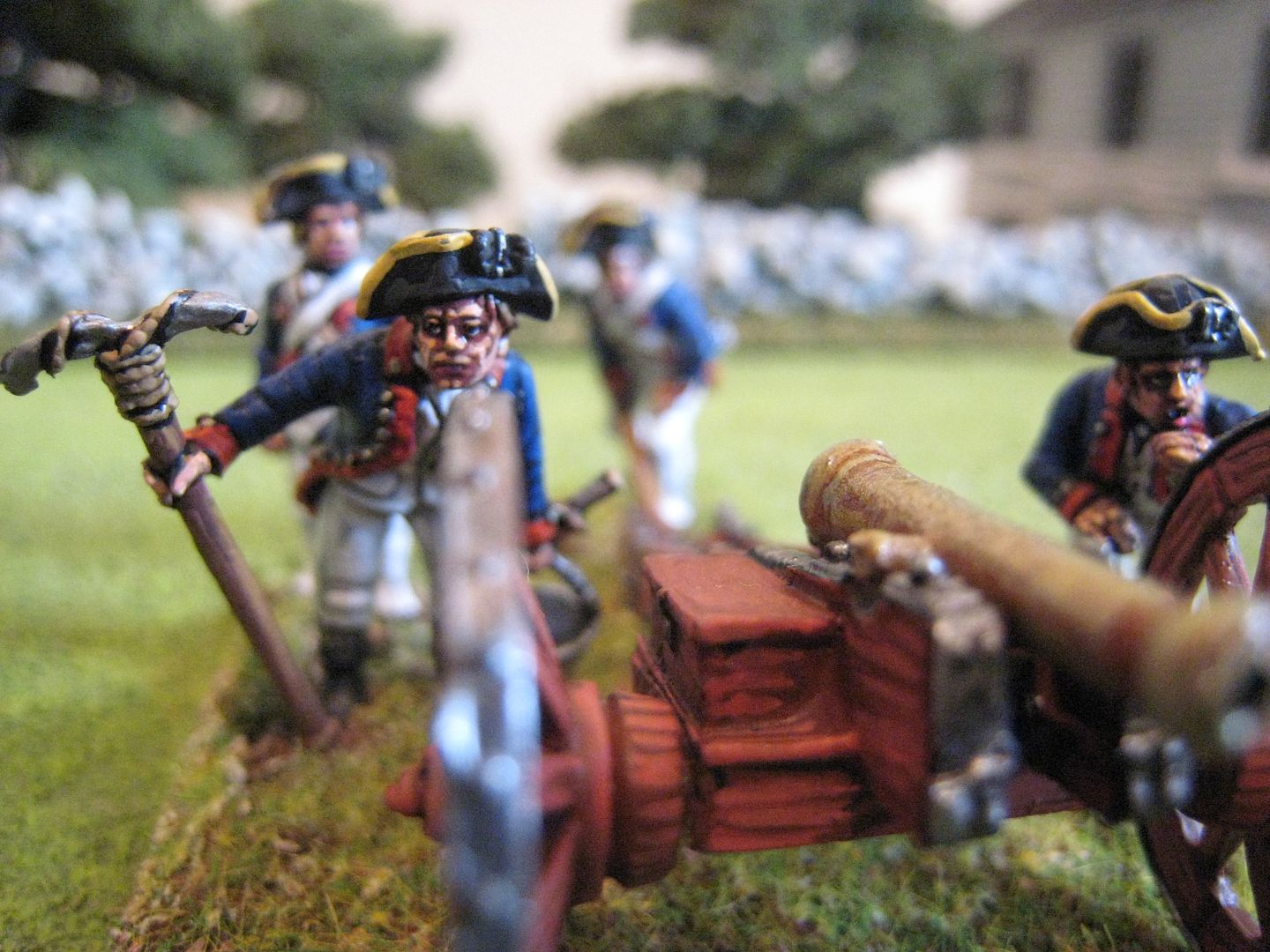
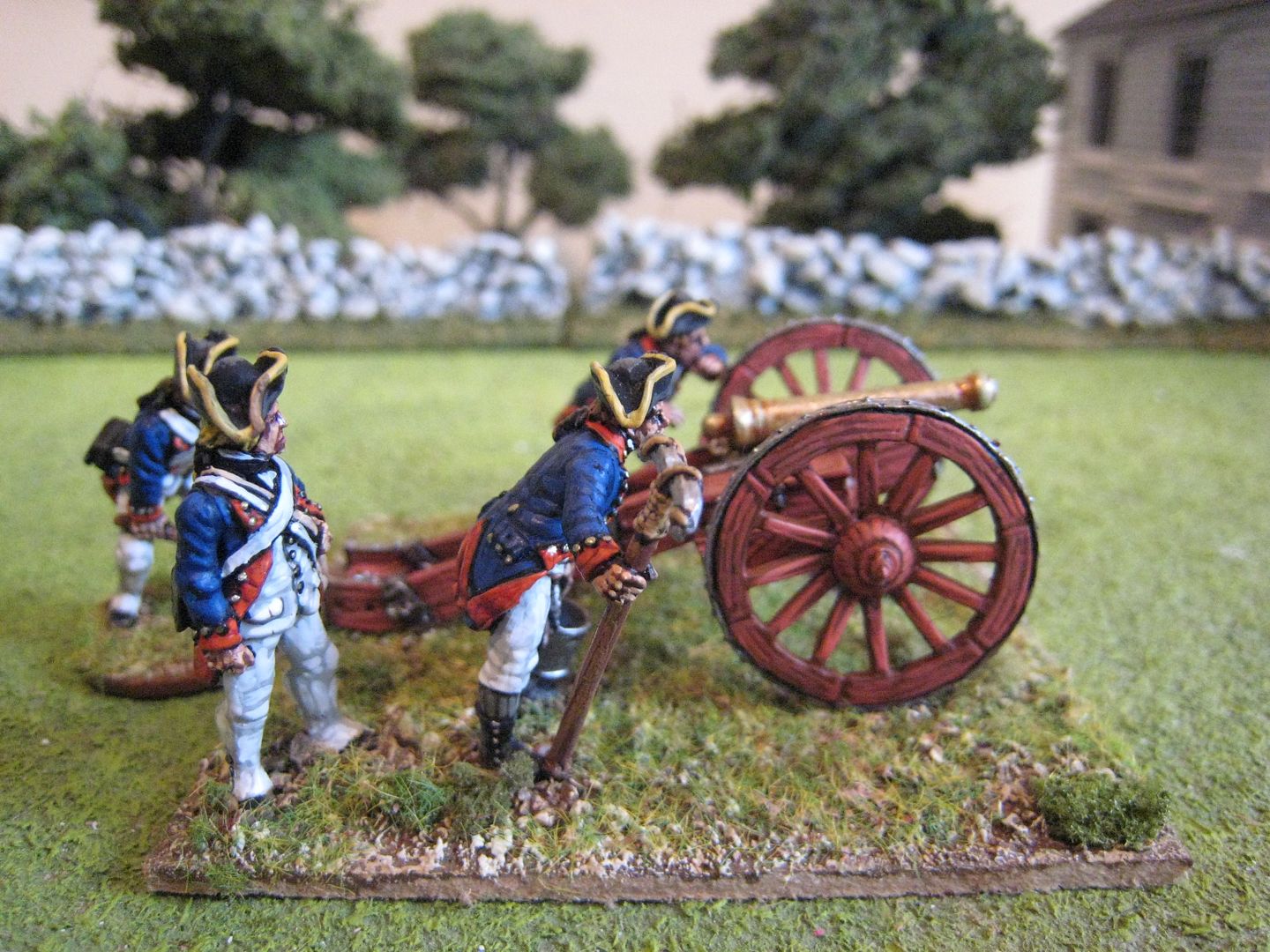
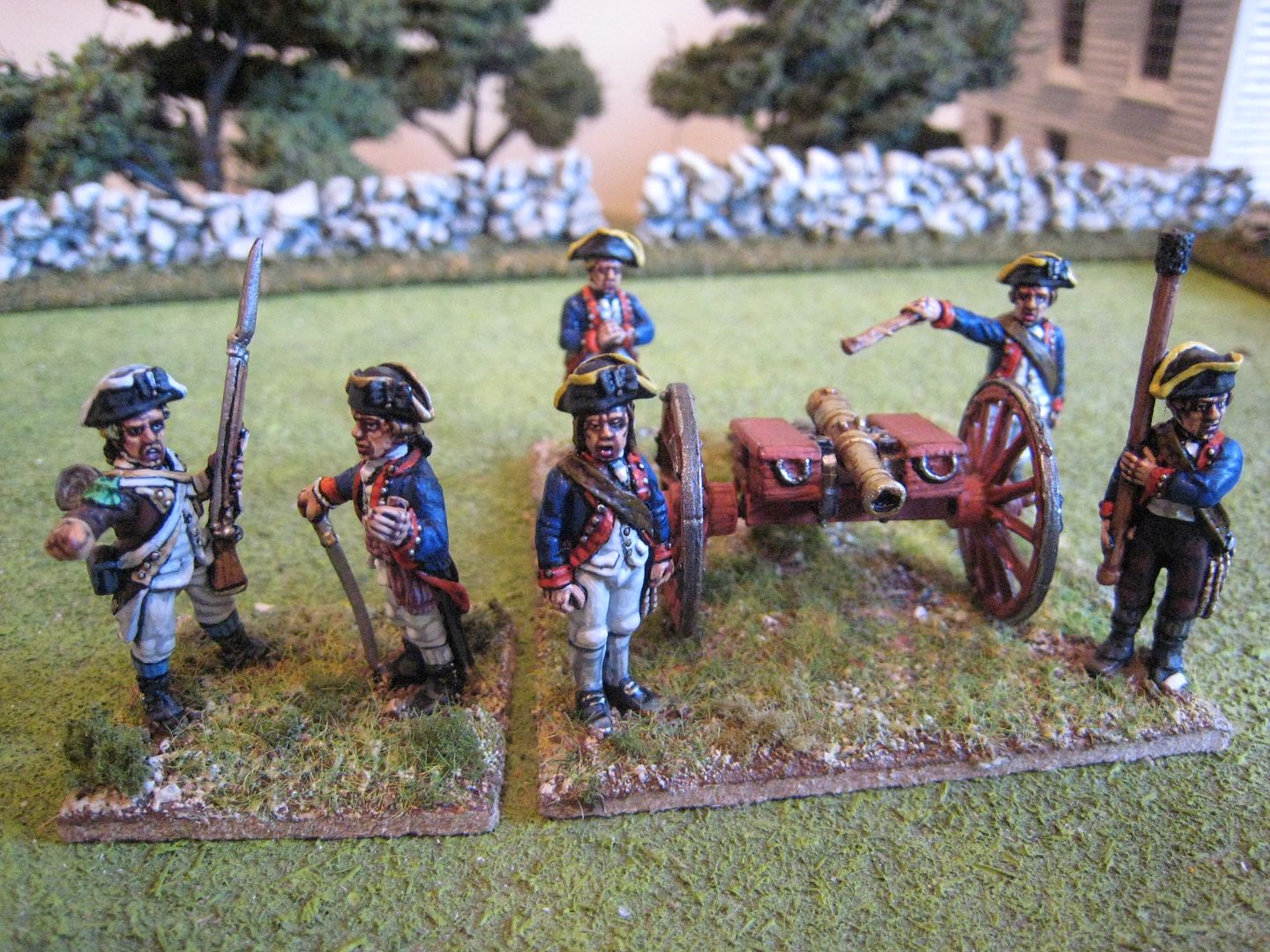
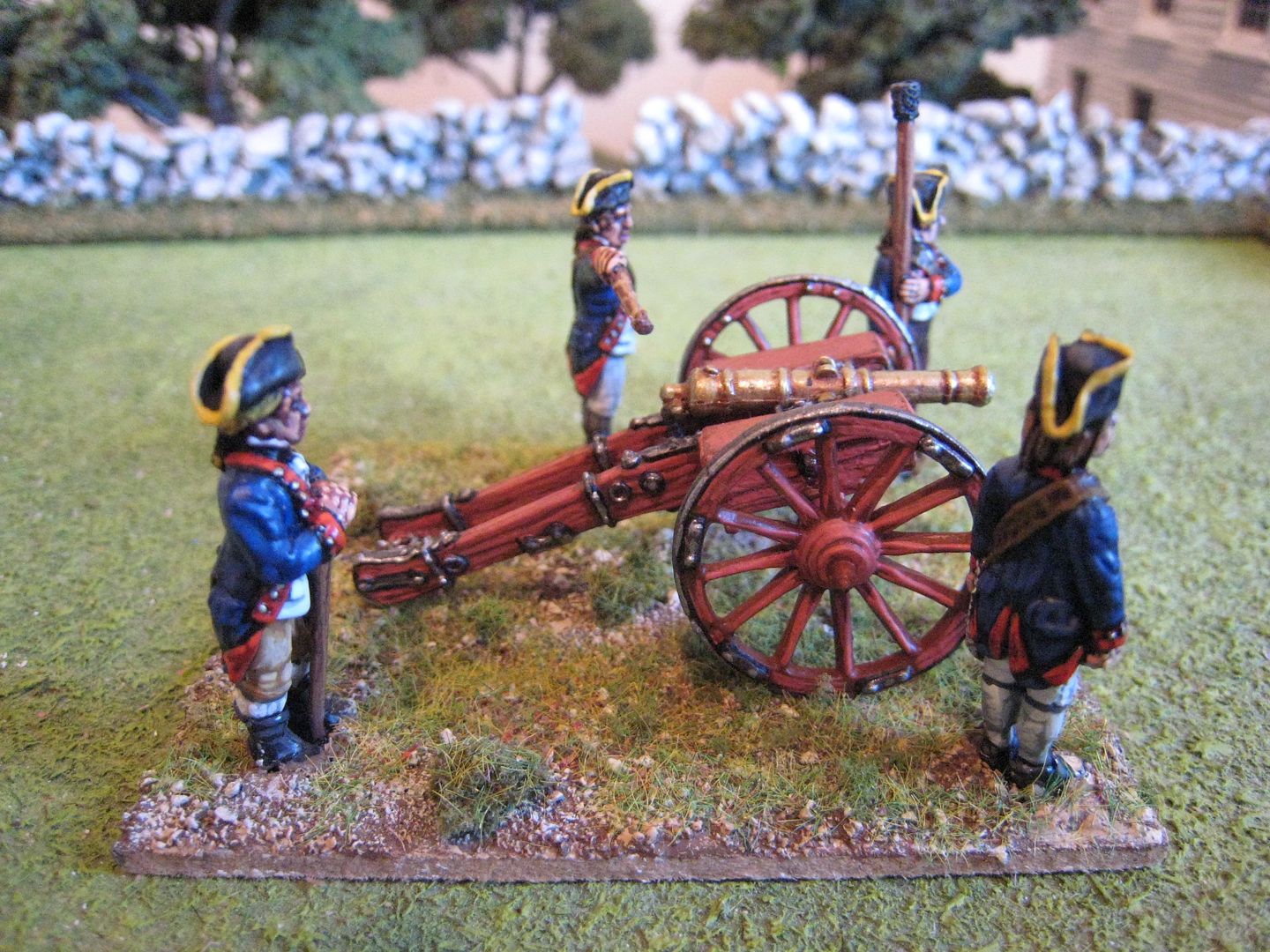
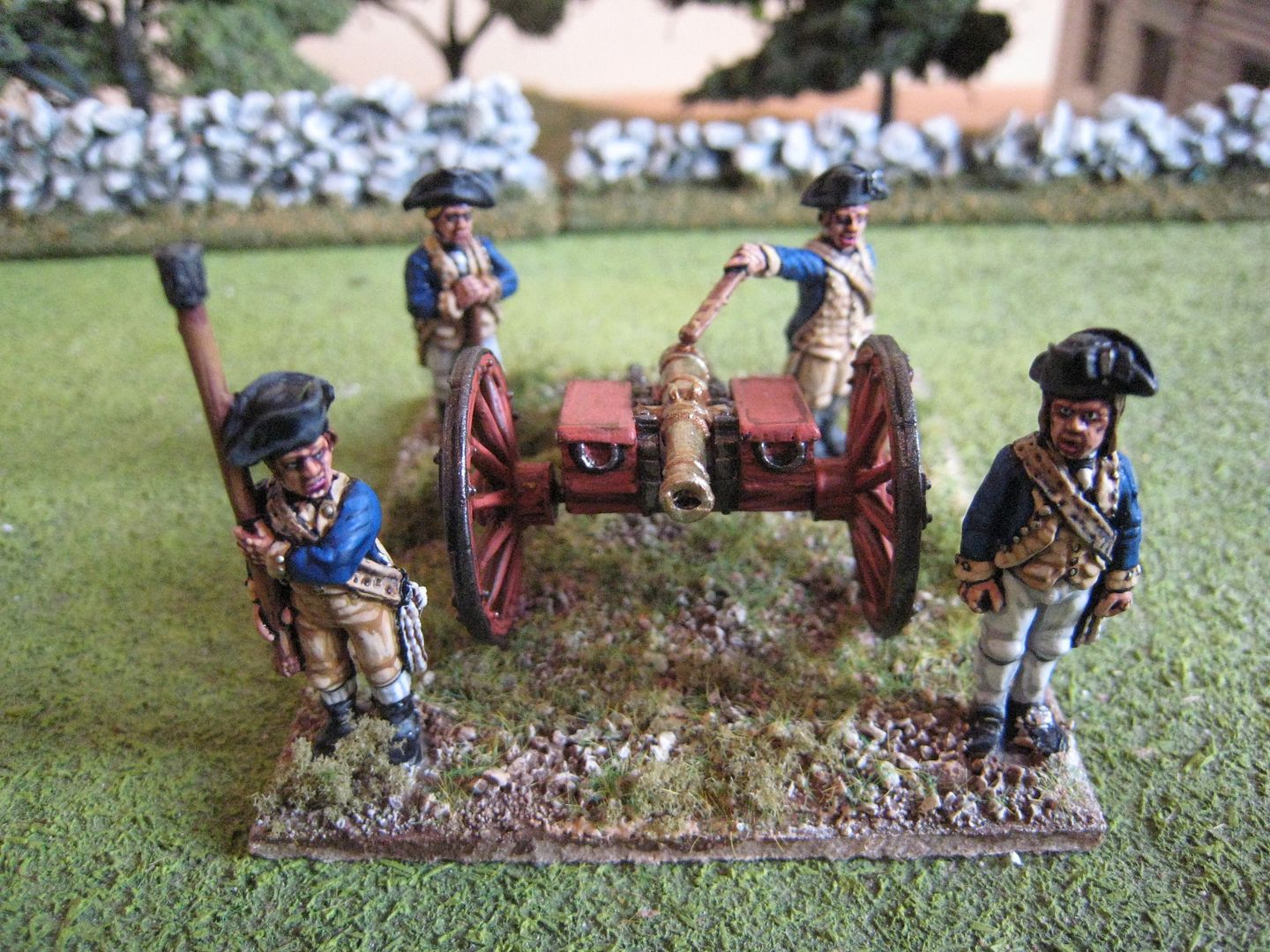
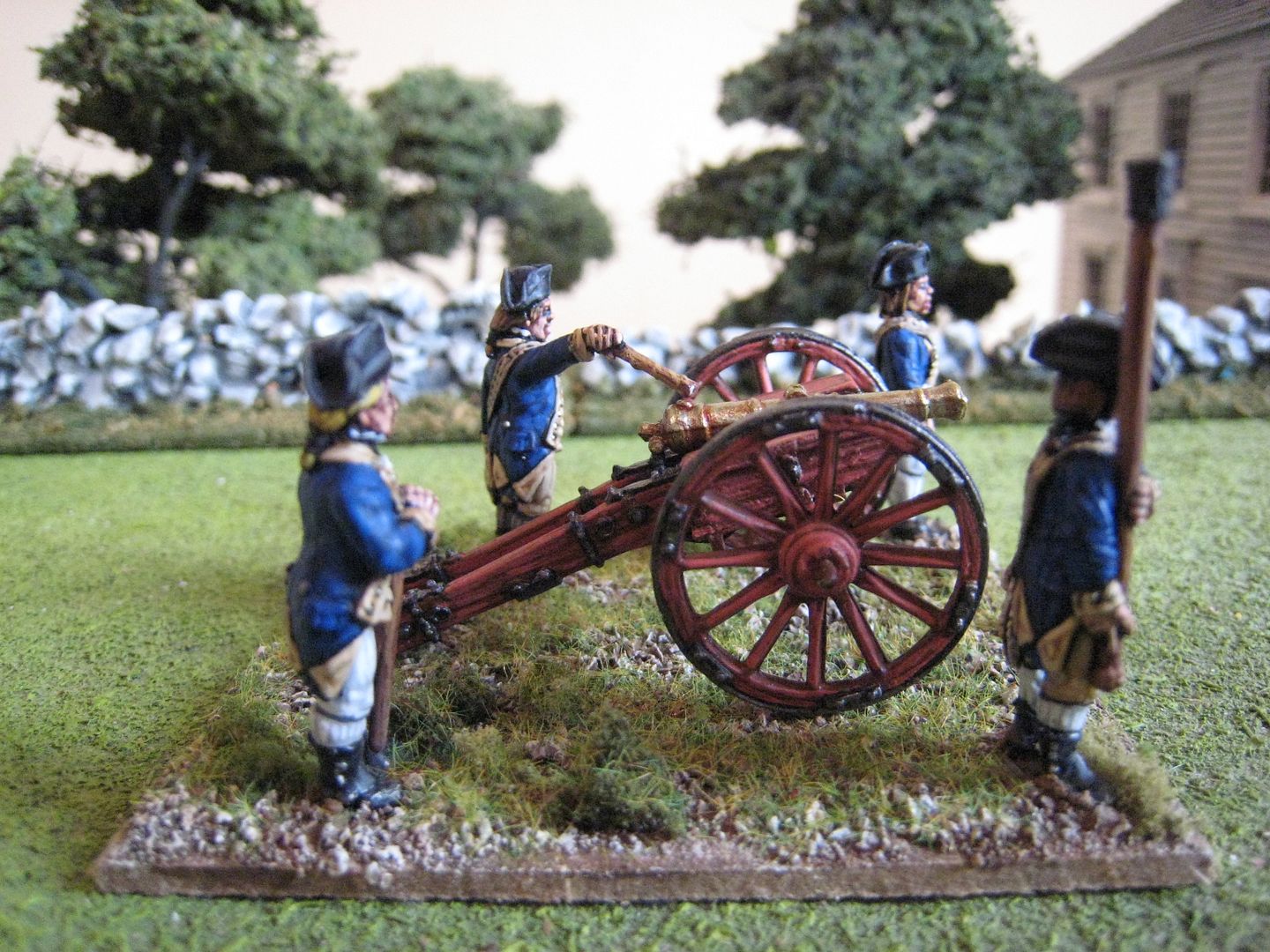
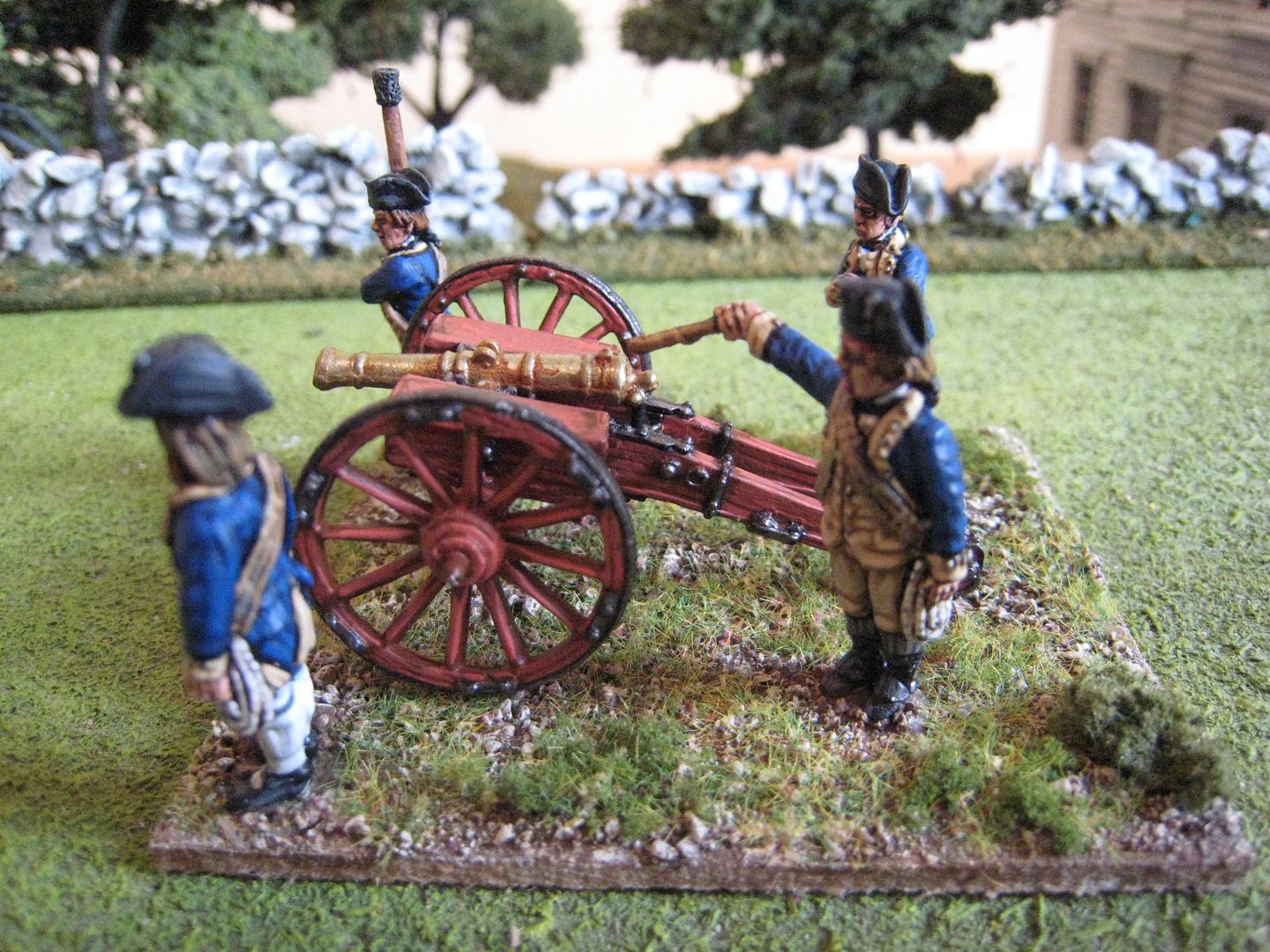
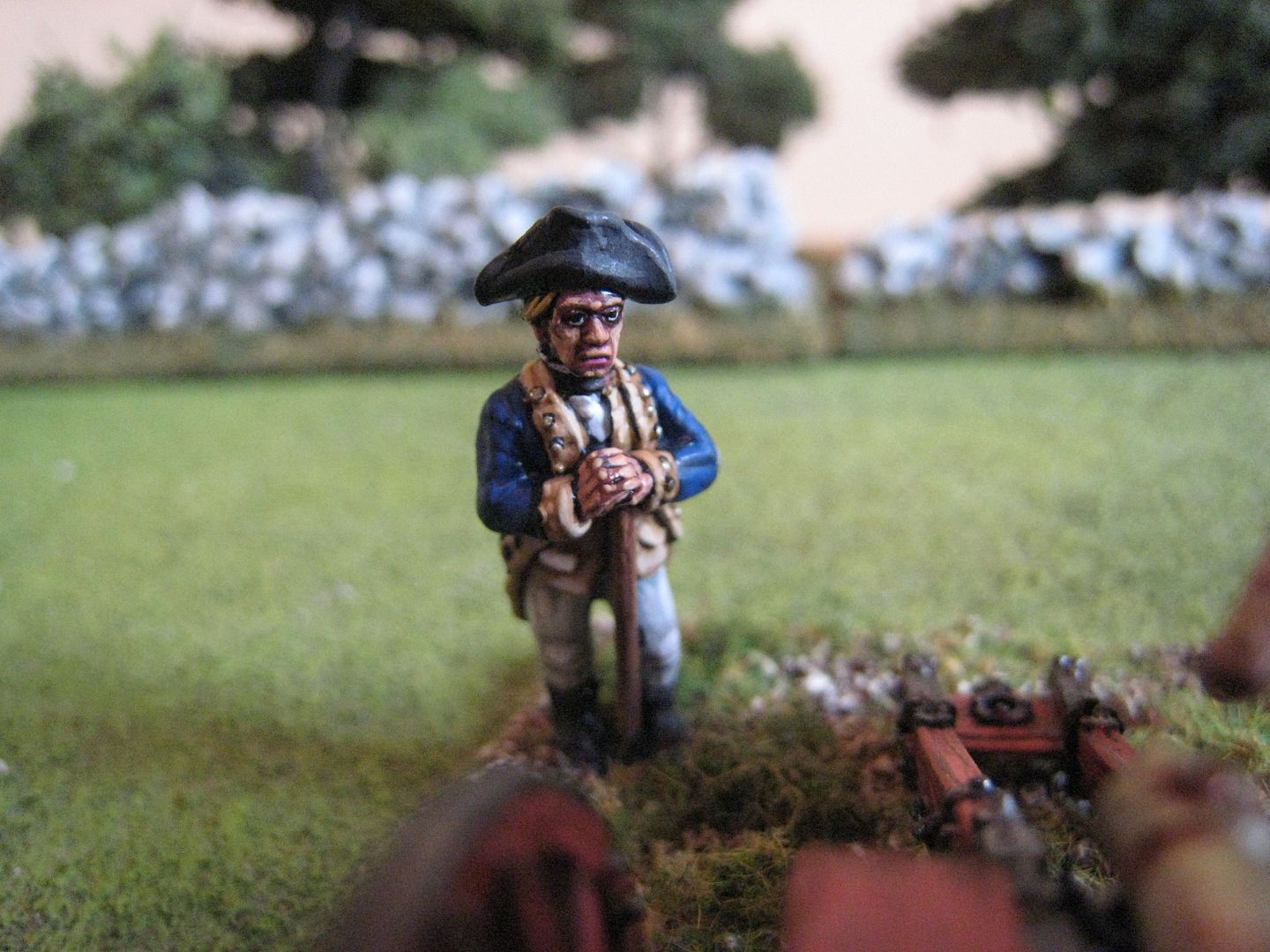
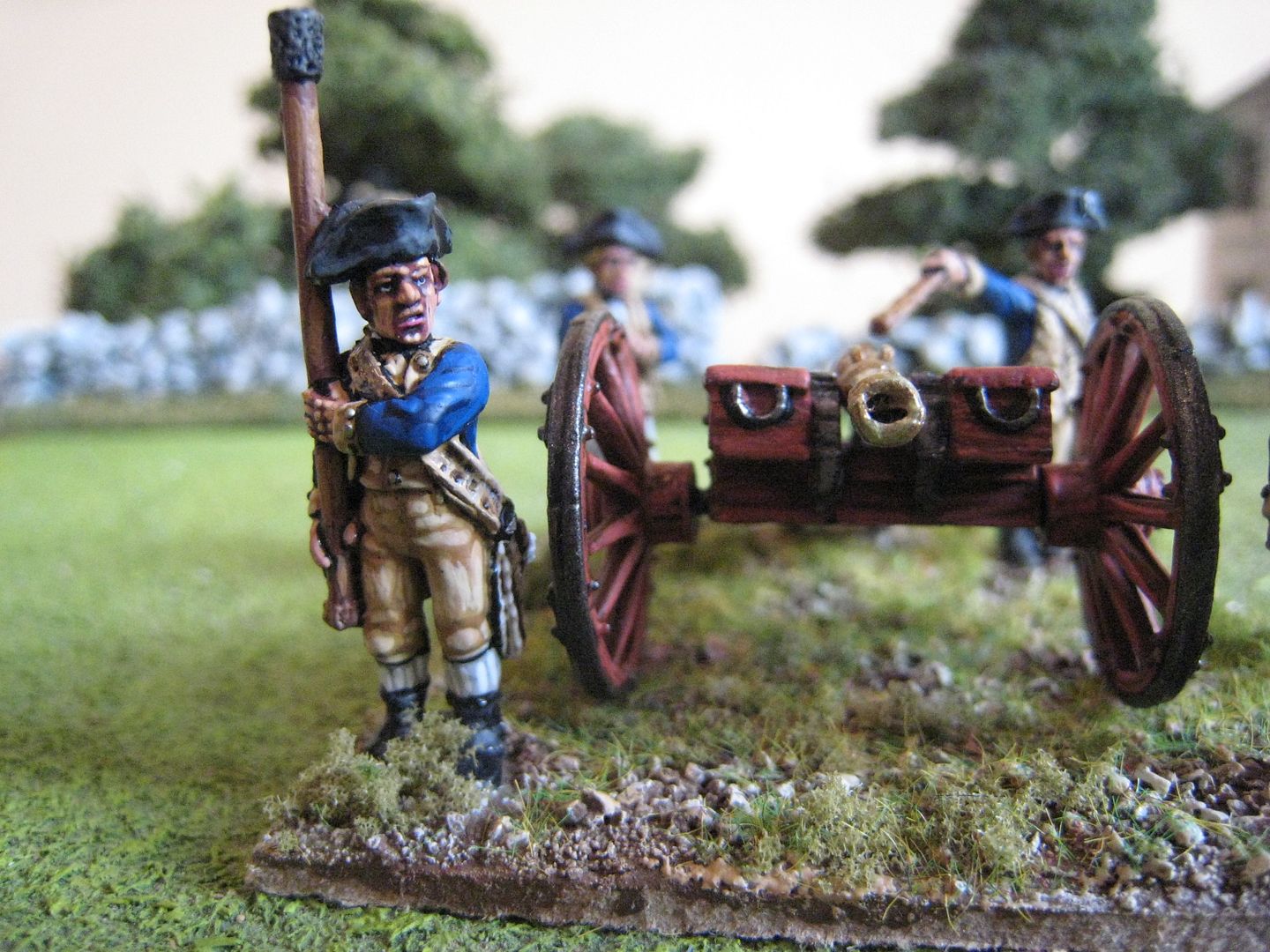
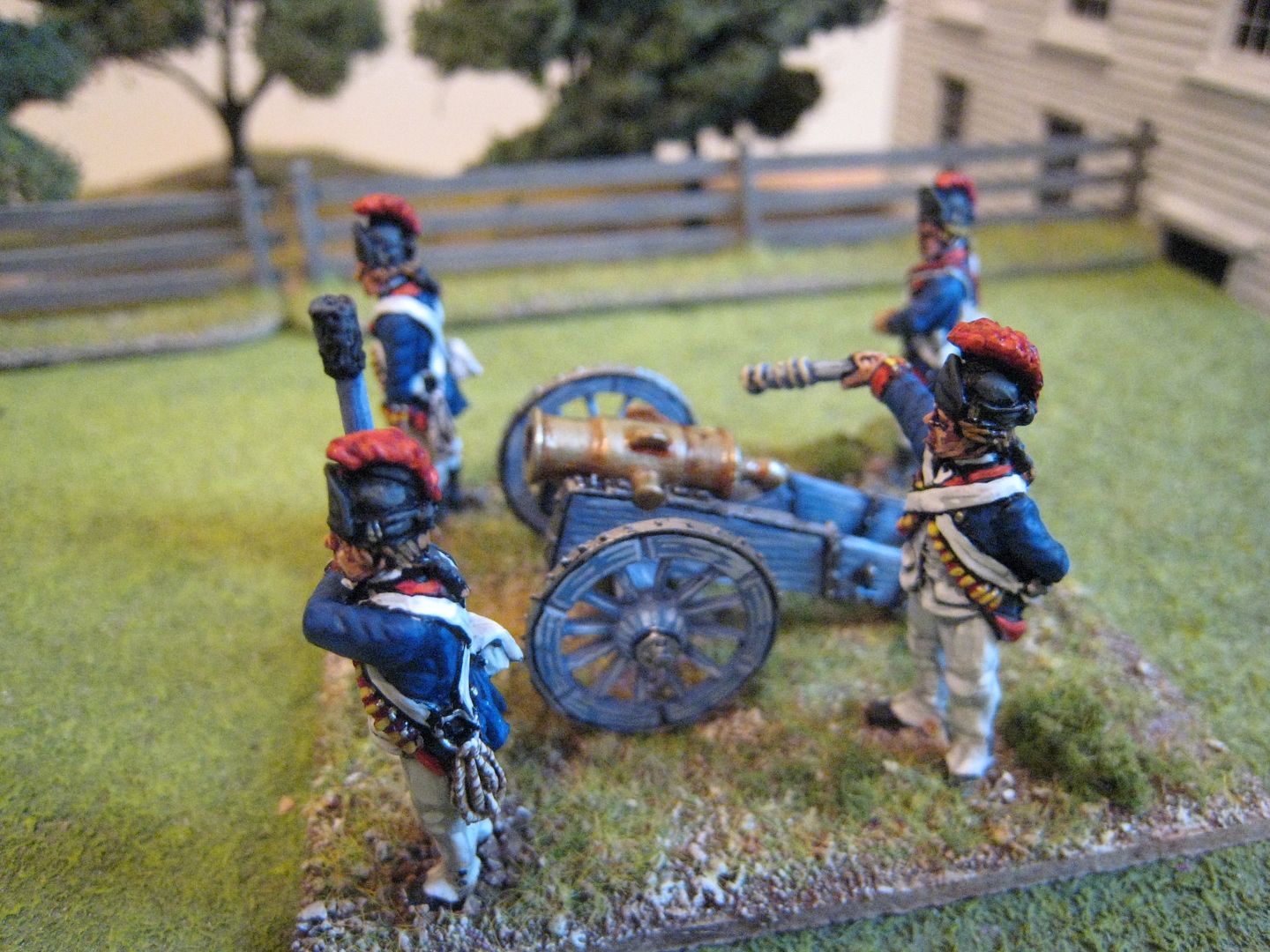
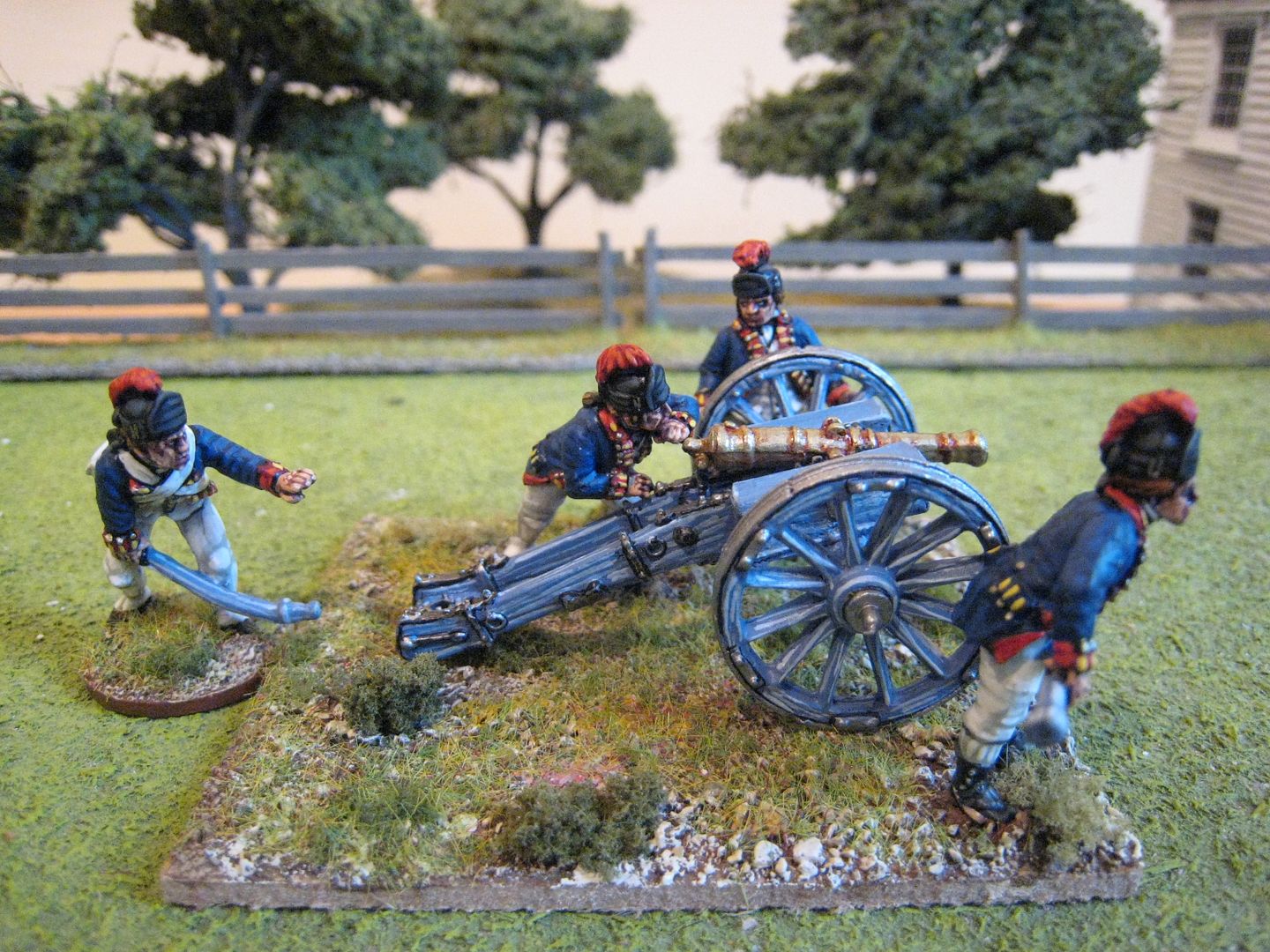
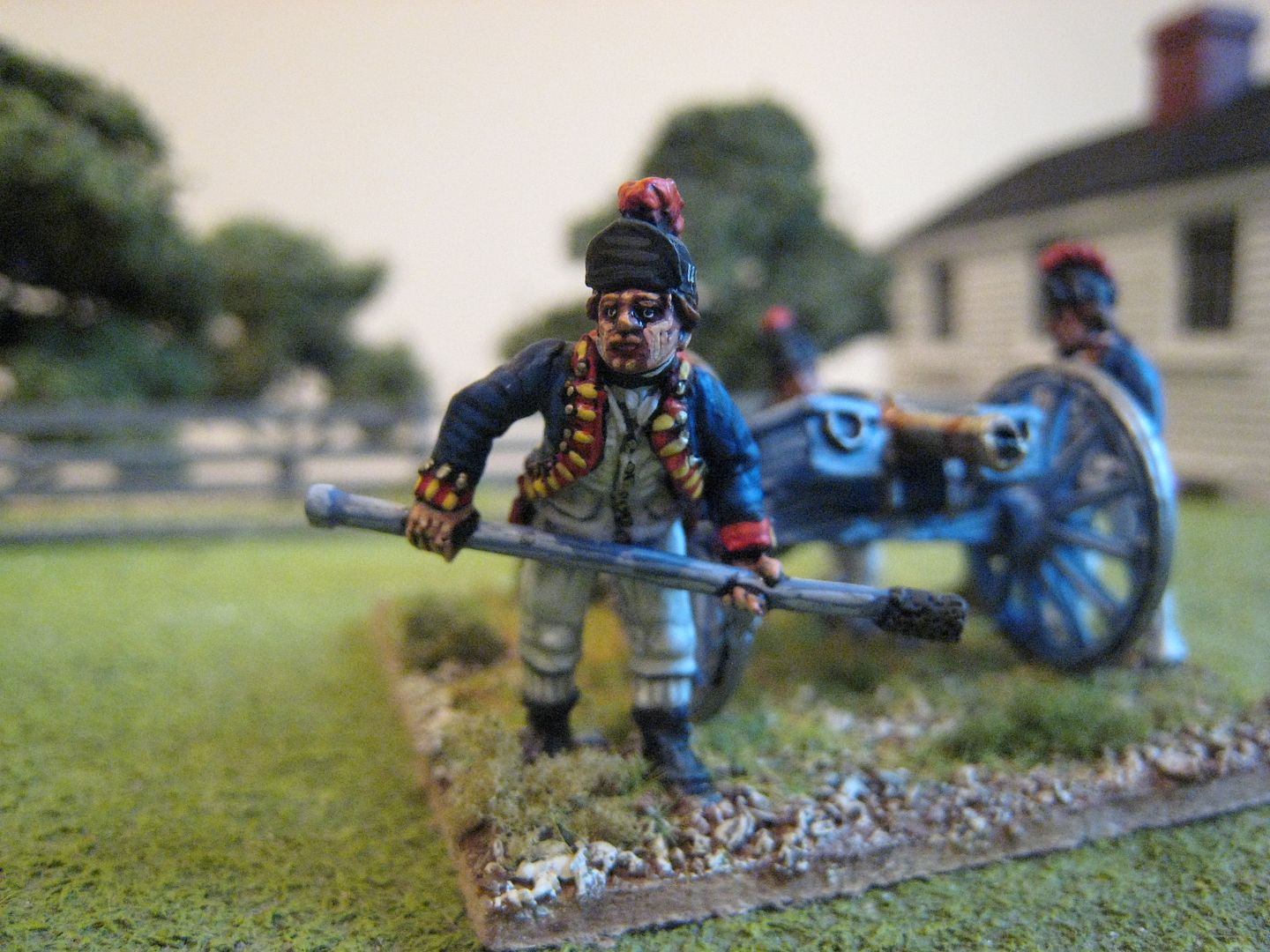
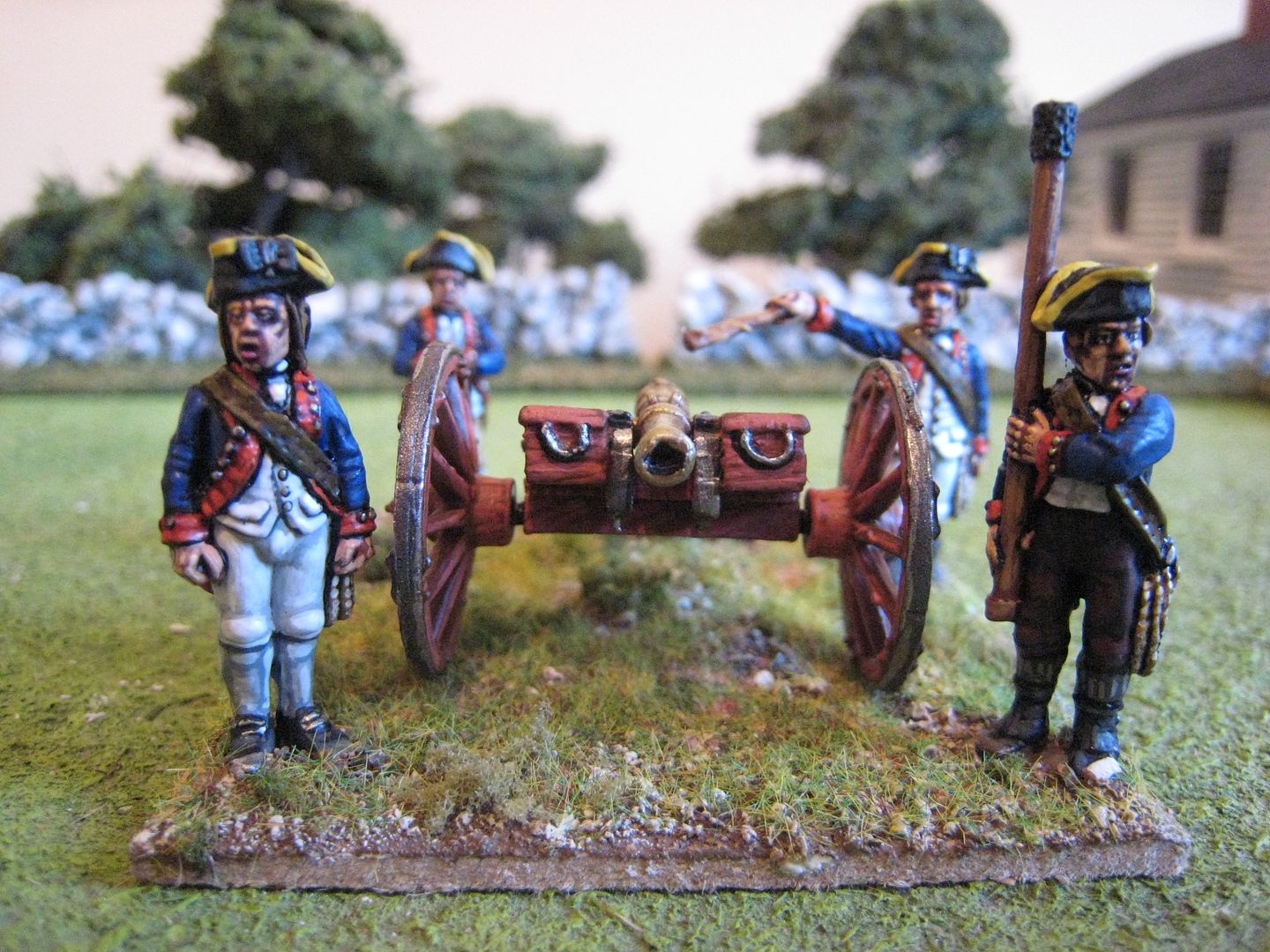
This should really be "American artillery (7)", but then that wouldn't include my Rhode Island artillery sets, which were the last American artillery bits I painted, back in 2017. The figures here are from Brigade Games' AWI range. When I placed an order a few months back I bought some Continental and militia packs, which I'm slowly working through, and decided to add one of the artillery packs. As seems to be the fashion these days, each pack comes with 6 crew figures and no gun, which you have to buy separately. The gun is a Brigade Games "6 pounder", although it's a bit on the large side when compared to the Perry/Foundry 6 pounders. As my AWI artillery crews each have four figures, I put two on pennies to have them floating around the rear or standing next to ammunition carts.  

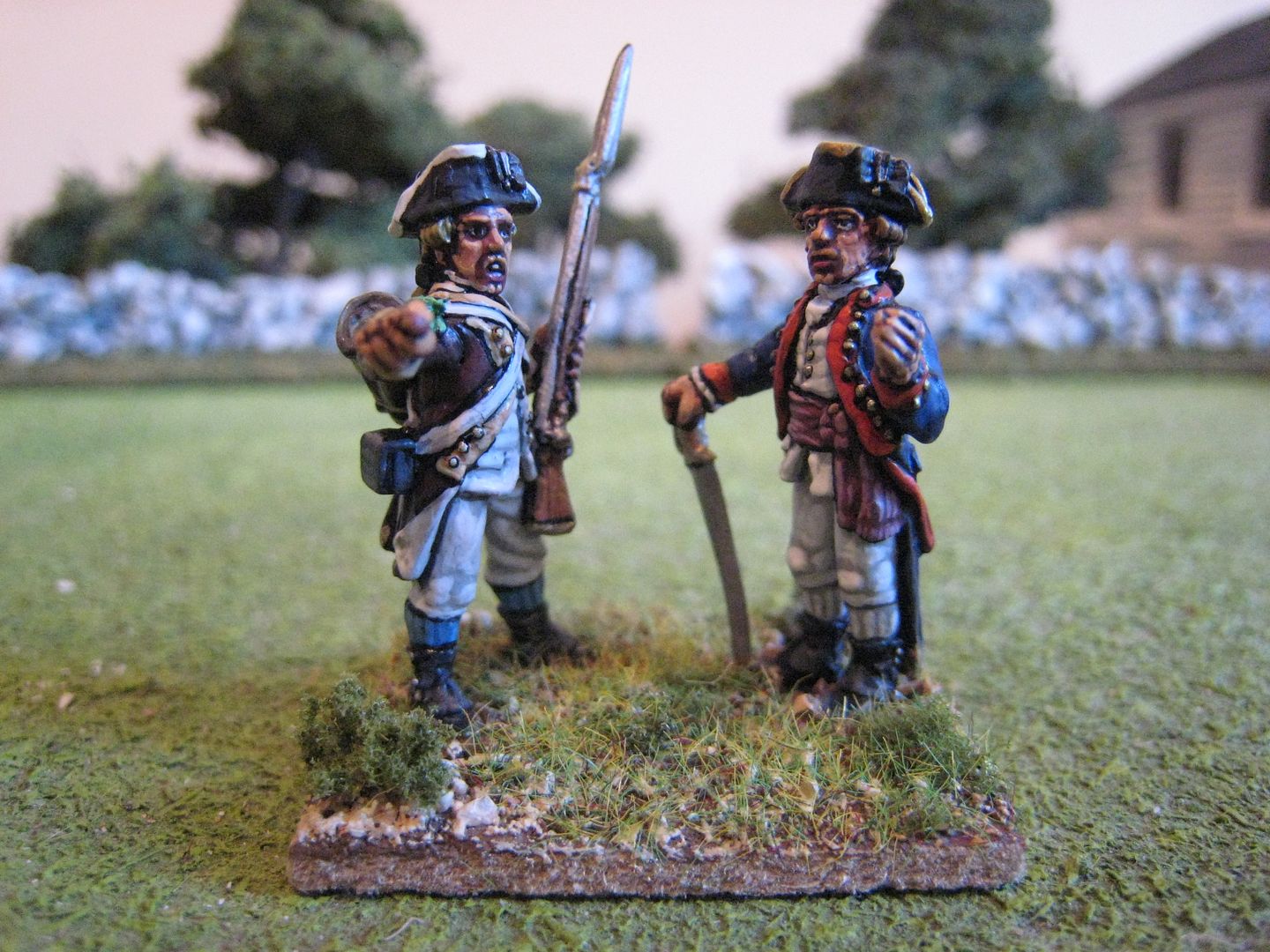
This set takes my tally of American artillery crews to 20, which is pretty ridiculous.  Even for a large battle like Brandywine you only need twelve guns on the American side.  But these are nice figures, even if the faces are a little "rat-like" (as David Bickley describes them!), and I'm pleased to add them to my collection.  Only one of the figures is wearing a uniform coat, and even then it doesn't have lapels or cuffs.  I painted the cuffs on, because I wanted to have at least someone wearing a semblance of a proper coat, and then I tried to put the others mainly in white/beige/off-white clothes to suggest they are in uniform and have just taken off their coats.  But I quite like the irregular look.  In this respect, the Brigade Games artillery figures are similar to the Eureka Miniatures ones, which are also in shirtsleeves and coat-free (although by the look of it, the other "loading" Brigade Games pack does have a couple of figures in uniform coats).    

Apologies for the lack of posts - I simply ran out of photos and have been too busy until today to take any more!

6 figures.  Painted September 2024. 


Monday, 16 January 2017

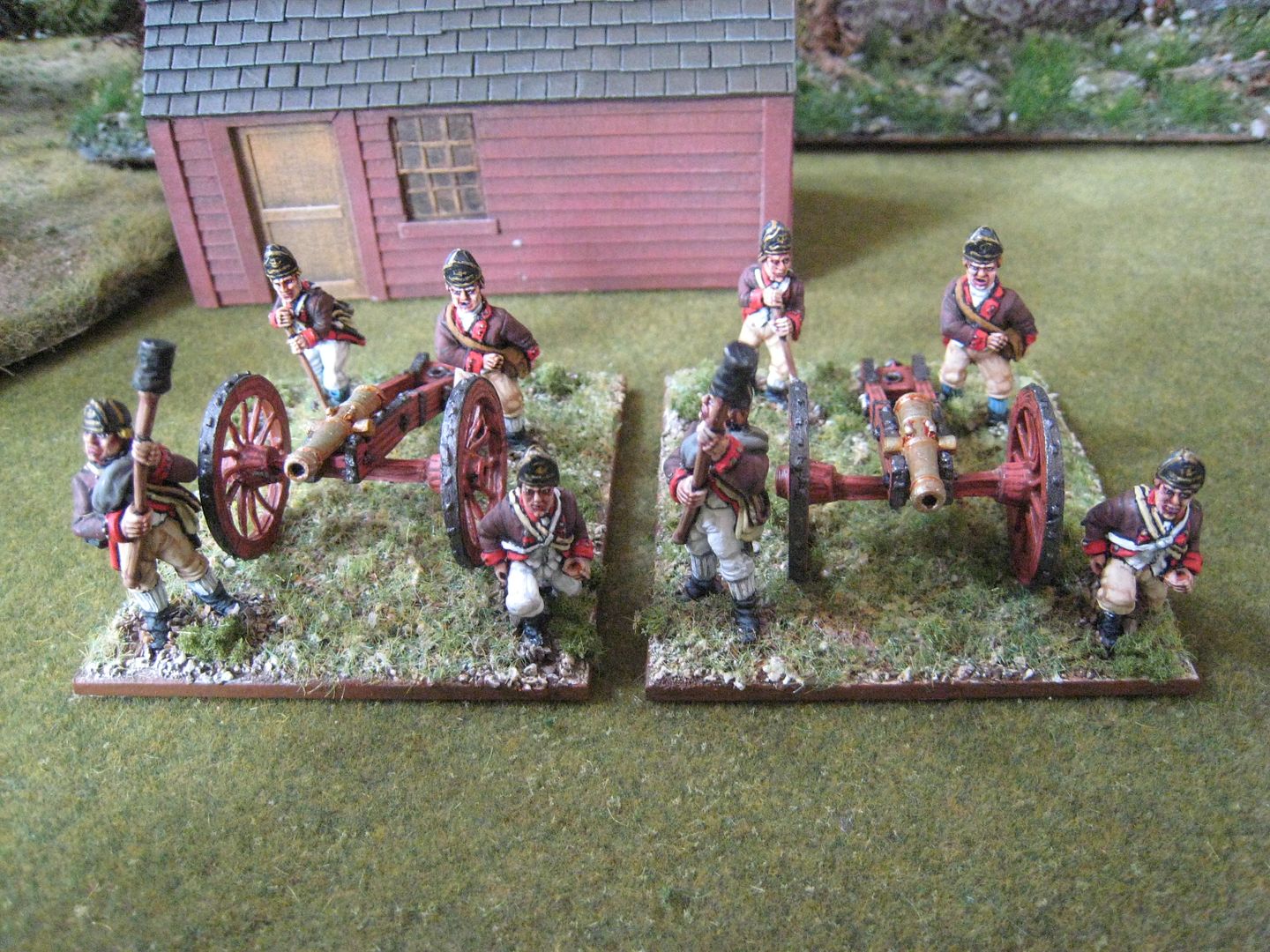
Rhode Island Train of Artillery

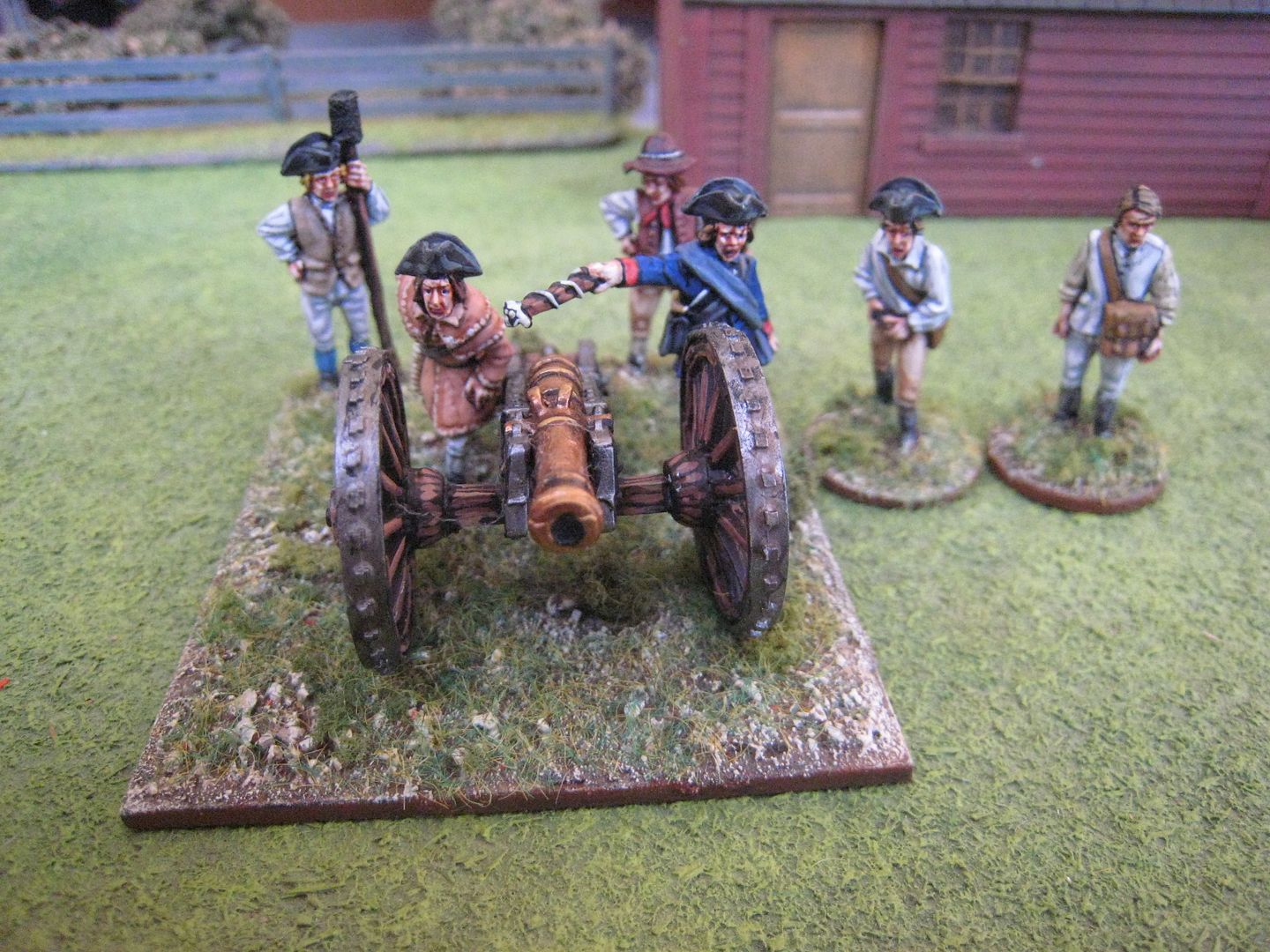
In May 1775 the Rhode Island Assembly voted to raise troops to contribute towards what then became the Continental Army (the Rhode Island contingent being called initially the Rhode Island Army of Observation).  Three infantry regiments and a unit of artillery were formed.  I'll write about what became of the infantry regiments shortly (I painted one last year and completely forgot about it, although photos of it appear in the fourth Caliver/"British Grenadier!" scenario book).  In the meantime, here is the artillery train.  The uniform was notable for its brown faced reds coats and the leather caps.  These caps had a front of black leather which was decorated with a gold painted anchor and the words "For Our Country" painted above it.  Some time around December 1775/January 1776 the unit was incorporated into the Continental Artillery Regiment and at some stage thereafter the uniform was changed to the more common artillery uniform of blue coats faced with red.   The unit was stationed at Boston in 1775 and then New York, and companies fought in the Saratoga, Philadelphia and Monmouth campaigns. 

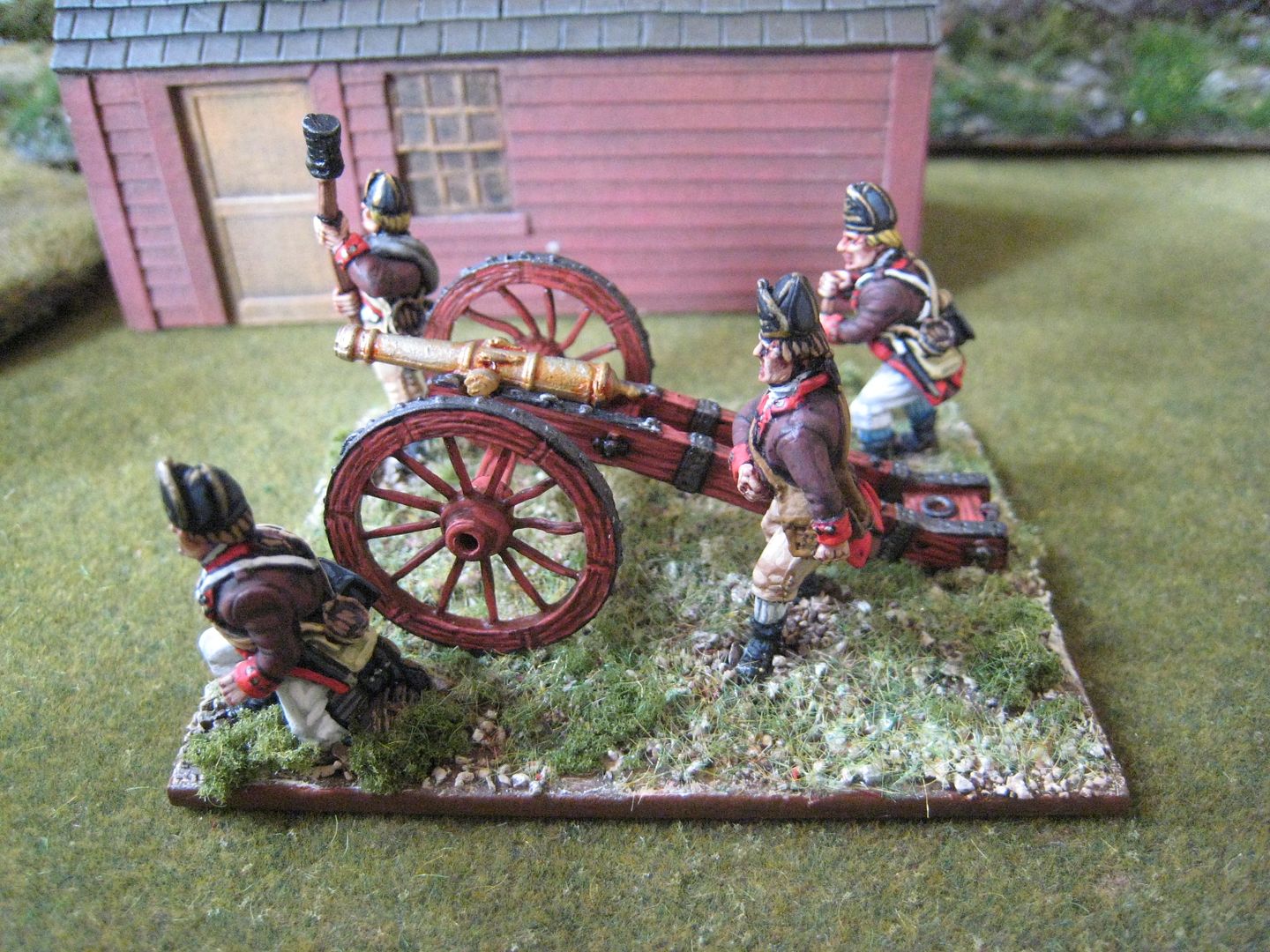
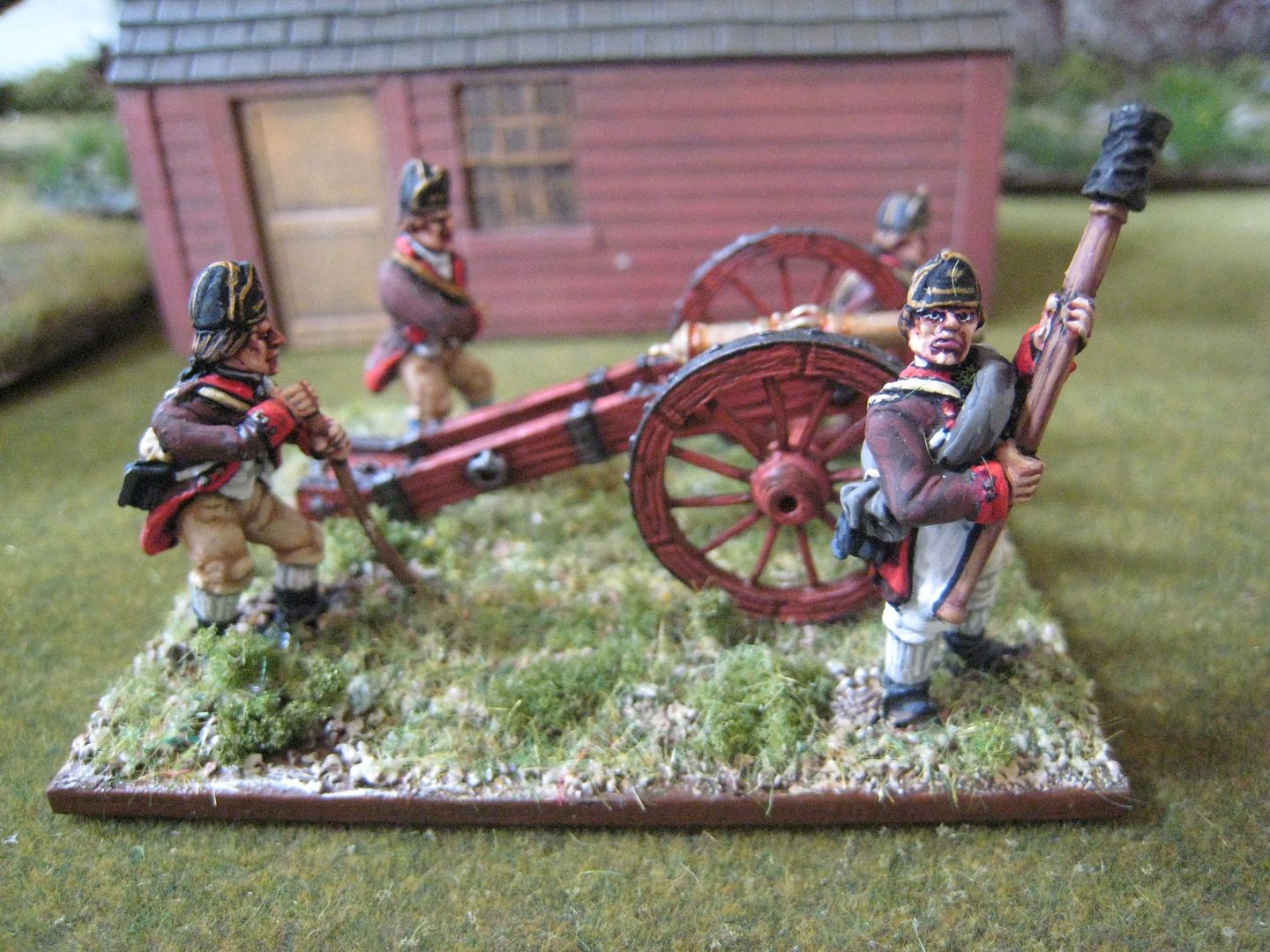
These are most of the figures from Old Glory's pack of Rhode Island artillery.  The pack also contains two figures of an officer waving a sword - I haven't painted those because both swords had broken off.  My artillery pieces have 4 crew members on a 60mm x 70mm base, so I don't need those officers anyway.  I may at some stage try to glue one of the swords back on and paint the figure as John Crane, who commanded one of the unit's companies.  These figures are typical Old Glory sculpts - some are better than others and it's difficult to know precisely what's happening.  It looks as if the crew are preparing to fire, but there's no one with any sort of match and the chap with the handspike looks as if he's trying to move the gun.  Anyway, I'm not all that bothered and I think the crews generally look ok.  Perry Miniatures make a pack of figures in the Rhode Island uniform.  That was released after I'd already acquired the Old Glory figures and it is hard to justify buying another pack.  Anyway, I think I've done the best I can with these figures, and having a couple more 6-pounder models is always useful.  I painted the guns in my "red oxide" colour, which I discussed some years ago in this post.  

As the unit history above indicates, figures in this uniform are really only fit for service in 1775 and early 1776, Long Island being the most likely battle to use them in (even though the uniform may well have changed by then).  The unit fought at Newport in 1778, most probably in the standard blue faced red uniform, but I suppose I can use these figures for two of the eight American guns that are required for that scenario.   I now have seventeen American gun crews, which is far more than one needs for the AWI - the largest numbers are at Brandywine and Monmouth, which require respectively twelve and nine guns on the American side.

8 figures and 2 guns. Painted December 2016.


Wednesday, 6 July 2016

Conestoga wagon

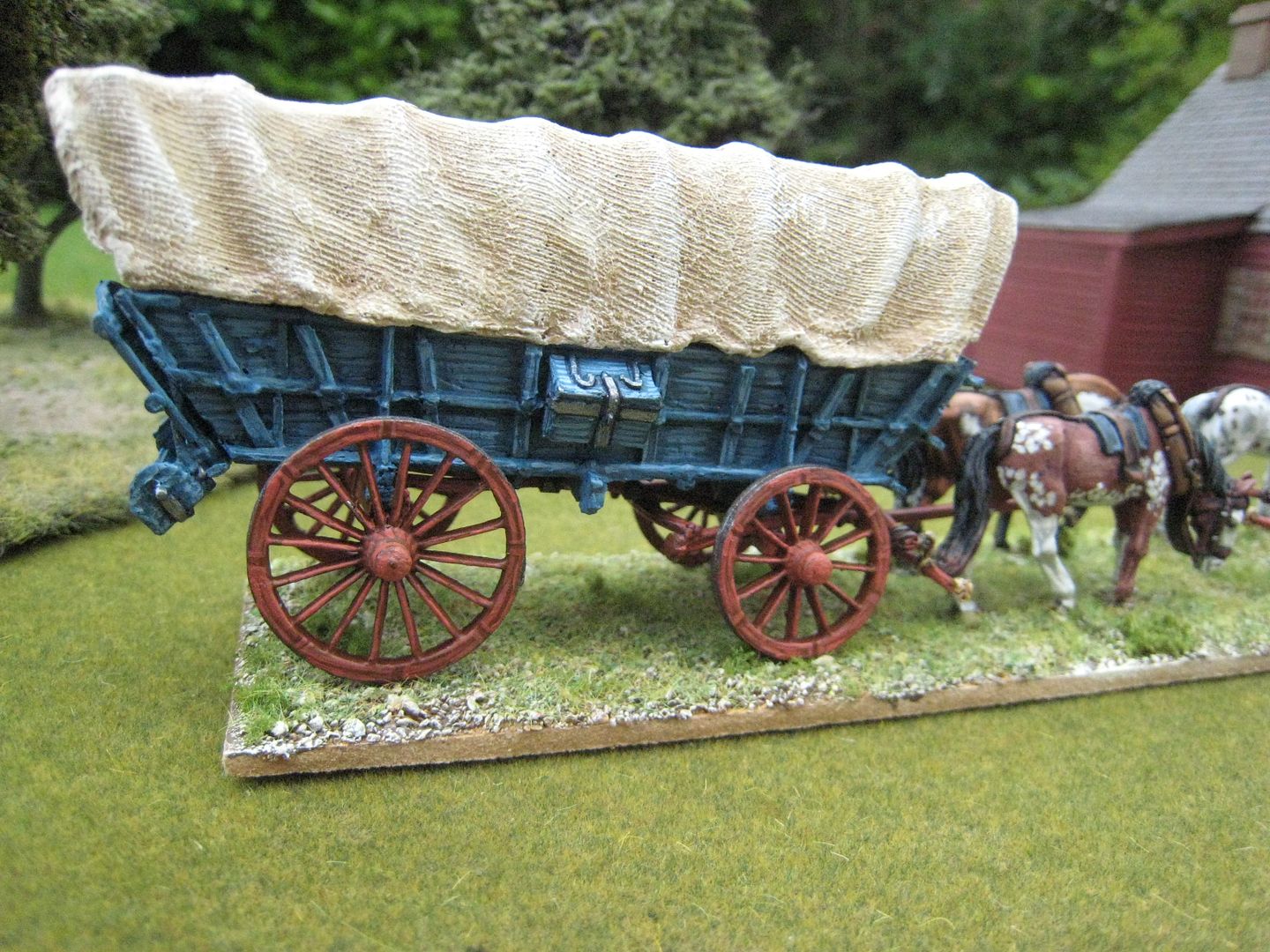
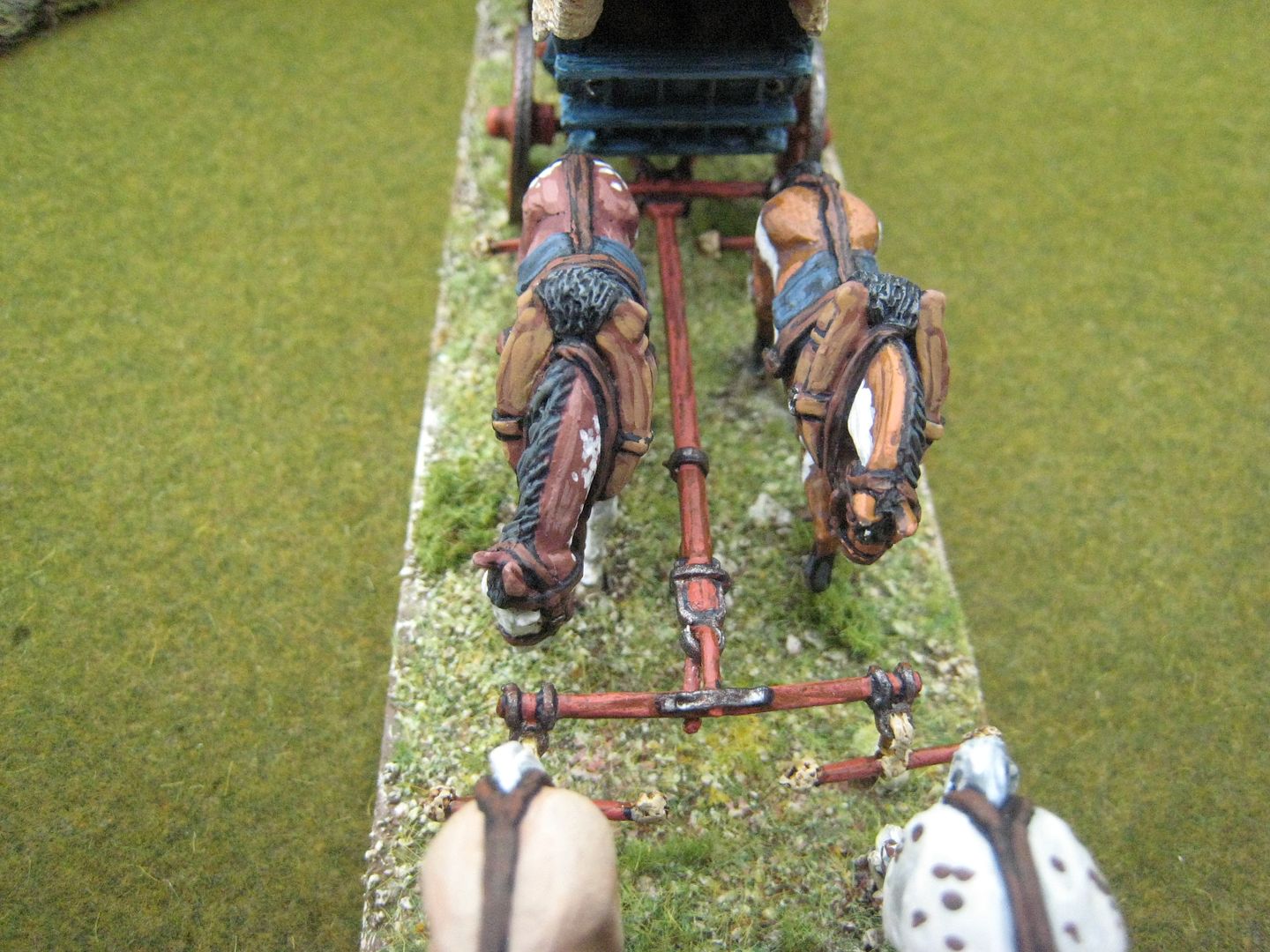
This is the Conestoga wagon from Perry Miniatures.  The model represents a type of heavy, covered wagon that was used during the eighteenth and nineteenth centuries in the eastern USA.  It could carry loads of up to 6 tons.   The name "conestoga" appears to have been taken from the "Conestoga River" or "Conestoga Township" (quite possibly named in turn after a local Native American tribe) in Lancaster County, Pennsylvania, where early wagons were built.  The first recorded use of the name was in 1717.  A special breed of horse, the "Conestoga Horse" was developed by Dutch settlers to haul these huge wagons.  The use of these wagons is one theory why American drive on the right rather than the left: the wagon's driver sat on the left rear horse so he could use his right arm to lash the team and consequently wanted oncoming traffic to pass on his left so the driver could ensure he avoided the oncoming vehicle's wheels.  The distinctive curved shape of the wagon helped prevent cargos from shifting around and the large, tall wheels helped river crossings.  In 1776 Congress created a Wagon Department to help move supplies for the Continental Army.  It grew to include enlisted wagoners, but during the AWI probably had plenty of hired civilians who may well have provided their own wagons for temporary military use.  So this model (a kind gift from wargaming friend Timmo) is for use as a supply wagon for my Continental armies.    

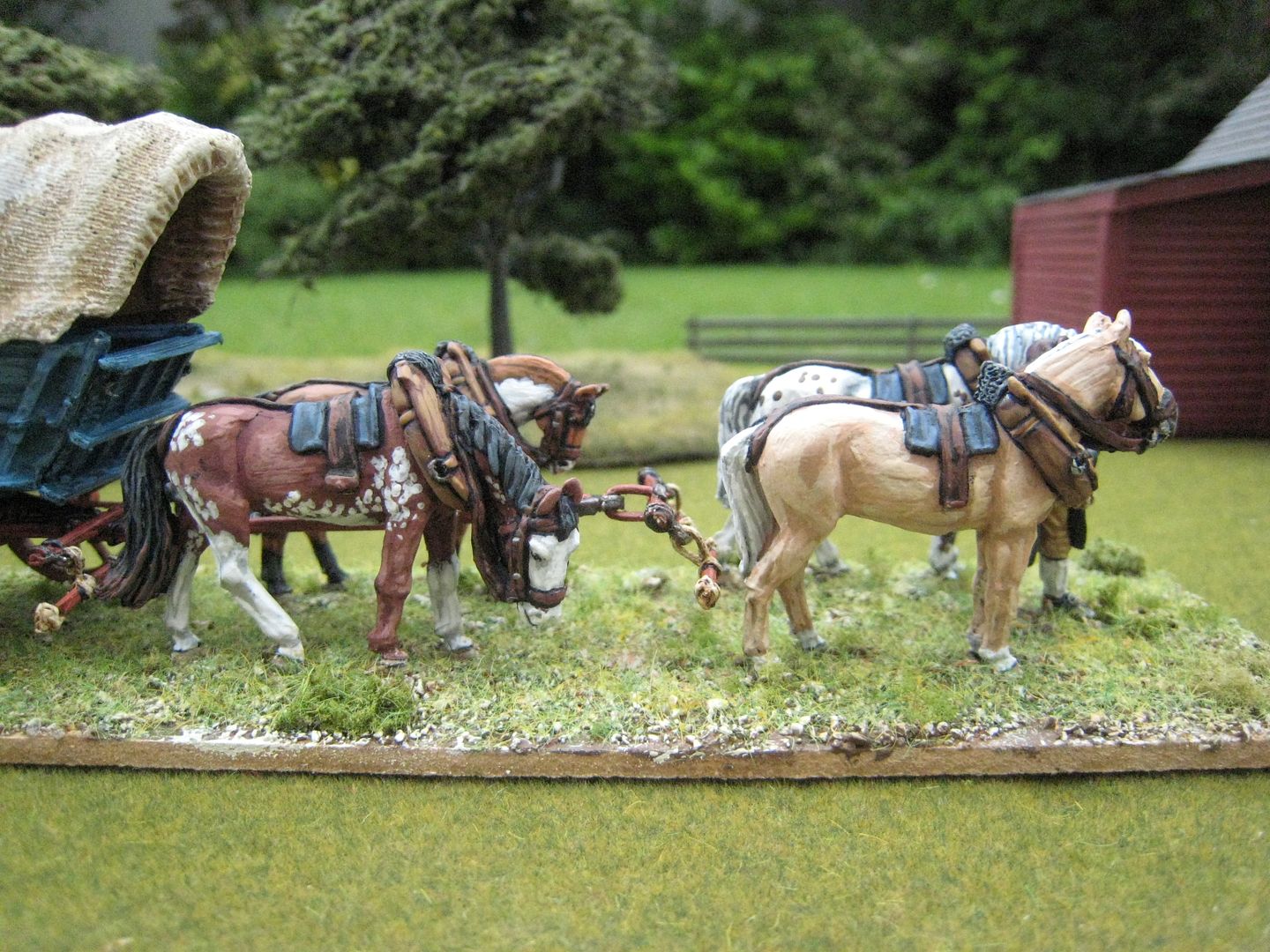
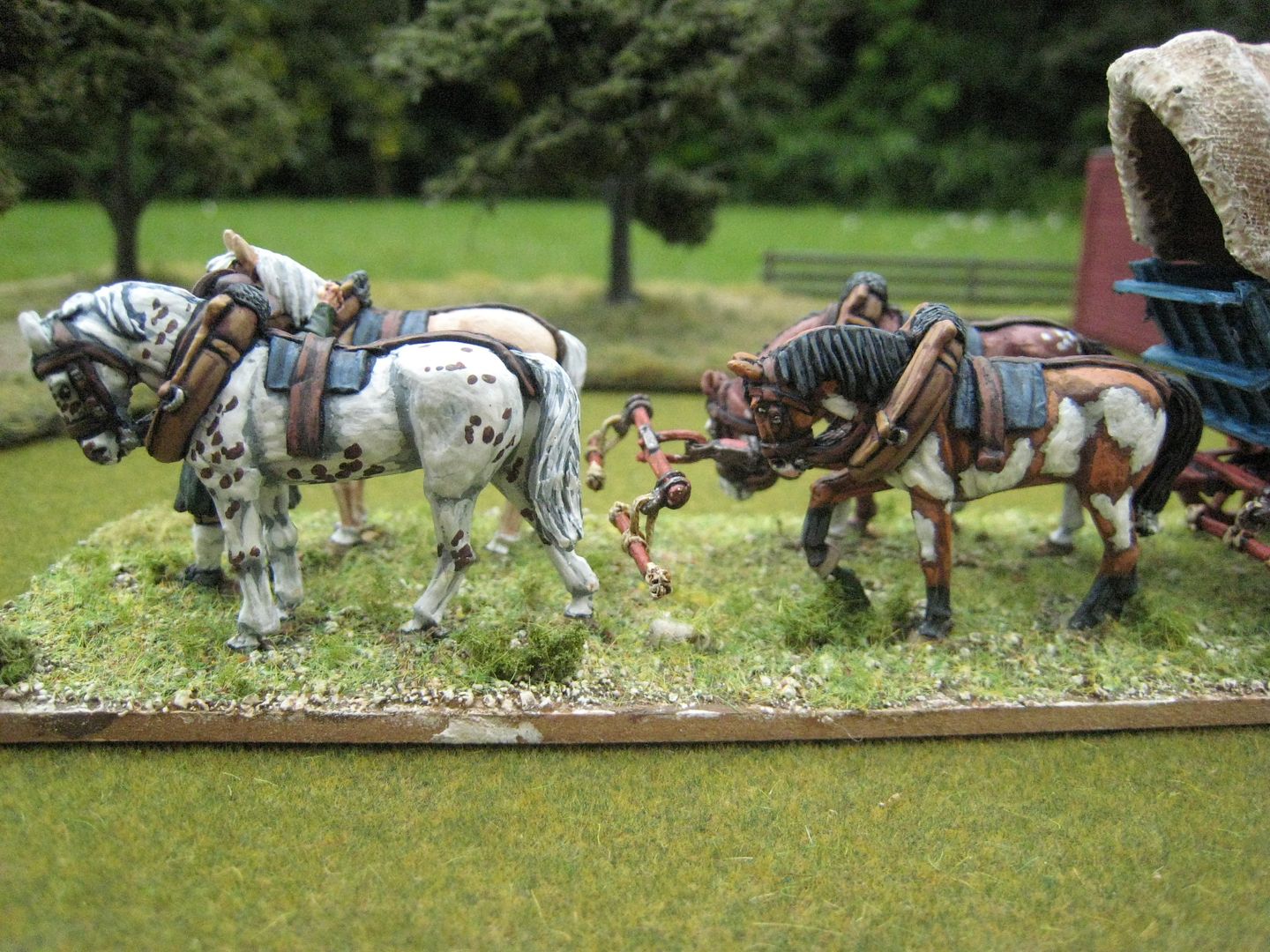
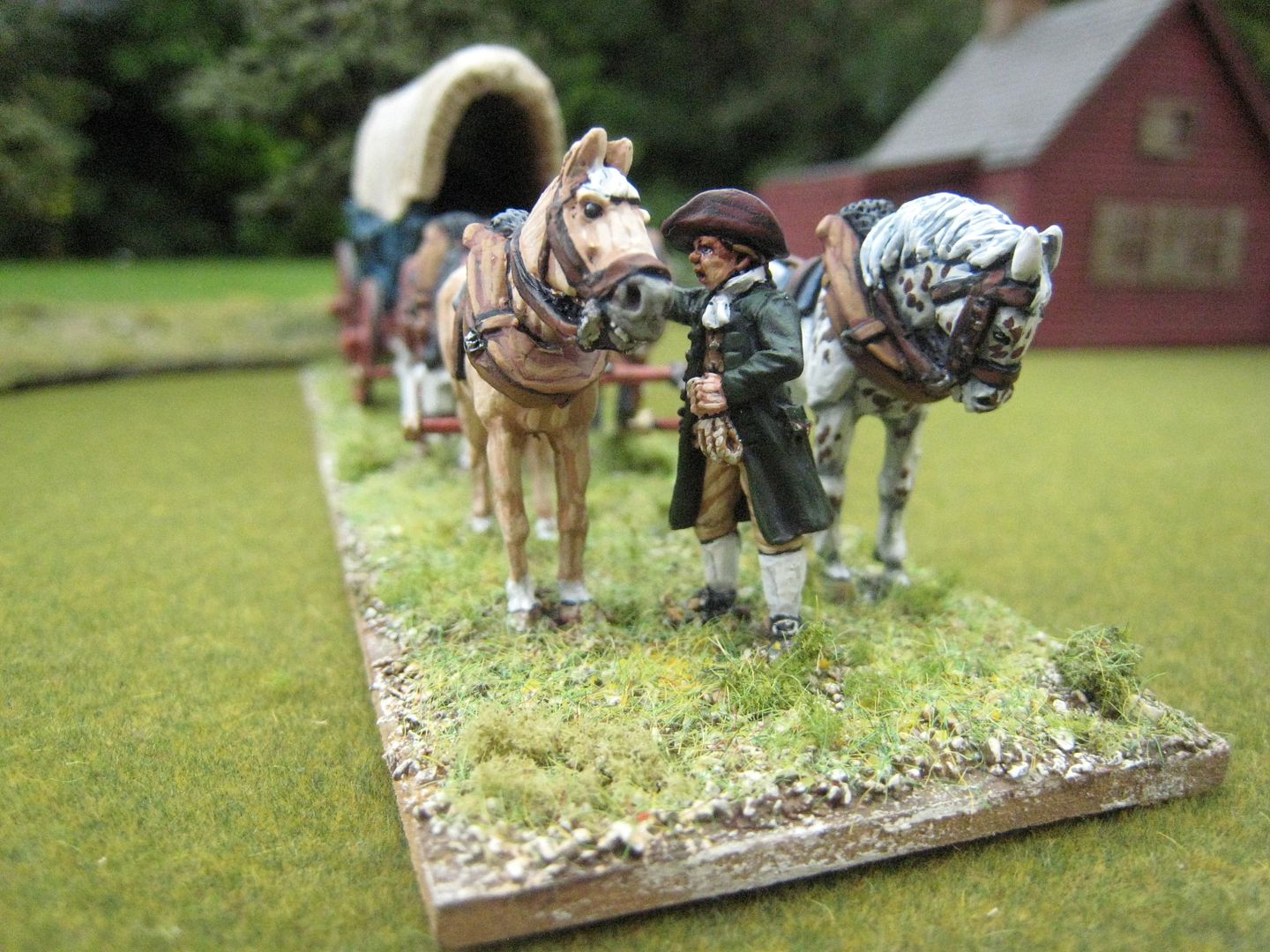
I painted and assembled this set over 2 days' off work I had a couple of weeks ago. When painting horses nowadays I like to work from photos, particularly when doing some of the more "funky" colours that I do for American horses.  I chose a bay overo, an appaloosa, a chestnut sabino and a palomino.  Overos and palominos are staples for my American cavalry units, but it's been a while since I've painted an appaloosa and I don't think I've ever painted a sabino.  

Chestnut sabino (l) and palomino (r)

The colours I used for the horses were these:

- bay overo: Foundry "Tan 14" with markings in "Arctic Grey 33";
- appaloosa: base colour of Coat d'Arms Uniform Grey 525 with highlights using a variety of other Coat d'Arms greys and whites; spots with Foundry "Bay Brown 42";
- chestnut sabino: Foundry "Conker Brown 54" with markings in "Arctic Grey 33";
- palomino: base colour of Foundry "Palomino 56" with mane and tail in "Austrian White 67".

Appaloosa (l) and bay overo (r)

For the hooves I used Foundry Rawhide 11B and C.  In real life, the colour of hooves on horses is generally determined by the colour of the leg just above the hoof: the lighter the leg then lighter the colour of the hoof.  However, I think having different coloured hooves on 28mm figures just looks a bit odd and so all my horses get the same hoof colour irrespective of whether they have a white or dark sock etc.  Something else one notices when looking at photos of real horses is that the ends of the tails often have bits of different colour.  The photo of the chestnut sabino showed some copper going right up to the buttock on the inside of the tail, and I've tried to replicate that.  For furniture and other bits and bobs I used the following:

- reins/bridle etc: base coat of GW Rhinox Hide with a single highlight of Foundry "Spearshaft 13A";
- saddle cloth: Foundry "Storm Blue 39" palette (this is my standard AWI saddle cloth colour; Troiani et al often show dark grey/dark blue, so that's what I use);
- collar: Foundry "Dusky Flesh 6" and "Spearshaft 13" for the wooden support.
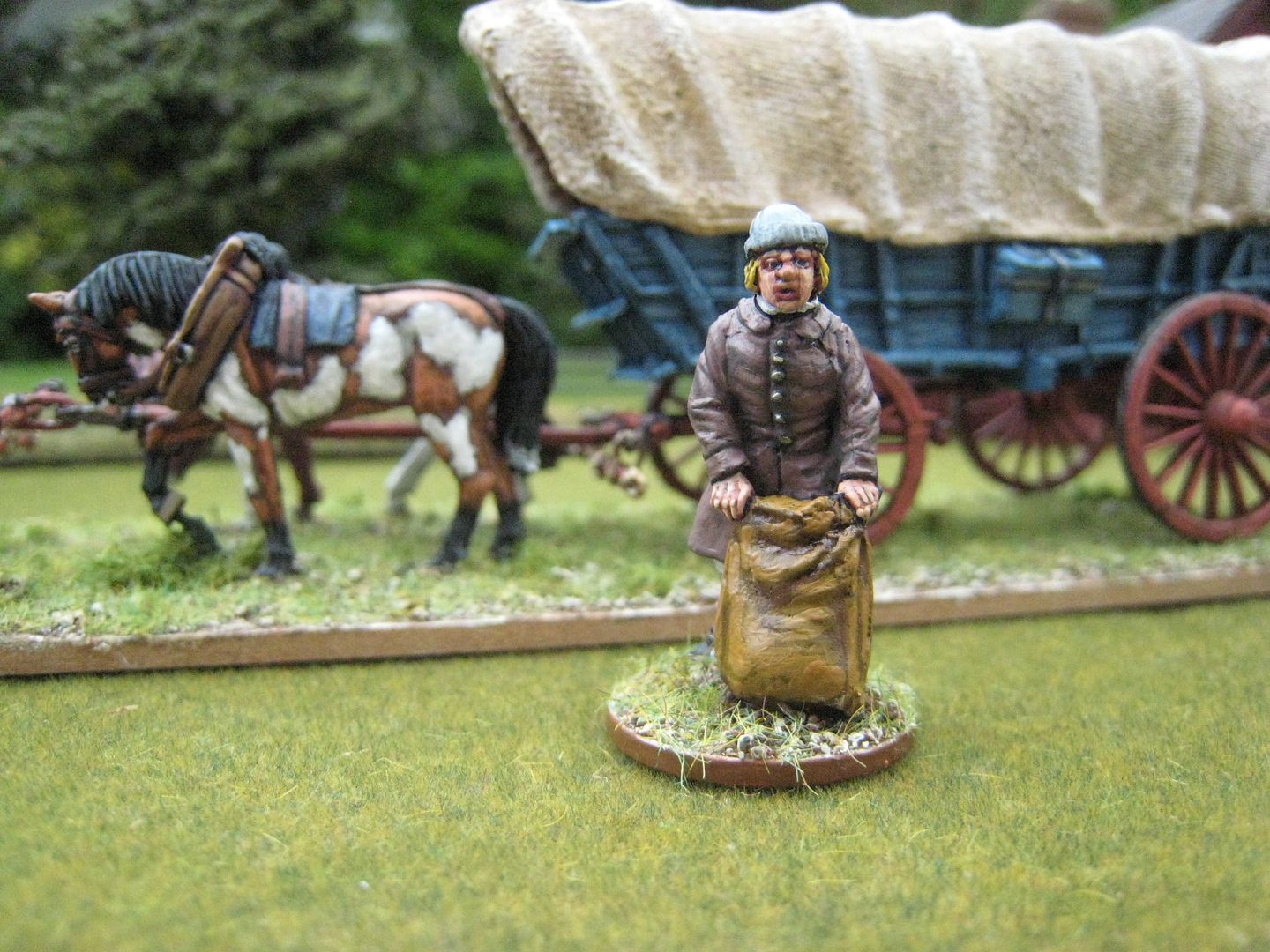
For the wagon itself, I looked at various photos on the internet to see whether I should go with "natural" or painted woodwork.  Examples of the latter included blue, red and green.  I settled on what I think is quite an attractive colour combination: mid-blue for the bodywork and then "red oxide" for the chassis and wheels.  The (resin) canvas top of the wagon was painted with the Foundry "Canvas 8" palette.  I needed two coats of the A colour and then heavy dry-brushing with the B and C colours.  The main palette colour I used for the wagon itself was Foundry "Prussian Gun Mid-Blue 106". The base coat was the A colour; I left out the B colour and did some wood-grain effect highlighting with the C colour and then C plus white. For the sacks I used various Foundry colours: "Palomino 56", "Deep Brown Leather 45", a couple of WW2 palettes that have been discontinued, and then "Spearshaft 13" for the barrels. It's a bit difficult to work out precisely what is in the wagon other than the clearly-visible sacks etc. There's a tarpaulin there, so I assumed that would have been rain-proofed and painted it black.  The chassis and wheels were painted with Foundry "Terracotta 37". 

I'll add some traces at some stage, but I wanted to get this photographed while I had a spare moment and it wasn't raining. I'm pretty sure the chap at the front is in the wrong place, but I didn't have enough room on the bas to put him to the right side of the front right horse, which is where he stands in the pic on the Perry website. There are a couple of other mistakes: the metal work is too bright I think, and I'm really not sure about that the yokes are in the right place - I found these bits very difficult to sort out and almost superglued my fingers together several times.  I also found the resin rather brittle - a couple of bits broke off but I couldn't tell whether they were part of the kit or just flash.  But overall I think this is an excellent model from the Perries and it's worth taking the time to put it together.  It's the sort of thing, along with ammunition carts and limbers, that will always appear on the table.

Painted June 2016.


Wednesday, 9 February 2011

Bombardiers de la marine


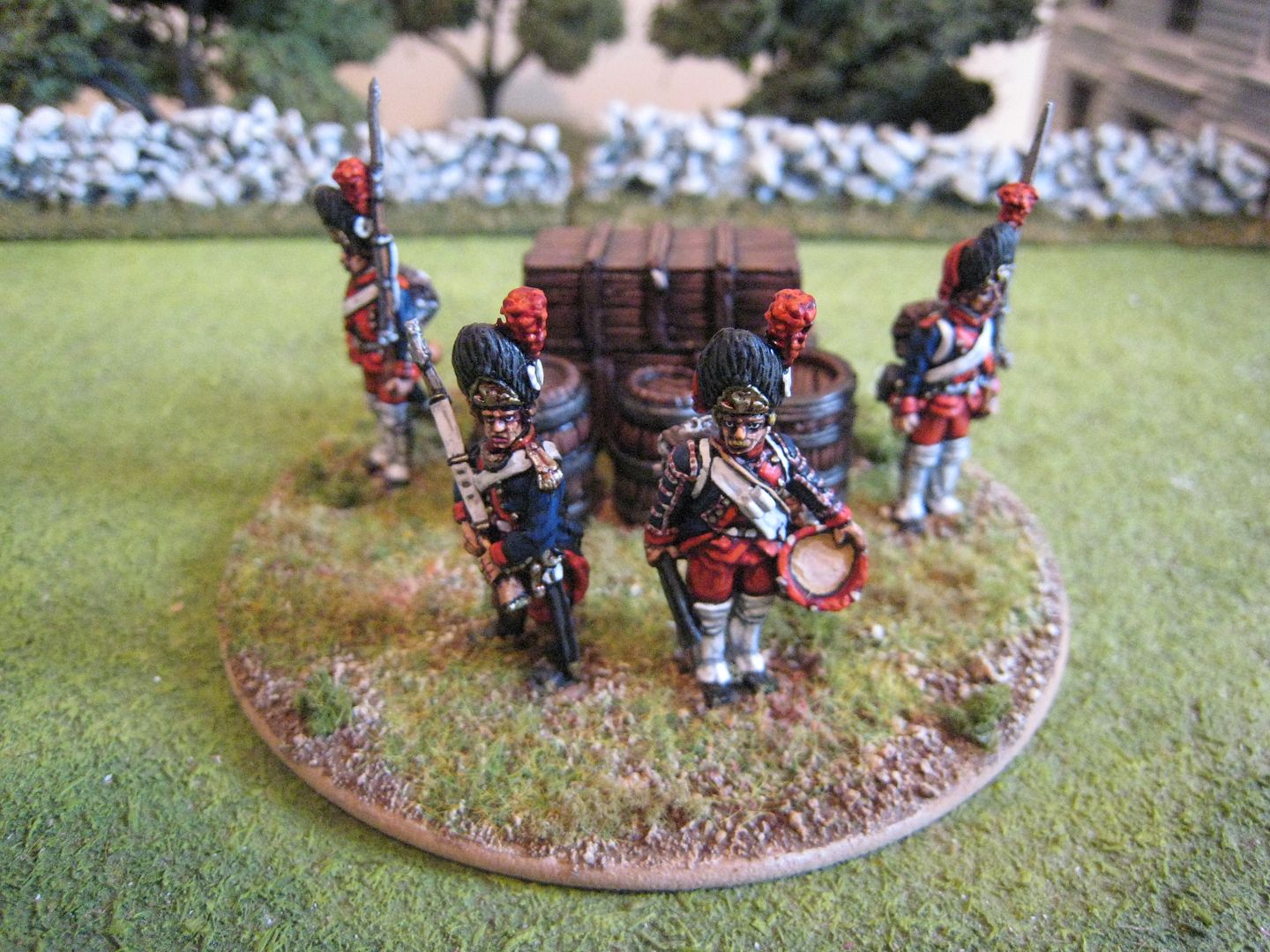
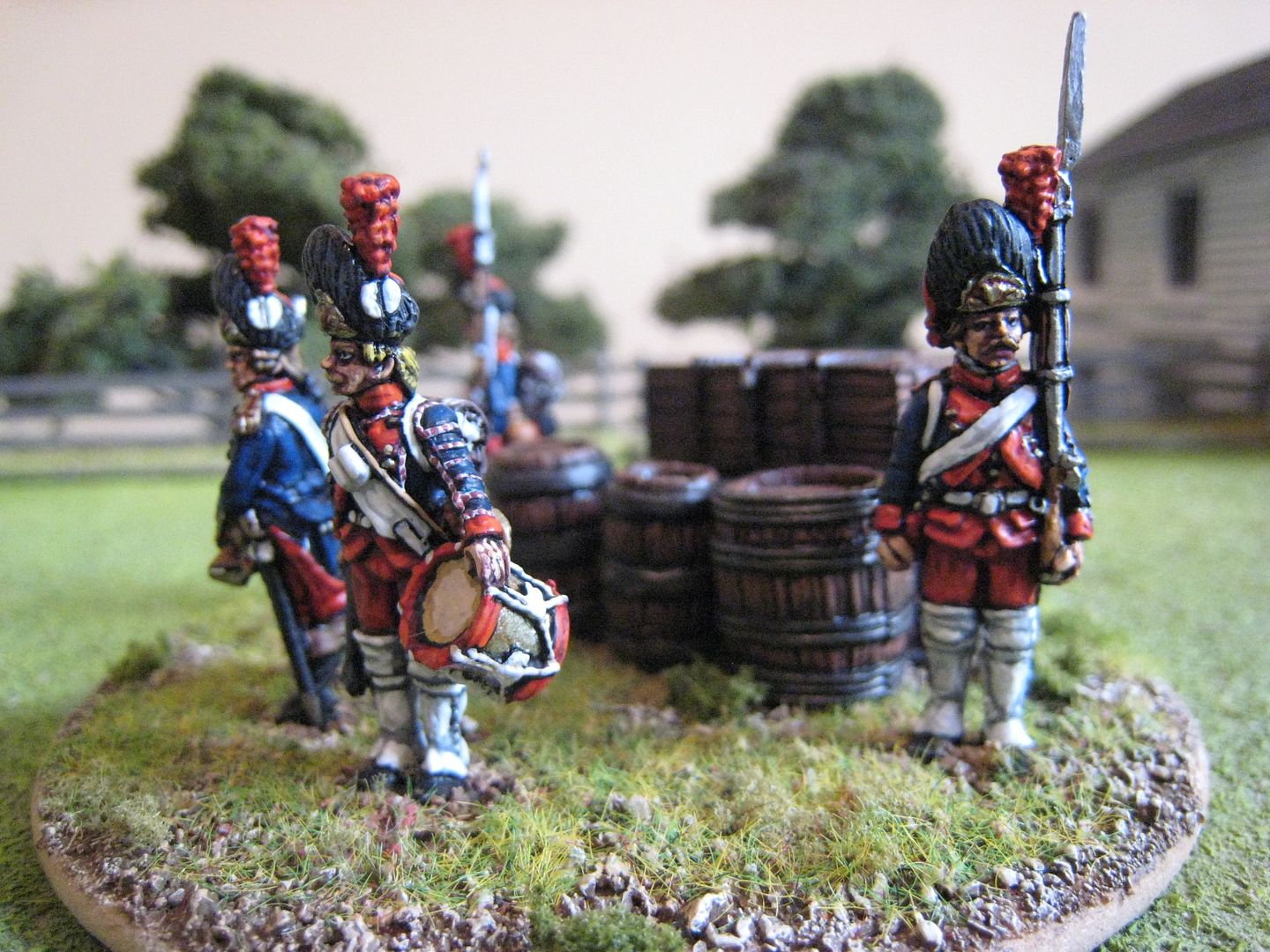
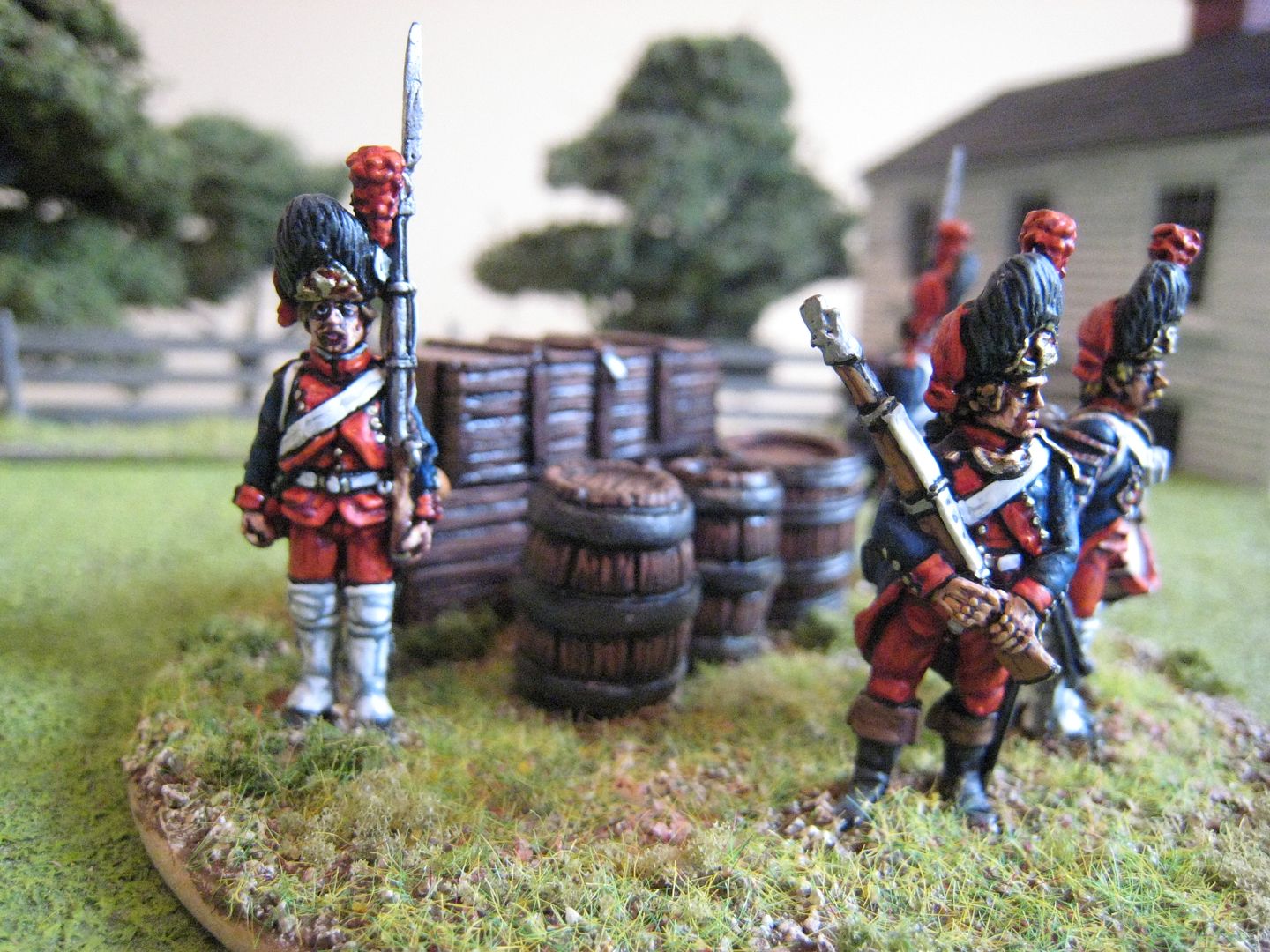
With two French infantry battalions completed it was time for a vignette! The bombardiers de la marine formed a navy unit created in the early 1680s to provide experienced sailors who could also handle the mortars in the bomb ketches that the French had developed to bombard port towns on the Barbary coast. In 1692 two companies were officially formed, situated in Brest and Toulon and comprising 50 men each. A few years later a third company was raised to be stationed in Rochefort. The three companies were part of the Artillerie de Mer and so remained under navy rather than army control, although there was a short period where the two branches of artillery were combined. In 1764 the companies were reorganised into two brigades, of around 100 men each; however the old 3 company organisation seems to have been reinstated 10 years later. I have not been able to find detailed information about the campaigns that the bombardiers participated in, but assume that they were deployed wherever the French navy operated and they certainly arrived in America at some stage.
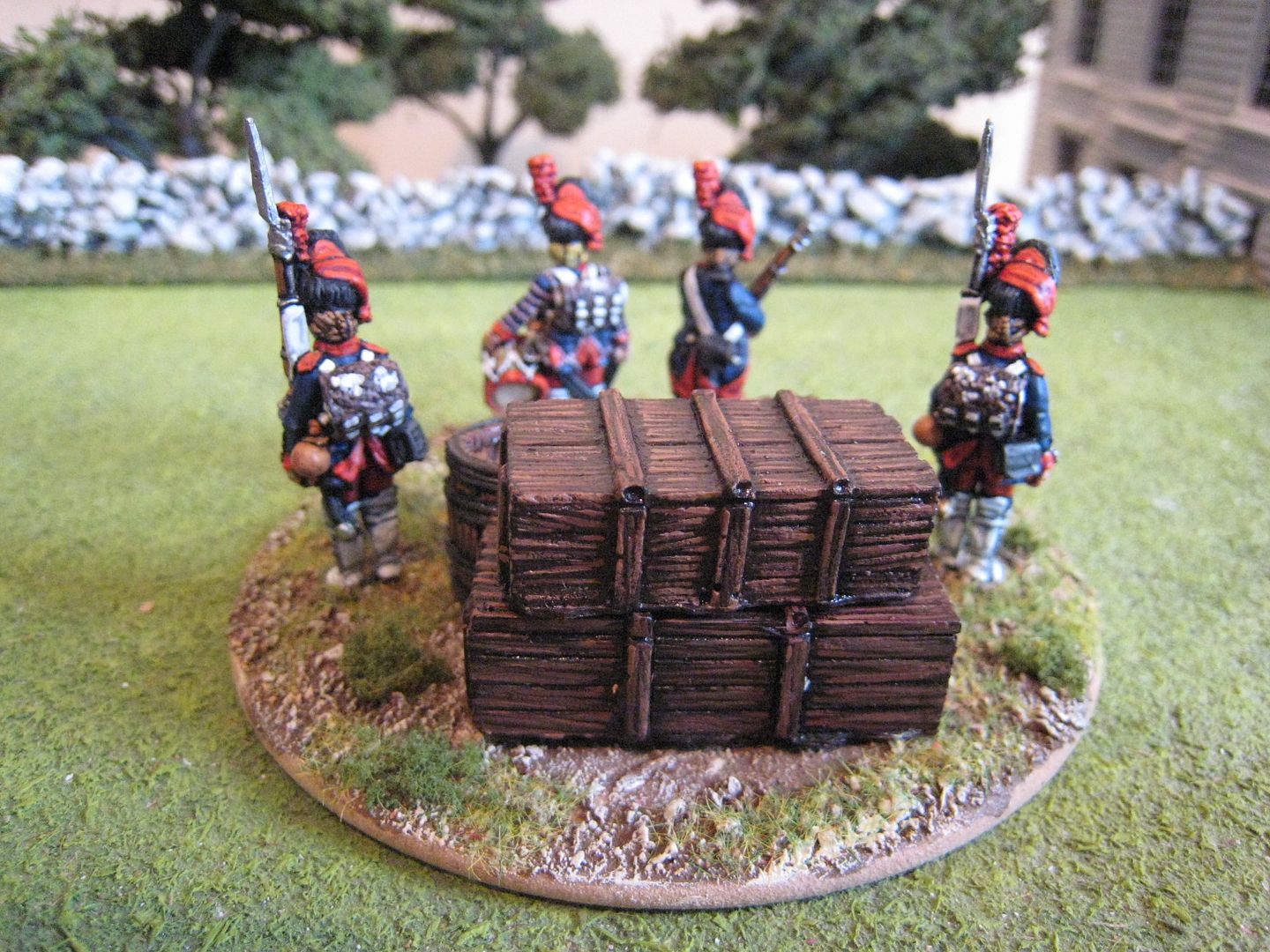
Followers of the Perry Miniatures range may recall that the French grenadier figures that were in the first release of French troops were sculpted with bags hanging off their bearskins. Alan Perry then said that this was a mistake and he was remastering the figures so they didn't have the bags. By this time I had already bought some of these figures and decided I wouldn't send them back to be replaced if I could find a use for them. The Osprey MAA has an illustration of the bombadiers which clearly shows a bag on the bearkin. So I decided to make a small vignette of the bombadiers guarding some stores or ammunition. This was also a way of using up the 2 grenadier figures from the standing infantry command pack that also had bags on their bearskins. The only part of the uniform that I suspect may be wrong for the bombadiers is the plume on the bearskin - this isn't present in the Osprey illustration. But, frankly, who cares and I quickly decided I couldn't be bothered to carve the plumes off. Out of the possible colours I thought red would look best, and to be honest I think the red plumes give the figures a bit of a "lift" anyway. I had no sources of information for the drummer, but thought it best to keep him in the dark blue coat and add the standard drummer's lace. The blue paints used were Foundry's "Napoleonic French Blue 65" palette, with an final subtle highlight of Foundry "Deep Blue 20 C". The woodwork on the barrels was painted with a base coat of GW "Scorched Brown" given a wash of Winsor & Newton dark brown ink, then highlights of Foundry "Spearshaft 13 A and B".

The crates and barrels are from Warlord, save for the larger barrel which is Renedra. The Renedra barrel looks ok now it's painted, but I found the two plastic halves didn't fit together properly. The Warlord crates are resin - you get a variety of sizes in the pack. Only one of the crates seems to have anything resembling a lock (the silver bit on the topmost crate), although I suppose that may just be a bit of surplus resin. The round base is a drinks coaster that I bought with Peter Haldezos in Wellington! I have 4 of the standing grenadiers left over - if anyone can think of another use for them then please let me know, otherwise I'll just paint them up as more bombardiers!

4 figures. Painted January 2011.


Sunday, 6 February 2011

American artillery (6)


These are the last American artillery crews I will paint for some time. They are the 2 "standard" Continental artillery packs from Perry Miniatures (the other Perry packs can be found elsewhere in the "Artillery" label', save for the Rhode Island pack which in will worry about some other time). The figures are based on the same "dollies" that are used for the British SAratoga crews and so largely wearing gaiter trousers and carry bayonets. I thought the latter was a bit strange on American artillerymen - I'd be interested to know what readers think. None of the Foundry American artillery figures carry bayonets, incidentally. I painted the gunners themselves in standard artillery blue-faced-red coats with yellow lace on their hats. I gave a couple of the figures some buff and brown trousers to suggest that campaign dress look.

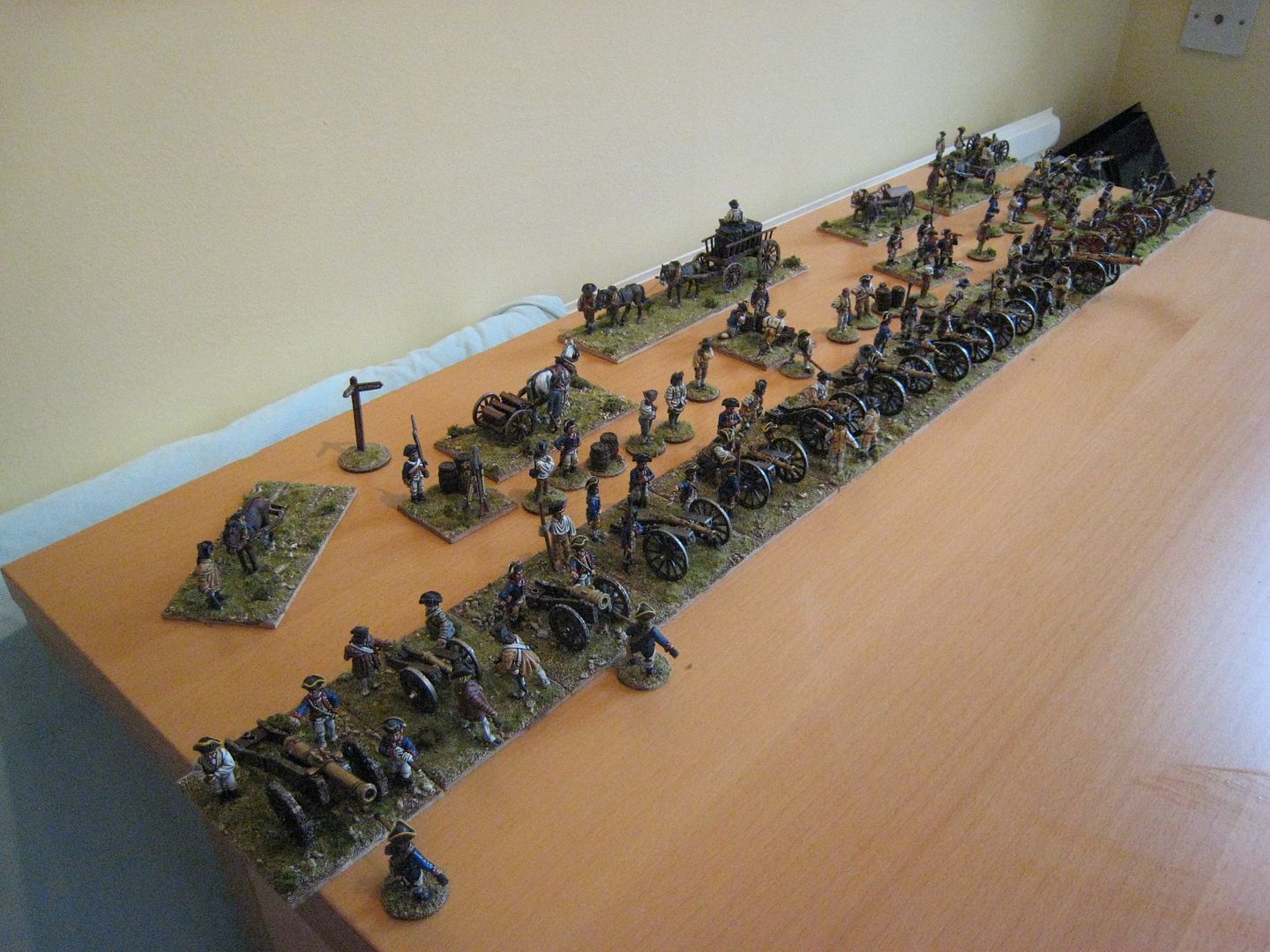
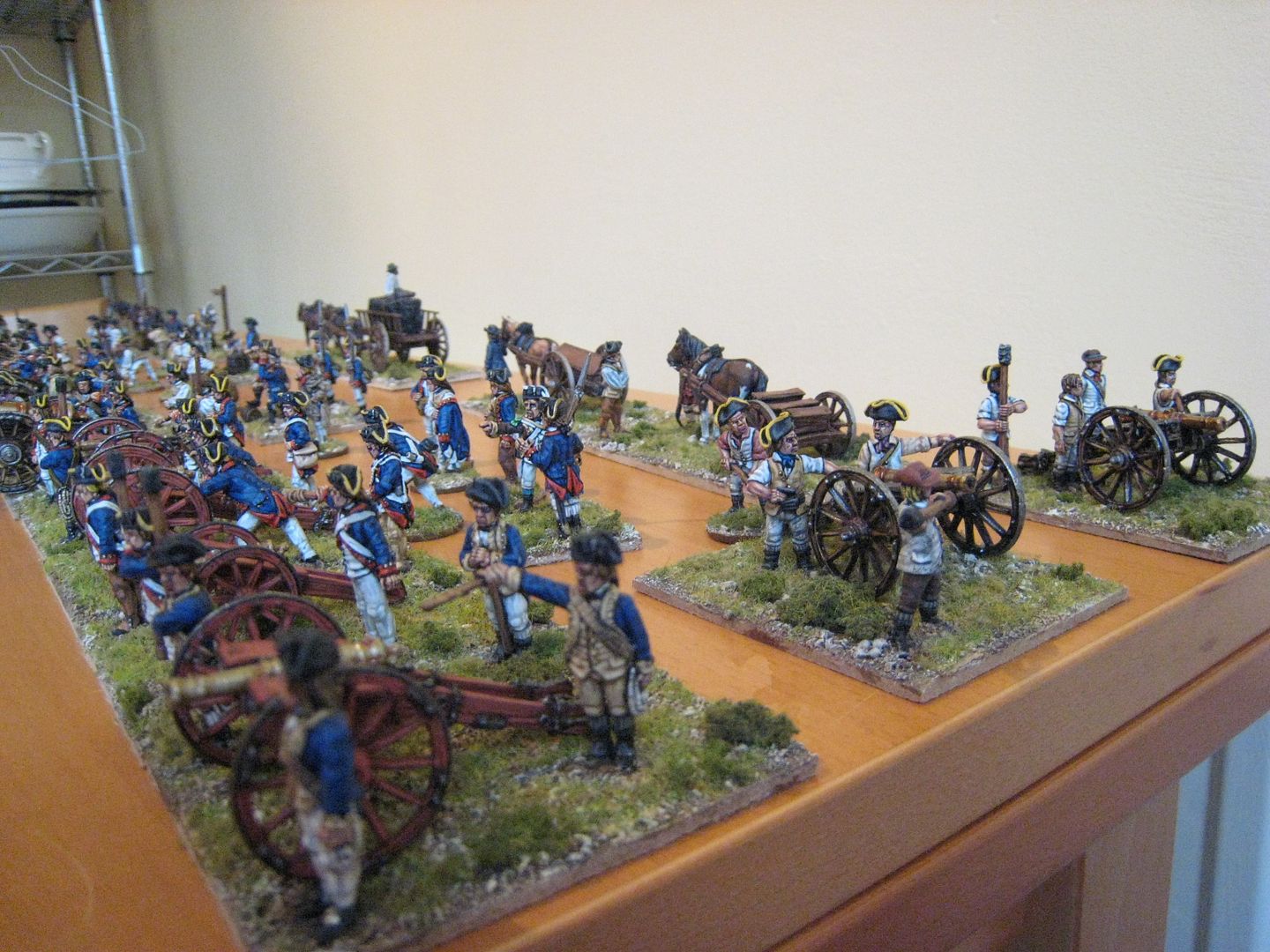
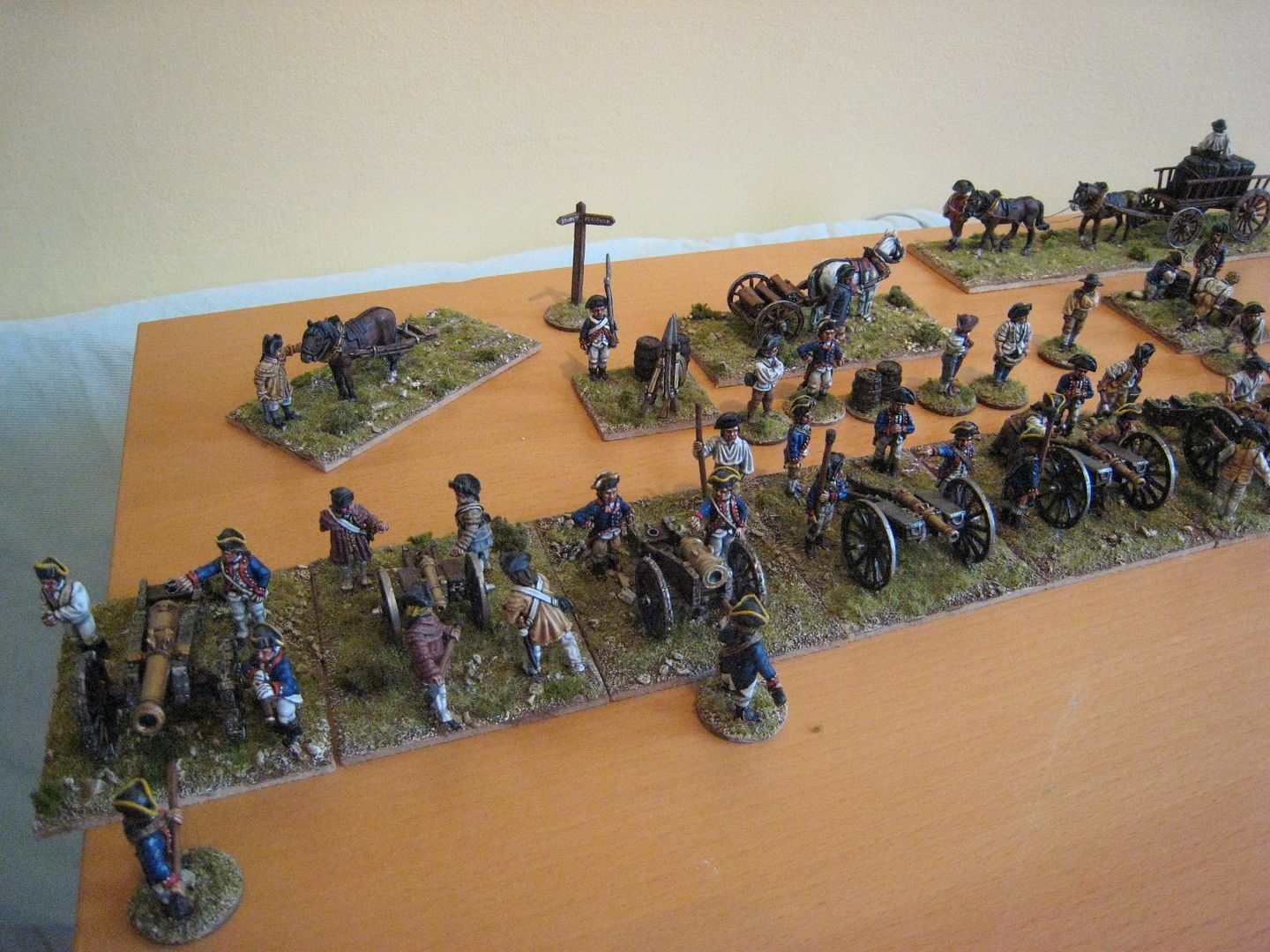
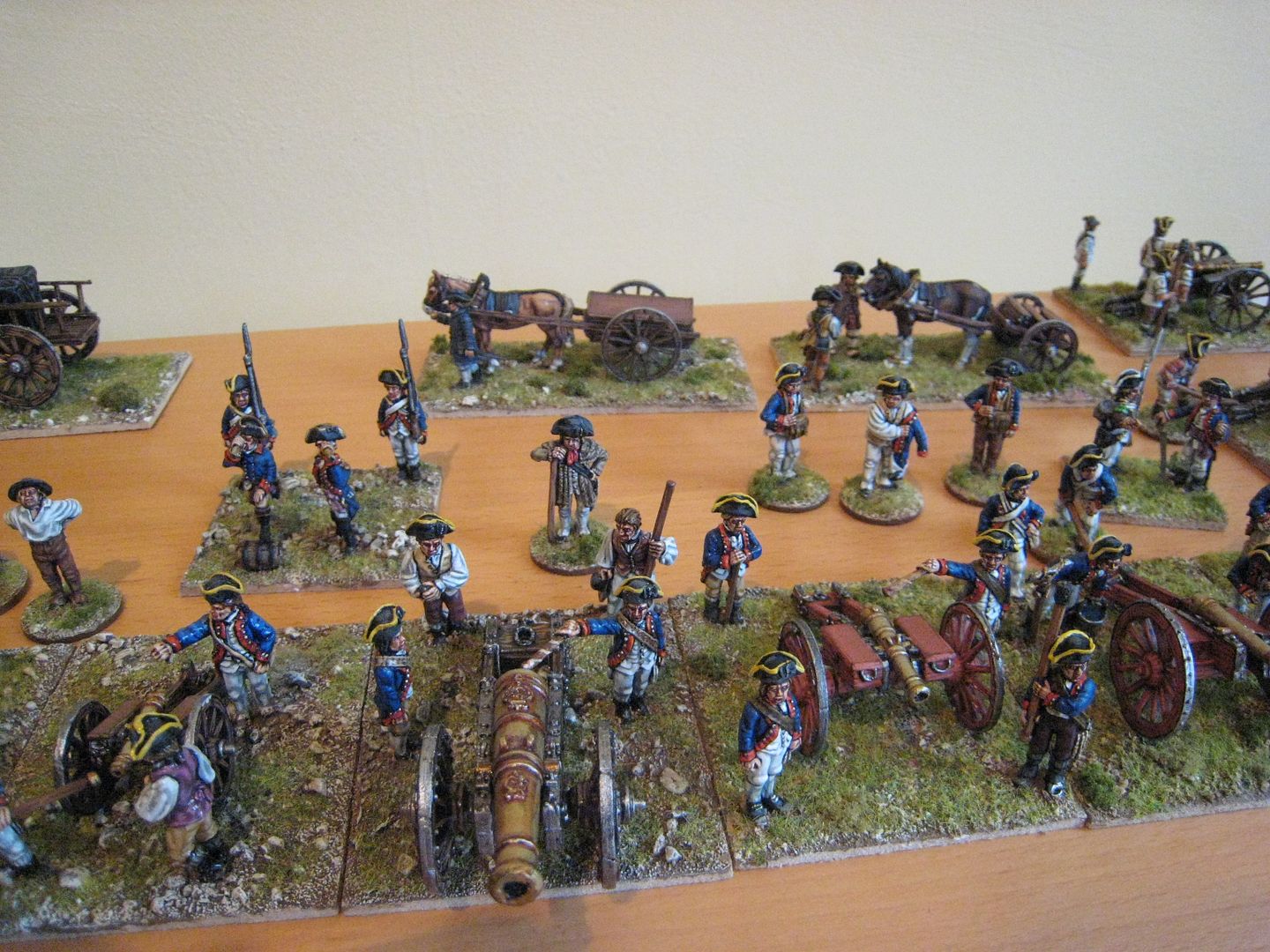
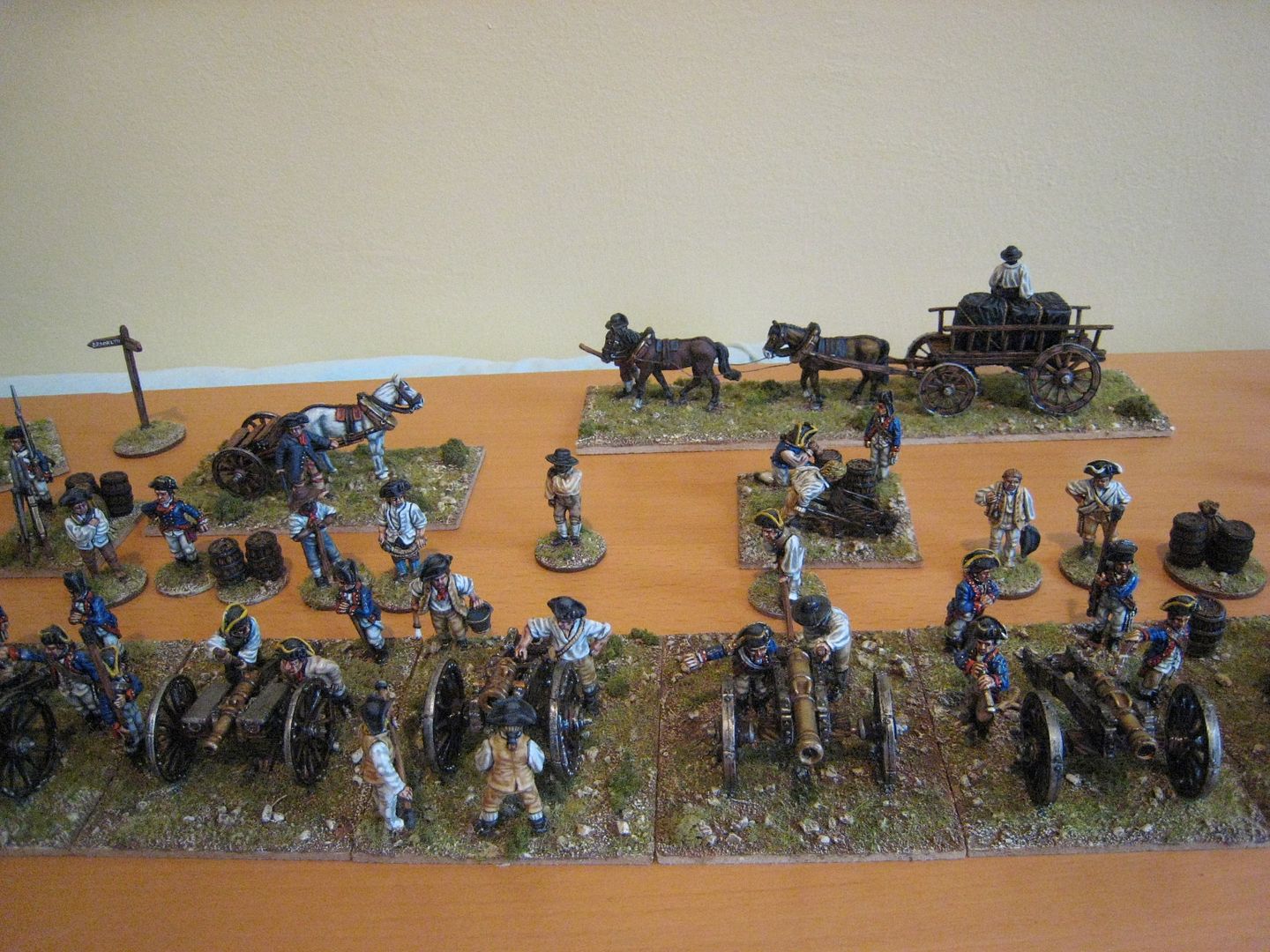
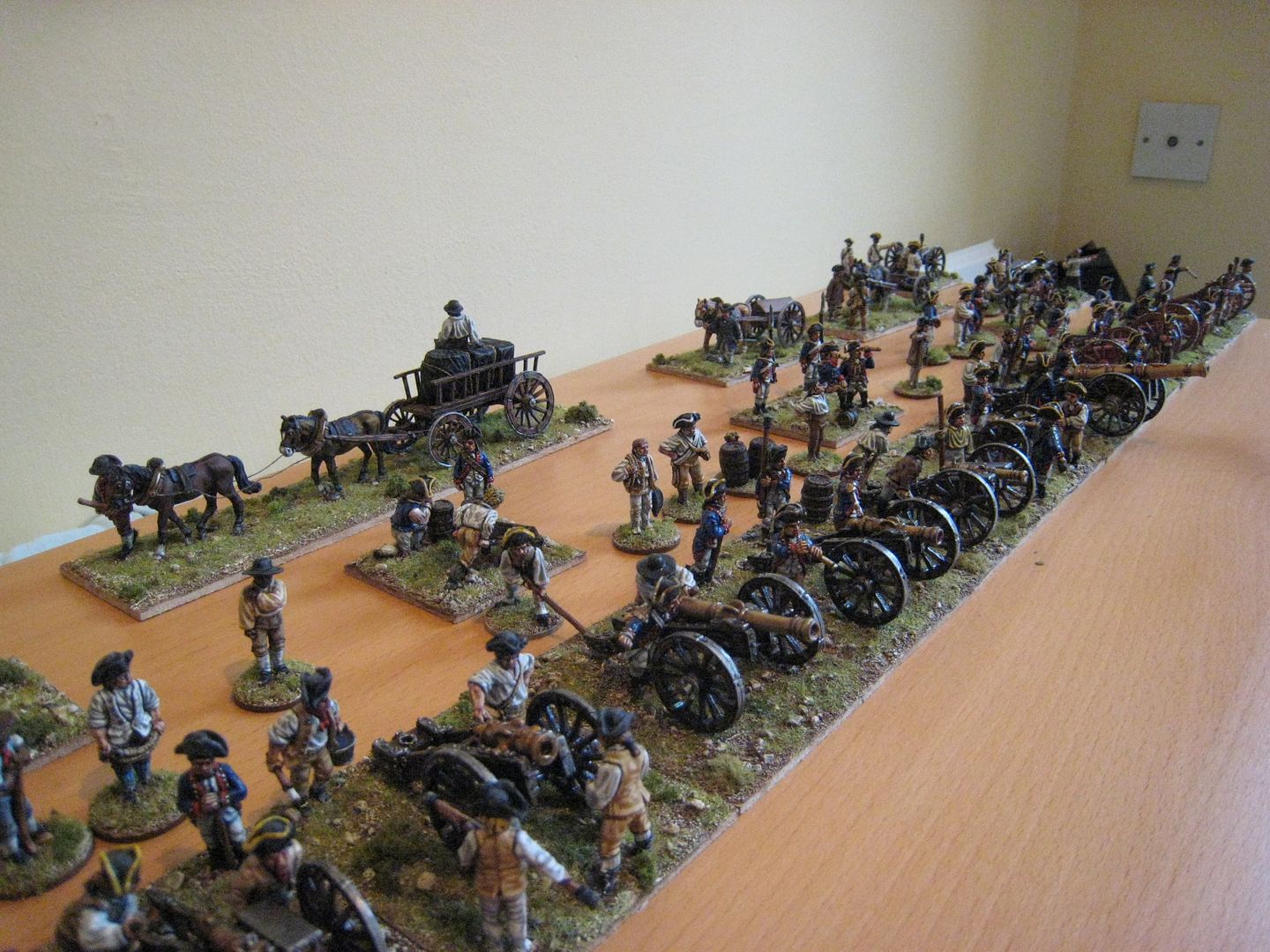
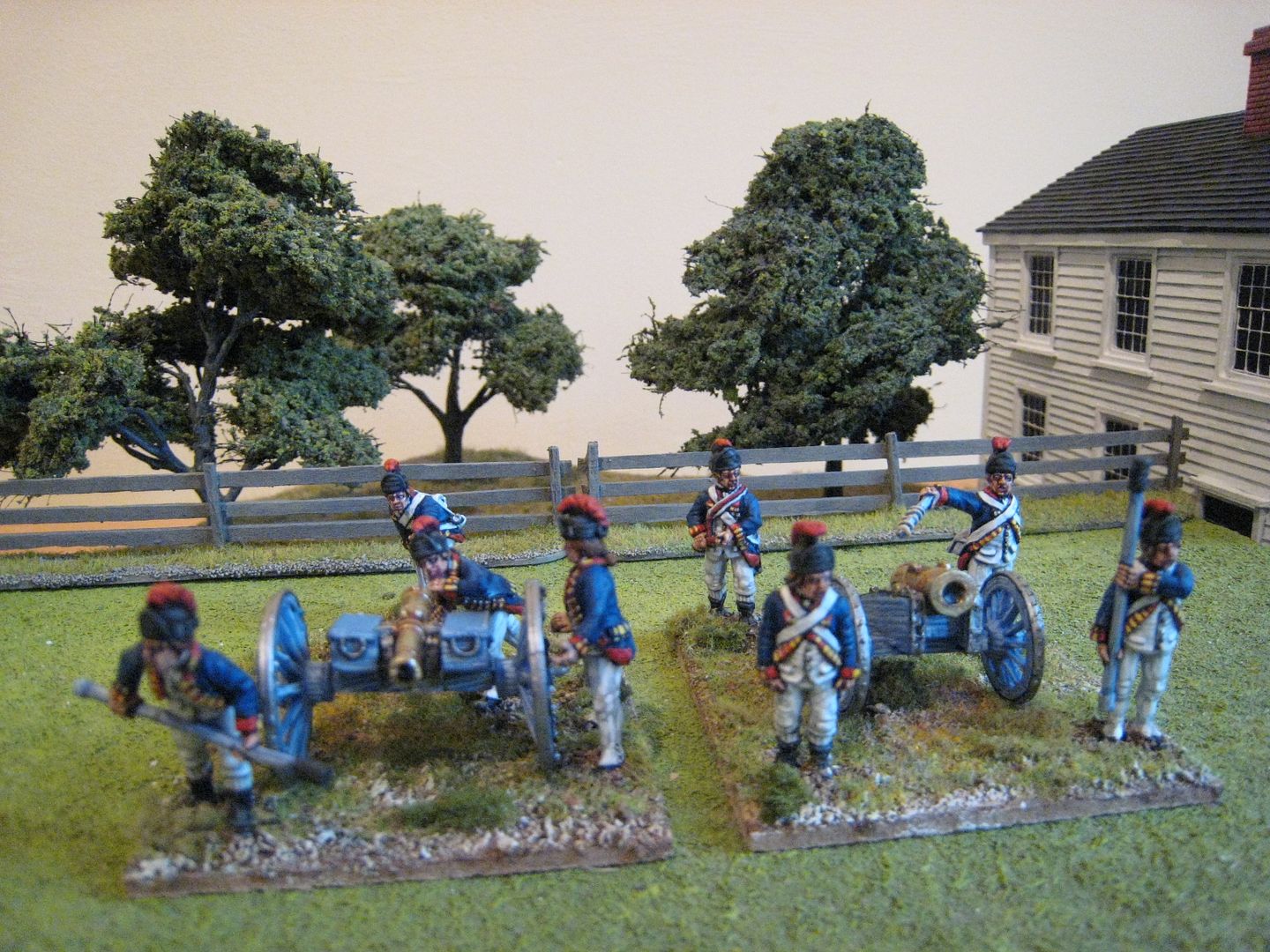
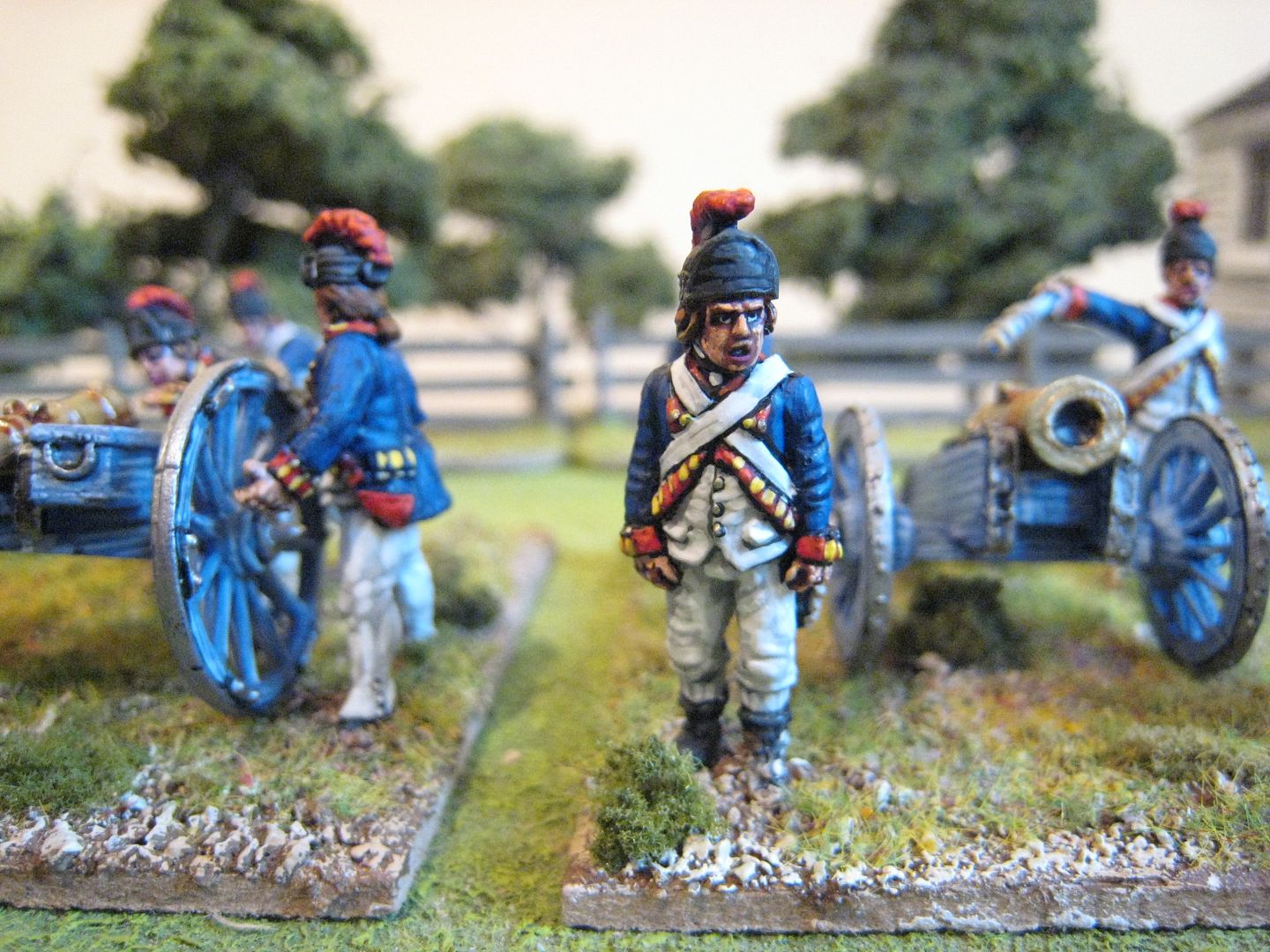
As these are my last American artillery pieces I thought I would get all the others out and see what they looked like all set up together (apologies for the unsophisticated nature of the pics). They just about fitted on the kitchen table, although I had to put the two Eureka "Molly Pitcher" guns along the flank. I have 17 artillery crews in all on the American side - this is way more than you need for most AWI engagements and, I expect, may exceed the total number of guns that were actually present in one or two of those engagements...Anyway, below are photos of my entire Continental artillery collection. Most of the guns/crew were painted a few years ago, when I first started out with the AWI; the crews are the various Foundry packs mixed together. Those earlier guns need some work and the crews are a bit glossy. But en masse I think the set-up looks ok. The Perry "add-ons", like dragrope men and the ammunition carts etc do bring the battery to life. There are a couple of Old Glory fogures too, on the battery commander command stand in the centre.


8 figures and 2 guns. Painted January 2011.


Friday, 14 January 2011

American artillery (5)


Here is the second Foundry Continental 6-pounder that I recently finished, together with a small American artillery command stand. I put this crew in the standard blue faced red coats, but gave a couple of them non-regulation breeches to suggest a bit of campaign wear and tear. The command vignette was inspired by Bernard Cornwell's latest novel "The Fort", which describes the Penobscot Campaign of 1779. Various historical characters do not come out of the novel particularly well, one such being Paul Revere who commanded the American expedition's artillery. Revere as painted by Cornwell is disobedient and unhelpful, more concerned with having a good breakfast than obeying orders. The situation envisaged in this vignette is that an infantry corporal has been despatched to discover why his battalion is not receiving the artillery support it needs. "Sir, you are supposed to be assisting us and we have been forced to move to a new position over there!" "Corporal, my orders are to fire in the opposite direction and so that is what I intend to do. Good-day!" I painted the corporal (as evidenced by the green epaulette) in a brown faced buff coat to contrast with the artillery officer's blue and red.

6 figures. Painted December 2010.

Sunday, 2 January 2011

American artillery (4)


I would normally post artillery crews in pairs but the companion to this piece is the same Foundry pack so I'll post that in a few days with an artillery command vignette. I have had two of these packs in the lead pile for a good few years and in fact it was these packs that prompted me to spend a bit of time focusing on artillery for both sides. I already have 2 or 3 of this firing crew in my collection so decided to paint one of the new packs in the buff facings of Lamb's New York company of 1775. I appreciate that this uniform is not really "correct" for anything outside of the invasion of Canada (during which campaign Lamb's company was all but wiped out), but it makes a nice change from blue coats with red facings.

I painted the gun in a completely different way. All my other American guns are in a natural wood colour. For the 4 new American guns I am working on I decided to paint the guns themselves in the reddish-brown colour that I have read about on TMP and other fora. Apparently Continental gun carriages were sometimes painted in a red oxide colour, which was also commonly used on farm and other buildings - see the picture of the Neilson House on the Saratoga battlefield here. For the gun carriage I used the Foundry "Terracotta" palette and then "Blackened Barrel" for the metal work. The buff facings on the artillerymen were painted with the Foundry "Buff" palette with a final highlight of Coat d'Arms "Bone".

4 figures. Painted December 2010.


Tuesday, 28 December 2010

British artillery (5)


This is my second batch of Saratoga campaign British artillery. This gives me 3 gun crews and the command stand shown here. The Royal Artllery crews engaged at Freemans Farm suffered at the hands of American riflemen. Lieutenant Hadden's detachment of 6-pounders was caught in open ground. Of the 22 men in the detachment only Hadden and 3 others remained unknotted by the time reinforcements under Captain Thomas Jones arrived. Jones and the 11 men who had arrived with him were soon casualties and the remnants of Hadden's battery had to retire, leaving the guns themselves to the Americans. Had den himself carried Jones to a log hut that was full of wounded, but Jones had been mortally wounded and died shortly thereafter. The officer and drummer are taken from the Perry standing Saratoga line command pack.

At the recent Freemans Farm game I played with Eclaireur we used a rule that prevented Hadden's battery from rallying off disruption points by virtue of remaining stationary in a game turn. The point behind this was to replicate the conditions in which the battery found itself on the day. Sure enough, the battery quickly took casualties from Morgan's riflemen without causing much damage itself. The deliberate targeting by the Americans of officers and specialists is something that rules should take account of. If British regulars receive plus modifiers on bayonet charges and firing etc, there seems no reason why they should not be disadvantaged by American targeting...

6 figures. Painted December 2010.


Tuesday, 23 November 2010

British artillery (4)


This is the first of two posts featuring British artillery for the 1777 Saratoga campaign. These Perry Miniatures figures show the crews in the modified uniforms that were worn on (and are unique to) this campaign - shortened coats, gaiter trousers and caps with red horsehair crests. I think it's correct to say that only Perry make Royal Artillery in this uniform. I have painted 3 of these sets and a small battery commander vignette which will feature in a second post. The 6-pounder you see here with the aiming crew is actually from Foundry; the pack's 6-pounder strayed to the 3rd crew I painted (whose own 3-pounder I lost somehow). The guns are painted in my usual British blue-grey palette, which I appreciate is more "blue" than "grey" but it's what all the other guns are painted with so I wanted to maintain consistency. The three colours used are GW "Shadow Grey", first highlight of Foundry "French Hussar Sky Blue 76B" (replacing GW "Hideous Blue" which has apparently been discountinued), then second highlight of GW "Space Wolves Grey". If I was starting from scratch I'd probably use Foundry's "British Gun Grey 108" palette. The gunners' coats were painted with Foundry "Deep Blue 20", my default dark blue for AWI figures.


The Royal Artillery had a hard time of it during the Saratoga campaign. I'll elaborate on this in my second post. I appreciate that these photos are a bit rubbish. For the past couple of weeks the weather in London has been grey, miserable and very photo-unfriendly. If this year is like 2009 it will remain grey and miserable until next March...So I've had to rely on artificial, overhead lighting; hence the yellow glow. The good news is that I hve several posts' worth of stuff now, so blogging should be more regular in future. An advantage of painting artillery is that they are quick to do.


I was surprised to see on checking this blog's archives that I last painted up some artillery over 3 years ago. I am making an effort to polish off all the artillery I might need for the British and Americans over the next couple of months (I don't require any more Hessian crews so that will only leave the French). With the completion of 3 Saratoga crews the British are now essentially finished - I suppose I could do with some larger guns perhaps, but will only buy and paint those when they are specifically required. Another couple of limbers might be useful, but again are not a priority. The British total is therefore 12 crews - 5 in "full dress", 2 in "northern campaign dress", 2 in "southern campaign dress" and 3 in the Saratoga uniform. I'm not particularly fussed about mixing these figures up; if I did Freeman's Farm, for example, which requires 6 guns on the British side, I'd use the 3 Saratoga crews and then 3 of the others.


8 figures and 2 guns. Painted November 2010.