Showing posts with label Civilians. Show all posts

Wednesday, 30 March 2016

Civilians (13)

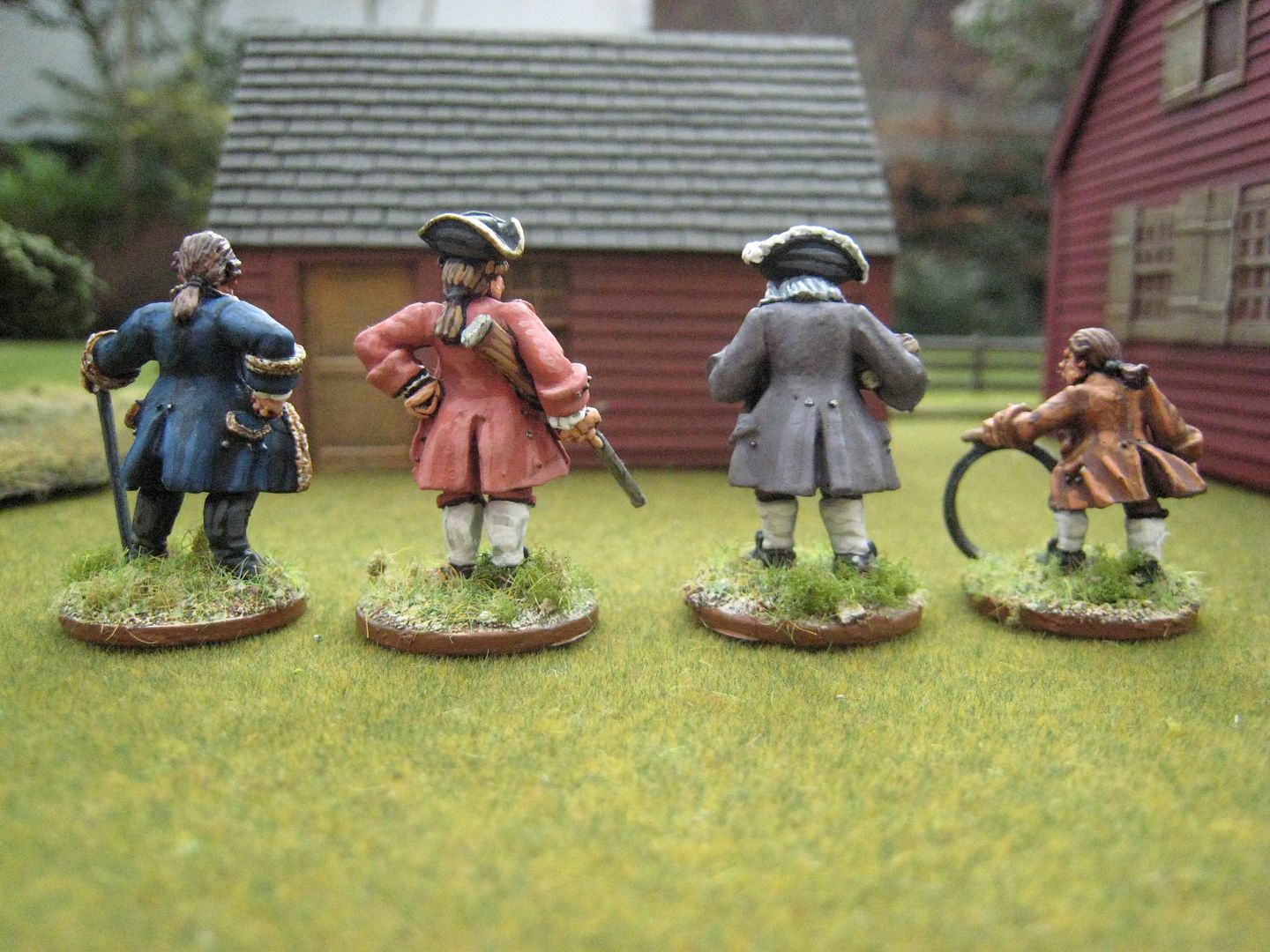
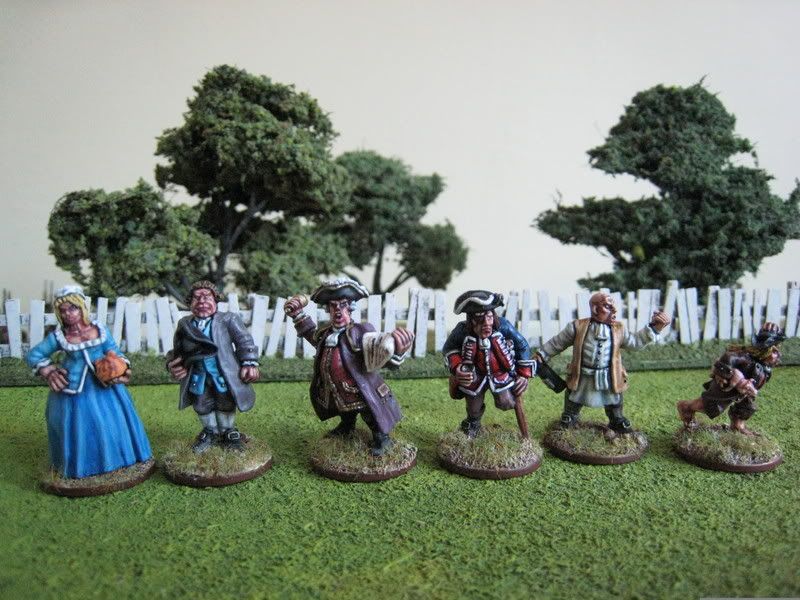
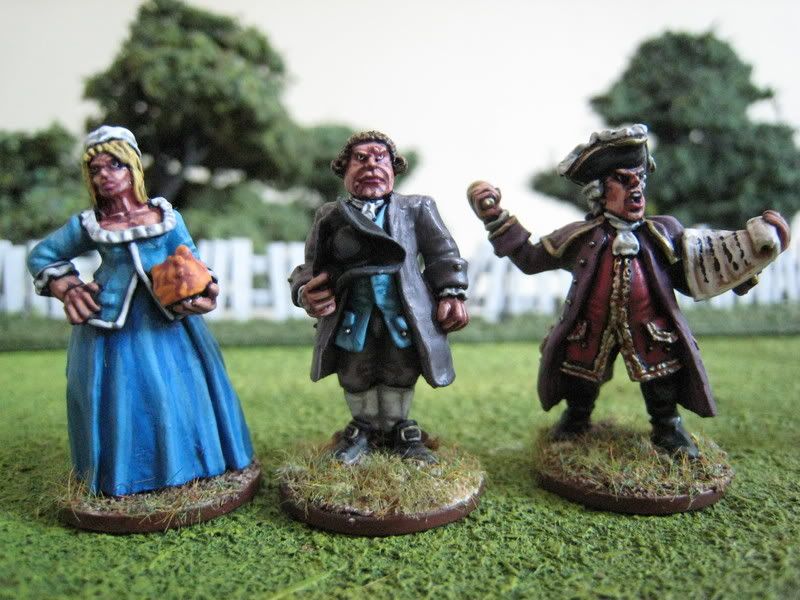
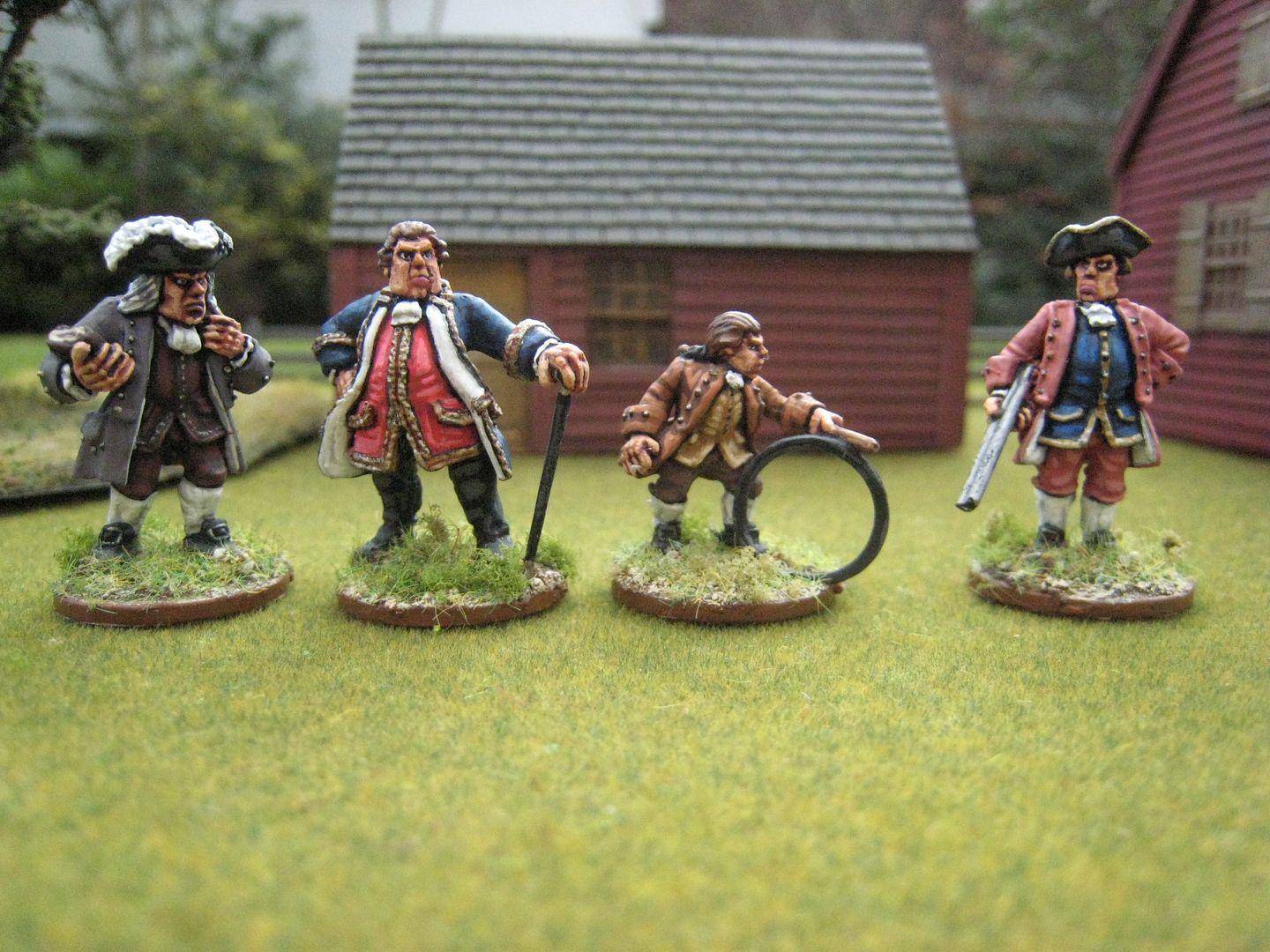
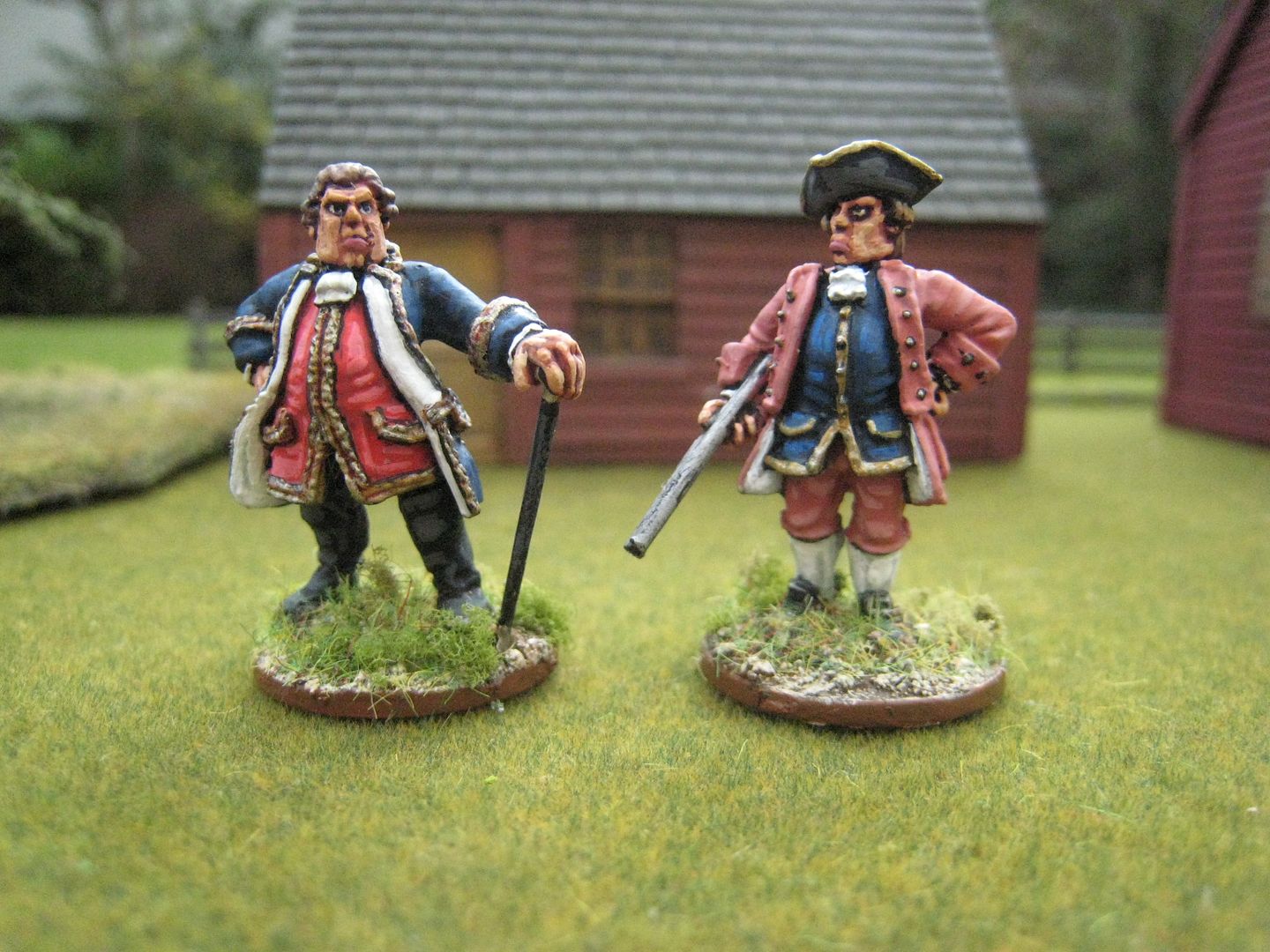
A few weeks ago I found a pack of Foundry 18th century civilians in my AWI leadpile box (actually a large Pampers nappy/diaper box) and thought I'd paint them up.  I must have had this pack for years, because I recall buying a few of these civilian packs at Salute when they were brand new releases - that was some time ago.  These figures are from pack CIV3, which contains 2 very smart ladies, a finely-dressed "gent" with a cane, a "notary" (as per Foundry's description), a chap who looks like a "gamekeeper" or bodyguard, and a kid with a wooden hoop.  I've only painted the males at this stage, and here the are.  The figures, sculpted by Rob Baker, are quite large and chunky and characteristicly square-jawed.  The "gamekeeper" would make a good militia officer, while the "gent" is wearing clothing that would closely resemble an admiral's uniform were it not for the large boots that he's wearing.  Nonetheless, the outfit does look rather military and I these two chaps would go well together on a militia command stand.

As I've mentioned in previous posts (see here, for example), when I paint civilians for the AWI I like to draw inspiration from contemporary artwork.  I choose one of my various exhibition catalogues of later 18th century artists and pick out suitable "models".  This approach only really works when painting up "aristocrats" and civilians in top-draw outfits like these figures, as surviving portraits are invariably of the well-to-do types who could afford to commission the leading artists of the day.  Buut contemporary paintings do give you an idea of the fashions of the day.  So I thought I'd put up pictures of the various paintings I followed for these figures.  These were painted, with one exception as detailed below, by the English artist Joseph Wright, usually styled "Joseph Wright of Derby", who lived between 1734 and 1797.  Wright went to Liverpool in 1768 and spent 3 years there mainly painting portraits of the local gentry and (usually slave-owning) merchants.  His subjects included a certain John Tarleton, businessman and major of Liverpool in 1764, and his wife Jane; their second son joined the 1st Dragoon Guards in 1775....The book I used is the catalogue of an exhibition of the work Wright produced during his time in Liverpool.

The "gamekeeper", with his madder red coat and breeches and royal blue waistcoat is modelled on Wright's portrait of  Fleetwood Hesketh, dating from 1769.  The Hesketh family were Lancashire landowners with business interests in Liverpool.  Hesketh is shown here in his hunting outfit (complete with powder horn and gun).
     
Fleetwood Hesketh

The "notary" is based on a 1766 portrait of Richard Gildart (1671-1770), a businessman specialising in shipping, tobacco and rock salt. He was mayor of Liverpool three times and then served as Member of Parliament for the city from 1734 to 1754.  Gildart became one of the leading Liverpool slave traders, sending ships to West Africa to barter tobacco for slaves that were then shipped to the West Indies.  I used the Foundry "Quagmire 63" palette for the coat.  The catalogue states that at the time of painting the coat has "a slightly outmoded, deep-cuffed style", which isn't really out of place for a man who was 95 at the time of sitting.
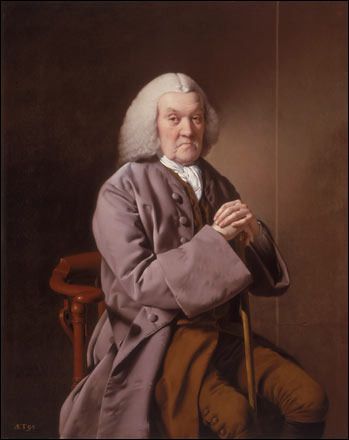
Richard Gildart

Nothing of Wright's own work jumped out at me for the "gent", but one of the introductory essays in the catalogue featured a 1755 portrait by George Stubbs of James Stanley.  Stubbs is nowadays revered as a painter of horses, particularly racehorses.  Nothing is known about James Stanley other than that he was a cousin of the 11th Earl of Derby, was 33 at the time of this painting, and was probably a fried of Stubbs' during the latter's childhood in Liverpool.  I saw this picture and thought a dark blue coat, red waistcoat, and white lining would be suitable for the "gent".   This painting is actually the earliest surviving painting by Stubbs (he was 31 at the time).  He may have sensed that portraiture wasn't his forte.
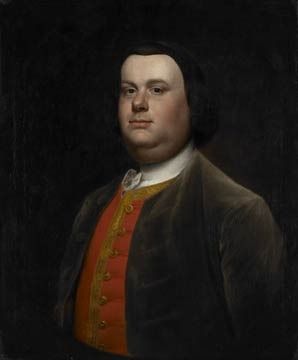
James Stanley
 
No "model" was used for the little boy.  Hoop rolling has been a children's game since the earliest times - the ancient Greeks even turned it into an adult sport.  By the 1840s it was a real problem in the streets of London and newspapers led calls for the activity to be banned.  At this time many hoops were made of iron and so often caused injury to pedestrians.  Maybe I should have painted the "gent" as an admiral - not quite sure how I would have used him, though.  The "gamekeeper", on the other hand, may well see militia service at some stage.  

Four figures.  Painted December 2015.


Monday, 20 May 2013

Civilians (12)

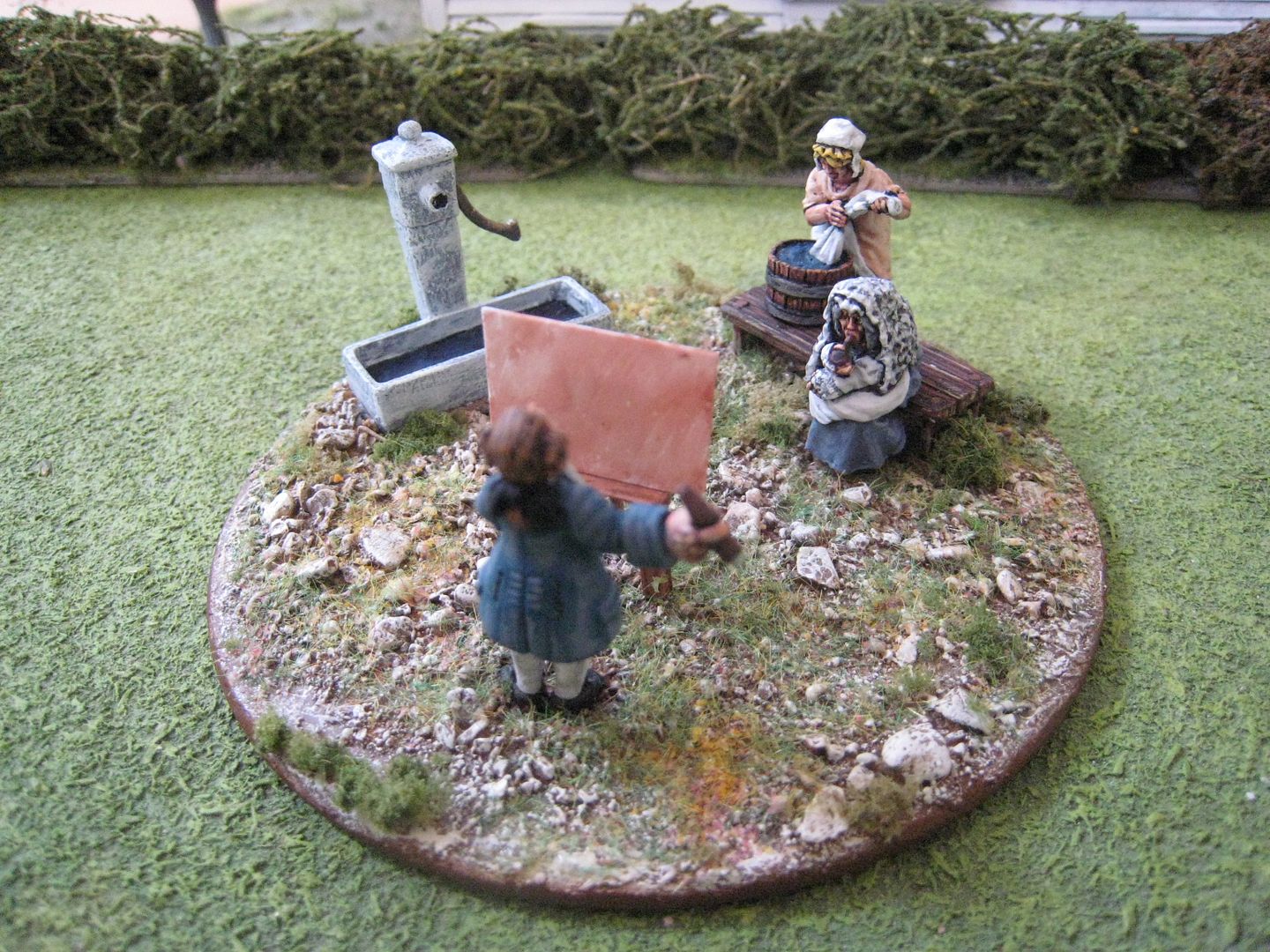
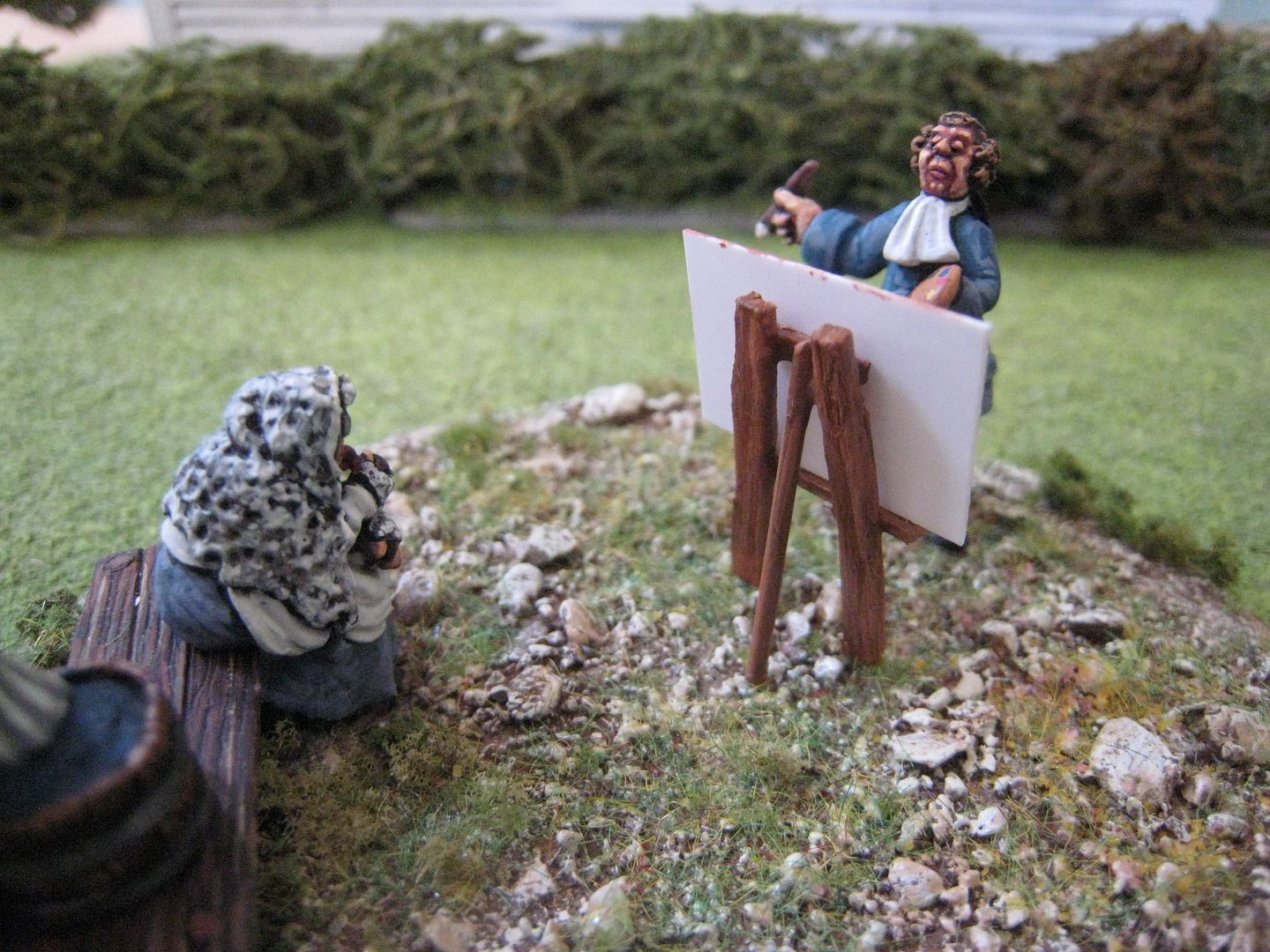
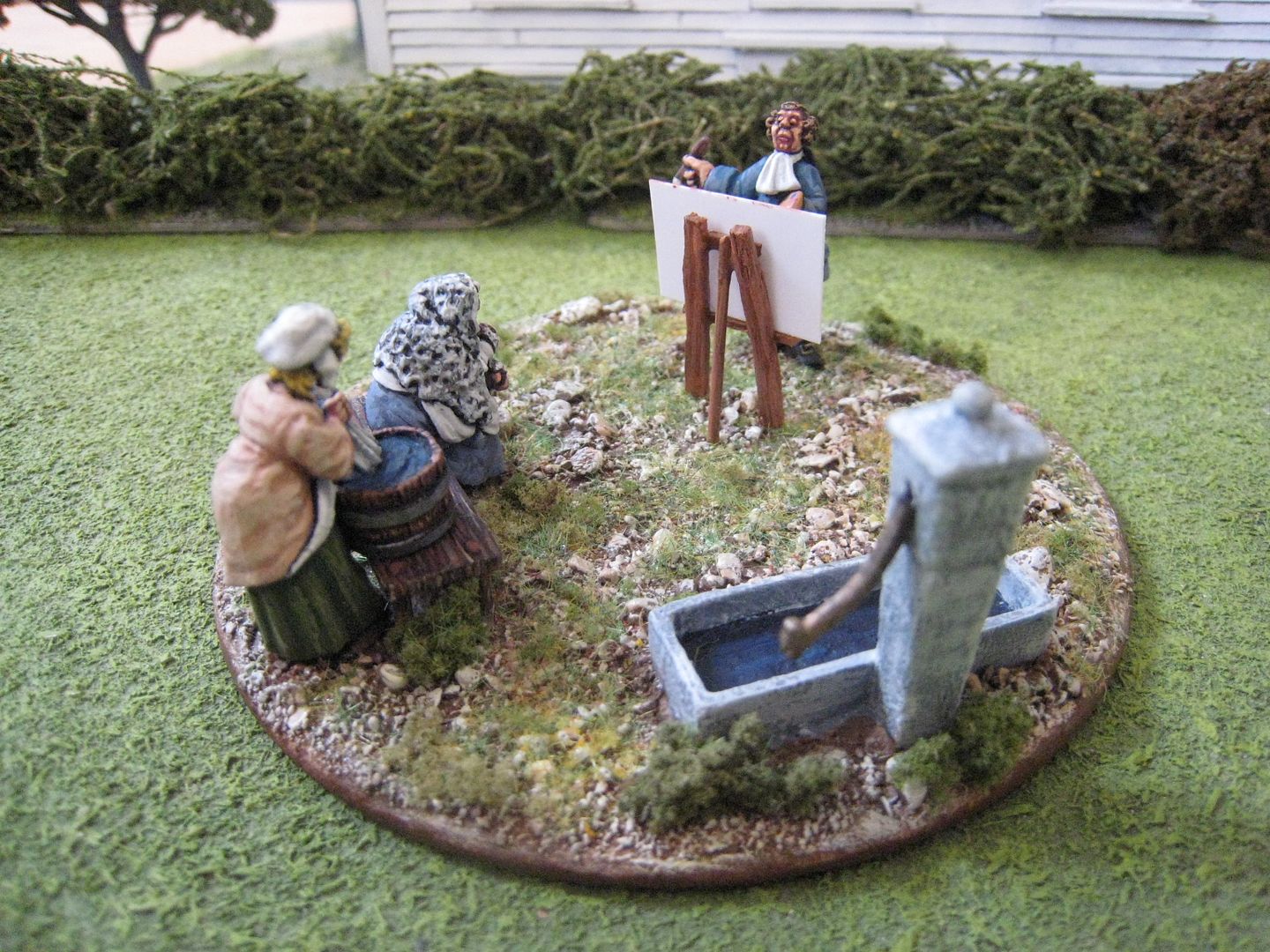
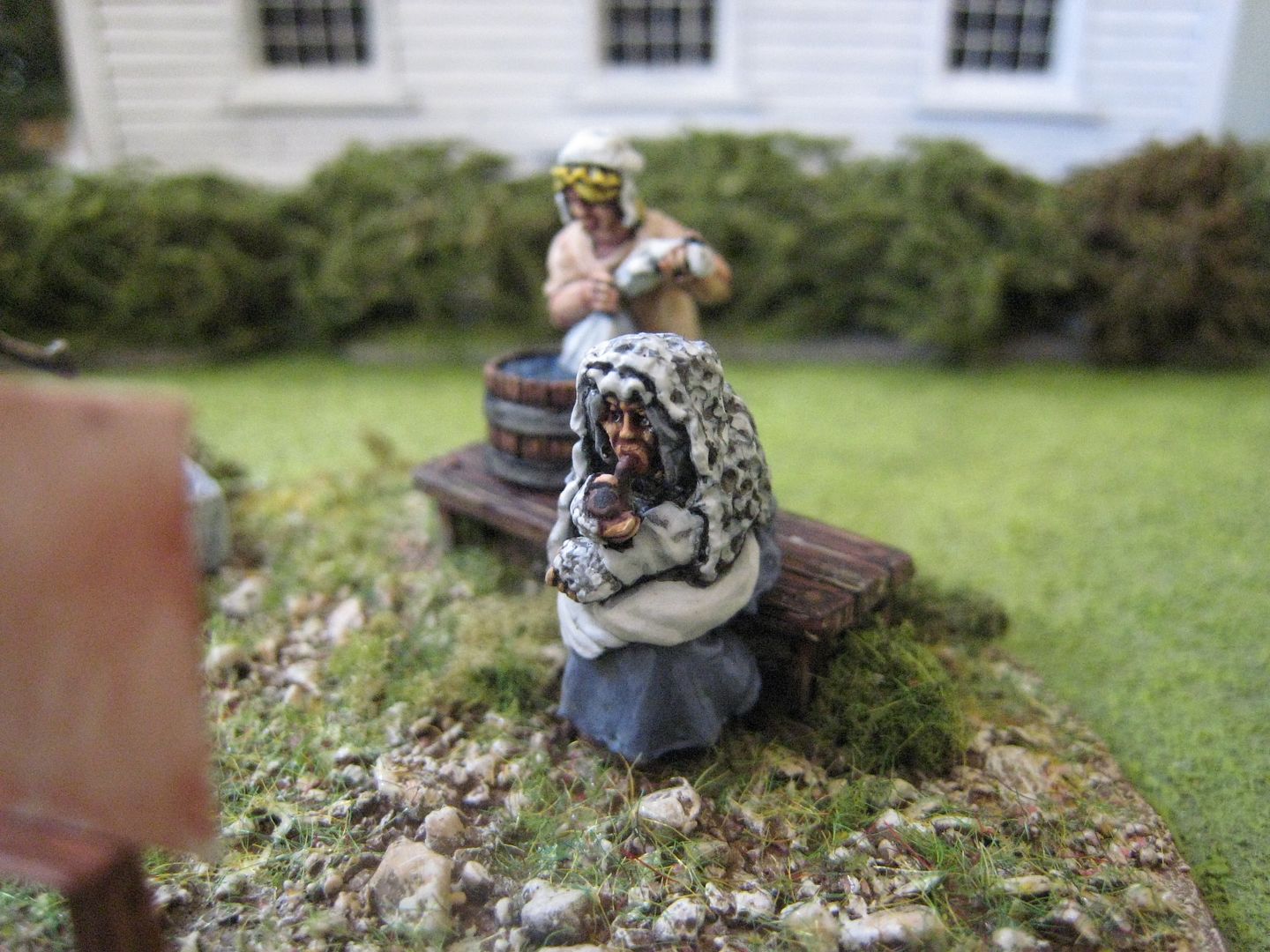
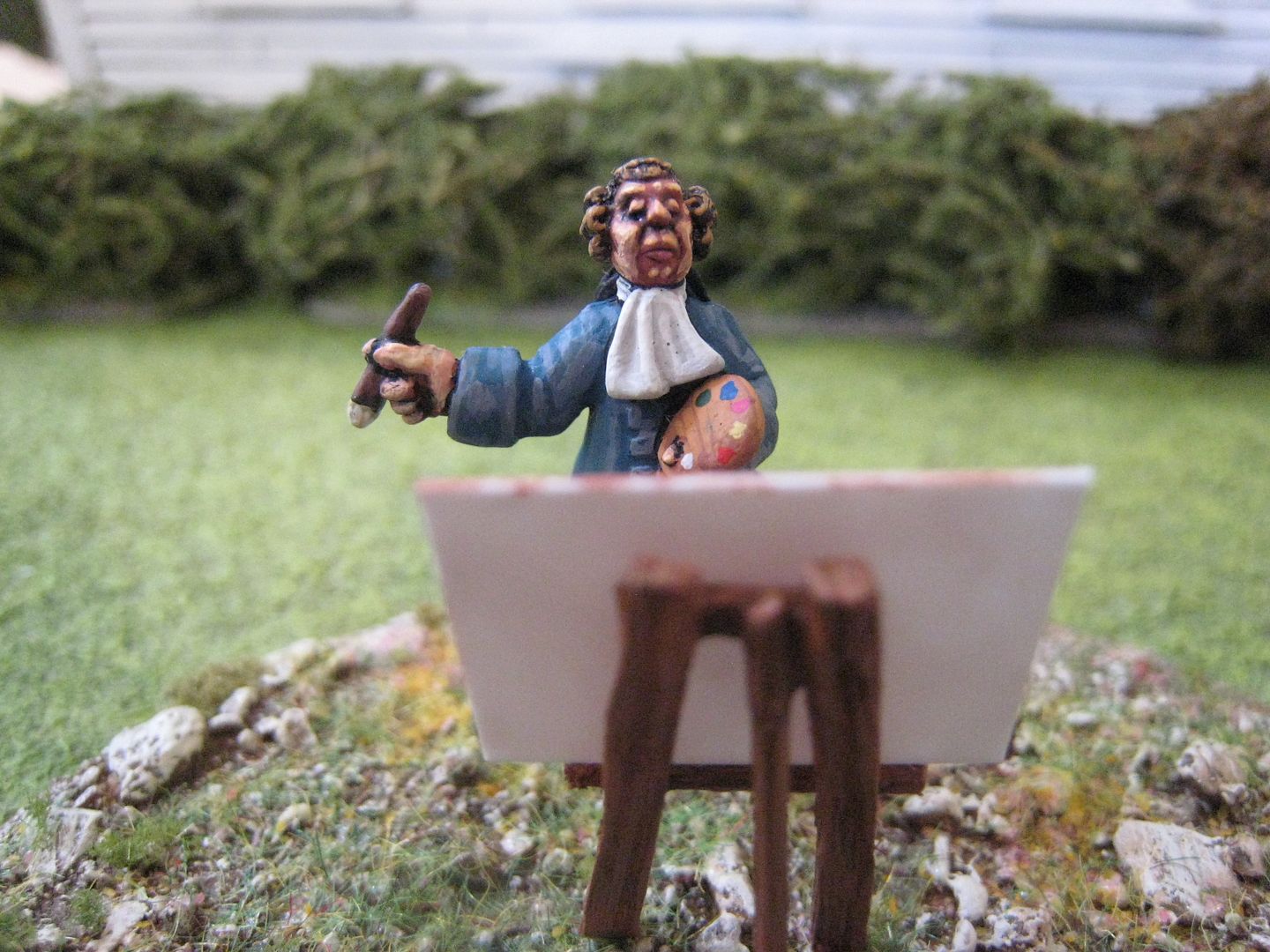
I think this vignette holds the record for the length of time I've taken to complete something.  I can't actually remember when I started painting these figures, but it was definitely before I moved out of London, and even then the two figures I'd painted, the girl and her chaperone, had been finished for a while.  So I reckon is was about July 2011 that I began work on this scene.  I picked up all these figures when I visited Eureka Miniatures HQ in Melbourne earlier that year.  The washer-woman, old crone and water trough come from a set in the Eureka Revolutionary Wars set, which also includes a French cavalryman watering his horse.  I'm not sure where the artist figure comes from - there are all kinds of jems in the Eureka catalogue which can be difficult to find on their website.  When I visited Eureka, wargaming chums John Baxter and Mark Spackman found all sorts of things for me to buy that I'd never seen before (including a wig-maker with a giant poodle - I must paint that set sometime soon).  The reason for the massive delay in finishing this set was twofold.  First, I couldn't decide on how to paint the stone water trough.  Secondly, I was having difficulty arranging the scene and, in particular, finalising how to deal with the artist.  I had decided quite quickly that I would use all these figures together, as an early example of en plein air painting.  The tricky part, however, was working out how to make the artist's easel and whether to add any other bits to the scene.  So having painted and based the humans in 2011, I then failed to apply myself to the water-trough and the easel and consequently this vignette languished on my desk until April this year, when I shamed myself into sitting down and working through the outstanding items
As I find is often the case with "tricky" bits of modelling, the "difficult" bits didn't actually take long to finish.  I painted the water trough with the Foundry "Stone" palette, and then gave it a final drybrush with an off-white (I forget which paint exactly, but it would have been a Coat d'Arms light grey).  The easel I scratch-made from bits of matchsticks.  I spent a bit of time searching the internet for pictures of mid/late 18th century easels to see what they would look like - not many seem to have survived, but there are quite a few paintings from the period which are themselves pictures of painting scenes. That said, easel design doesn't seem to have advanced all that much over the past 300 years.  It probably the case, however, that the type of easel I made isn't the sort of thing that a painter would have taken out of the studio.  Also, the painter in this scene is probably an amateur, as most established artists in the 1770s would have been concentrating on grand historical scenes or society portraits and wouldn't have wasted their time painted the local rustics. Anyway, the easel was a bit fiddly to do in the end, the hardest part being to carve out the ridge in which the painting sits.  Once it was all glued together, I painted the easel with the Foundry "Chestnut" palette.  Looking at these photos now, I realise that I should have added some gloss varnish to the water in the tough and the washer-woman's basket.

I arranged the figures in what seemed to me to be the most satisfying way, although I appreciate that it's not clear exactly what it is that the chap is painting.  The picture itself is simply a bit of Gale Force 9 plasticard.  I did think about trying to paint the scene into it, but discarded that idea after about 5 seconds.  Rather than leave the "canvas" completely blank, I painted a "red ground" on it.  Apparently red grounds are often used by landscape painters to prepare their canvases; I read that Constable favoured a sort of mid-brown colour and I tried to replicate that here.  Making the scene look as if the artist is just about to start also meant I could put paints in the palette without smearing them around.   I haven't glued the painting to the easel - so I could in theory have a go at painting something in the future.

4 figures, a water-trough and an easel. Painted July 2011-April 2013.


Monday, 28 June 2010

Civilians (11)


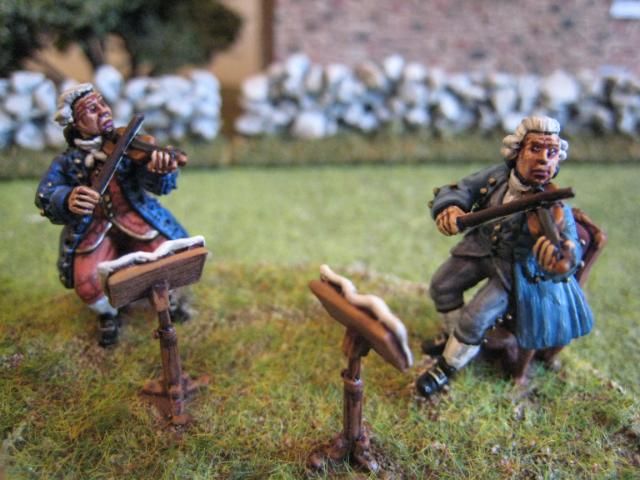
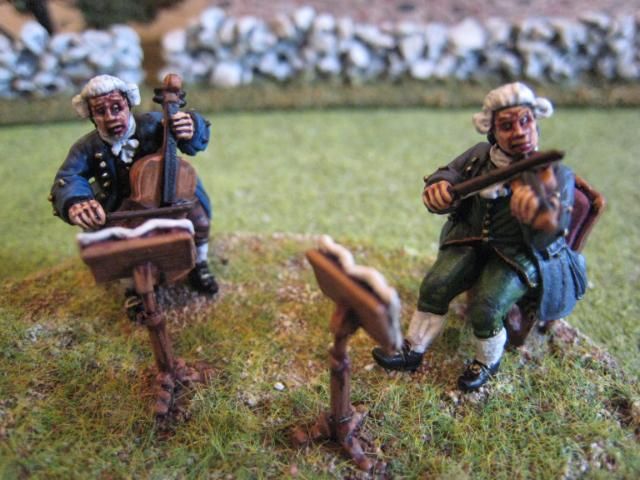
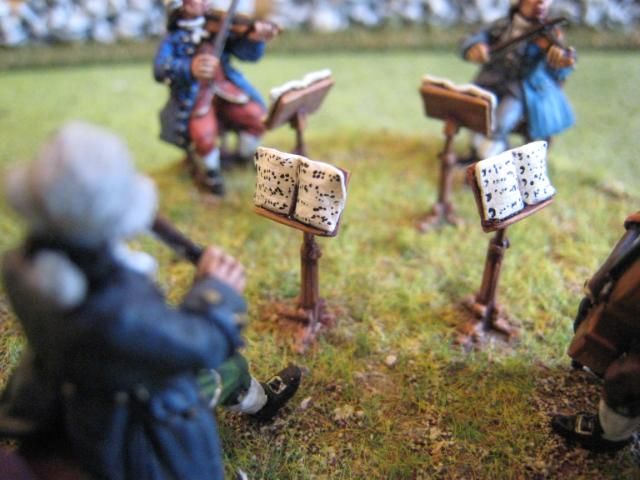
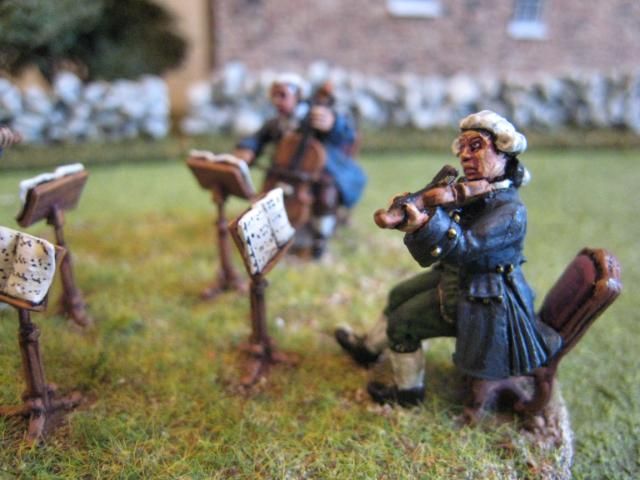
I thought I'd put these figures under the "Civilians" label but this is the first post of 3 on Eureka Miniatures' 18th century musicians and perhaps they deserve a separate label. Anyway, Eureka have done a fantastic job in releasing this string quartet and "personality" figures of Frederick the Great playing his flute and CPE Bach playing his keyboard (I've finished Frederick but haven't started Bach yet). These are all equisite figures and I recommend them to all 18th century gamers - you can never have enough musicians on the tabletop. The sculpting of the instruments and the way they are being played is very good. I was delighted to see that the viola (my own instrument) is noticeably a bit larger than the violins and I like the way that the players are leaning forward as they play. My only niggle is the positioning of the heads - only the cellist is actually looking at the music. But I suppose you could think of the others as (quite validly) either looking at their finger-work or at each other; on that basis I tried to position the figures so that they are looking at each other.


One option with these figures is to paint them all in the same outfits to represent a court or house band. Given that these are for use in 1770s America I decided against the livery look but tried to create some uniformity by giving each player a powdered wig and a blue coat. I wanted to suggest a group of professionals who are wearing their own clothes but are ensuring that they co-ordinate in some fashion. One of the two violin players has a more elaborate coat than the other and so I decided he should be the leading first violin. For the instruments themselves I found that the Foundry "Tan 14" palette was perfect. The seating of the figures is not quite right, which is a bit annoying because I did some research to see whether is was (and is) more common for the viola or cello to sit on the outside. There is no "correct" answer to that point and I put the viola player on the outside. However, in front of an audience the viola is supposed to be opposite the first violin with the other two forming a semi-circle behind them; this is so that none of the players' backs are presented to the audience. With my figures, even though there is a nice symmetry in the way they sit on the base the backs of two of the players will always be towards the audience. I'm not sure how that happened.... and perhaps it would have been better to have based each player separately, but never mind.


The quartet is playing the opening of Quintet No.6, Op.57 by Luigi Boccherini (the fifth part is piano). When painting the music I wanted to work from an actual score rather than just make up the annotation, and this was one of the few suitable pieces I could print off online. The quintet was probably composed in 1780 and it has a suitable nickname, "The Military Night Watch in Madrid". Trying to fit a full 10 staves on each page would have been ridiculous, so I settled for 4 staves per page and I did try to ensure that what I painted followed the music and thereby captured the various intruments' roles. So, for example, the music for the first violin is busier than for the other players and the viola player (as usual) has some long rests and a part that is not particularly exciting; hopefully the clefs look a bit different too. These figures are part of Eureka's "100 Club" system, whereby you put your name down for figures in advance of their being sculpted. Consequently I don't think they are on general release just yet.


Recordings of suitable period music are easy to find. Some of my favourites are Haydn's Op.17 quartets (1771), Boccherini's Op.19 flute quintets (1774-6) and Antonio Rosetti's Op.6 quartets (1787).


4 figures. Painted June 2010.


Monday, 9 November 2009

Civilians (10)


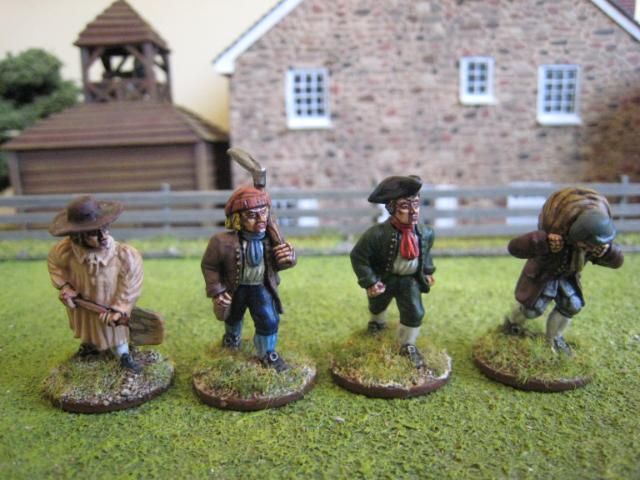
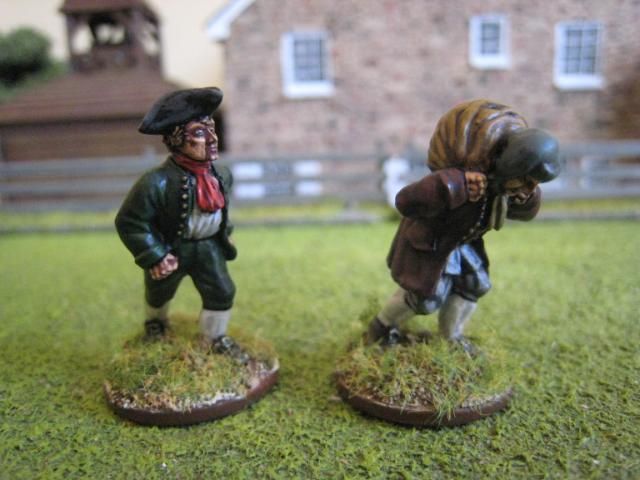
You can't have too many civilians for the AWI. Well, I suppose there probably is an upper limit on what would look good on a table, but non-combatants always enhance a game and can make a welcome change to painting military types. Many of the AWI's engagements were fought across villages and townships and civilian onlookers have provided memorable accounts of the fighting they witnessed (for examples, do visit the utterly outstanding "Boston 1775" blog).


These figures are from Front Rank and are the contents of one of the packs in their 18th century civilians range. The figures have the trademark Front Rank chunkyness that makes them look very Billy Bunter-ish in comparison to Perry Miniatures, Eureka and some other manufacturers; it's not so much the faces but more the enormous calves that look a bit out of place - in this they are a better fit with the Foundry 18th century civilian figures. That said, I'm quite fond of Front Rank and these figures are a useful addition to the non-combatant ranks. There seems to be a "labourers" theme to this particular pack and I bought it for last November's Long Island game. I had intended to paint all 4 figures to put in the Brooklyn earthworks as hired help. As it happened, the only figure I managed to complete in time for the game was the chap with the shovel. I saw the other 3 figures in my "to do" box the other week and decided it was high time to finish them off. The only other Front Rank figures that I have in my collection are some militia based up as skirmishers and a couple of casualties. The 25mm range as a whole is nicely sculpted, if you like the chunkier style, but I think it is now showing its age and has been eclipsed by the Foundry/Perry/Eureka troika. But the civilians are still worth buying!


4 figures. Painted October 2008 and October 2009.

Saturday, 2 May 2009

Civilians (9)


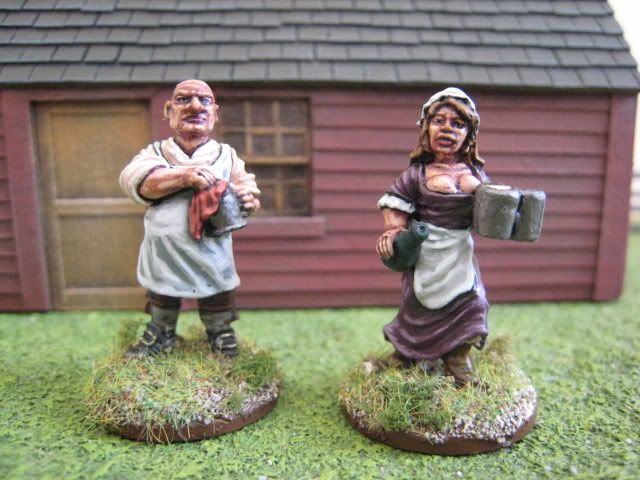
Just 2 figures for this post, painted last weekend. I am always on the look out for suitable, interesting civilian figures and I found these sculpts at Salute a few weeks ago. They are from Outpost Wargames Services (see their website here) and are part of a Highwaymen range. Elements of the figure's attire are more 17th century than 18th century (e.g the ties at the bottom of the barman's breeches) but I think these figures would pass muster for pretty much anything from 1620 to 1820. The barman's head is also a bit caricature-ish, but not in an extreme way like some Old Glory sculpts and the faces on both figures have a lot of character (although why do sculptors always make bald barmen?). All together I am quite pleased to have found these sculpts. The figures cost £2 for the pair, although the website shows that the figures can be purchased separately. A barmaid figure is something that I have been particularly looking out for. Maybe she's bringing a bottle of Louisiana Claret to some thirsty British officers...

2 figures. Painted April 2009.

Monday, 25 August 2008

Civilians (8)


This is the Perry pack of civilians, which I bought from Dave Thomas at the Woolwich show a couple of week ago. With "one-off" packs like these, I find it very tempting to follow the colours used by the painters on the Perry Miniatures website, and I did so for the chap carrying the barrel, althugh I don't think I managed to highlight the black suit as subtley as Maestro Woodward did. I have seen people say that the best way to highlight black is to add purple, or flesh tones or something like that; this figure uses the Foundry "Charcoal Black" palette and this paint triad doesn't quite work for larger areas of colour. For the old gentleman and his wife/daughter, I looked at a catalogue of paintings by Thomas Gainsborough for inspiration. The man's outfit of light brown coat and yellow waistcoat is taken from a 1777 portrait of Carl Friedrich Abel, a German composer who lived in London and who provided music lessons to the royal family (for which see here). The woman's turquoise and gold dress comes from a 1778/79 painting of Anne, Lady Rodney, wife of the eldest son of the famous admiral (for which see here).


6 figures. Painted August 2008.


Saturday, 10 November 2007

Civilians (7)


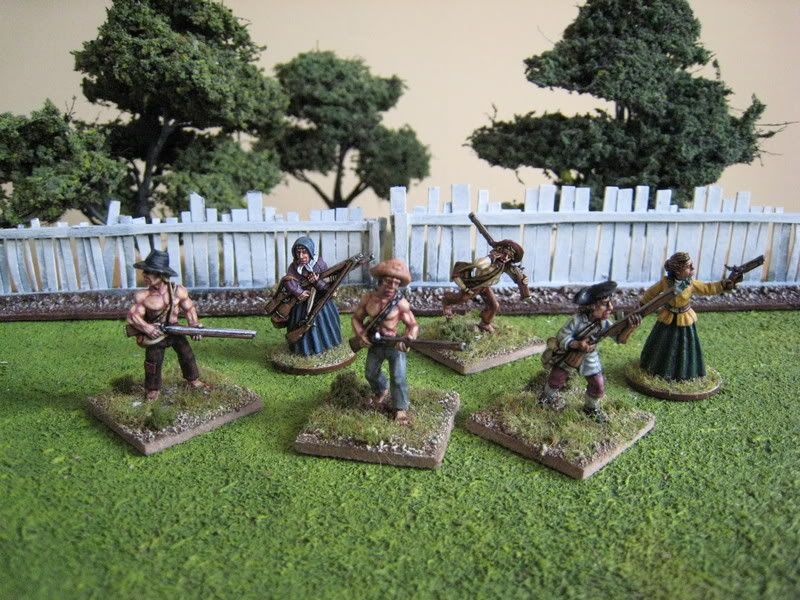
Meet the Duke family from Albany, NY. Bo and Luke are the local tearaways and have been the heads of the family ever since Papa Duke had that nasty encounter with the local Huron. As you can see from the way they hold their muskets, they are at their happiest when playing their mandolins; it's unfortunate for them that they were not born 200 years later, since they undoutedly would have been rock stars. Daisy Duke ensures she always wears the latest Parisien fashions, paid for by her brothers' illegal moonshine operation. When those three are off boozing and scalping their way across New England, Mama Duke does her best to keep young Pip and Puck on the straight and narrow. Alas, all the youngsters seem to want to do is to fire the odd pot-shot at the residence of the local British governor, Quentin Hogg.

These are most of the second pack of Conquest Miniatures' settlers. There are two others, the men of the family, who will be drafted into my next militia unit. Again, these are lovely figures and will be used for all kinds of things. Mama Duke and the kid who's running (and no doubt shouting something rather rude about the British) would look very good in the redoubt at Bunker Hill. Anyone wanted figures for a "The Patriot" game need look no further. The sculpting on these figures, the faces in particular, is first rate. Todd Harris is one of those rare sculptors who can really show age in a face - probably difficult to see from these photos (and those of the previous pack) but very noticeable up close.

6 figures. Painted October 2007.

Thursday, 1 November 2007

Civilians (6)


These chaps are more than just civilians, I suppose. They are the first "Settlers" pack in Conquest's marvellous F&IW range and are clearly designed to fend off rampaging natives rather than stand around as innocent bystanders. One or two might be able to stand duty as militia skirmishers, but I see these figures being used more as farmers protecting their farms and families from the dangers posed by passing soldiers. I will place the figures next to farms and other buildings and perhaps invent a rule that allows them to fire off a shot or two at any soldiers who pass within, say, 6 inches: roll 2D6 and a double six gives the soldiers a casualty, something like that. I suppose a couple could be used as Tory or Patriot scouts as well. With these uses in mind, I based the figures on standard 25mm x 25mm skirmish bases, as opposed to the pennies I usually use for civilians.

The chap on the right in the first photo below, in the blue waistcoat, is a dead ringer for Mel Gibson from "The Patriot". He's certainly going to find his way into southern campaign battles. I'm not entirely sure who the person on his left is supposed to me - an irate chef perhaps.

8 figures. Painted October 2007.


Tuesday, 16 October 2007

Civilians (5)


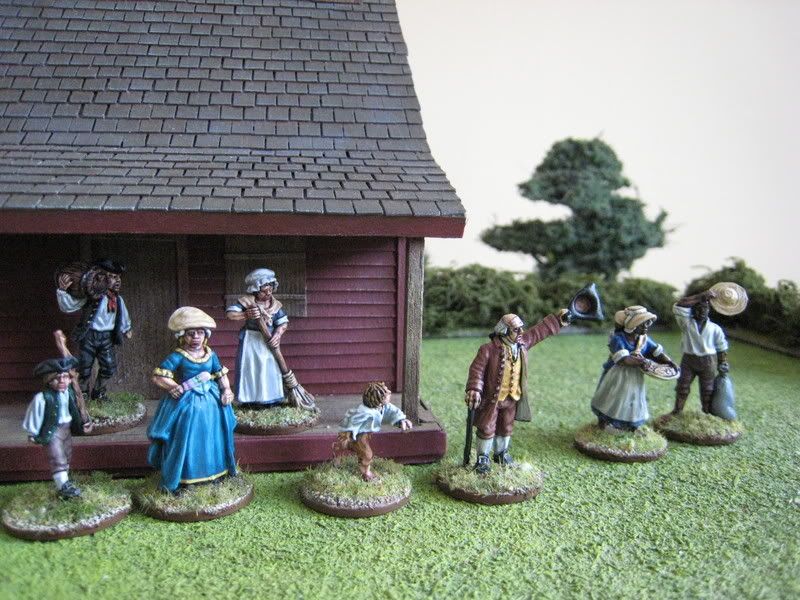
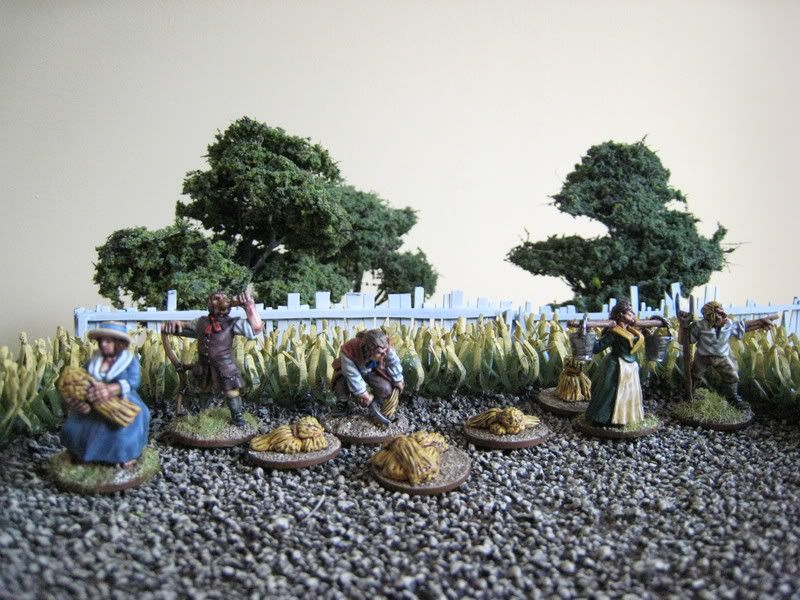
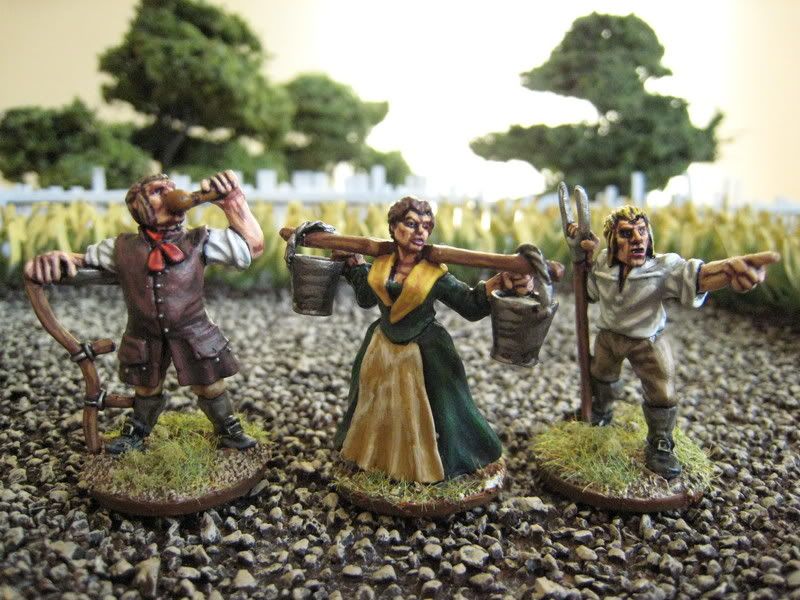
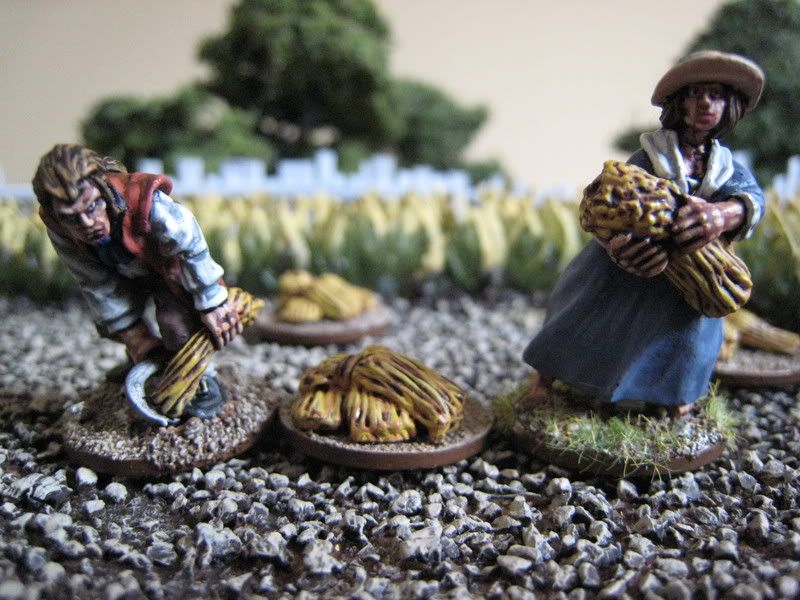
This is another pack of Foundry's 18th century civilians, namely farmers and country folk. For £10 you get five figures and four bushels of wheat, which may or may not be good value. I actually quite like these figures as they will probably be more useful than the urban gentry types I painted earlier. Most AWI battles involve a farm or two and I expect these figures will often be floating around the edges of the table. The wheat blobs are also quite handy for my Touching History wheat/corn fields, one of which the figures are standing in. The figures themselves possess the usual characteristics of this range - huge, oversized hands (look at the hands of the woman carrying the wheat - the right hand is actually bigger than her entire head) and large calves and bottoms. Another particular problem with this range, which I remarked on earlier, is that the metal is extremely strong and quite un-bendable. So when you have a figure like the woman in blue who is leaning forwards, it is impossible to bend the figure back upright. Maybe she's supposed to be a hunchback, but I'd rather she wasn't and it's annoying. I haven't yet acquired the Perry pack of civilians, so I don't know how all these Foundry figures compare specifically to them, but they are a fair bit larger than Perry figures generally.

Incidentally, Foundry are now offering 20% off everything on their website until 5 November, so you can buy this pack for £8; i.e. 50p cheaper than it was before the last round of price-hikes. That clearly makes it better value, although you'll need to buy lots of other stuff to escape being clobbered on postage! Having had a quick perusal of the 18th Century Civilians range, I quite like the look of the smugglers pack - three of the figures will do nicely for militia, whilst I can envisage the chap waving the lantern as someone peering through the mist at Germantown wondering what on earth all that noise is. I might have to buy that pack, if I can find another 9 packs that I want!

5 figures and several bushels of wheat. Painted October 2007.

Friday, 14 September 2007

Civilians (4)


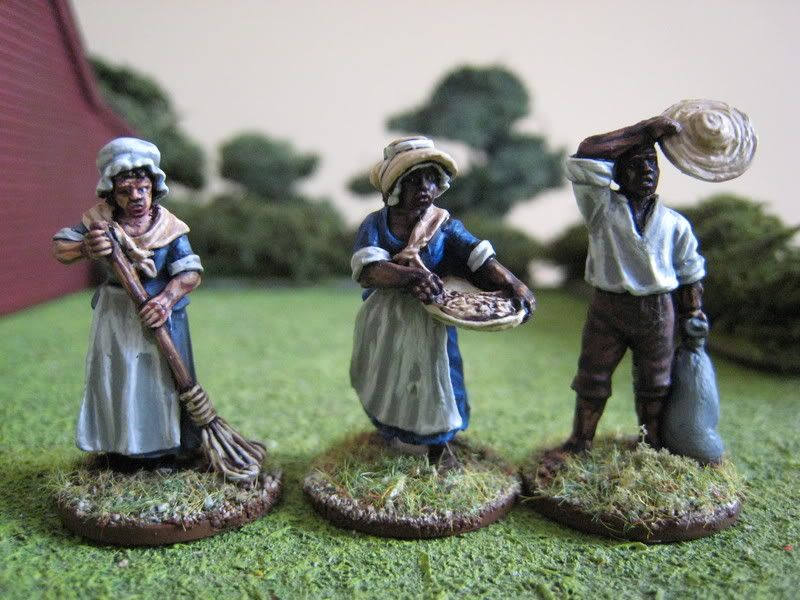
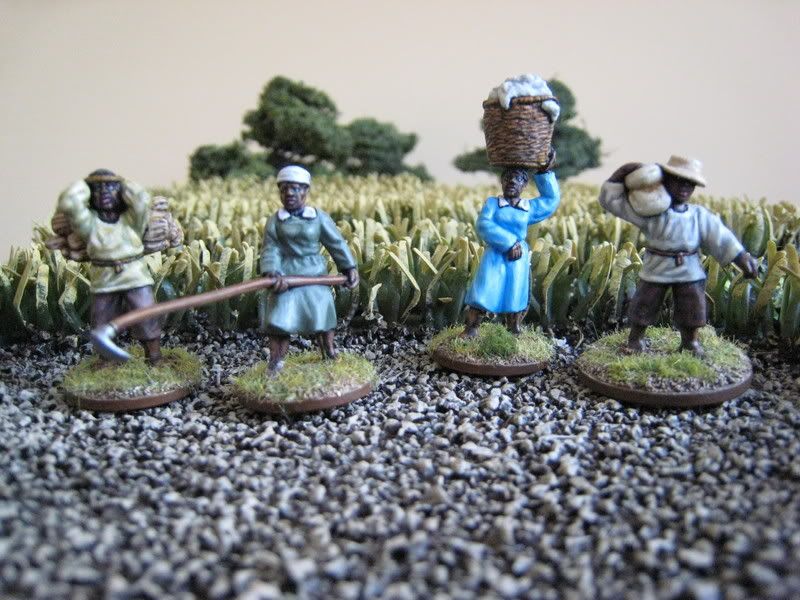
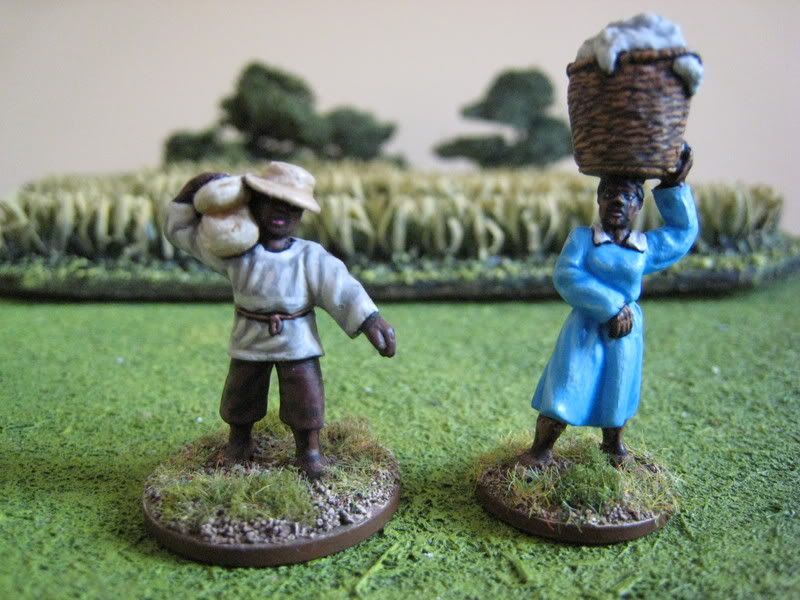
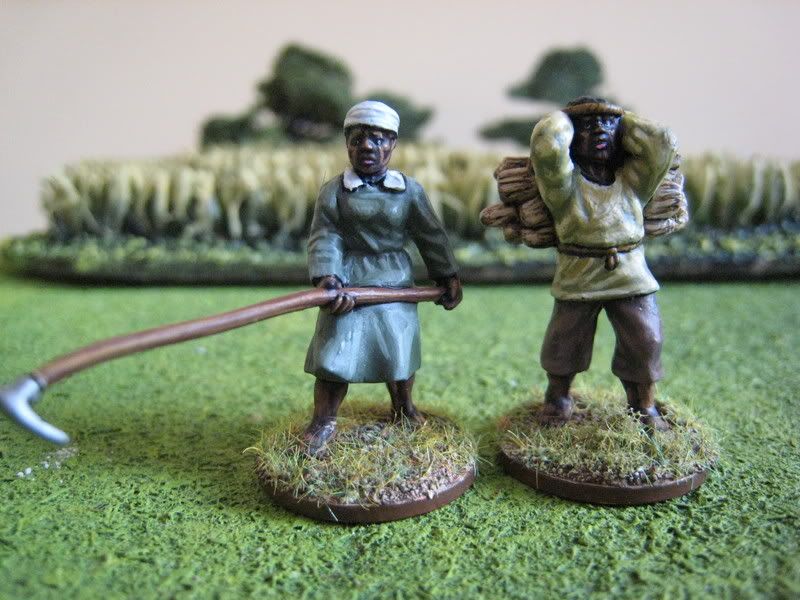
I'm not sure that "civilians" is the correct description of these figures; involuntary migrant workers perhaps? Anyway, they are taken from Eureka's 19th century Colonials range, where they are described as "plantation workers". I bought a pack at the time of my first purchase of Eureka's ragged Continentals a couple of years ago; I needed to buy a few more figures to qualify for free postage from Fighting 15s. They patiently sat in the leadpile until last Friday, when I suddenly decided to paint them. I see that there are a few more variants in the range - in total Eureka have 5 women and 4 men. When I turn my attention properly to the southern AWI theatre (the latter half of next year on current projections!), I may buy some of those other variants, although it looks like they come in random packs so you can't choose the exact figures you want. The dress of the men is a little bit odd. They seem to be wearing tunics fastened with a rope belt; I'd have thought a simple shirt would be more suitable no matter there they are supposed to be.

I'll add a couple of painting notes in respect of the chap carrying chopped wood. Whilst on painting autopilot I almost began painting the wood with my usual Foundry "Spearshaft" palette, but then realised that of course chopped wood looks very different to other wood - it is pale cream on the inside and then much darker on the outside. So I used various "Boneyard" and "Buff colours to create a freshly chopped look. Not quite so suitable is the colour of the figure's tunic, which was painted with Foundry's "Raw Linen" palette. I find this set very difficult to get right. The differences between the 3 shades are quite extreme (as opposed to some of the palettes where the differences are negligible, like "Stone" for example). "Raw Linen" works ok on small areas, and it is one of my standard set of colours for shoulder-bags, but is less effective on larger areas when used "straight out of the tin". I should have mixed some intermediate colours; to be honest these figures were painting in a bit of a rush. Still, 4 figures in one evening ain't bad! Negro flesh I paint using the Foundry "Dusky Flesh" palette on top of an undercoat of Coat D'Arms "Negro". I blend in the second and third Foundry colours as those are more paints where the variation in the tones is quite stark.

The scenery is once again a Touching History cornfield (with Realistic Modelling trees in the background). This time I have taken the central section of the cornfield out, to show what the ground underneath looks like.

4 figures. Painted September 2007.

Tuesday, 14 August 2007

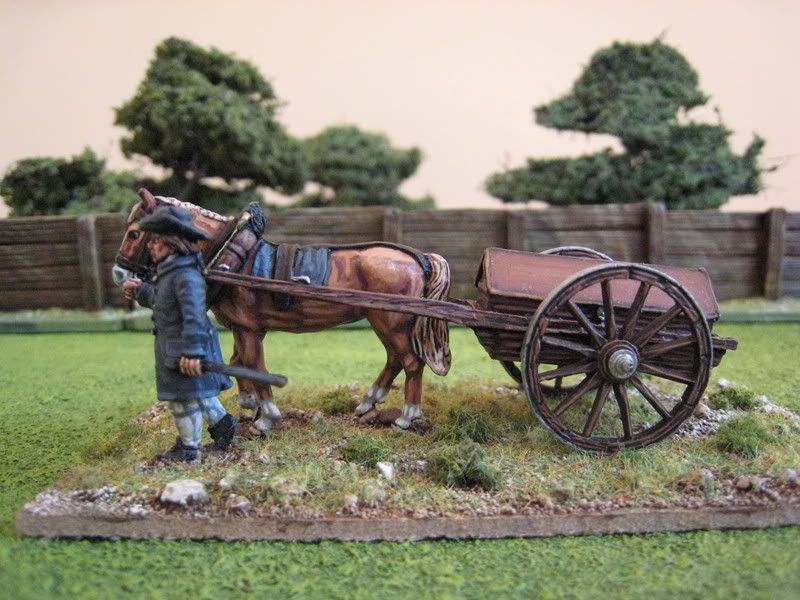
Artillery powder cart


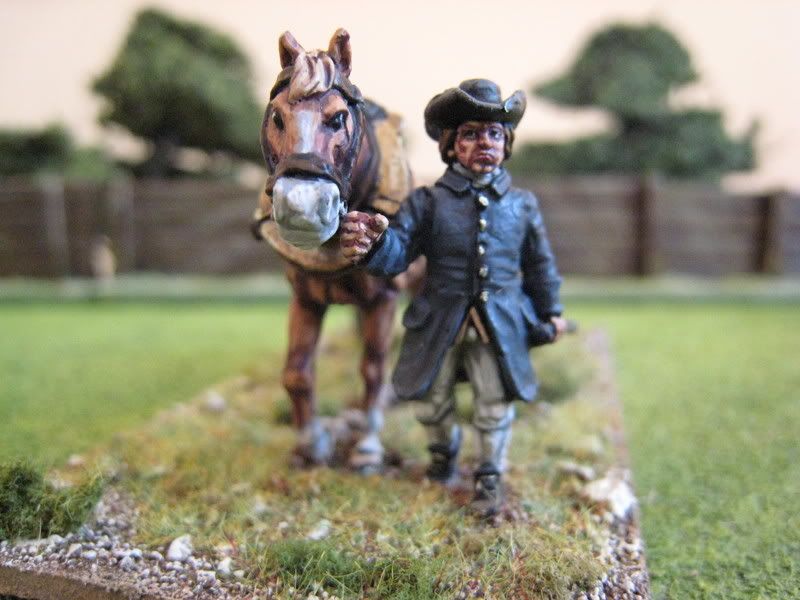
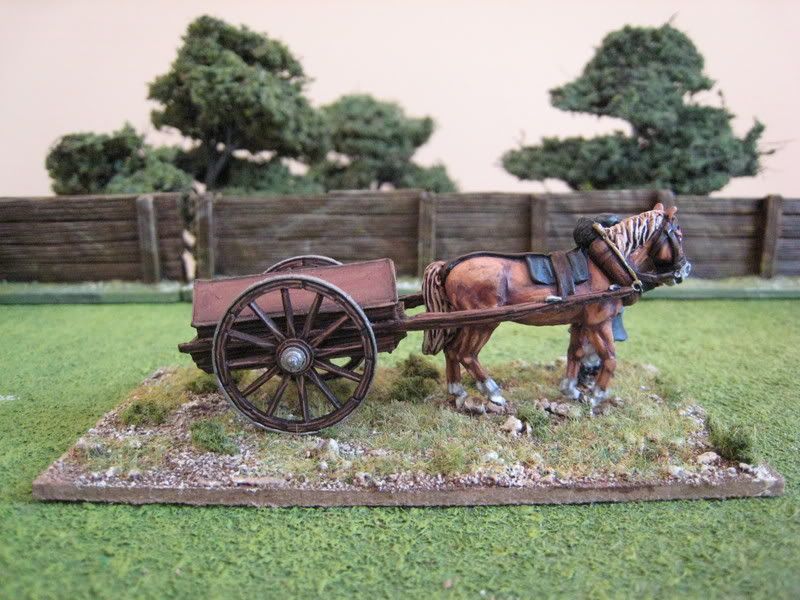
This is the latest pack to be released by Perry Miniatures. It is a powder cart that can be used for either side. I do not know if British wagons were painted blue-grey like the artillery pieces themselves, but I wanted this to be usable for both sides anyway (what's the military/wargaming term for "unisex"....?). The cart itself was painted with the 3-colour Foundry "Spearshaft" palette over a base coat of GW's "Scorched Brown" washed with dark brown ink. The wood grain effect is easy to do as it is largely sculpted into the metal. The horse was painted using the Foundry "Chestnut" palette over a base coat of Foundry "Bay Brown B"; white was added to "Chestnut C" for the final highlight (no dry-brushing was involved). The mane and tail were painted with the Foundry "Boneyard" palette and a couple of brown ink washes, with pure white then used on the bottom of the tail (if you look at pale coloured horses' tails you can see that the bottom of them is often quite a bit lighter than the top). This is a neat little set - with the earlier limber and ammunition cart it makes an effective artillery train.

Painted August 2007.

Wednesday, 23 May 2007

Civilians (3)


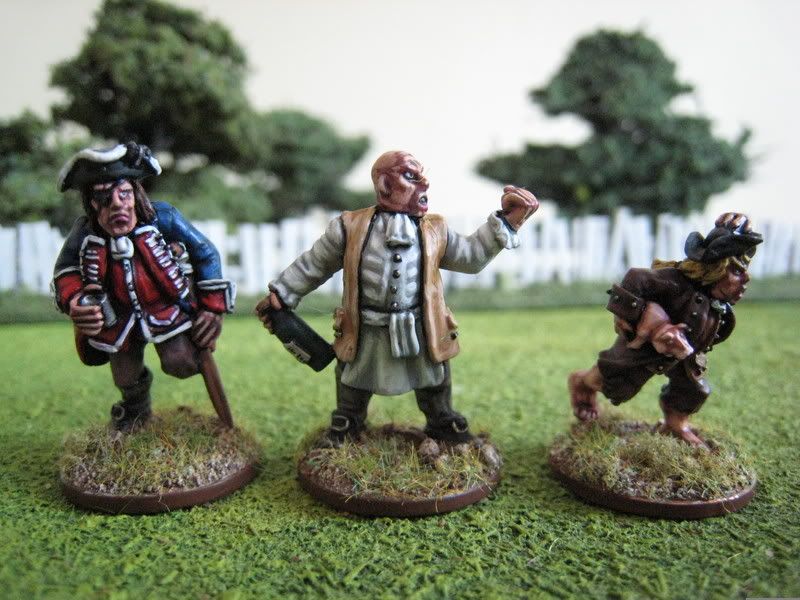
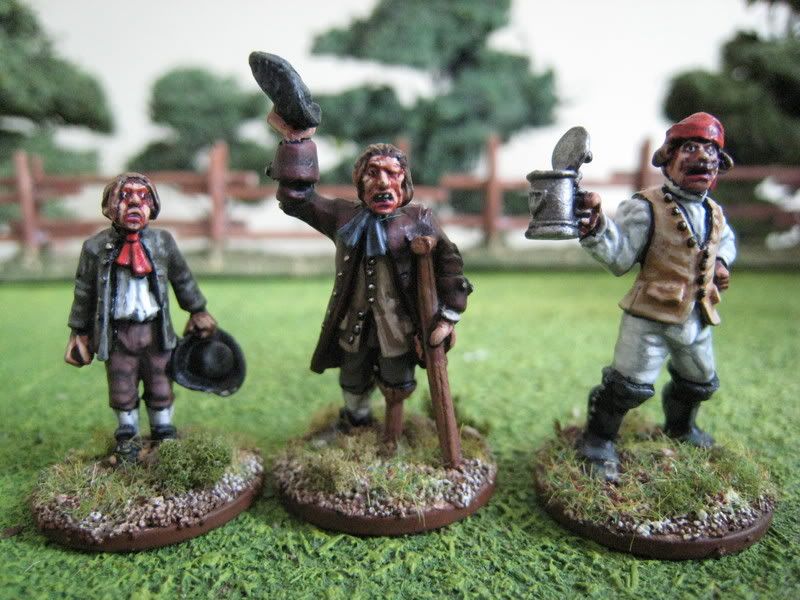
These are the figures from another un-released Foundry pack, "Townsfolk" or "CIV6". These are again Rob Baker sculpts and exhibit his sculpting tics - large hands, calves and bottoms, and fingers the length of rolling pins. I think the best figure is the woman, although her backside is even bigger than J-Lo's. I also have no idea what she's supposed to be carrying. The uniform of the crippled soldiers is that of the Albany Militia Regiment, c.1745-63, which I found in Osprey's "Colonial American Troops (2). I did some quick and dirty internet research on the breed of pigs that might have existed in 1770s New York, but I won't bore you with it and in the end just went for an average "pink" pig. I quite like the scene of the kid running away from the pig's lawful owner, although I'm not sure why the butcher/shopkeeper is carrying a bottle of wine; a meat cleaver or ham joint would seem more appropriate.


Painting the running kid made me think that £10 for a pack containing 5 adults and 1 child was pretty poor measure even by Foundry standards - the Perries will usually throw in a kid or two "free" with their civilians packs, which cost less in any event. Then again, the sculpts are so huge that the Foundry pack probably contains more metal. The figures vary in height. The irate shopkeeper and old soldier are 28mm from head to toe whilst the other adults are easily 30mm tall (just to the top of the head, not even to the top of the tricornes). The woman measures 32mm to the top of her hat. Another difficulty with these new Foundry figures is that the metal is very hard and quite un-bendable. That creates problems because I've noticed that quite a few of the figures lean forwards and ideally you would want to bend them back a bit; examples here are the shopkeeper and town crier. Nevertheless, these figures do have a certain charm and "character" and at least the quality of this range is consistent...


6 figures. Painted May 2007.

Wednesday, 9 May 2007

Civilians (2)


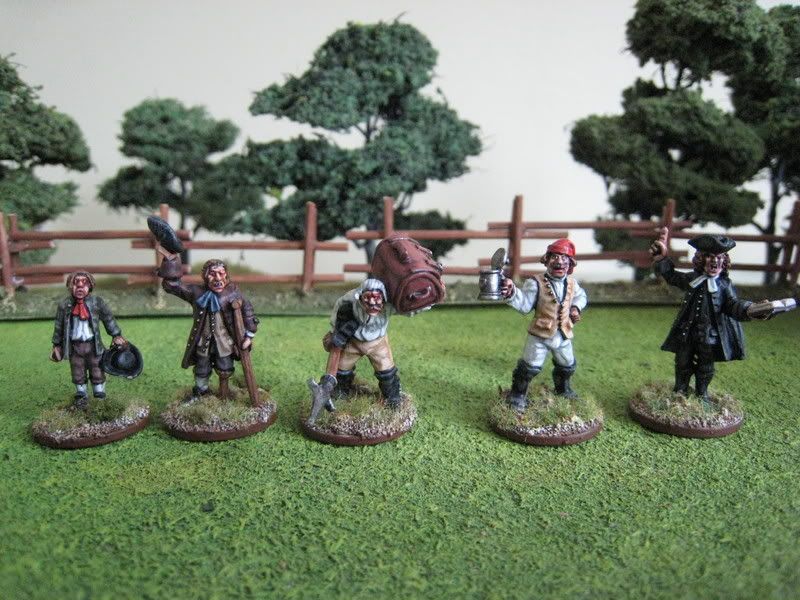
Whilst I finish off the next pack of newish Foundry civilians, I thought it might be instructive to compare the Duellists below with some of the older Foundry Seven Years War figures, one of which I only finished off painting last month. These 5 sculpts are by Mark Copplestone and are from the Prussian part of the SYW range. They (or at least some of them) were originally released some 10 years ago as part of the original Guernsey Foundry SYW range. In those days the figures were sold separately, which is how I acquired the preacher. Now these figures can be found in two packs. All save the preacher come from the "Prussian Vignette" pack (which includes two Prussian officers which feature on my Hessian generals stands). The preacher can be found in the "Camp Followers" pack (which includes 3 cantinieres, an army policeman and a femme fatale).

Compared to the new Rob Baker sculpts, these figures are far better proportioned and more "25mm", although the hands are still on the large side (just look at the size of that raised fore-finger!). But I like these sculpts a lot, particularly the preacher and the oppressed Hessian servant. Incidentally, I see that these close-up shots show the danger of not giving a finished figure a final check to ensure any excessive black-lining is corrected. The Hessian servant in particular has suffered from over-zealous black-lining and as soon as I saw this picture on my screen I went and tidied him up! Painted April 2007 (the preacher) and August 2005 (all the others).