Showing posts with label Brunswickers. Show all posts

Wednesday, 5 March 2008

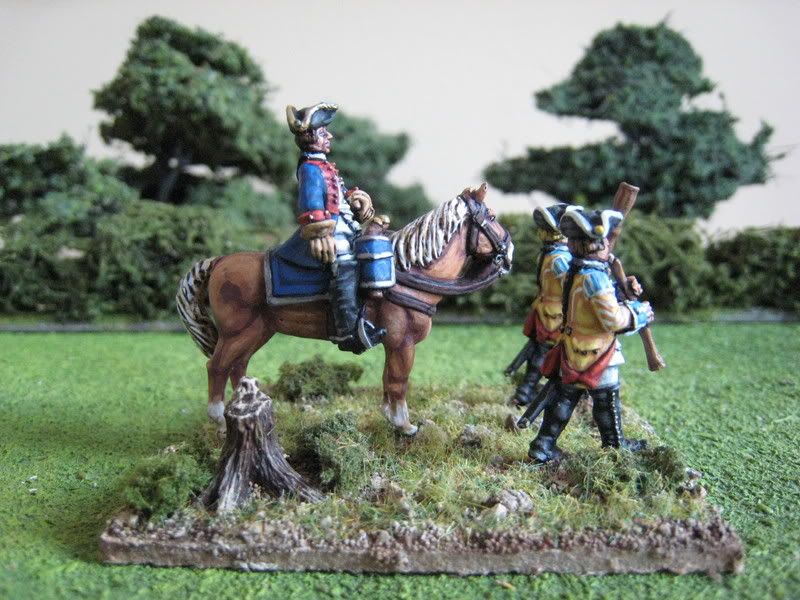
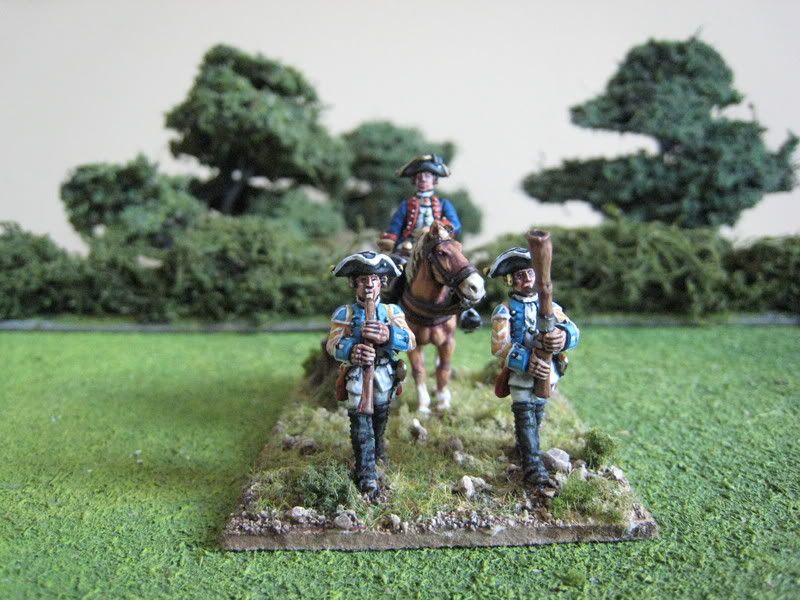
Lieutenant Colonel Heinrich von Breymann


Von Breymann was one of the Brunswick officers who was employed in Burgoyne's Saratoga campaign. He was the colonel of a Brunswicker combined grenadier battalion and commanded the Advance Corps, which consisted of a detachment of Hesse-Hanau artillery, Barner's light battalion, a company of jaegers and Breymann's own grenadiers. Brunswick was in fact the first German state to sign a treaty with Britain for the supply of troops (4,300 men in total). Breymann didn't fare well in the campaign. He was wounded at Bennington, where in command of the relief force Breymann failed to arrive in time to save a foraging expedition (and was criticised by Burgoyne for contributing to that disaster by marching too slowly). Breymann was then killed at Bemis Heights in the redoubt that was named after him, possibly shot by "friendly fire".


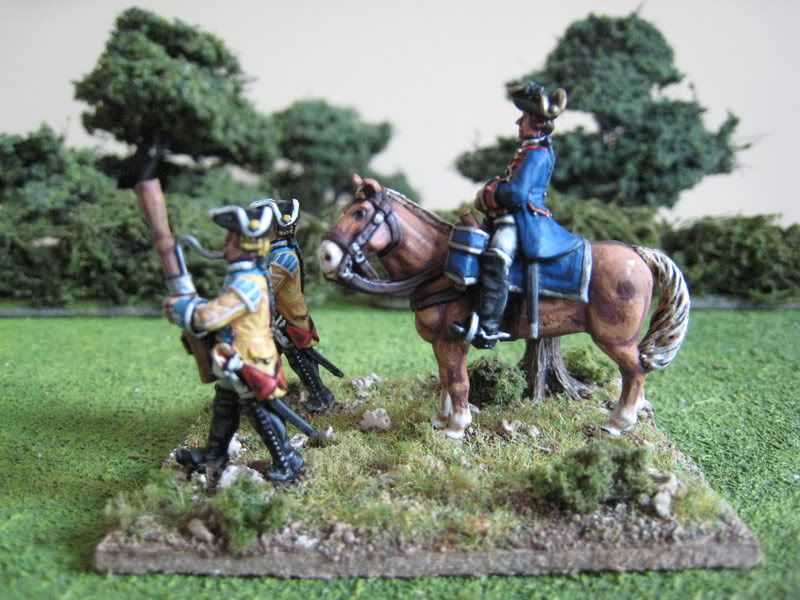
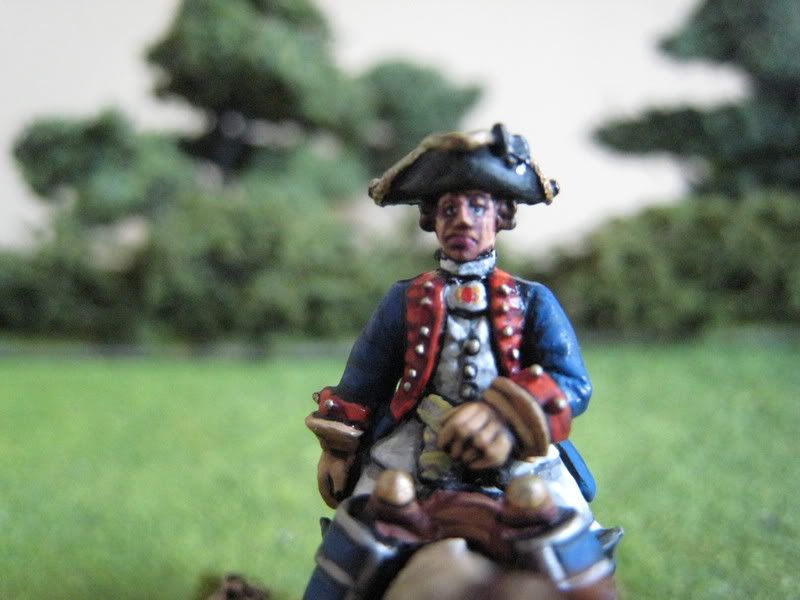
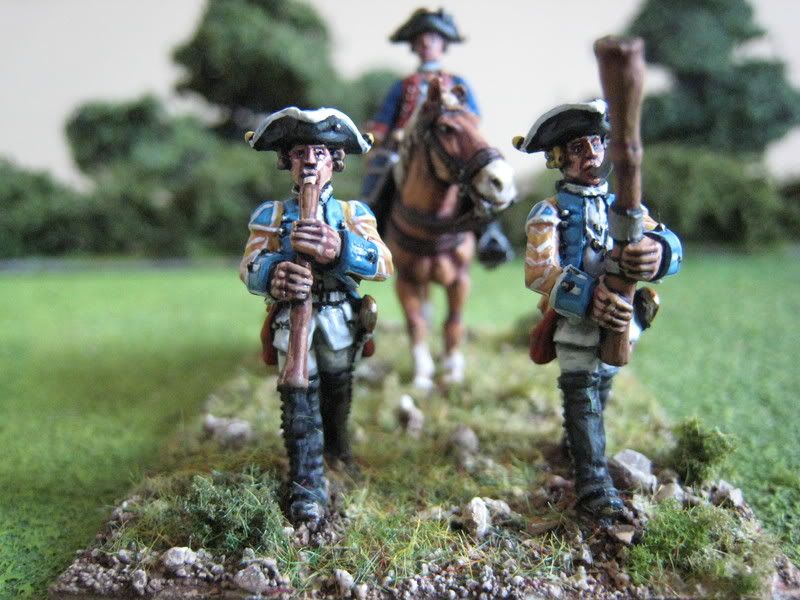
These figures are from Eureka's Seven Years War Saxons range. This range is more suitable as Brunswickers than Perry Hessian figures (for example) because of the larger cuffs and the arrangement of the buttons on those cuffs. Mollo also has the Brunswick toops in black gaiters, which most Perry figures do not wear. These Eureka sculpts are a bit smaller than Perry/Foundry figures but not excessively so; grouped together they look fine. Although I have no doubt that in real life Burgoyne's army would not have ferried bassoons and oboes around the Hudson Valley, I reckoned that a colonel who had been criticised for taking his time on the march would be the kind of person who would enjoy having his own band. We know next to nothing about Breymann and this vignette probably does him a great disservice, but it looks neat and these Eureka musicians are really quite diverting sculpts. The yellow and sky-blue uniforms were particular to Brunswick musicians and deserve plenty of tabletop exposure. Modern oboes and bassoons come in all kinds of shades of brown and black, but I painted these in standard natural wood on the basis that this is probably authentic for the late 18th century.


Painted February 2008. Tree stump from Front Rank.


Monday, 19 February 2007

Major-General Friedrich Riedesel


Friedrich Adolf Riedesel (1738-1800) was the commander of the Brunswick contingent, troops which like those of Hesse-Cassell were hired out to King George by his fellow monarchs in Germany. Riedesel joined the army when aged 17 (much to the displeasure of his parents, apparently) and saw action in the Seven Years' War. He was swiftly promoted and by the mid-1760s Riedesel was the adjutant to Duke Ferdinand of Brunswick. Duke Charles sent a corps of troops to America in 1776, initially of 4,000 infantry and about 350 dragoons, and Riedesel was placed in command. The Brunswickers were stationed in Quebec and then took part in General Burgoyne's ill-fated Saratoga campaign. The troops that survived the campaign entered captivity when Burgoyne surrendered his army in October 1777. Riedesel's wife Caroline and children had accompanied him on the expedition. They were released by the Americans in 1781.

2,431 Brunswickers are recorded as having surrendered at Saratoga, and the number of killed, wounded, captured or missing was recorded as 1,122. The troops fared badly in captivity, being put to work for their food and clothing and then being marched down to Virginia during the winter of 1778/79. Many Brunswickers elected to remain in America and so deserted. Of 5,723 total men who came over to America during the war only 2,708 returned, of whom fewer than 500 were from Riedesel's Saratoga force.

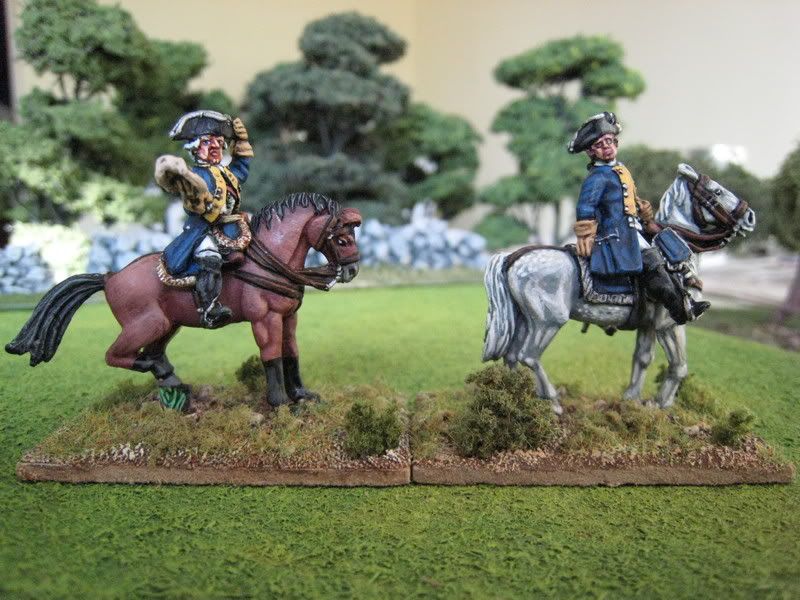
I have two Riedesels in my collection, from the Old Glory (left) and Perry (right) ranges. The Old Glory sculpt is from their "Foreign Generals" pack, which also includes Steuben, Knyphausen, Lafayette and a couple of French generals. I find Old Glory's AWI range a bit of a mixed bag. This sculpt is ok, although the horse looks as if it's scratching itself in the way dogs do (which horses don't). However, I do like the pose of Riedesel himself; he looks as if he's completely lost in the back woods of the Hudson River valley. The Perry sculpt is much finer; Riedesel looks younger and more dynamic than his Old Glory counterpart, which is more accurate given that he was not yet 40 when captured in 1777 (although he still seems to have that "what on earth am I doing here?" look about him). I thought the horse's saddle furniture looked odd when I painted it and I discovered last week that this horse is largely the same sculpt as Napoleon's horse from the "Napoleon's personal staff" set in the 1815 French range! Both figures sport the yellow facings of the Musketeer Regiment von Reidesel. The uniform is basically the same as that worn by Hessian generals, except that the silver sash has a yellow weave instead of red. Painted May 2006 (Old Glory) and January 2007 (Perry).