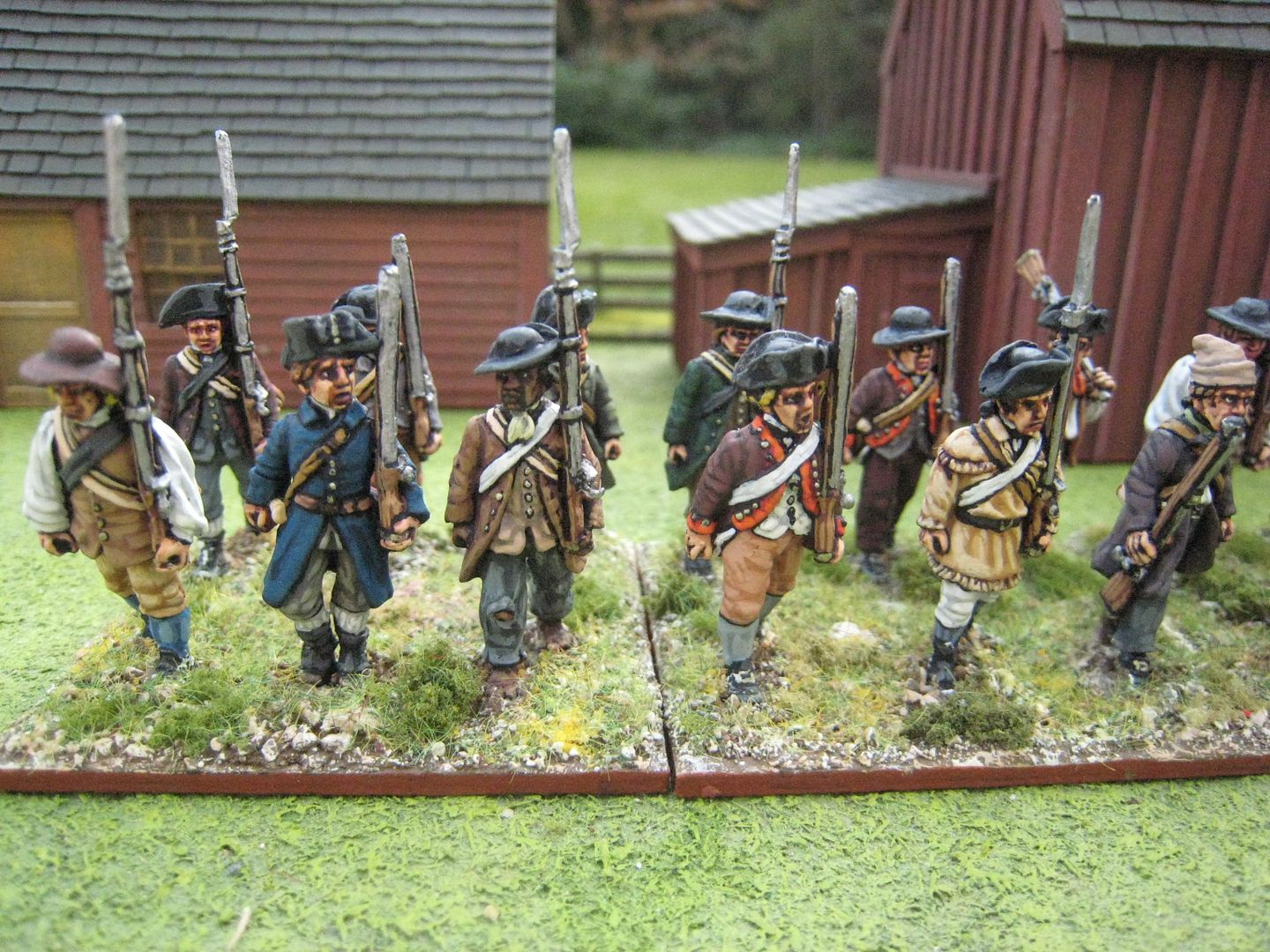
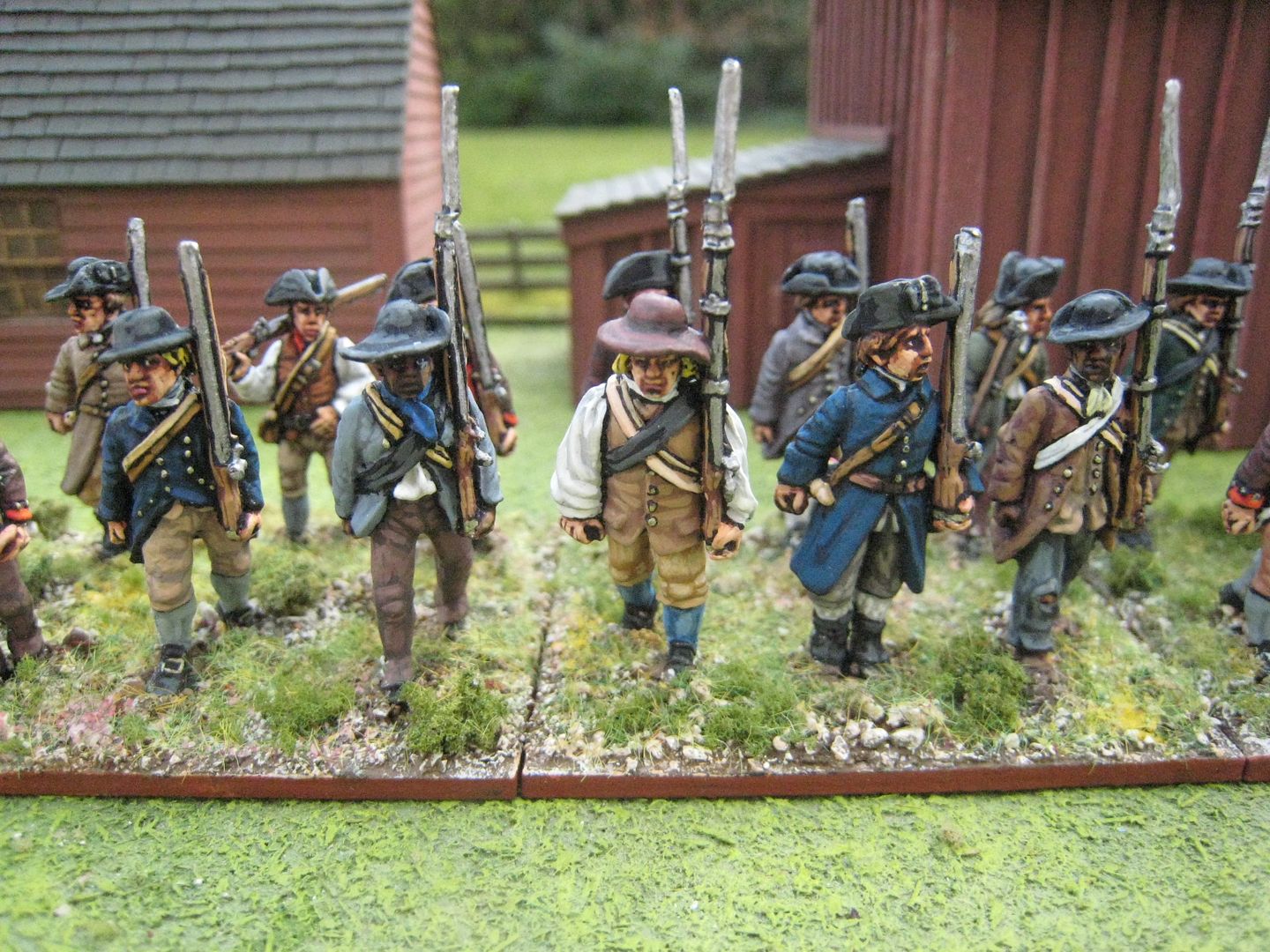
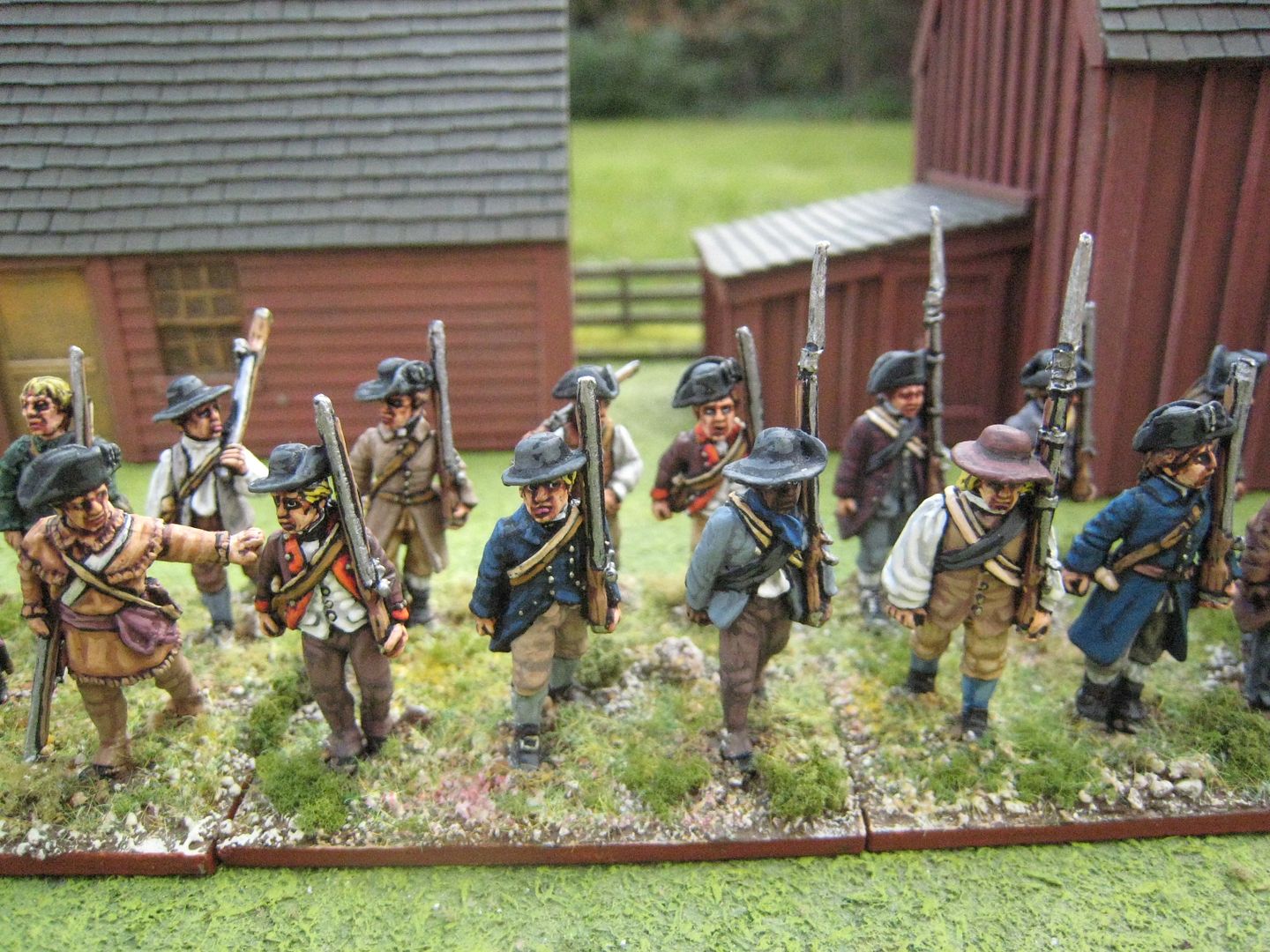
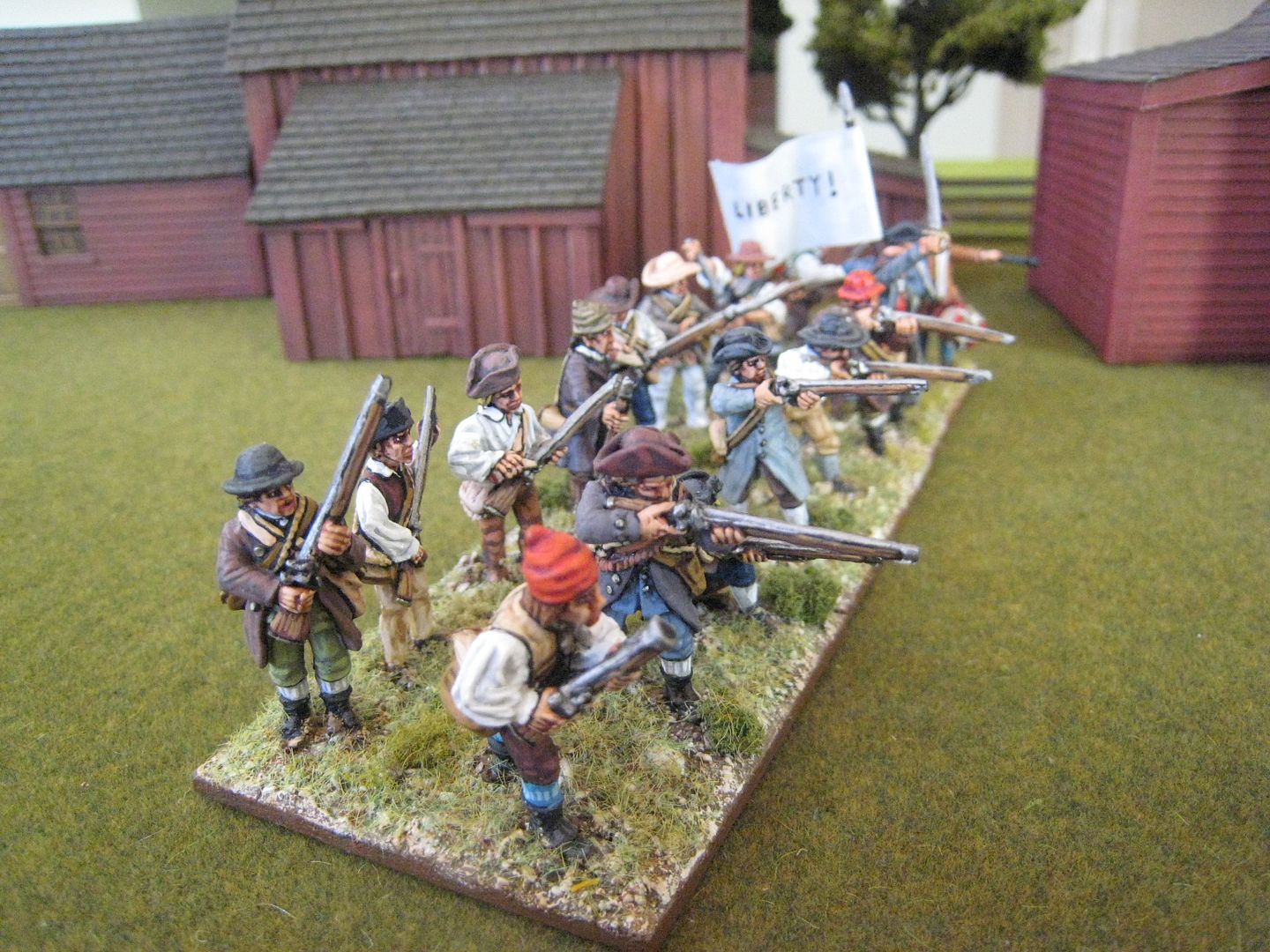
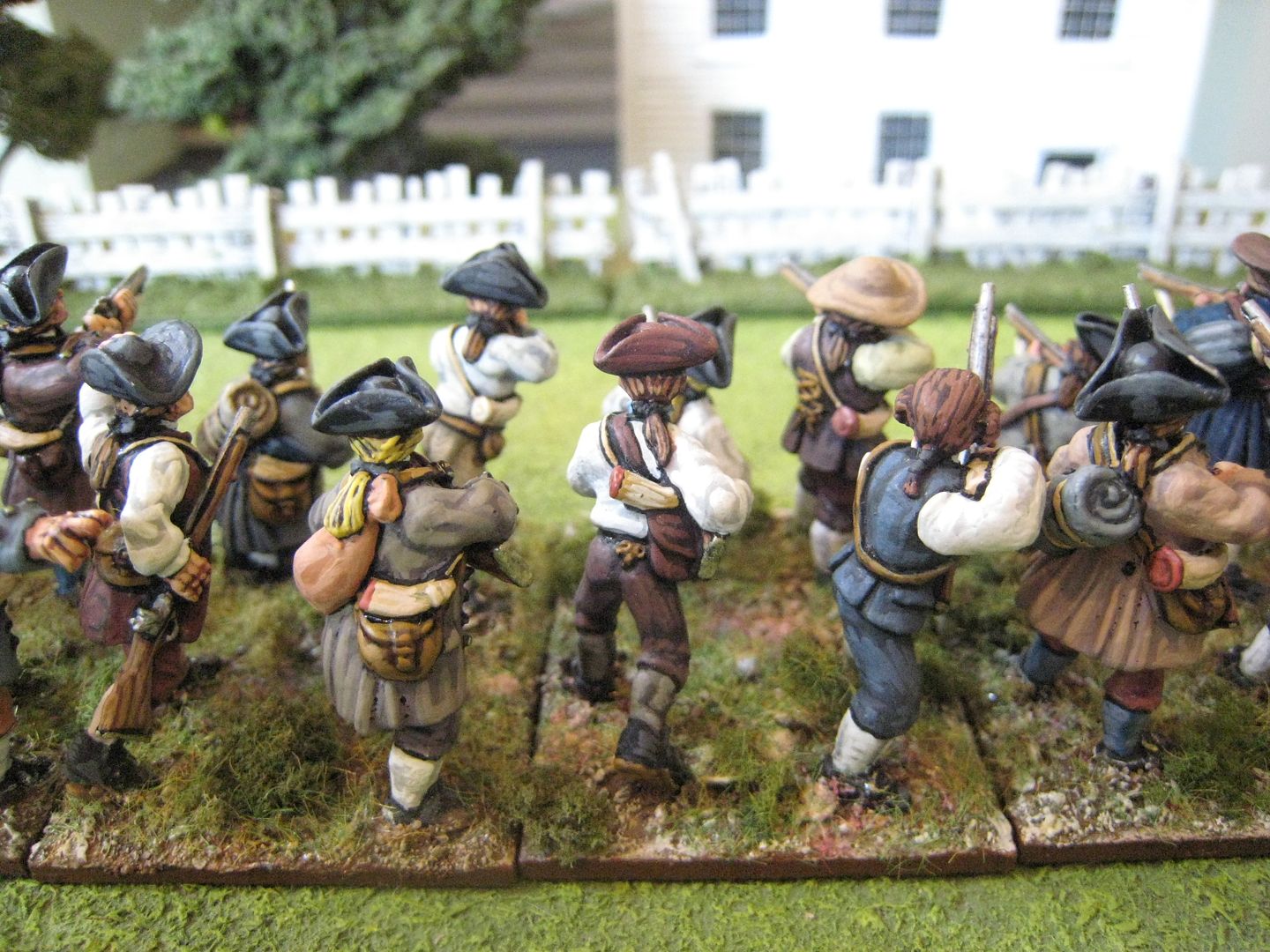
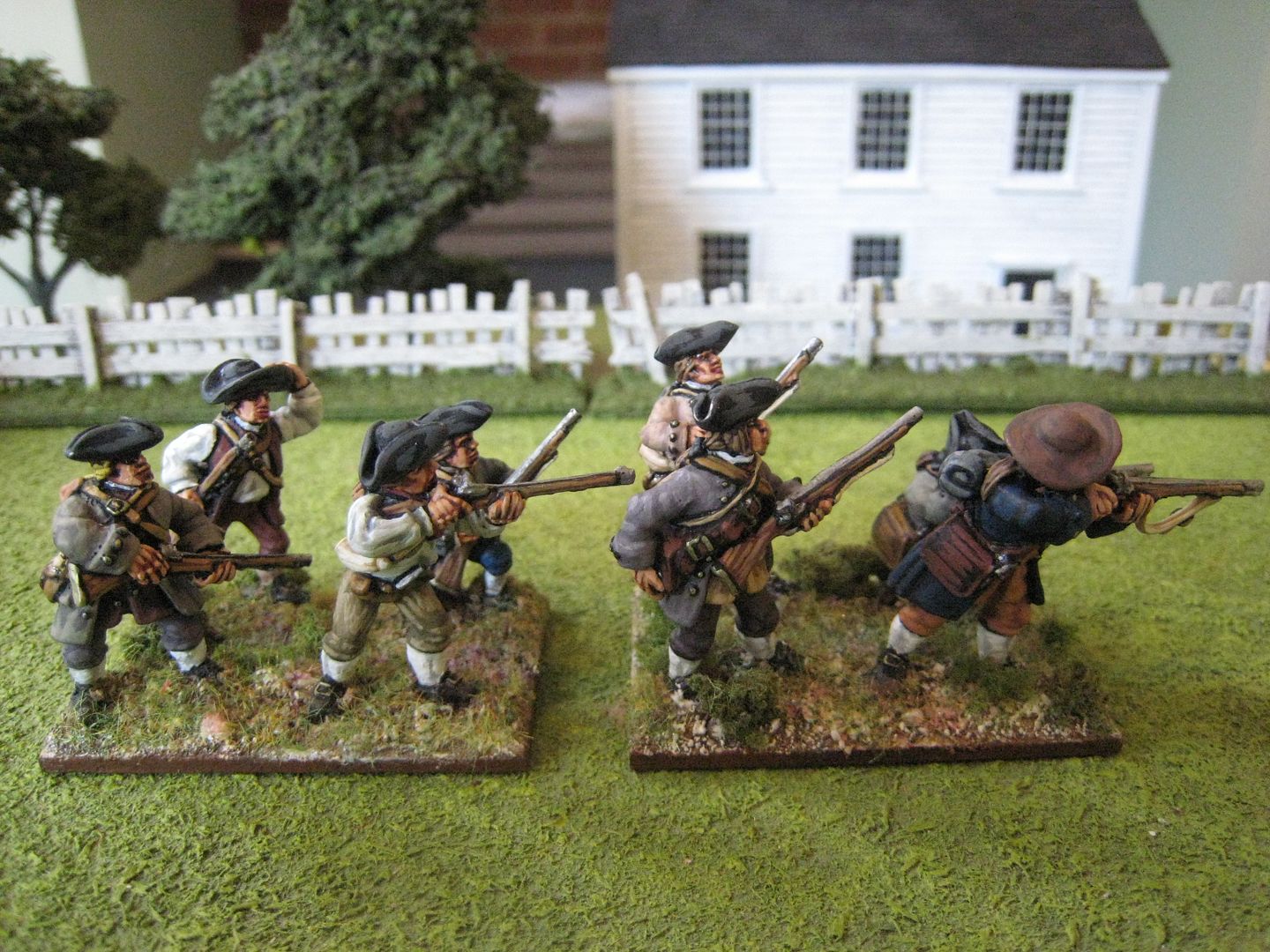
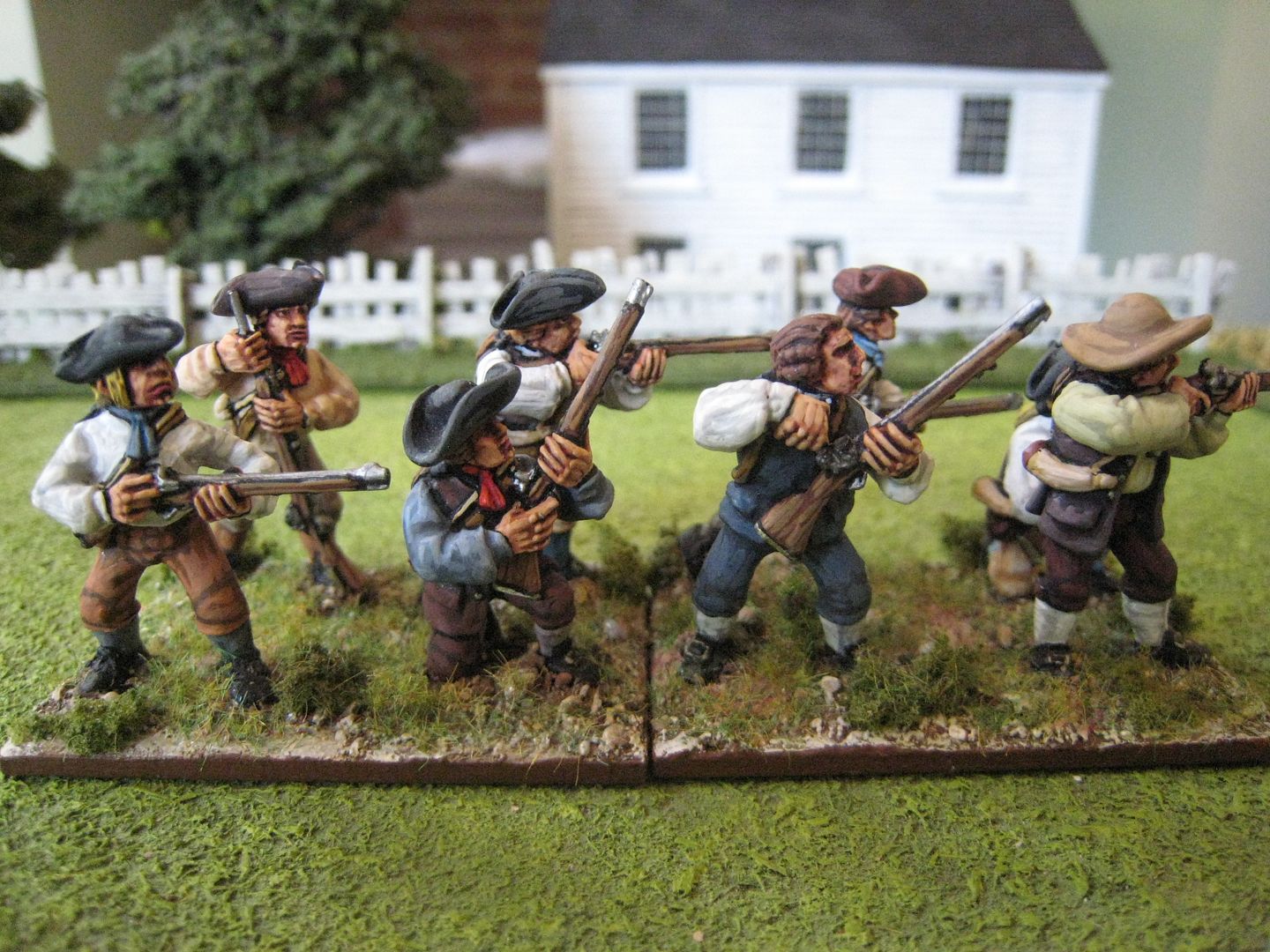
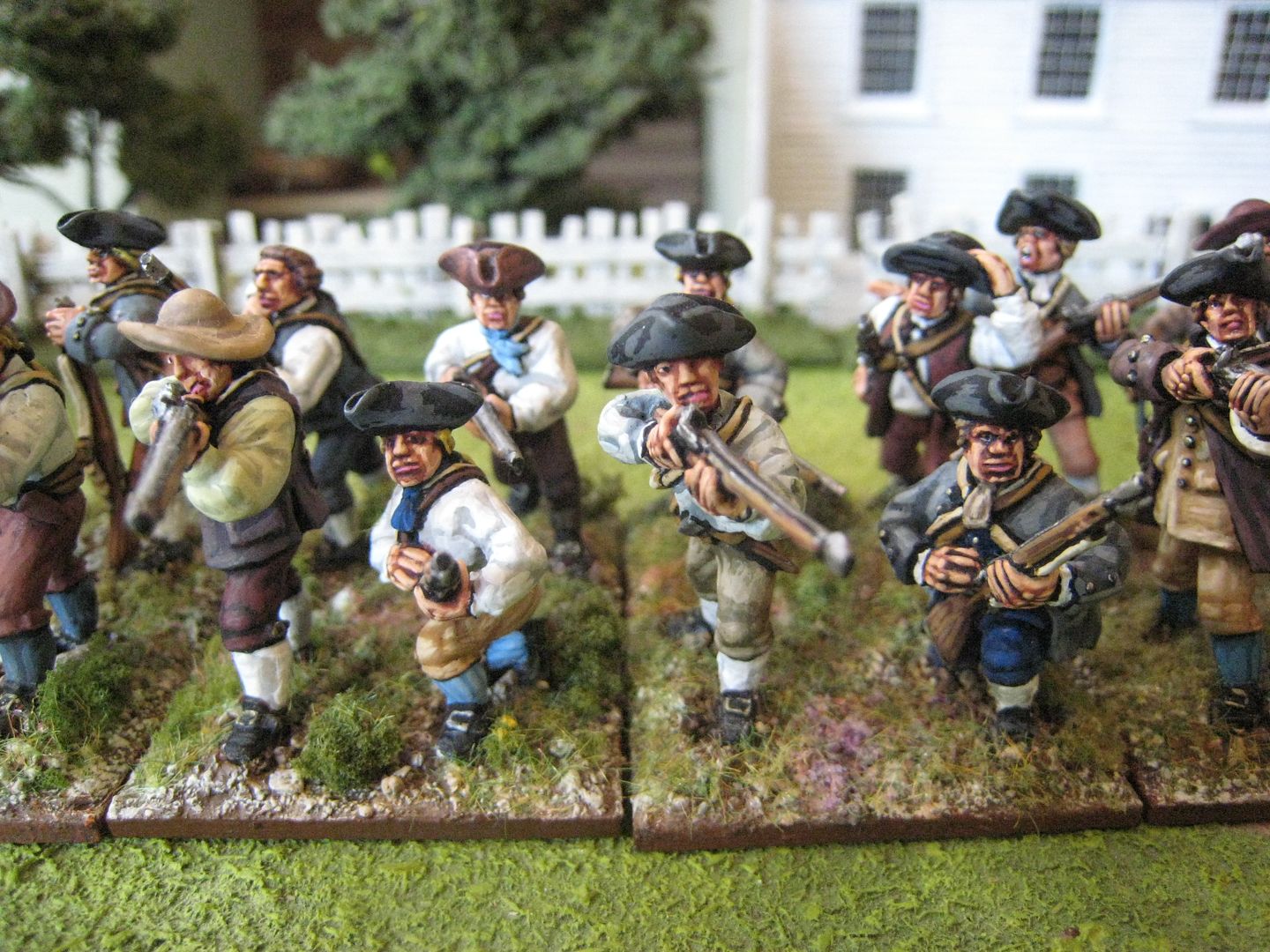
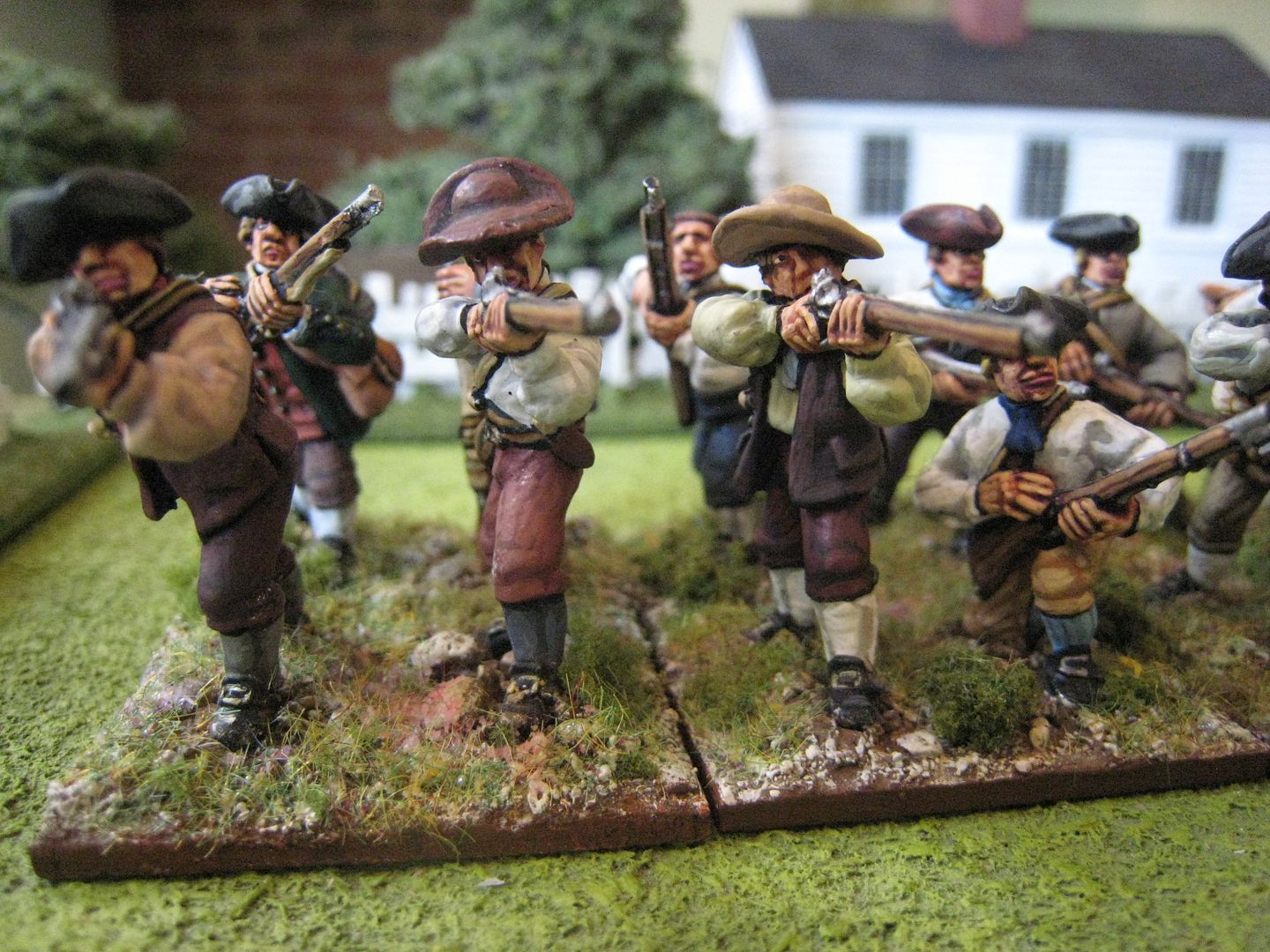
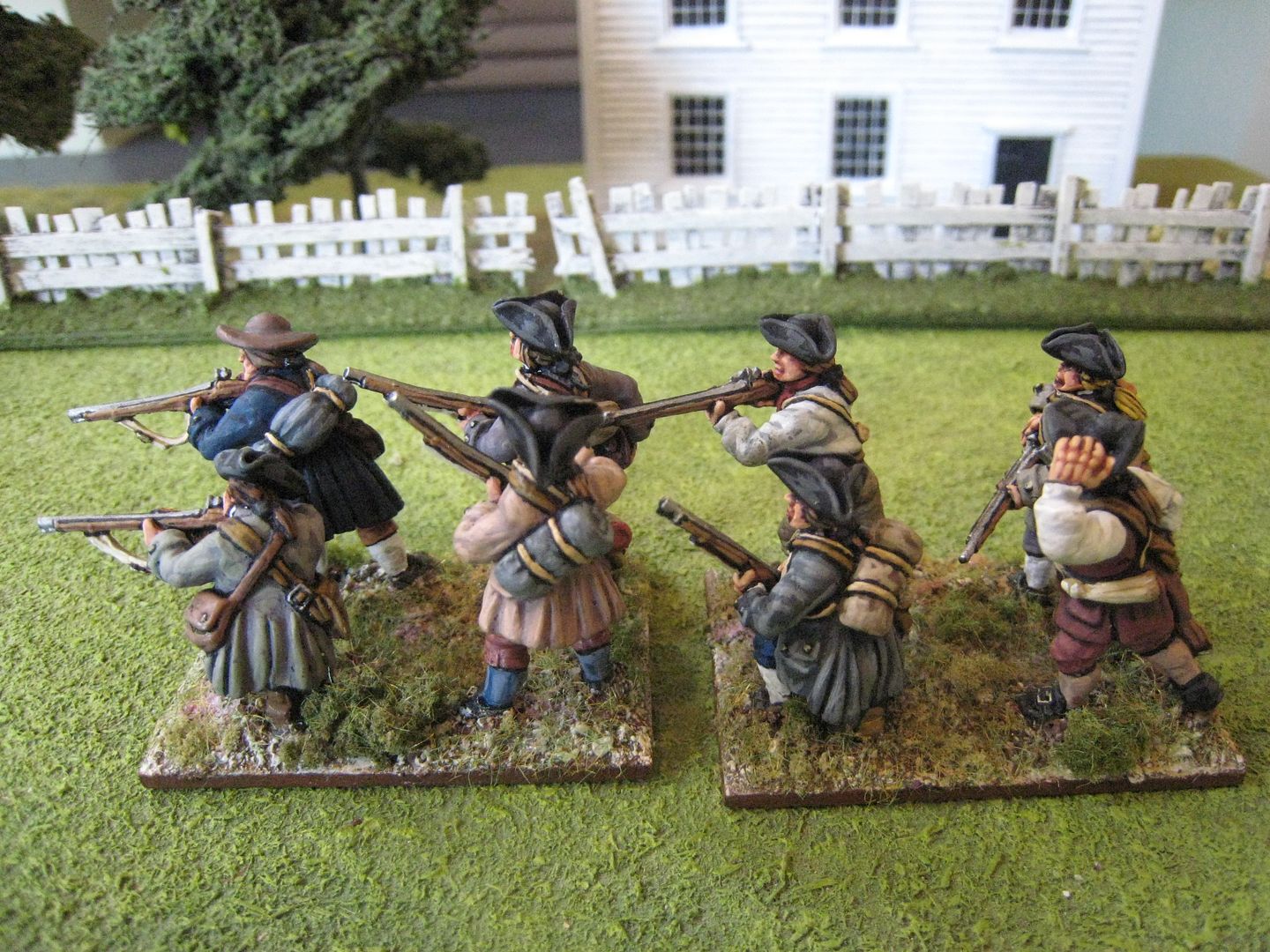
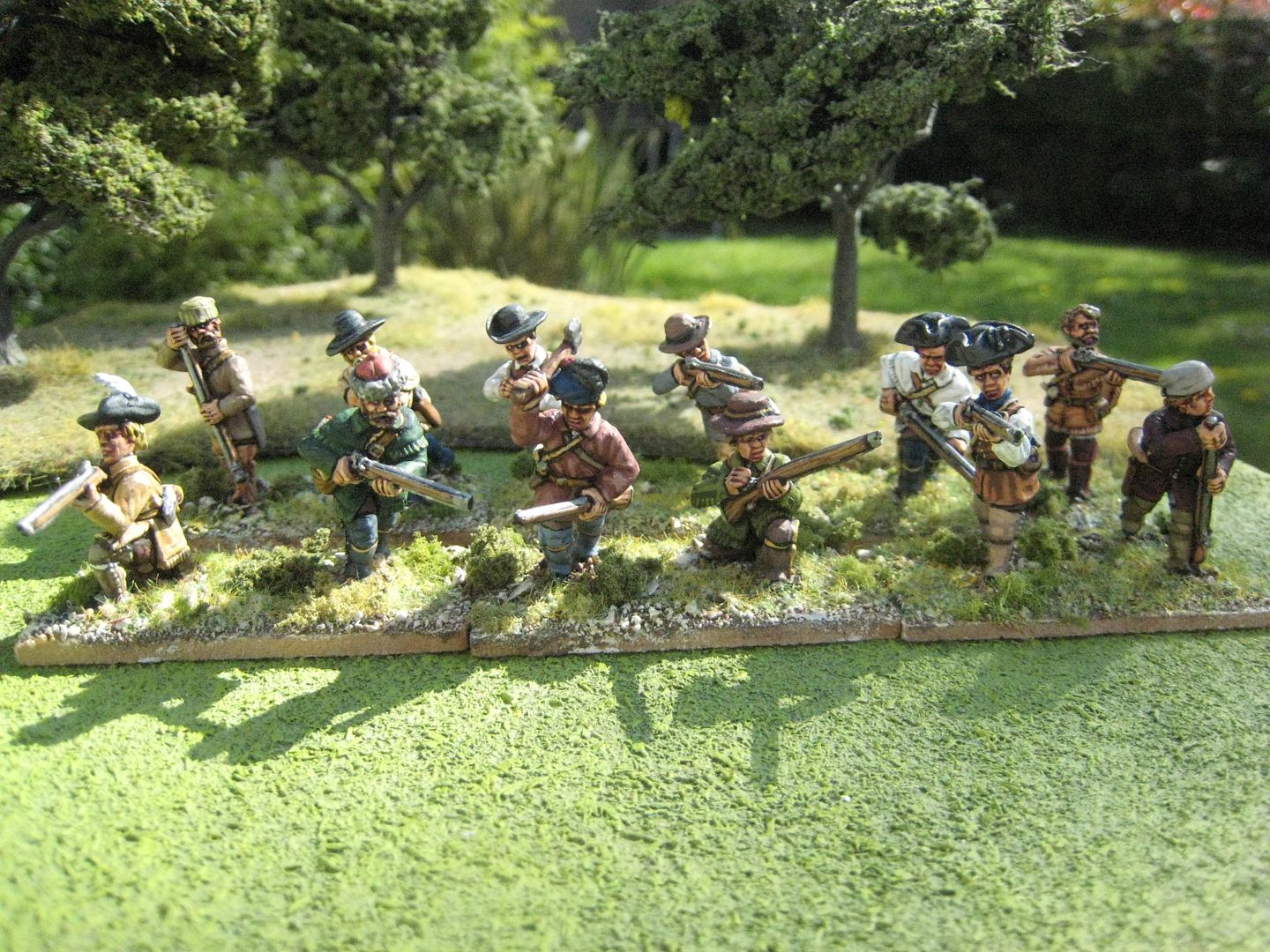
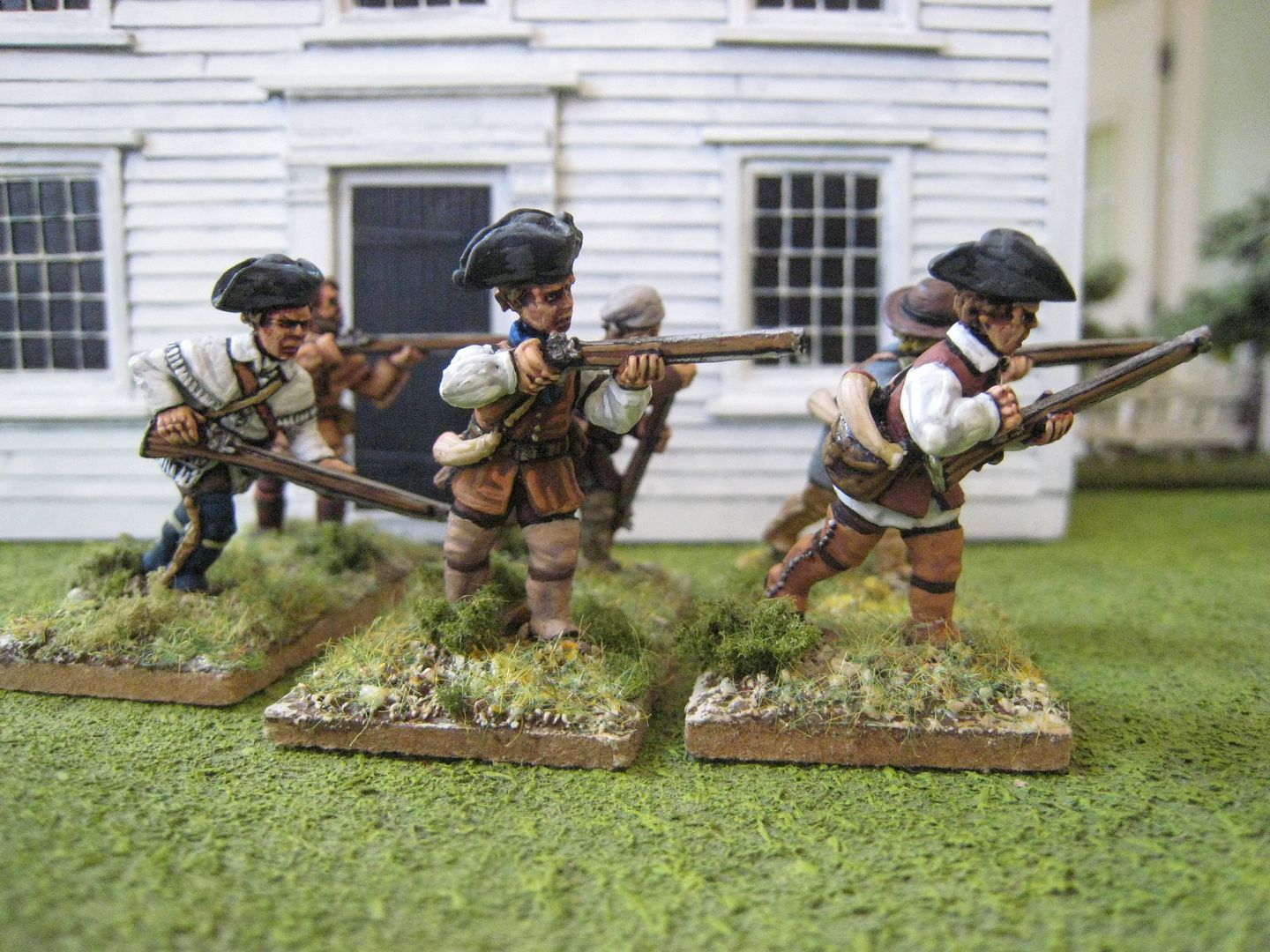
6 figures. Painted June - August 2017.
Showing posts with label Militia. Show all posts
Tuesday, 12 September 2017
Militia cavalry
6 figures. Painted June - August 2017.
Sunday, 20 November 2016
American riflemen (4)
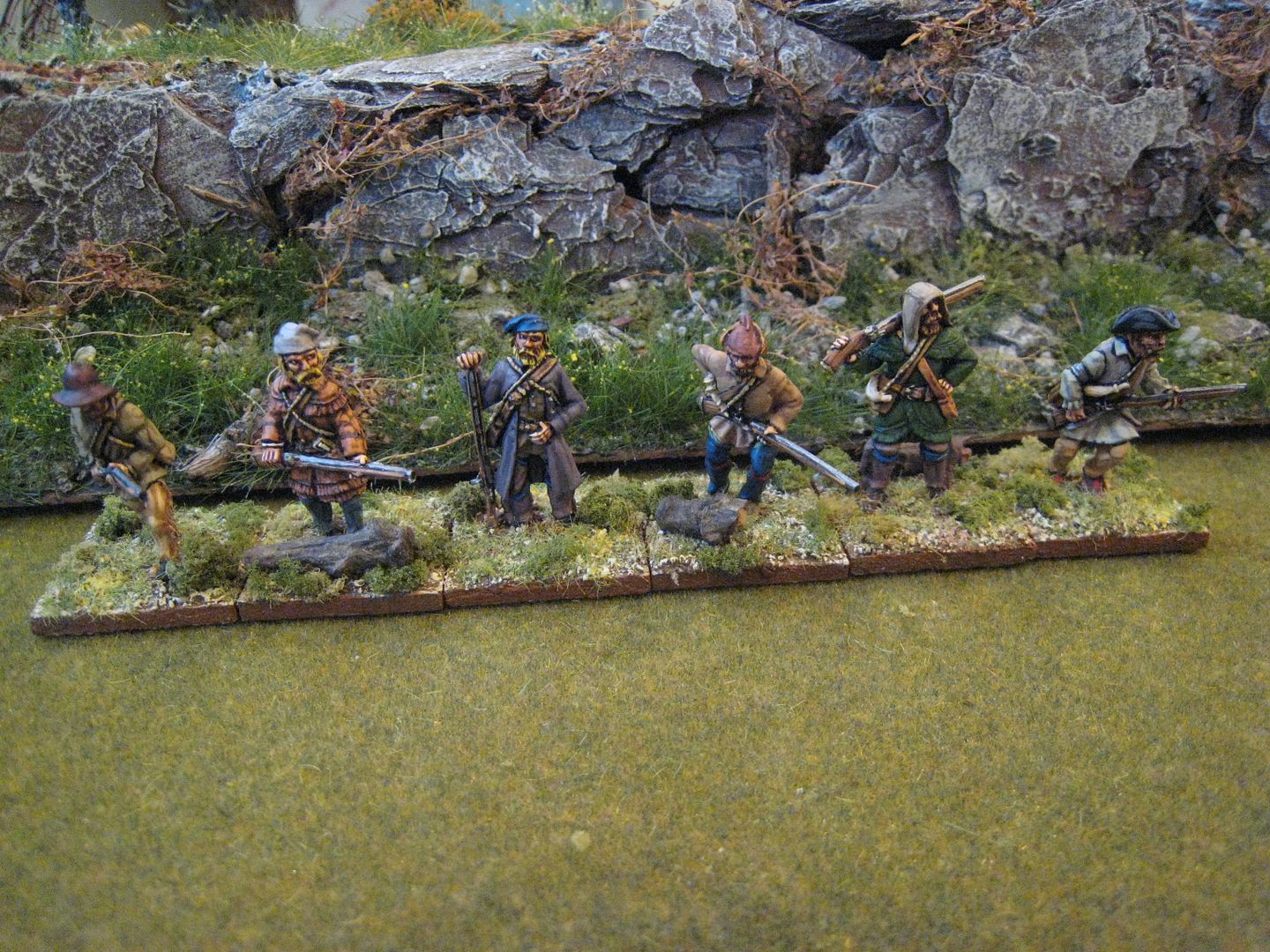
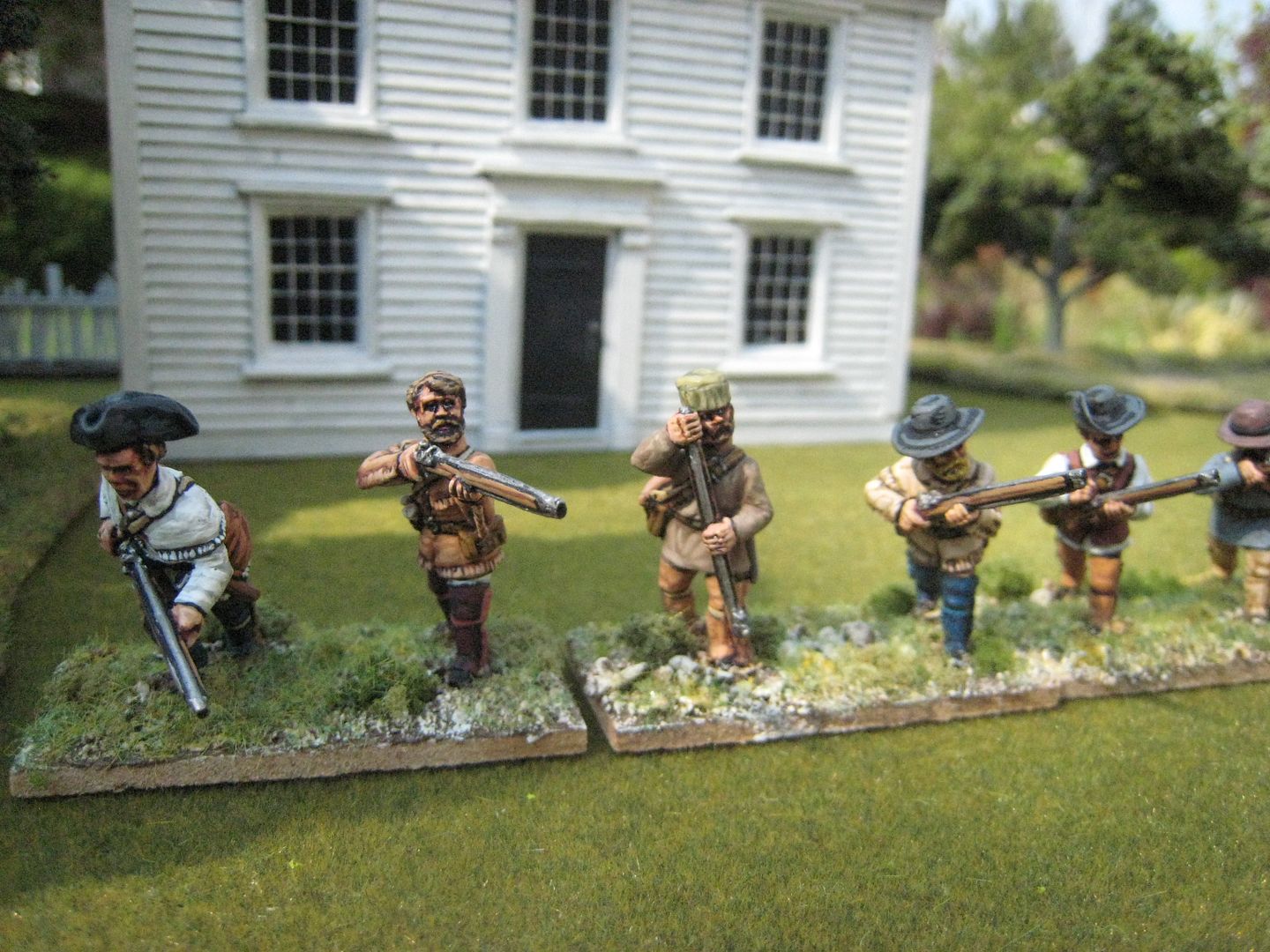
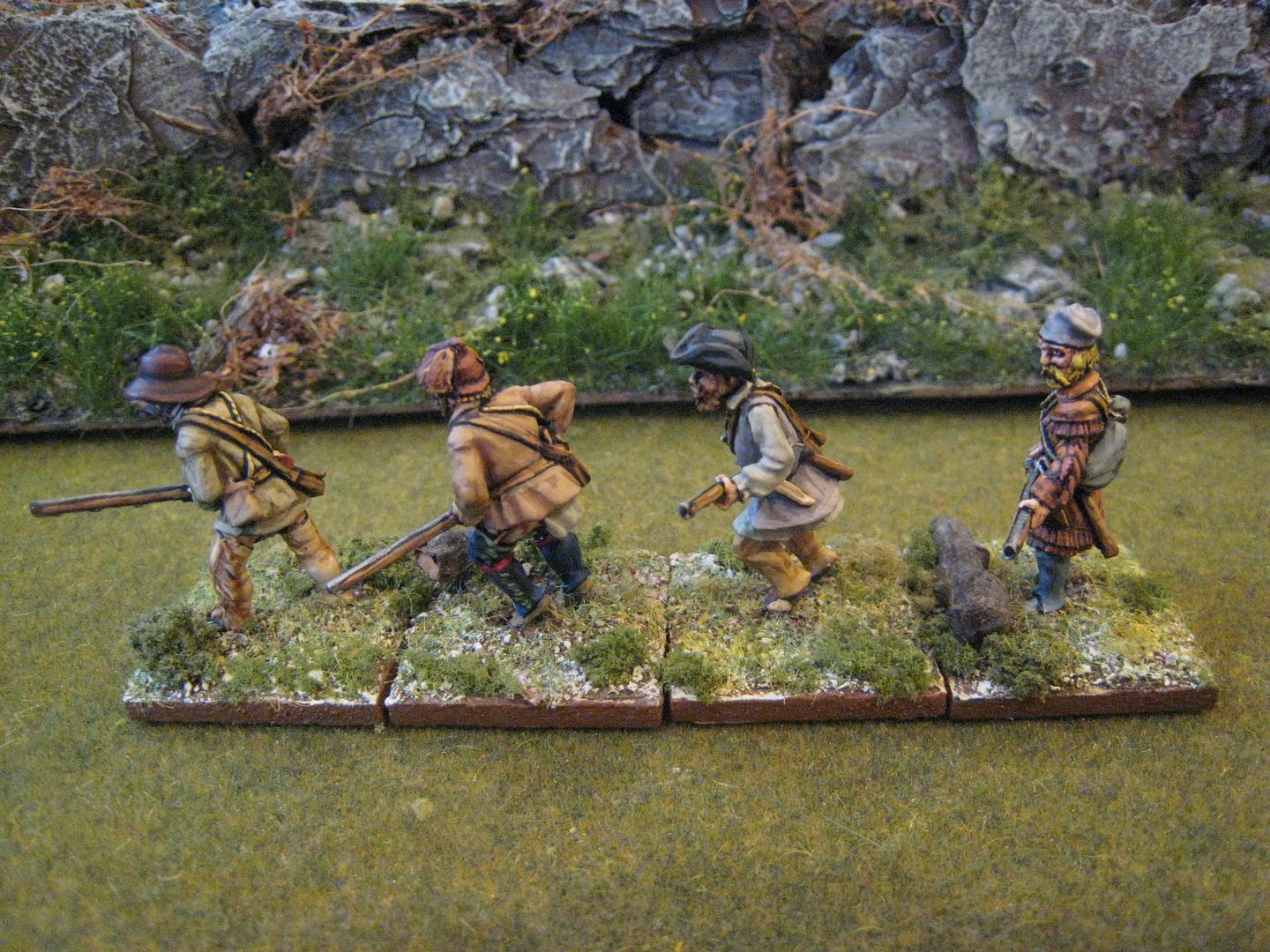
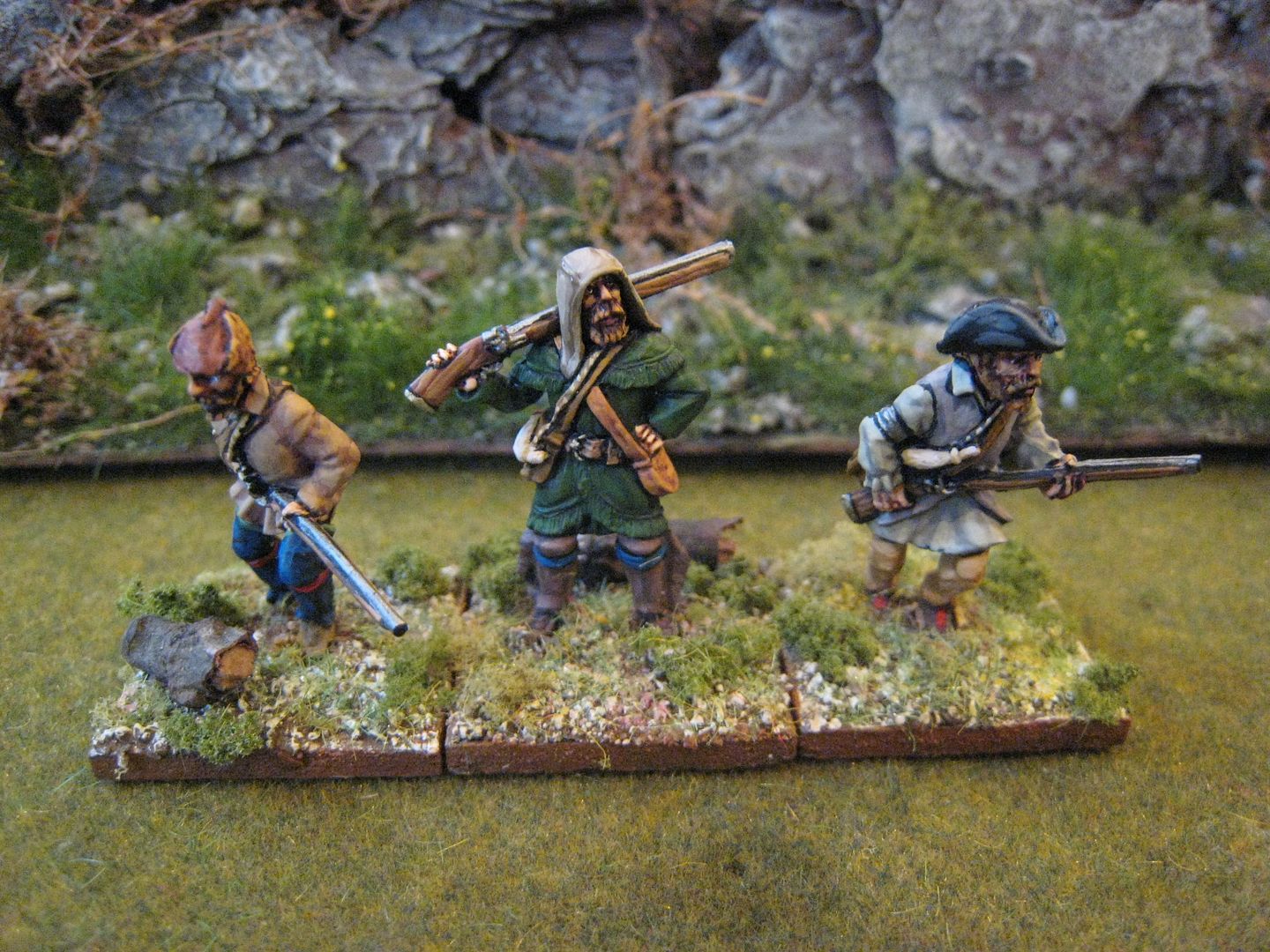
This is one of the two Conquest Miniatures packs called "Frontiersmen". I've had this pack in the leadpile for years and knocked it off a few weeks ago as part of my plan to paint most of my outstanding AWI lead by the end of the year. I have 3 or 4 full battalions to go, but much of what's left in my AWI box is odds and sods - command figures, a few cannon, and various packs from Conquest and Old Glory. This is another Oriskany-inspired unit, as the "British Grenadier!" scenario requires a couple of units of skirmishers or "rangers" on Patriot side. So these figures are something of an American counterpart to the Loyalist rangers I blogged about here. I'm not lacking in skirmishing Patriots. I already have Perry Miniatures riflemen based as skirmishers (see here and here) and a unit of "over mountain men" from King's Mountain Miniatures (see here). I also have a 9 skirmishing Front Rank militia, which form one of the first units I ever painted for the AWI (for Bunker Hill) and which I've never blogged about. I haven't taken a size comparison photo, but in terms of size the KMM figures are the largest and Conquest the smallest, with Perry somewhere in the middle. That said, they are all an effective "28mm" size and look fine in the same game. If you look at my earlier riflemen units you can see that I've been inconsistent in how I've based them. The "British Grenadier!" suggested base sizes are twos on 50mm x 25mm or threes on 75mm x 25mm (depending on the grade of skirmisher), but I had to use larger bases for some of the Perry figures. Otherwise I've largely based these riflemen types in pairs, but with Oriskany and the French & Indian War in mind I decided to base this pack on single bases of 25mm x 25mm.
There's not much else to say about these figures, so I'll take this opportunity to run down the "British Grenadier!" scenario requirements for these sorts of riflemen/militia skirmishing units (this list doesn't include Continental Army units in skirmish formation).
- Bunker Hill: 9
- Long Island: 10; 6; 6
- Pell's Point: 12
- White Plains: 9
- Oriskany: 6; 6
- Freeman's Farm: 16 (this is Morgan's riflemen, which can all deploy as skirmishers)
- Brandywine: 12
- Springfield: 12; 6
- Cowpens: 12
- Guilford Court House: 12; 12; 6
- Gloucester Point: 12
Incidentally, the rocky outcrop in the background, which has been featuring in recent photos, is a lovely piece of terrain hand-made by KMM proprietor and chum Bill Nevins - more on that soon. Currently on the painting table are more loyalist, using Perry plastics and KMM metals.
6 figures. Painted September 2016.
There's not much else to say about these figures, so I'll take this opportunity to run down the "British Grenadier!" scenario requirements for these sorts of riflemen/militia skirmishing units (this list doesn't include Continental Army units in skirmish formation).
- Bunker Hill: 9
- Long Island: 10; 6; 6
- Pell's Point: 12
- White Plains: 9
- Oriskany: 6; 6
- Freeman's Farm: 16 (this is Morgan's riflemen, which can all deploy as skirmishers)
- Brandywine: 12
- Springfield: 12; 6
- Cowpens: 12
- Guilford Court House: 12; 12; 6
- Gloucester Point: 12
Incidentally, the rocky outcrop in the background, which has been featuring in recent photos, is a lovely piece of terrain hand-made by KMM proprietor and chum Bill Nevins - more on that soon. Currently on the painting table are more loyalist, using Perry plastics and KMM metals.
6 figures. Painted September 2016.
Sunday, 20 September 2015
American Militia (10)
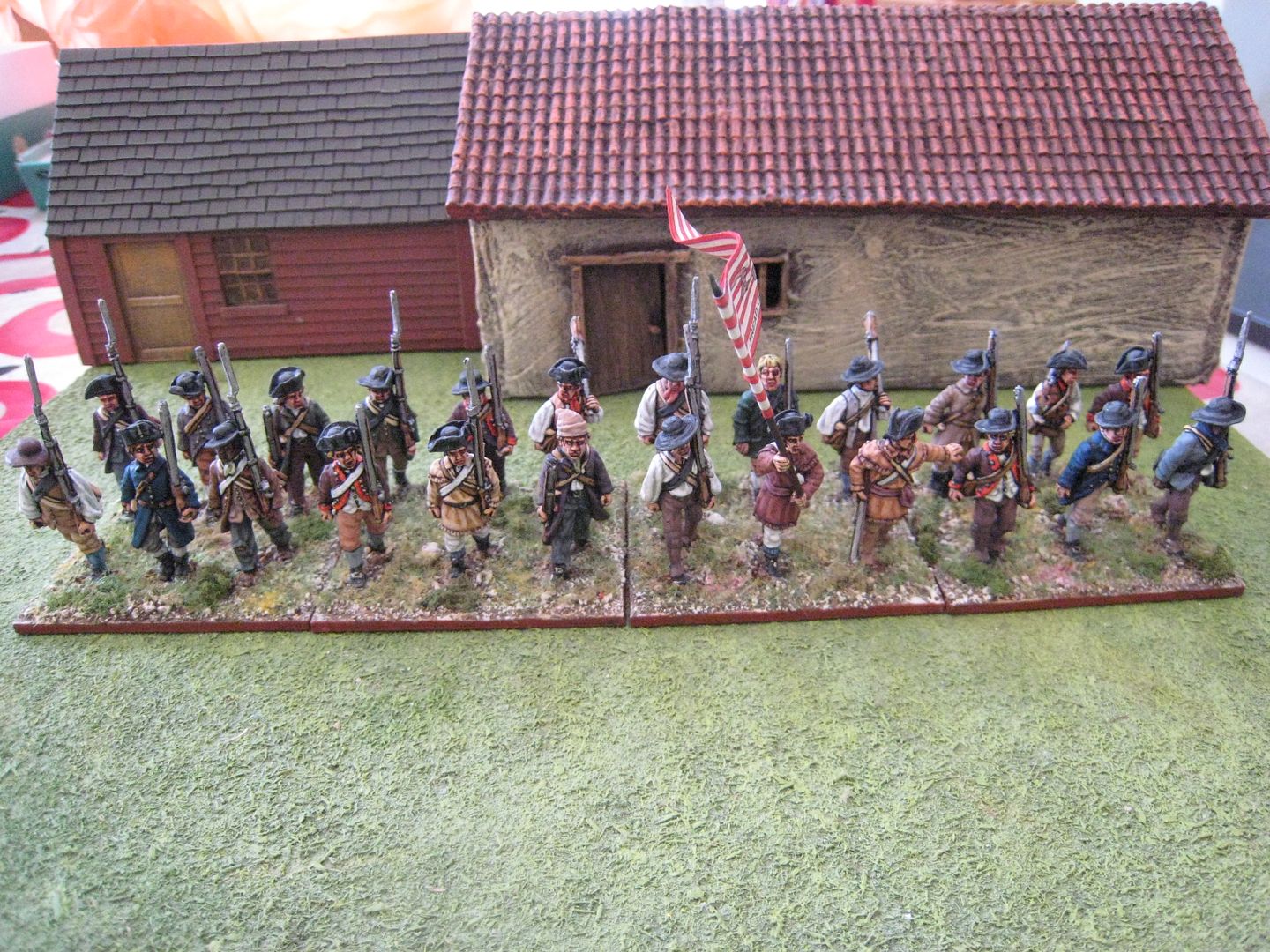
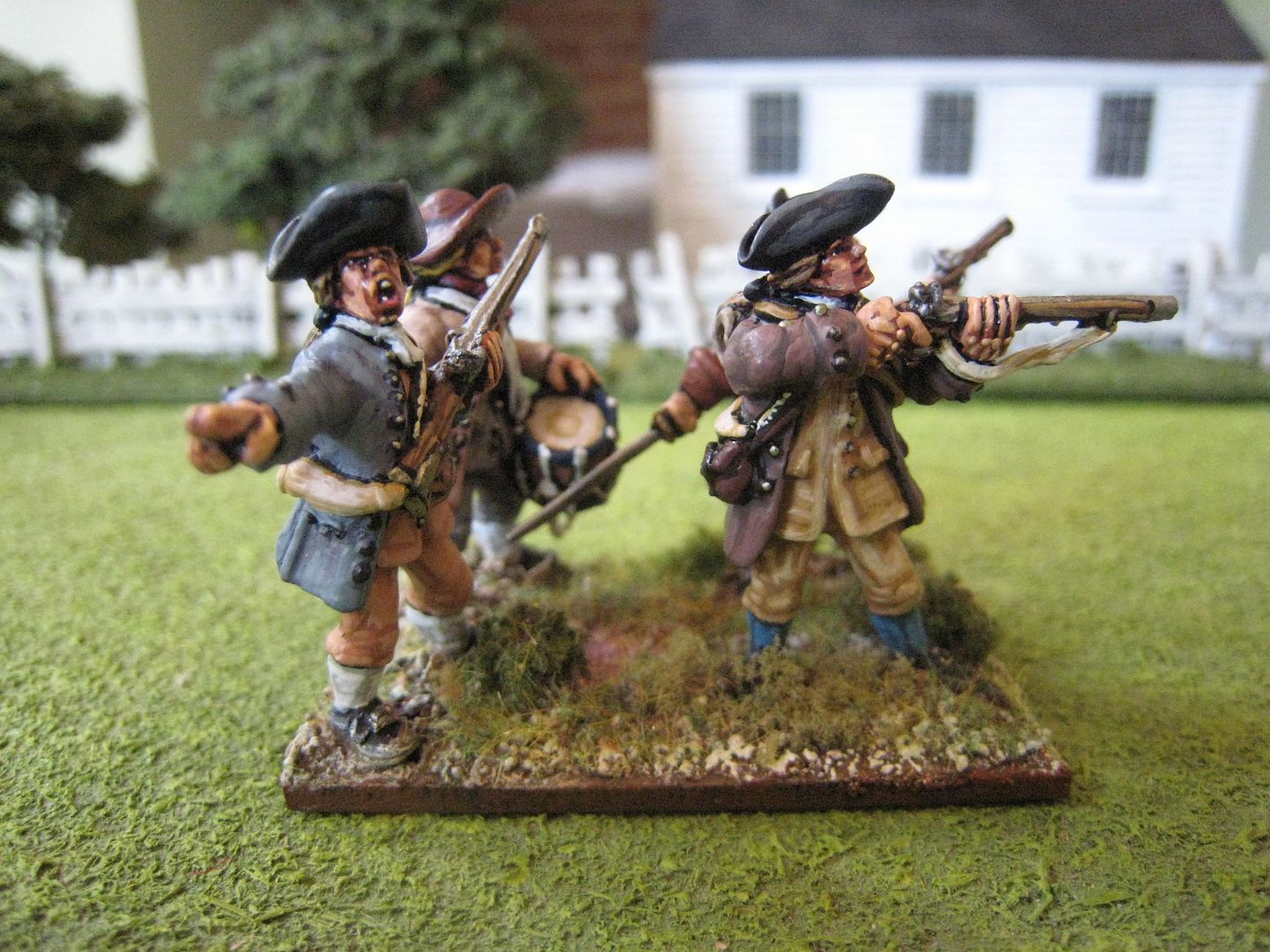
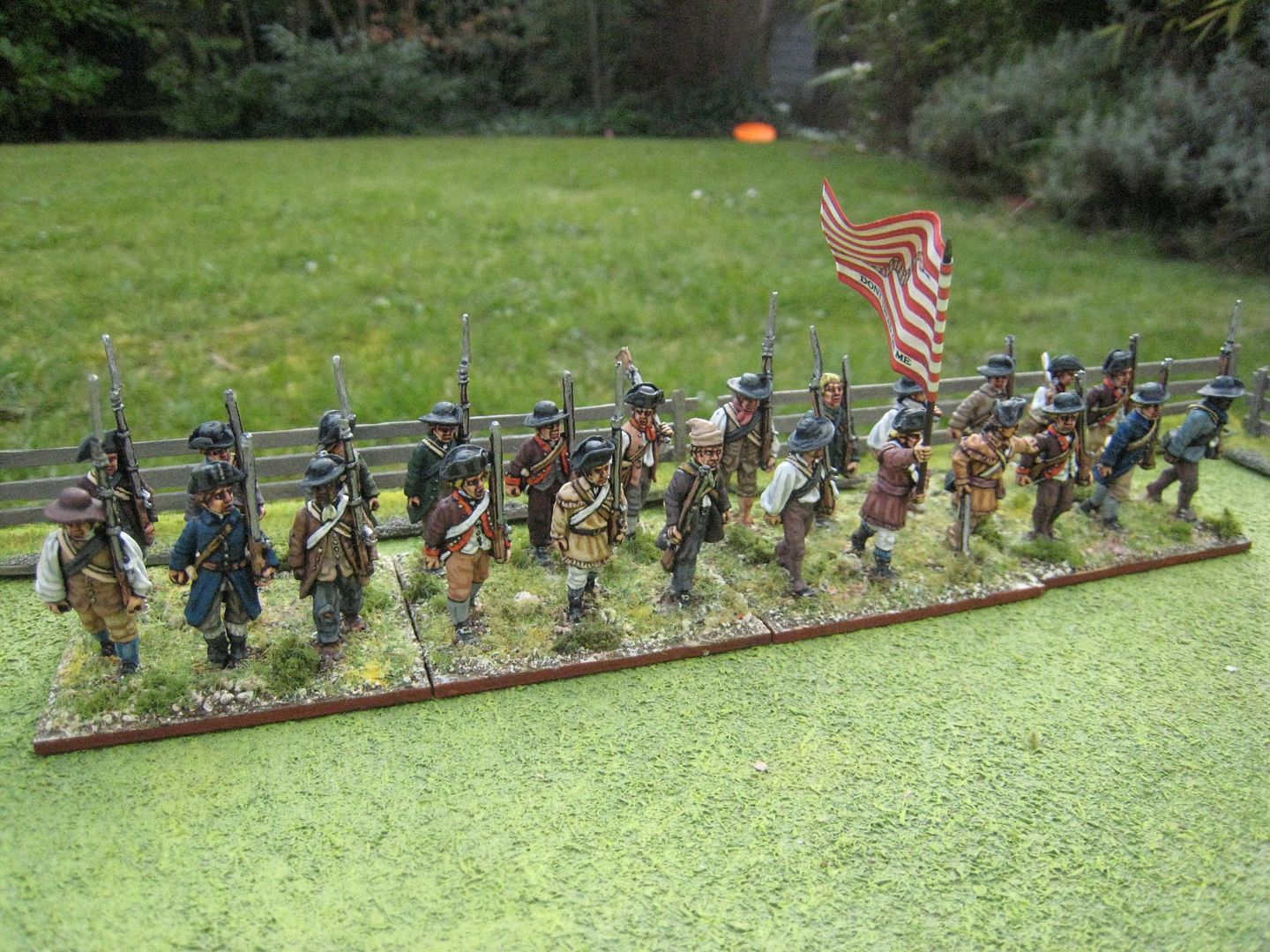
What does "pretty much done" mean? Well, I have a dozen militia units, of between 16 and 24 figures, and that will do for most scenarios. I have written before about how I think the scenarios divide more into "cold" and "warm" weather militia units rather than "northern" and "southern" ones (Guilford Courthouse, for example, was fought on a cold and damp day), but with some allowances I reckon I have enough militia now. These chaps are probably more in the "cold" camp, or at least not "height of summer", dress, although there are some hunting shirt types. In the rear rank is a Conquest Miniatures settler figure - thinner and smaller than the Perry sculpted figures, he makes a very good "teenager". As I said above, the purpose of this unit was to use up various leftover figures, so it's a bit of a "swings both ways" unit. I also expect I will combine stands from it with other units to make larger regiments for those 1:10 games that the more recent "British Grenadier!" scenario books tend to feature.
24 figures. Painted December 2013-February 2014. Flag by GMB.
Monday, 8 December 2014
American Militia (9)
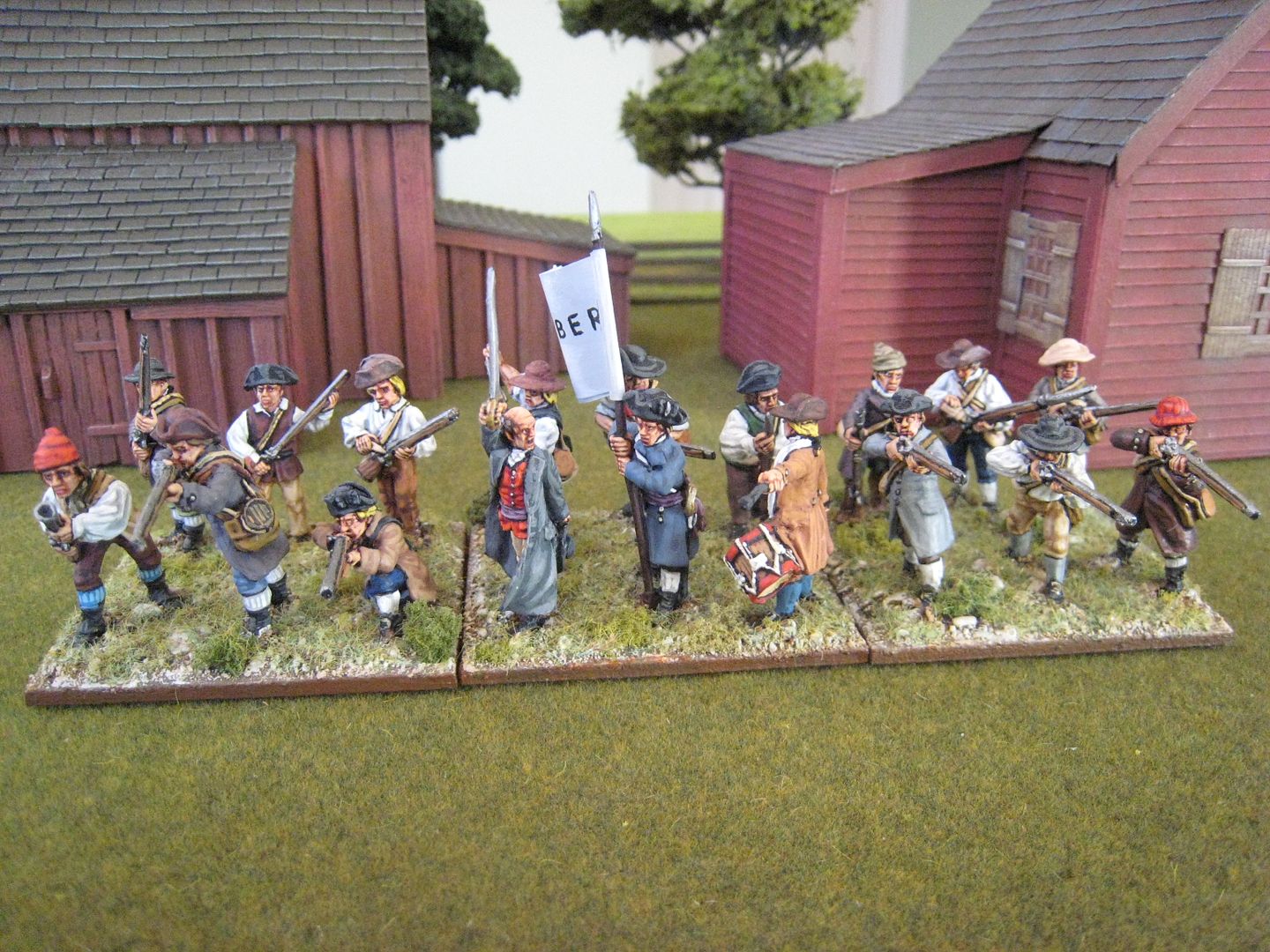
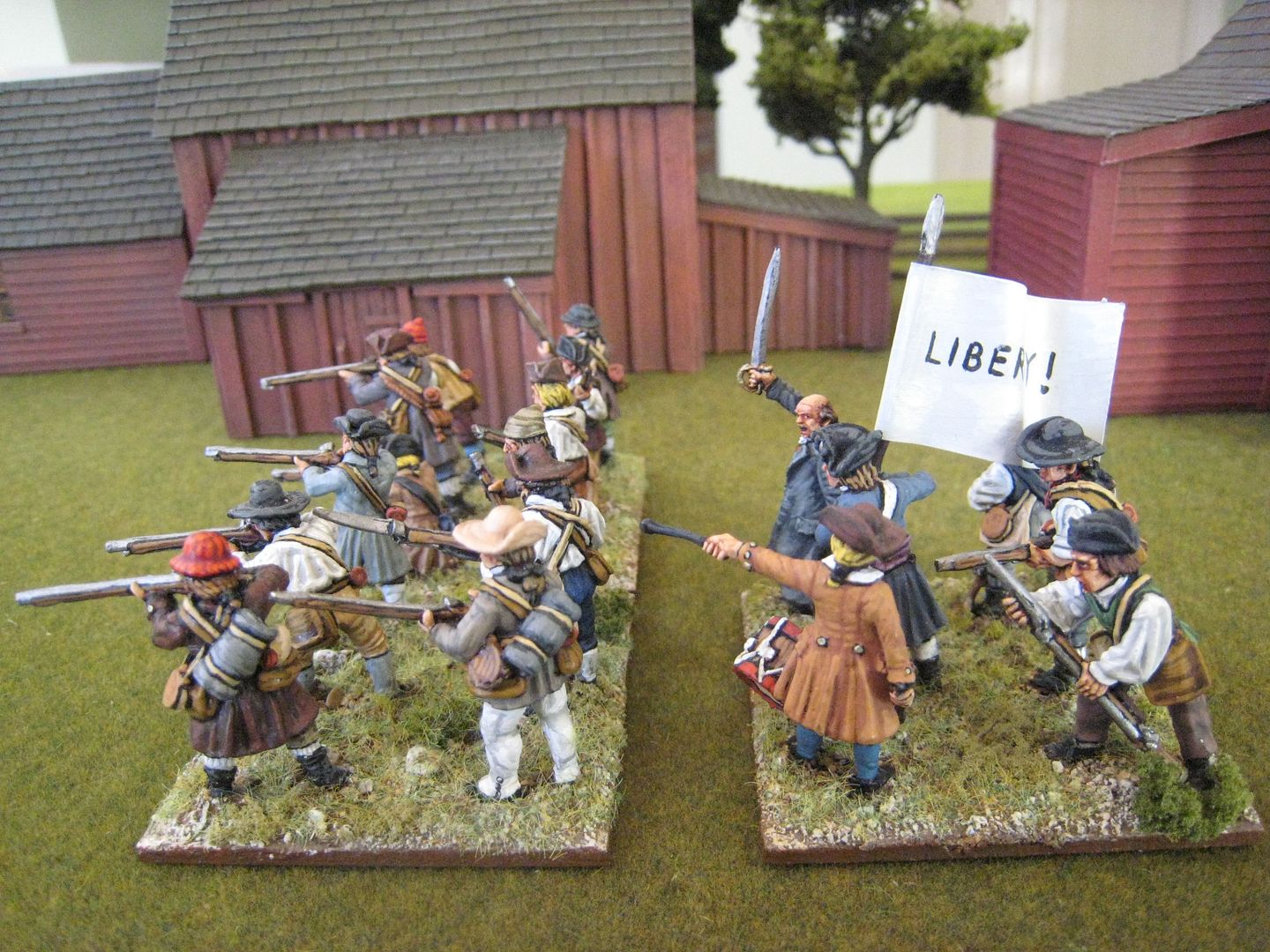
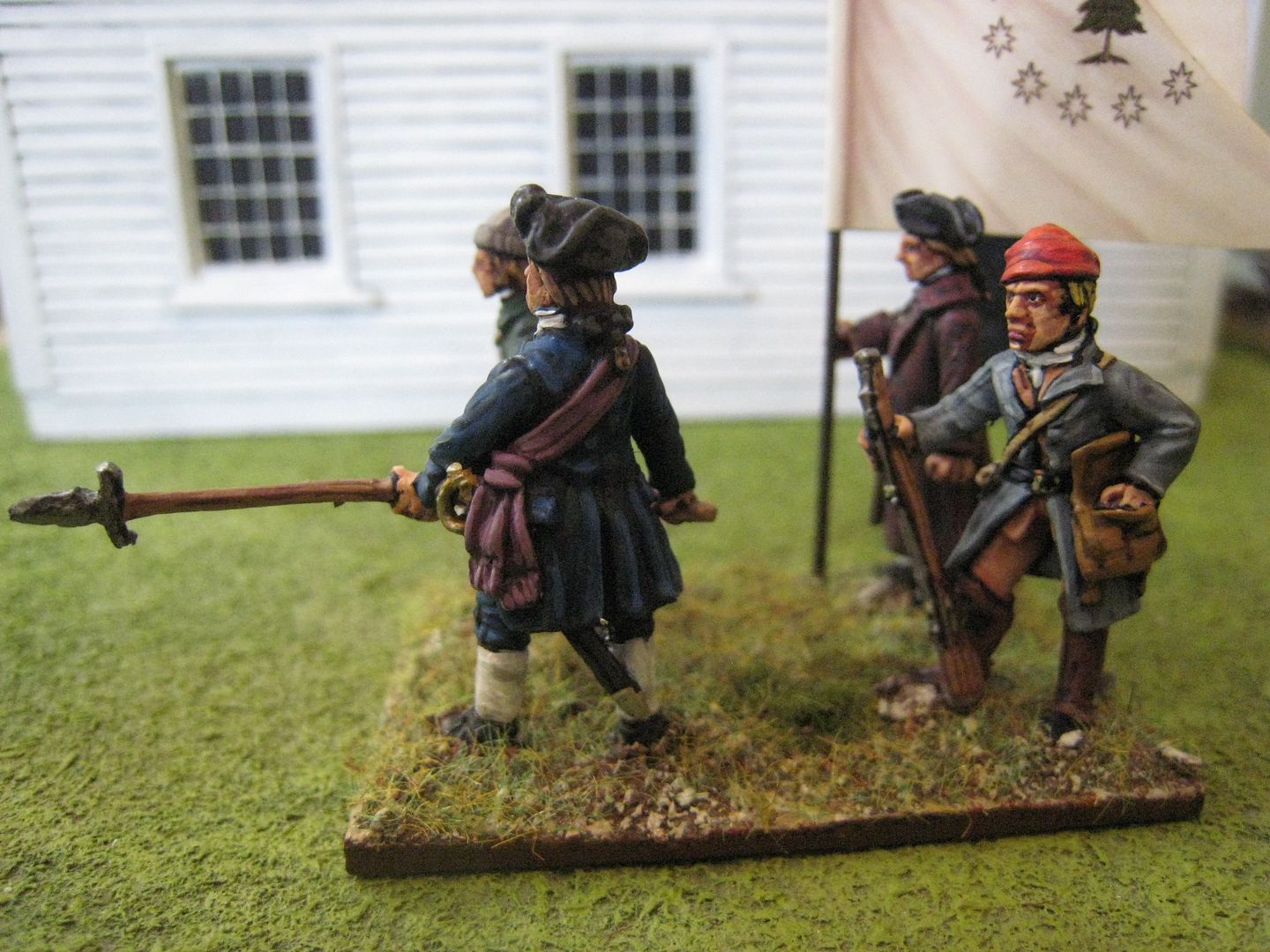
It's a sign of how far I've fallen behind with things that this unit was painted at the beginning of the year. It remained unfinished because I couldn't find a flag that fitted the standard bearer. The pole is cast on and too small for GMB or inded any other commercial flags that I had. So I needed to paint one up myself and I just never got around to doing so...until last week. So this unit of American militia stood on my bookcase unfinished for almost a year. It uses a mix of Foundry and Perry figures, together with one figure from one Conquest Miniatures' "settlers" packs (back row, second from left). I painted most of the figures years ago (see here) but saved two back as I thought they would fit into larger militia units rather than act as skirmishers. The smaller size of the Conquest figures makes them a good fit for teenagers - I thought of that scene in "The Patriot" where Heath Ledger interrupts a church service to call out the militia and a couple of boys stand up with their fathers. There's also a marching figure that is in another unit I'm just finishing off now.
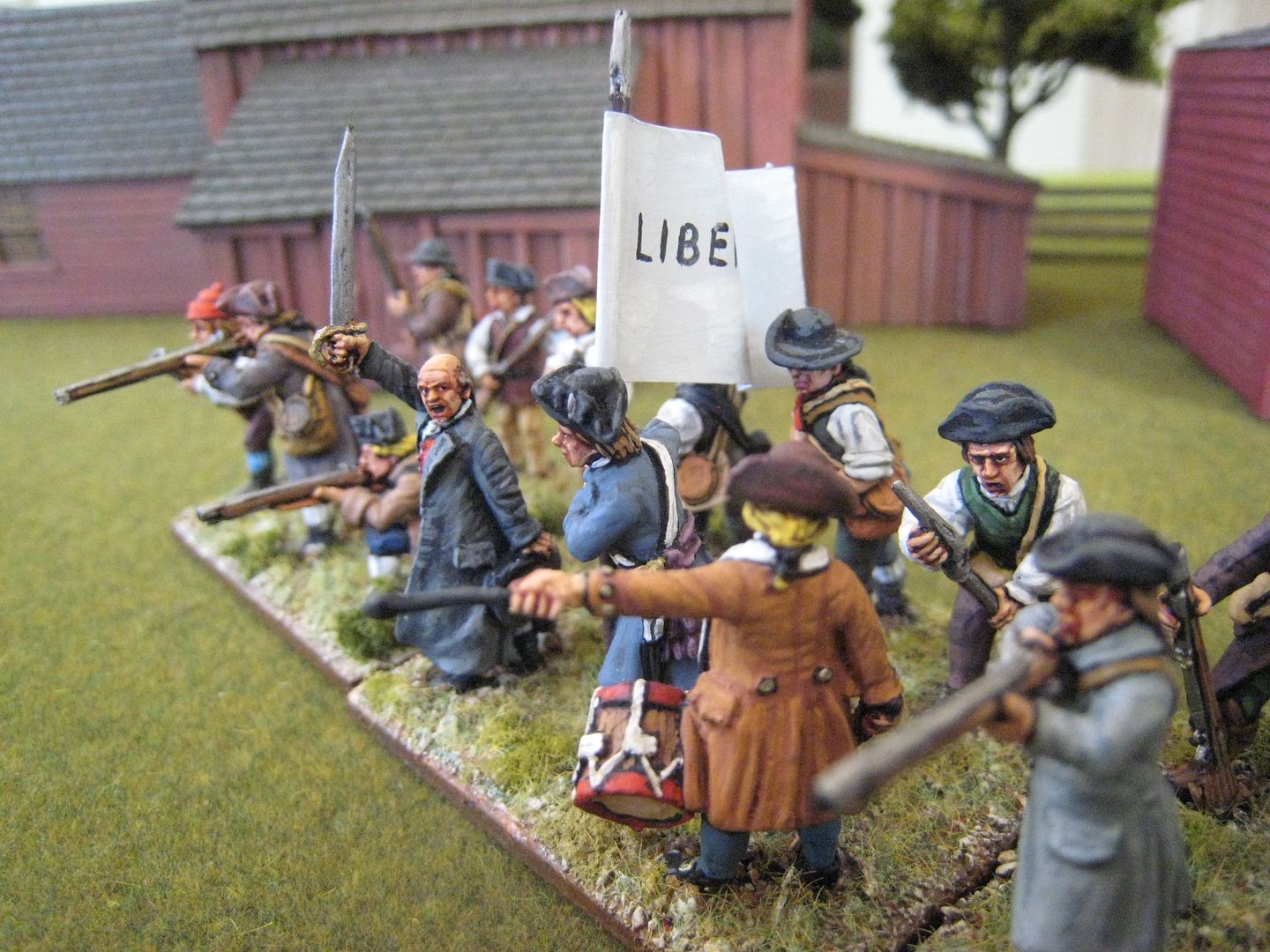
The Perry figures are a mix of "northern" and "southern" packs. I just wanted to use up all my remaining firing militia figures. The officer is, I'm pretty sure, modelled on Colonel William Prescott, one of the patriot commanders at Bunker Hill. He is usually depicted in a long overcoat and a floppy hat, brandishing a sword. There's a terrific statue of him at the site of the battle (see here for my reminiscences on visiting Boston). Prescott was 49 at the time of the battle, so may well have been rather thin on top. He is credited with giving the order "don't shoot until you see the white of their eyes". He survived the battle and appears to have then commanded a regiment of the Continental line. The flag is a very simple hand-painted affair - "LIBERTY!" on a white background.
I'm determined to get up to date on this blog by the end of the year. So, and I appreciate I keep saying this, there will be more regular blogs posts over the next few weeks. I certainly have enough material now.
18 figures. Painted January/February 2014.
The Perry figures are a mix of "northern" and "southern" packs. I just wanted to use up all my remaining firing militia figures. The officer is, I'm pretty sure, modelled on Colonel William Prescott, one of the patriot commanders at Bunker Hill. He is usually depicted in a long overcoat and a floppy hat, brandishing a sword. There's a terrific statue of him at the site of the battle (see here for my reminiscences on visiting Boston). Prescott was 49 at the time of the battle, so may well have been rather thin on top. He is credited with giving the order "don't shoot until you see the white of their eyes". He survived the battle and appears to have then commanded a regiment of the Continental line. The flag is a very simple hand-painted affair - "LIBERTY!" on a white background.
I'm determined to get up to date on this blog by the end of the year. So, and I appreciate I keep saying this, there will be more regular blogs posts over the next few weeks. I certainly have enough material now.
18 figures. Painted January/February 2014.
Saturday, 30 August 2014
American Militia (8)
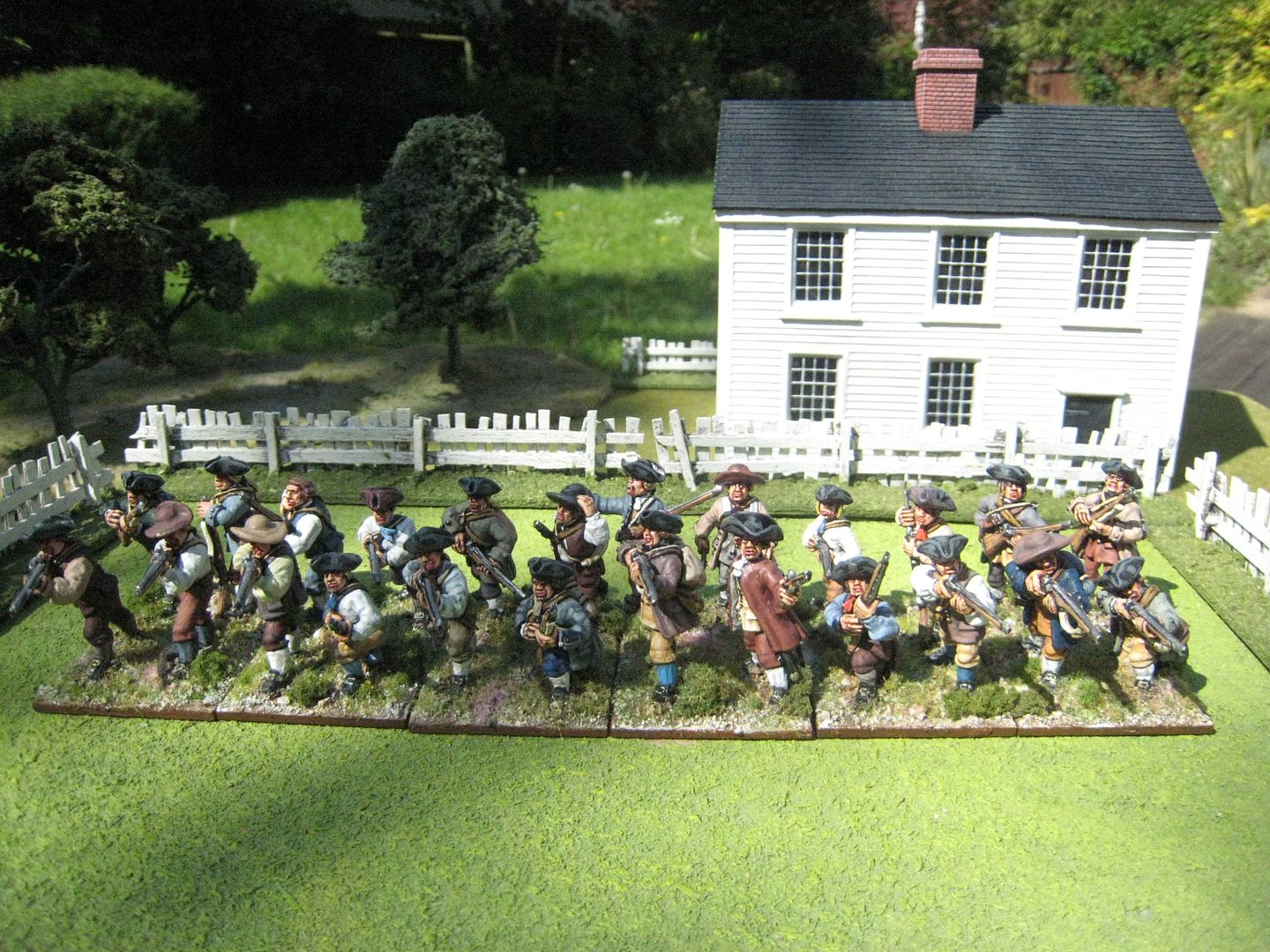
This is a unit of militia that consists of Galloping Major F&IW figures. I first started working on it in June last year, having picked up a couple of packs of "skirmishing settlers" at Salute. GM announced shortly afterwards that they were working on more militia figures so I waited for those to be released to complete the unit. Those figures came out earlier this year and so this unit contains a mix of lightly-armed settler types and more heavily equipped militia. I thik the mix works well, although some might quibble whether you'd find men in shirtsleeves and coats at the same time - it would be either too cold to be in shirtsleeves or too warm to need a coat! The GM packs don't contain a standard bearer figure. I suppose it might be possible to convert one, but I don't mind and I'm quite happy to have one militia unit that doesn't carry a flag as it can be used as Loyalists or Rebels.
In fact, when painting these figures I had them in mind as being used primarily for Loyalists - rightly or not, the more old-fashioned nature of the clothing (bearing in mind that these figures are designed for used in the 1750s) suggested to me men of a more conservative nature. I also had an eye on the Savannah scenario, which I've been working at on-and-off over the past couple of years - this requires a 20-figure unit of Tory militia. Other scenarios which feature units of loyalist militia are Camden (20 figures) and Hobkirk's Hill (16 figures). The poses of some figures would be good for smirmishers. If I'd started work on this unit once all the figures had been released I'd probably have saved some of the kneeling and running figures back and put those on some special skirmish bases. Perhaps I should have reversed the chap who is holding onto his hat and running so that it looked like he'd lost his bottle and was making a run for it. There is no standard bearer in the command packs, but that's not a problem unless you feel you really must have a standard in every unit - most militia didn't carry standard or flags, I suspect.
The figures are on the large side of 25/28mm. Being F&IW figures their reference point in terms of size is more Redoubt Miniatures than Conquest; the latter would look rather puny in comparison. So I'd suggest keeping these figures in their own units and not mix them with other standard AWI ranges. They are, however, a very good fit for the new(ish) King's Mountain Miniatures over mountain men, which Bill Nevins tells me were designed with more than one eye on the F&IW. The figures are easy to paint - the surface detail is crisp and accessible and the various straps are clearly set out.
You can't have too many militiamen for the AIW, so I recommend these figures, which come from a mixture of "settlers" and "un-uniformed militia" packs. Galloping Major have some sailors n the pipeline which will also be very useful for the AWI - the Savannah scenario, for example, requires a unit of 8 sailors. So it's worth putting this company on your AWI radar.
24 figures. Painted June 2013-June 2014.
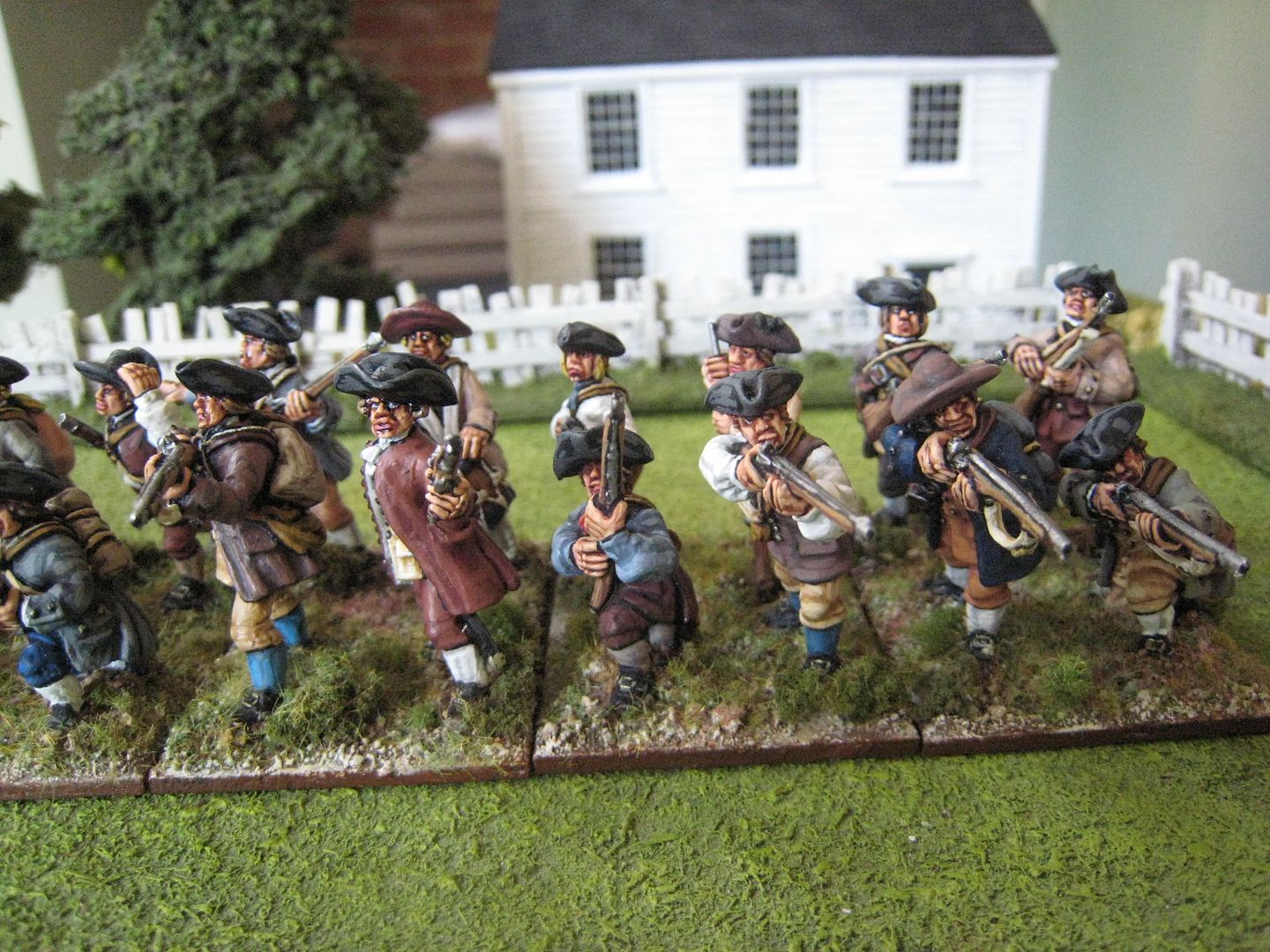
In fact, when painting these figures I had them in mind as being used primarily for Loyalists - rightly or not, the more old-fashioned nature of the clothing (bearing in mind that these figures are designed for used in the 1750s) suggested to me men of a more conservative nature. I also had an eye on the Savannah scenario, which I've been working at on-and-off over the past couple of years - this requires a 20-figure unit of Tory militia. Other scenarios which feature units of loyalist militia are Camden (20 figures) and Hobkirk's Hill (16 figures). The poses of some figures would be good for smirmishers. If I'd started work on this unit once all the figures had been released I'd probably have saved some of the kneeling and running figures back and put those on some special skirmish bases. Perhaps I should have reversed the chap who is holding onto his hat and running so that it looked like he'd lost his bottle and was making a run for it. There is no standard bearer in the command packs, but that's not a problem unless you feel you really must have a standard in every unit - most militia didn't carry standard or flags, I suspect.
The figures are on the large side of 25/28mm. Being F&IW figures their reference point in terms of size is more Redoubt Miniatures than Conquest; the latter would look rather puny in comparison. So I'd suggest keeping these figures in their own units and not mix them with other standard AWI ranges. They are, however, a very good fit for the new(ish) King's Mountain Miniatures over mountain men, which Bill Nevins tells me were designed with more than one eye on the F&IW. The figures are easy to paint - the surface detail is crisp and accessible and the various straps are clearly set out.
You can't have too many militiamen for the AIW, so I recommend these figures, which come from a mixture of "settlers" and "un-uniformed militia" packs. Galloping Major have some sailors n the pipeline which will also be very useful for the AWI - the Savannah scenario, for example, requires a unit of 8 sailors. So it's worth putting this company on your AWI radar.
24 figures. Painted June 2013-June 2014.
Friday, 27 June 2014
American riflemen (3)
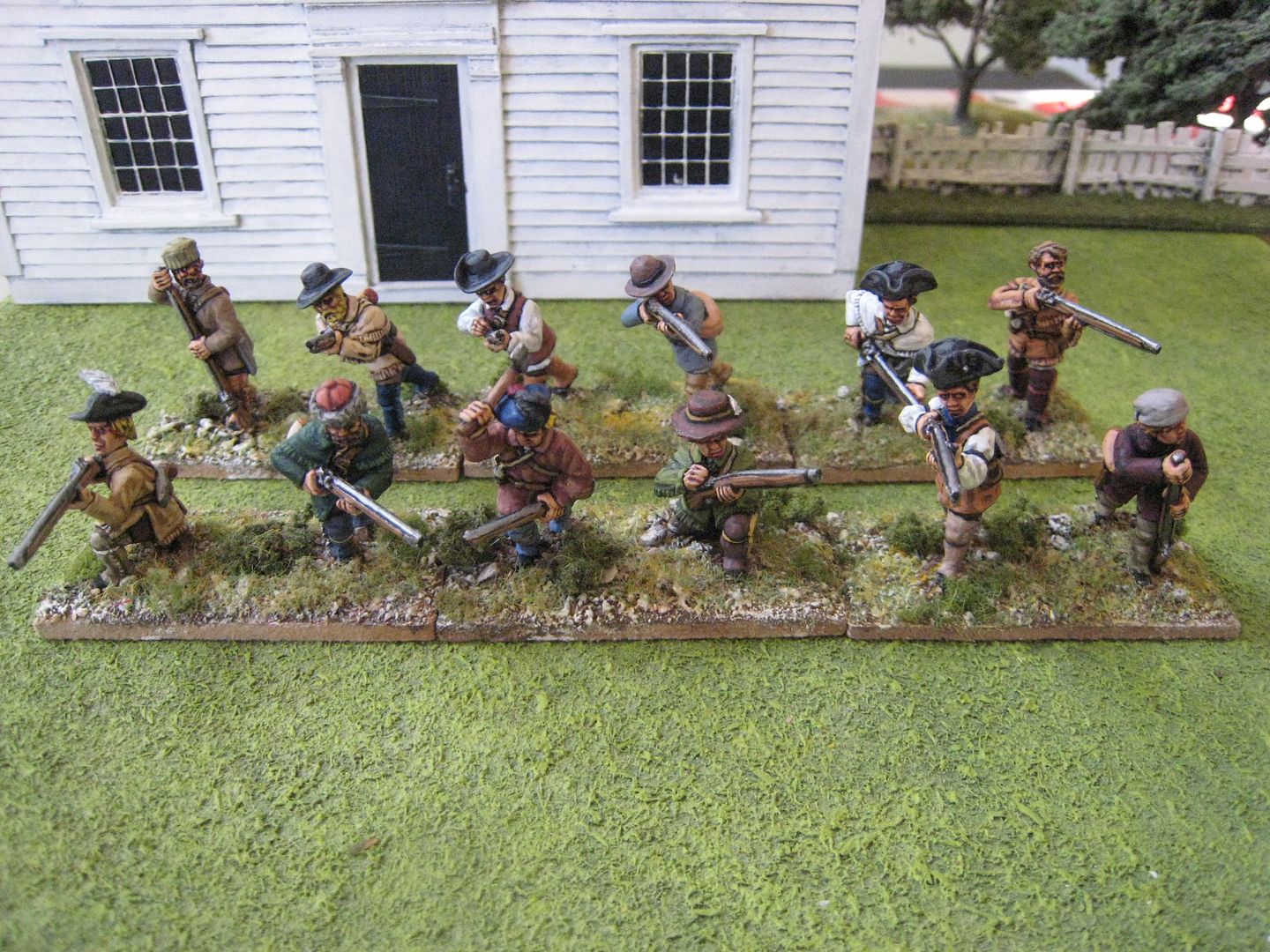
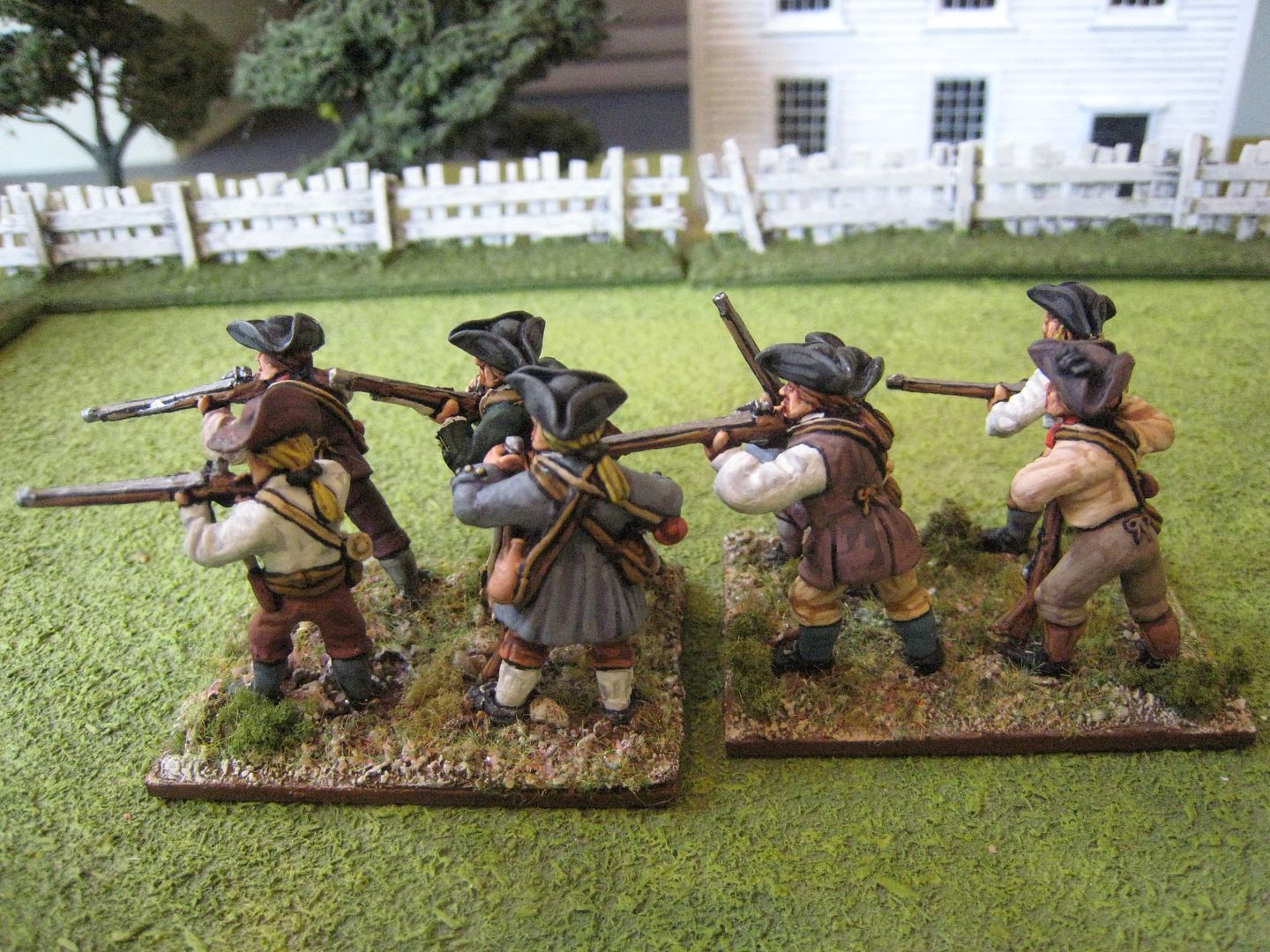
Sorry about the further long hiatus on TQ - real life, 2 young children, work, usual reasons etc. I had a total mojo collapse earlier in the year, but that's resolved now and I'm enjoying painting AWI again. These figures have been a long time posting, and they are of course "over mountain men" ("OMM") from Bill Nevins' King's Mountain Miniatures ("KMM"). These figures were released towards the end of last year subsequent to KMM's very successful AWI highlander range. I've been painting lots of the highlanders over the past 12 months, mainly for Bill but latterly also for myself (I found I was getting jealous that I didn't have any of these figures in my own collection!). You can see some earlier posts on these figures here. I've recently finished a lot more figures for Bill and a battalion of the 76th Foot for myself and will post on those over the next few days (that's a promise). However, in the meantime here are my first attempts at the OMM.
I don't know much about these chaps. I suppose their main claim to AWI fame is the destruction of Major Patrick Ferguson's command at King Mountain on 7 October 1780. The mountains of which they were "over" were the Appalachians and these men were settlers in the areas to the west of those mountains, in what is now northeastern Tennessee and southwestern Virginia. These were areas where the Crown had refused to colonise - the Royal Proclamation of 1763 prohibited settlement west of the Appalachians in recognition of the support that the local Indians had given the Crown in the French and Indian War. That did not deter settlers, who began to crose the Appalachians in the early 1770s and began to create settlements that were essentially illegal. It seems that in the first instances the settlers purchased lands from the local Indian inhabitants, but then in the way of colonisation those settlements quickly increased in size, to the concern of the locals. Conflict soon broke out and in 1776 began what is now called the Cherokee-American Wars, a series of struggles that lasted on and off for almost 20 years. The Cherokee chief at this time was a man called Dragging Canoe, who allied himself with the British during the AWI and appears to have had some role in the capture of Savannah in 1778.
The OMM were natural patriots and throughout the AWI skirmished with British loyalists as well as Cherokee along the Appalachian frontier. In September 1780 an OMM force of just over 1,000 gathered together in response to a proclamation by Major Ferguson that he would attack their settlements if they did not lay down arms against the Crown. So began a march over the Appalachians that ended with the encirclement and defeat of Ferguson's force of loyalists at the battle of King's Mountain. Most of Ferguson's force of 1,000 were killed or captured while the OMM suffered only 28 killed and 62 wounded. The destruction of Ferguson's force led Cornwallis to abandon his advance into North Carolina.
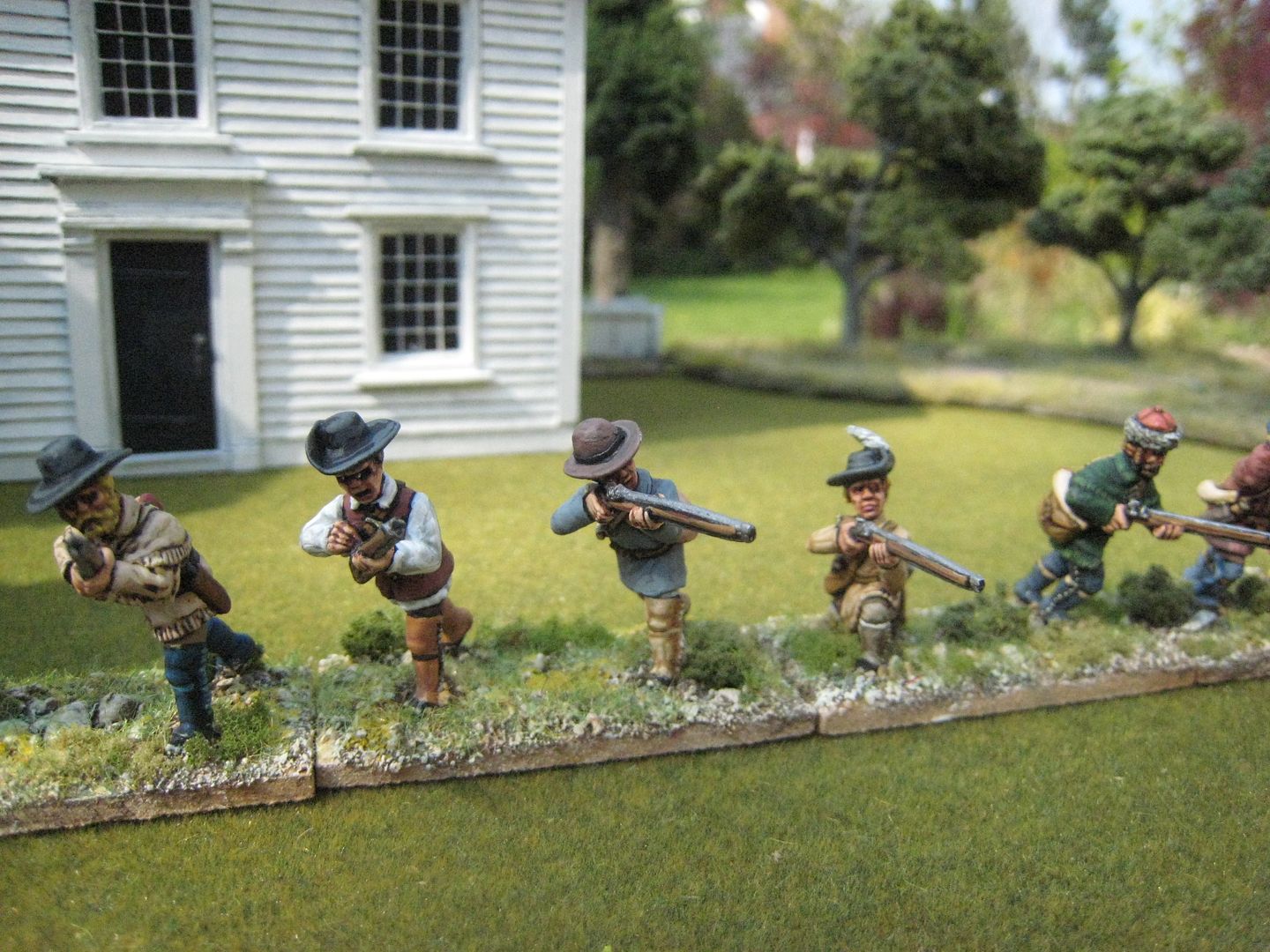
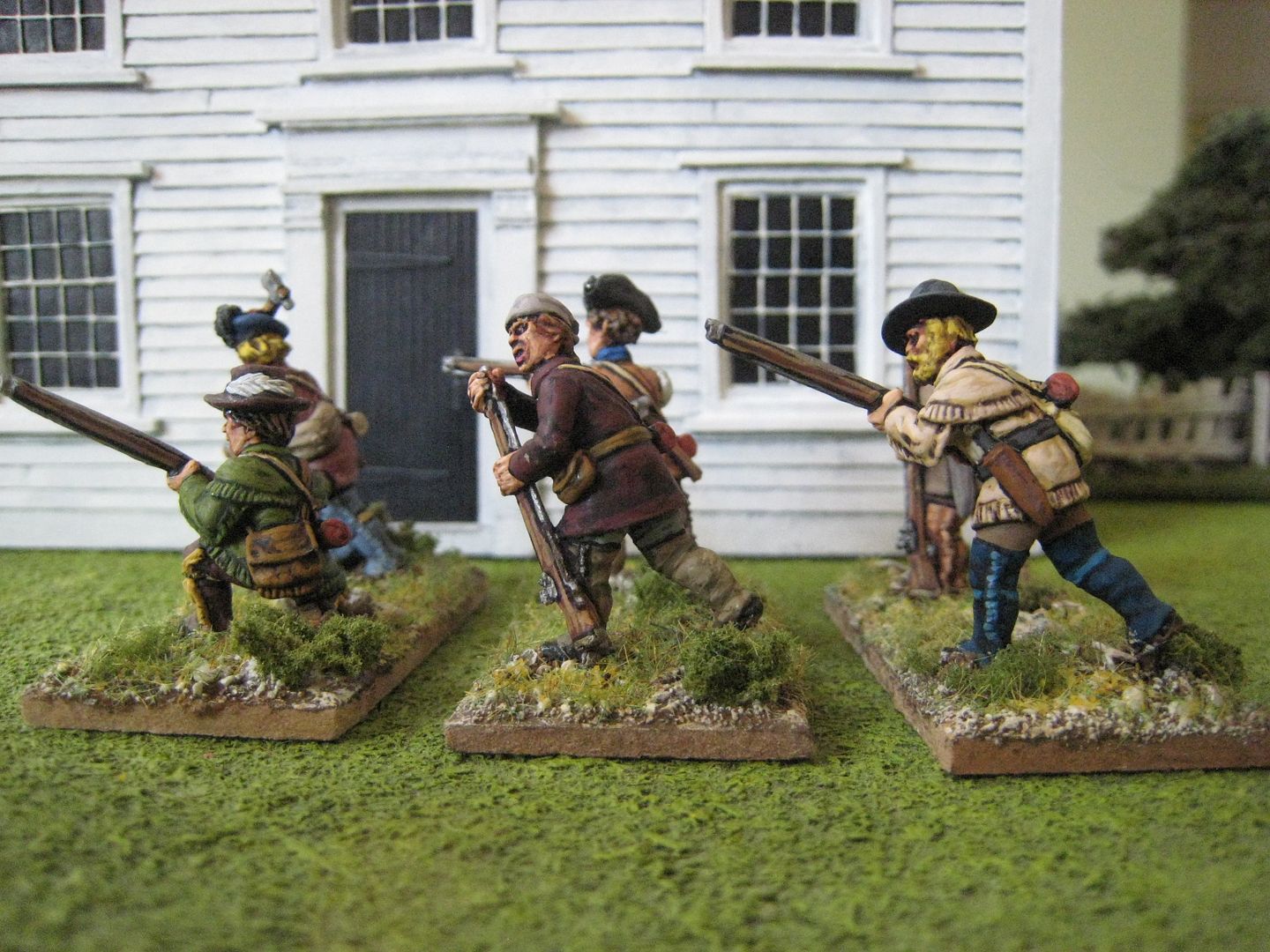
The KMM range has 16 figures in various poses that take separate heads from a vast selection. I haven't yet counted the number of different heads, but there are about 30 sets of varying headgear. Those sets include things like jockey caps and dragoon helmets which you wouldn't use for OMM but are instead designed for KMM's forthcoming Continental figures. So for the OMM you have instead lots of bearded heads with hats, caps, bonnets, bandanas etc which create a very distinct look. Some heads suit some bodies better than others, so you need to experiment a bit before you find the best fits. But these are very useful figures than can be adapted for all kinds of things. I have built a first unit of 12 figures, based in pairs on standard "British Grenadier!" skirmish bases. As well as using these figures for the OMM themselves, I have in mind a more generic frontier militia unit which I would use for Guilford Courthouse and other southern battles. I tried to keep the colours fairly muted, although I allowed myself a bit or artistic licence to introduce some colour onto the leggings.
12 figures. Painted December 2013 to February 2014.
The OMM were natural patriots and throughout the AWI skirmished with British loyalists as well as Cherokee along the Appalachian frontier. In September 1780 an OMM force of just over 1,000 gathered together in response to a proclamation by Major Ferguson that he would attack their settlements if they did not lay down arms against the Crown. So began a march over the Appalachians that ended with the encirclement and defeat of Ferguson's force of loyalists at the battle of King's Mountain. Most of Ferguson's force of 1,000 were killed or captured while the OMM suffered only 28 killed and 62 wounded. The destruction of Ferguson's force led Cornwallis to abandon his advance into North Carolina.
The KMM range has 16 figures in various poses that take separate heads from a vast selection. I haven't yet counted the number of different heads, but there are about 30 sets of varying headgear. Those sets include things like jockey caps and dragoon helmets which you wouldn't use for OMM but are instead designed for KMM's forthcoming Continental figures. So for the OMM you have instead lots of bearded heads with hats, caps, bonnets, bandanas etc which create a very distinct look. Some heads suit some bodies better than others, so you need to experiment a bit before you find the best fits. But these are very useful figures than can be adapted for all kinds of things. I have built a first unit of 12 figures, based in pairs on standard "British Grenadier!" skirmish bases. As well as using these figures for the OMM themselves, I have in mind a more generic frontier militia unit which I would use for Guilford Courthouse and other southern battles. I tried to keep the colours fairly muted, although I allowed myself a bit or artistic licence to introduce some colour onto the leggings.
12 figures. Painted December 2013 to February 2014.
Monday, 14 October 2013
American Militia (7)
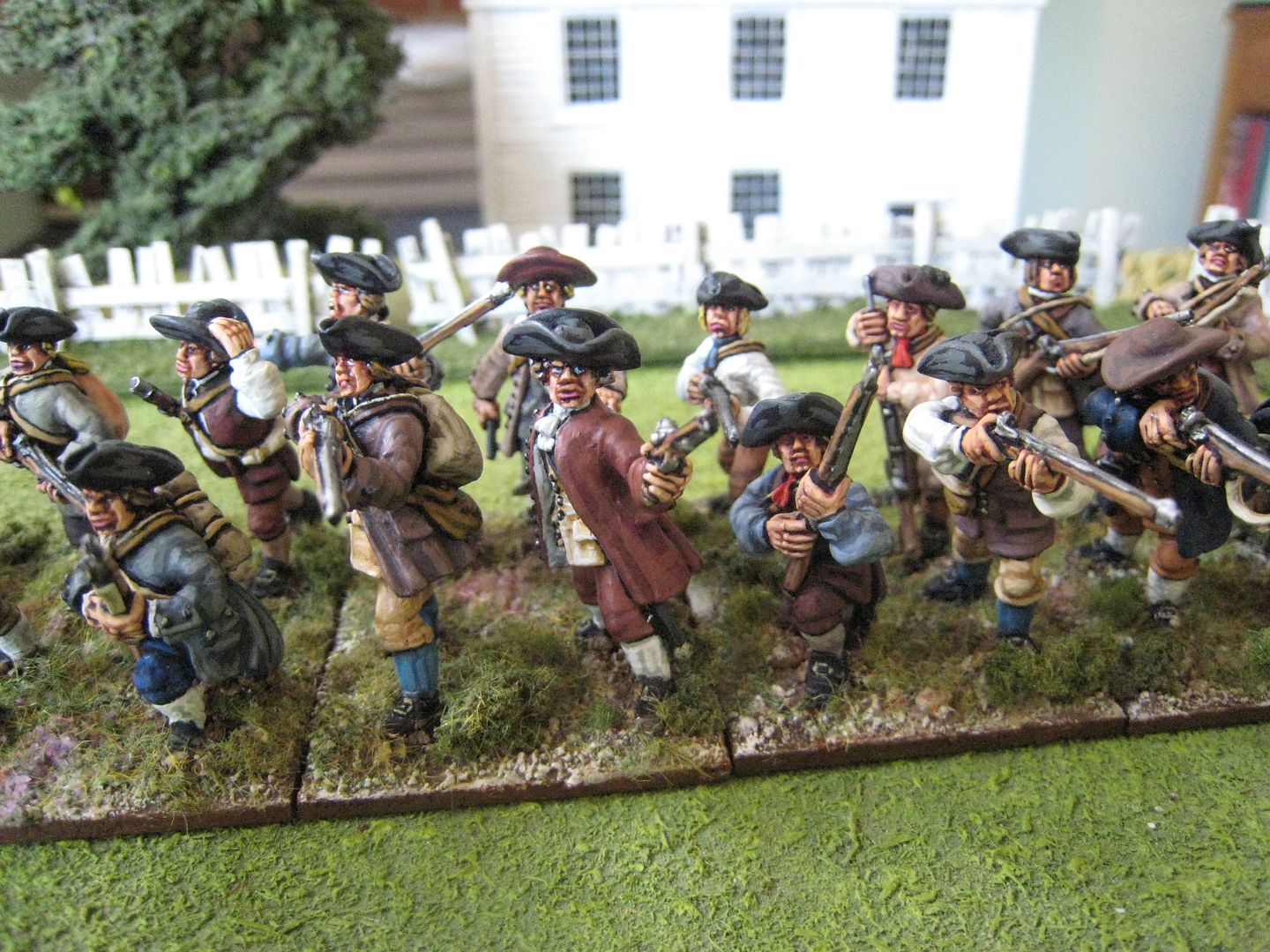
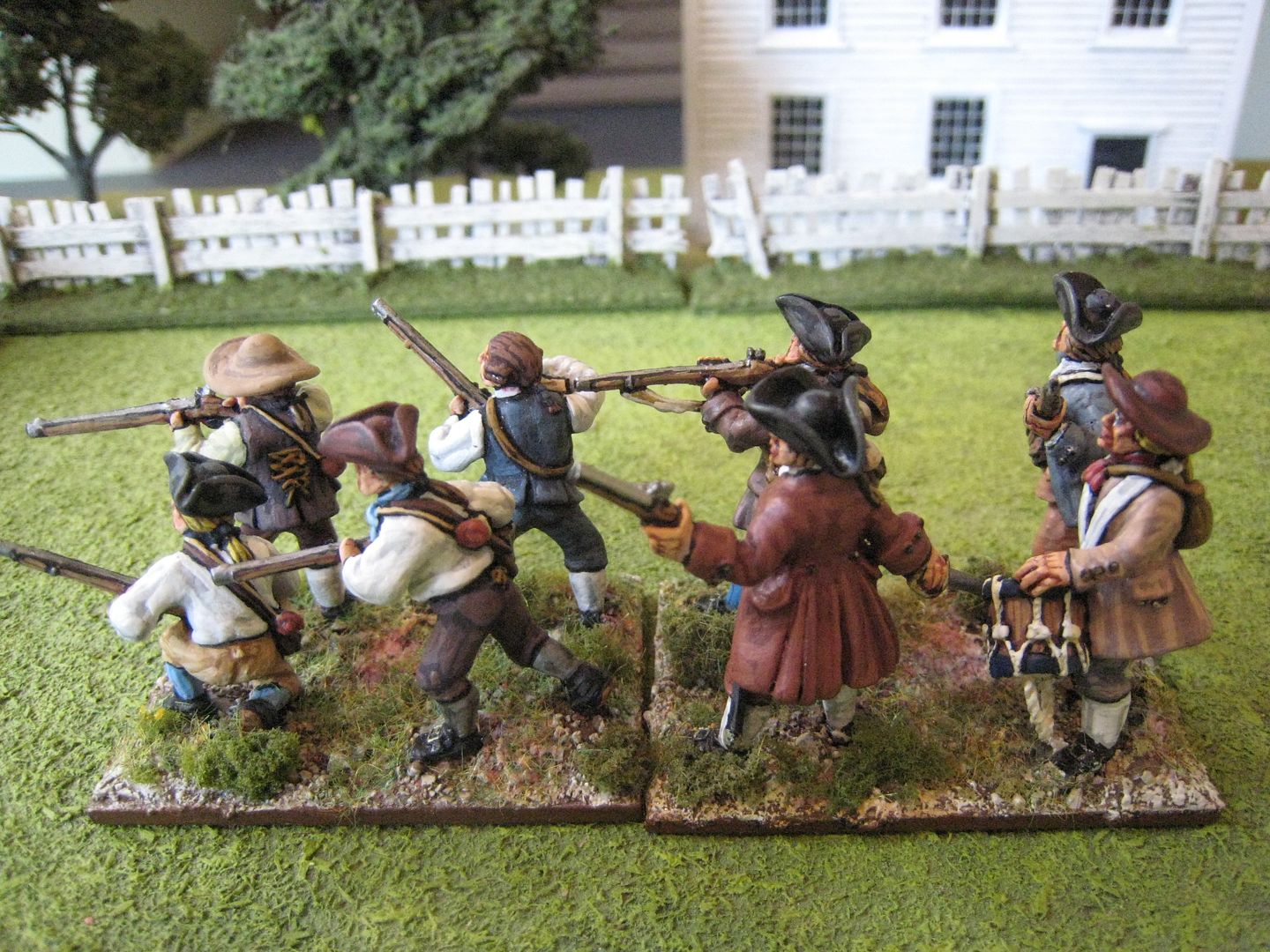
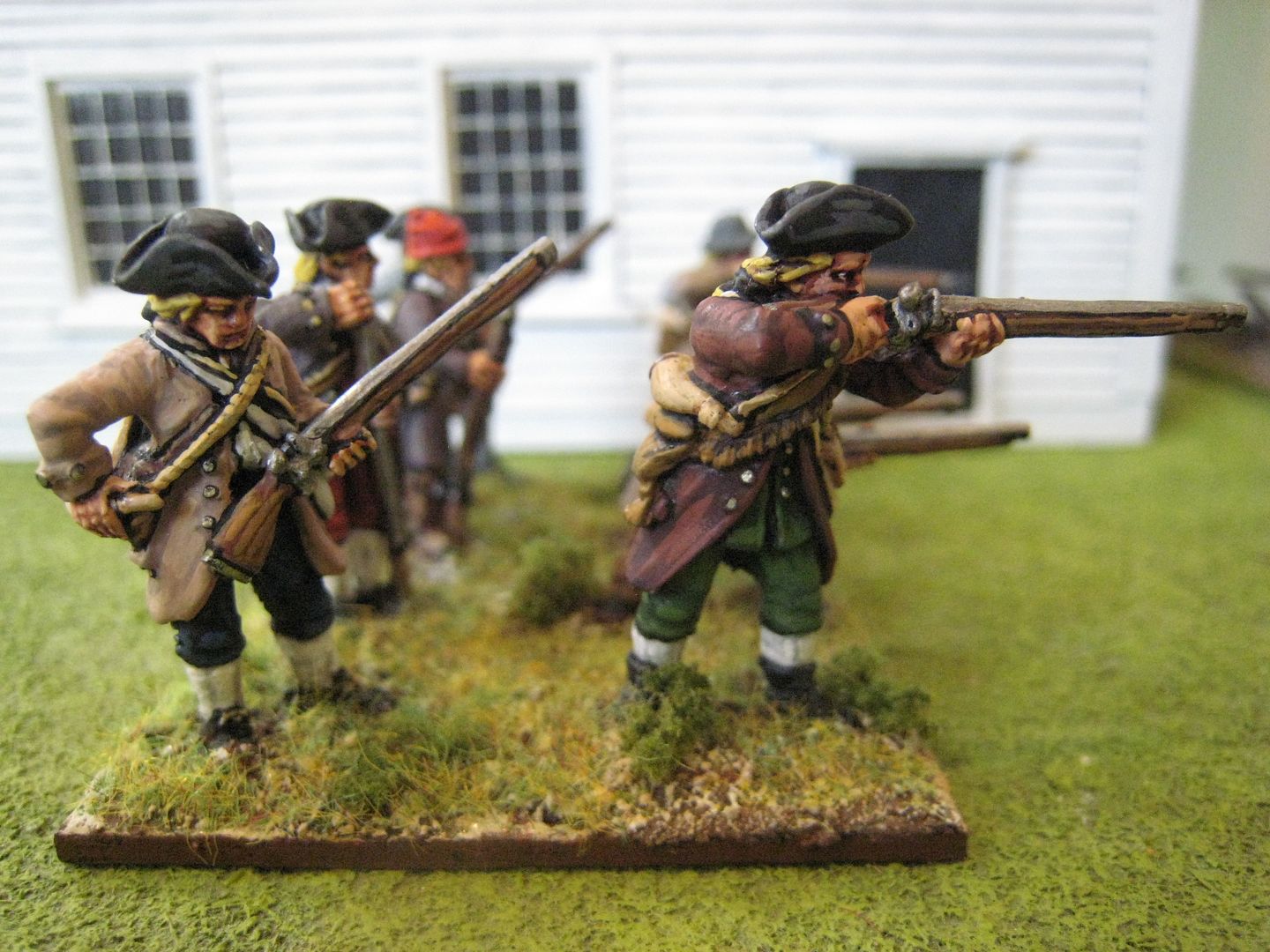
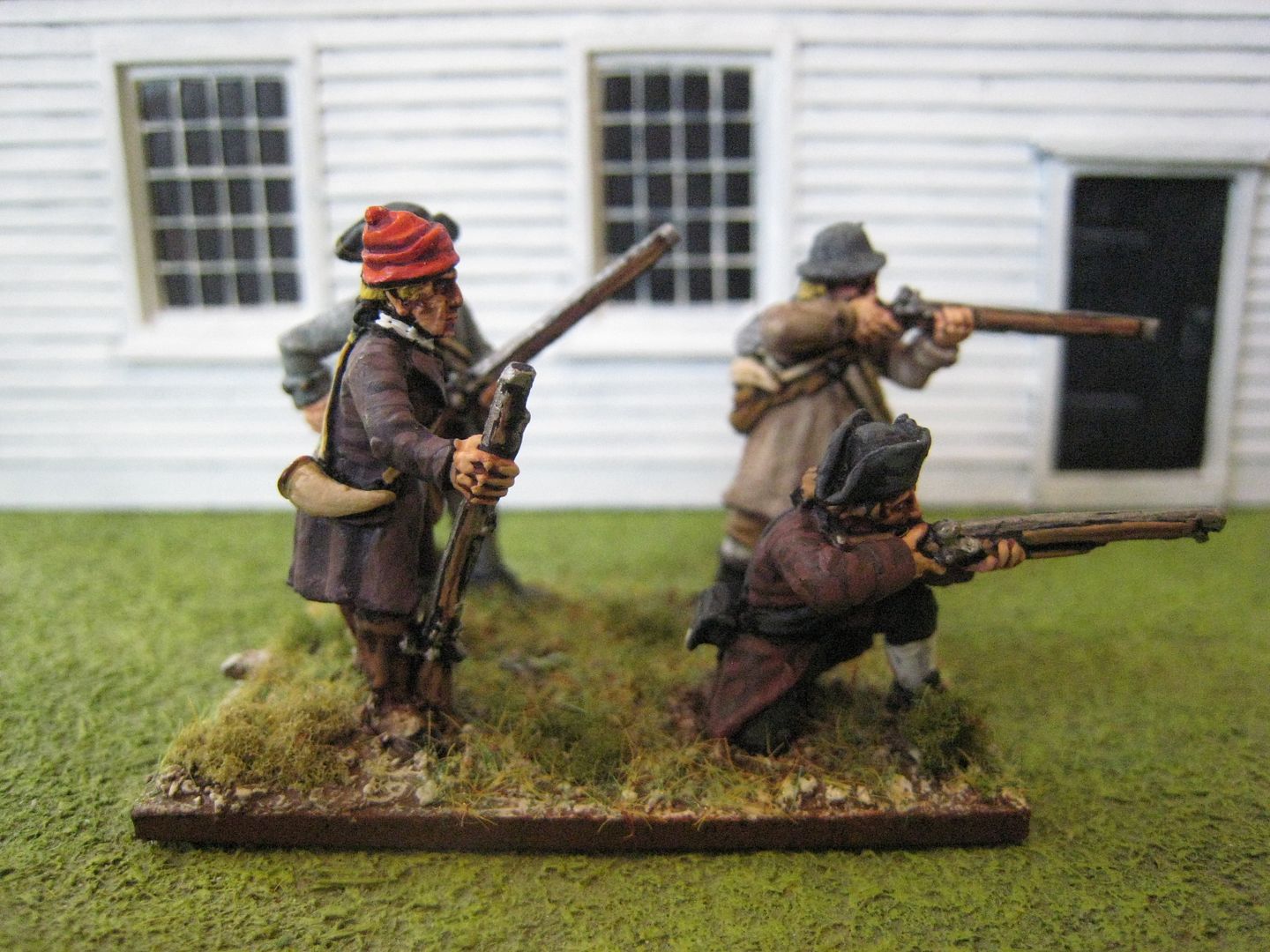
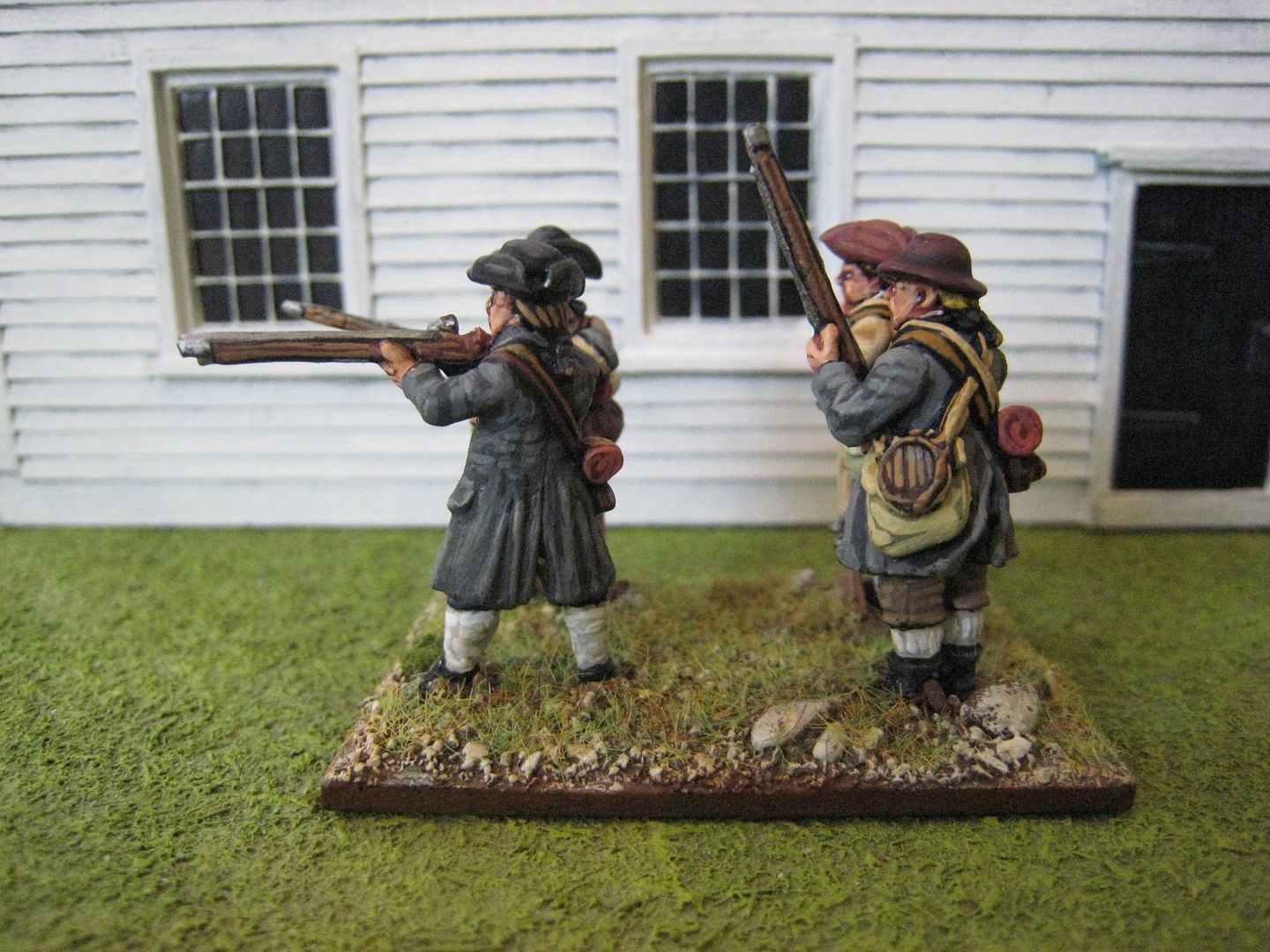
This is the first proper AWI unit I've finished since my first go at the Perry plastic British infantry. I bought a couple of packs of the new-ish Perry "northern militia" packs at Salute and decided to have a crack at them a few weeks ago. Once again, I needed a bit of a break from painting red-coated highlanders. This unit mixes figures from those Perry packs as well as some of the figrues in the older Foundry "minutemen skirmishing" pack that Alan Perry made years ago. The Perries have now released figures described as "southern" and "northern" militia (and some very useful marching negroes). This distinction is largely shown by the former being in shirtsleeves and the latter in coats. There is some difference in headgear too, with some northern types wearing a sort of skull-cap that I gather was popular in the northern states and the southern types wearing a variety of broad brimmed hats to shield their faces from the sun. The northern guys are carrying rather more kit.
As a general concept this north/south distinction clearly works. I've been to South Carolina and seen how hot it can get there and the shirtsleeve types are more suitable for summer campaigning in the South. But of course it gets hot in the northern states as well and it's worth remembering that two of the best known southern theatre battles, Cowpens and Guilford Courthouse, were fought on damp, cold days in January and March respectively (I've seen references to the temperature at Guilford as being around 45-50 degrees Fahrenheit or 7-10 degrees Celsius). So another way at looking at these militia figures is to think of them as being suitable for "hot" days and "cold" days. The Perry southern militia figures with bayonets are perfect for representing Continental infantry in battles in the north such as Monmouth, which was fought in June on such a hot day that troops on both sides collapsed from the heat and many Americans took off their uniform coats and fought in shirts and waistcoats. Bunker Hill was fought in mid-June and while I've experienced first hand how utterly freezing Boston can get even as late as April, I expect by June it's usually reasonably clement. Don Troiani's excellent painting (see here) of the "whites of their eyes" moment certainly has men in coats and shirtleeves Of course, on the tabletop none of this really matters - militia are militia irrespective of what they're wearing - but the choice is there if you want it.
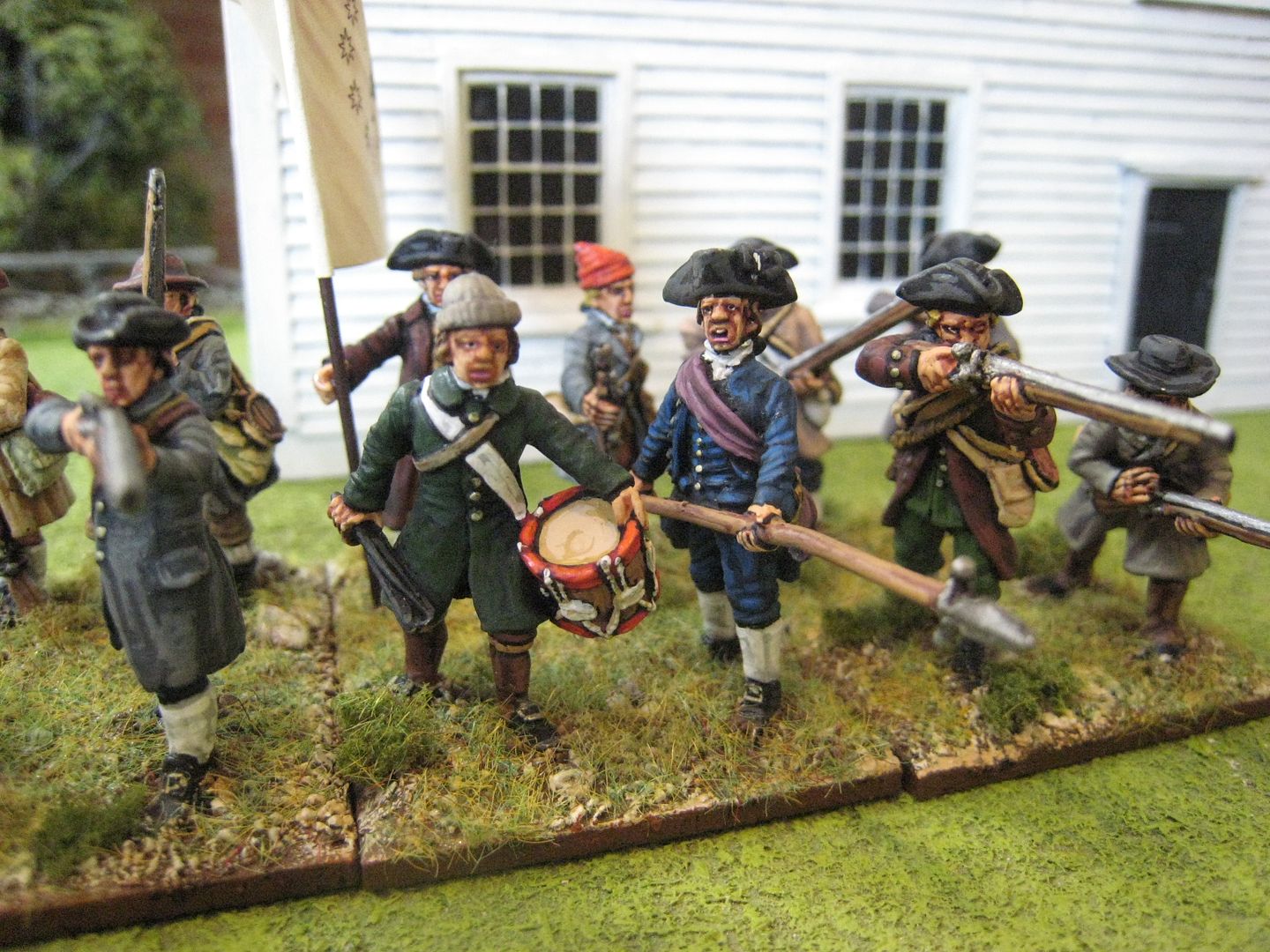
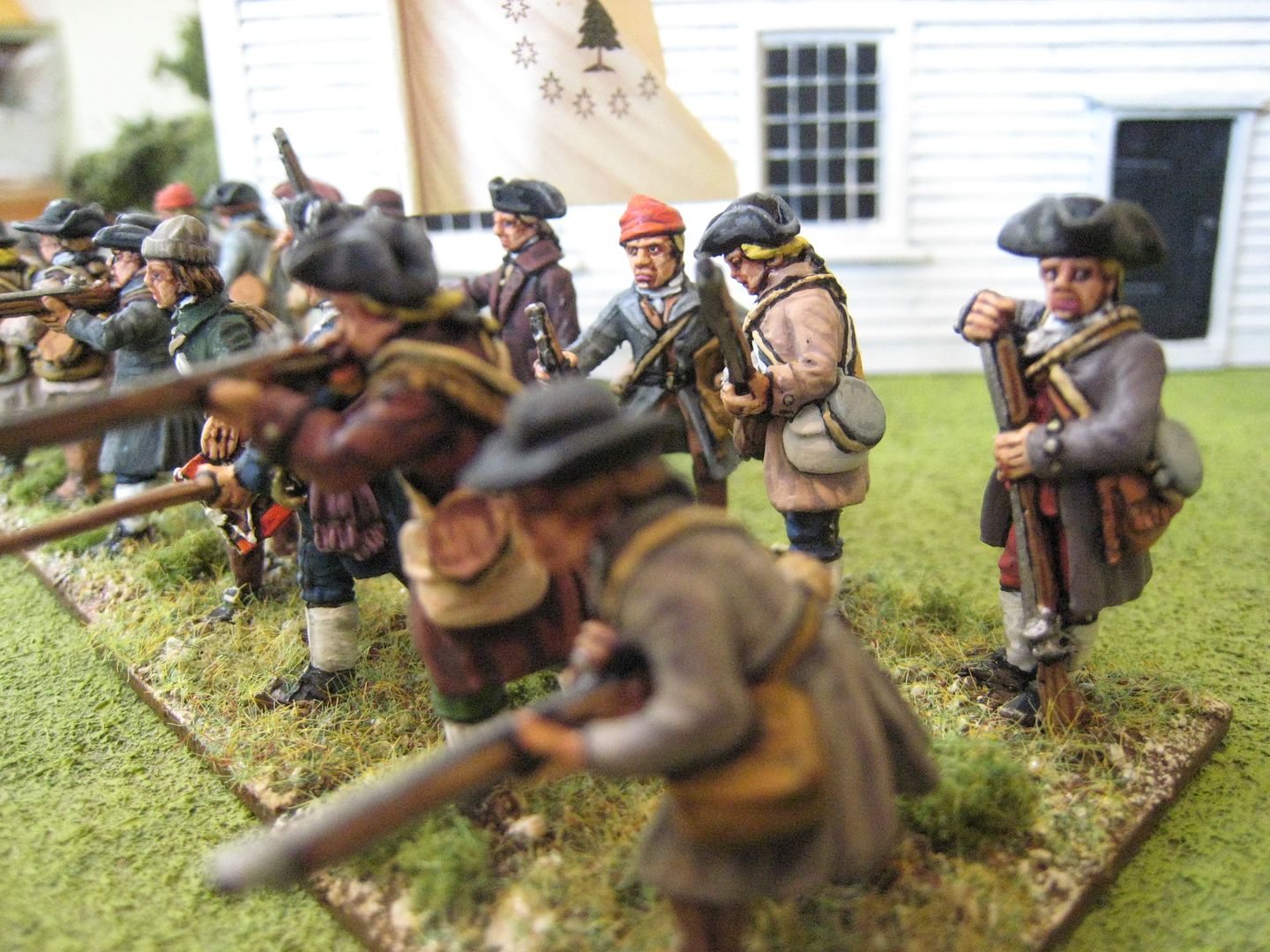
This unit, the first of two militia "firing lines" that I've been working on, is designed for cold weather service. To build a 16-figure unit requires a bit of doubling-up on figures, but I think there are only 2 pairs of the same figure, such as the Foundry figure in the liberty cap - I stupidly painted both caps red, which makes the figures jump out a bit. Those caps aside, I deliberately used a more muted palette on these - lots of greys, browns, dark greens and tans on the coats, many from the Foundry WW2 and ACW paints. In most cases I painted the breeches and the waistcoats in the same colours, as wearing this kind of "suit" seems to have been popular (according to contemporary portraiture, which of course probably reflects the richer end of American society; but then again Don Troiani has militiamen dressed like this too). I painted the officer in the dark blue suit Troiani uses for a similar-looking chap in his Bunker Hill painting - I'm not entirely sure which of Stark, Warren or Putnam this person is supposed to be (if any of them - I'm assuming the other Perry officer figure is modelled on Troiani's William Prescott, the person in the long, grey coat).
There's then the question of flags and whether militia carried them. I've already used my "Bunker Hill" flags (on very early units that aren't anywhere on this blog) so selected one of what GMB call "ex King's". I understand that this type of flag would have been a pre-war militia or provincial flag with the union jack in the corner removed. I think it looks pretty nice. The photos aren't the best, I'm afraid. I find taking shots of firing line figures can be tricky to focus correctly.
16 figures. Painted August/September 2013. Flag from GMB.
As a general concept this north/south distinction clearly works. I've been to South Carolina and seen how hot it can get there and the shirtsleeve types are more suitable for summer campaigning in the South. But of course it gets hot in the northern states as well and it's worth remembering that two of the best known southern theatre battles, Cowpens and Guilford Courthouse, were fought on damp, cold days in January and March respectively (I've seen references to the temperature at Guilford as being around 45-50 degrees Fahrenheit or 7-10 degrees Celsius). So another way at looking at these militia figures is to think of them as being suitable for "hot" days and "cold" days. The Perry southern militia figures with bayonets are perfect for representing Continental infantry in battles in the north such as Monmouth, which was fought in June on such a hot day that troops on both sides collapsed from the heat and many Americans took off their uniform coats and fought in shirts and waistcoats. Bunker Hill was fought in mid-June and while I've experienced first hand how utterly freezing Boston can get even as late as April, I expect by June it's usually reasonably clement. Don Troiani's excellent painting (see here) of the "whites of their eyes" moment certainly has men in coats and shirtleeves Of course, on the tabletop none of this really matters - militia are militia irrespective of what they're wearing - but the choice is there if you want it.
This unit, the first of two militia "firing lines" that I've been working on, is designed for cold weather service. To build a 16-figure unit requires a bit of doubling-up on figures, but I think there are only 2 pairs of the same figure, such as the Foundry figure in the liberty cap - I stupidly painted both caps red, which makes the figures jump out a bit. Those caps aside, I deliberately used a more muted palette on these - lots of greys, browns, dark greens and tans on the coats, many from the Foundry WW2 and ACW paints. In most cases I painted the breeches and the waistcoats in the same colours, as wearing this kind of "suit" seems to have been popular (according to contemporary portraiture, which of course probably reflects the richer end of American society; but then again Don Troiani has militiamen dressed like this too). I painted the officer in the dark blue suit Troiani uses for a similar-looking chap in his Bunker Hill painting - I'm not entirely sure which of Stark, Warren or Putnam this person is supposed to be (if any of them - I'm assuming the other Perry officer figure is modelled on Troiani's William Prescott, the person in the long, grey coat).
16 figures. Painted August/September 2013. Flag from GMB.
Subscribe to:
Posts (Atom)