Wednesday, 27 January 2016

New York Volunteers

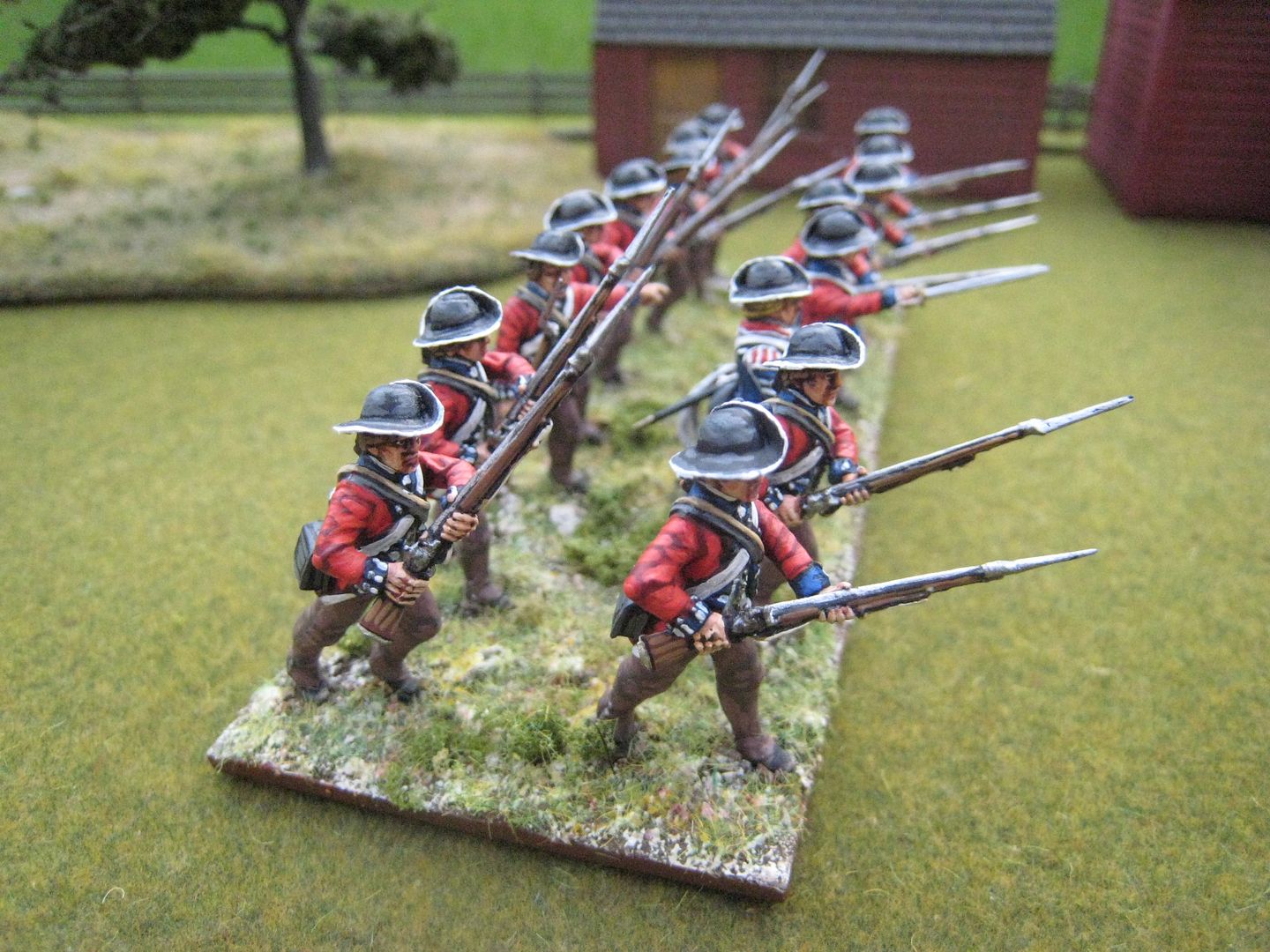
Despite the title of this post, when we have here is my generic loyalist unit that has multiple identities: New York Volunteers, New Yersey Volunteers and North Carolina Volunteers.  Research suggested that all those regiments wore red coats faced dark blue in the post 1779 period (if not earlier) and so I decided that one unit of Perry plastic British infantry with slough hats would do for all of them, given that they appear in different scenarios.  Rather than try to provide a history of each of these regiments, I set out below the "British Grenadier!" scenarios in which they appear:

- New York Volunteers: Hudson Forts (16); Hobkirk's Hill (18); Eutaw Springs (12);
- New Jersey Volunteers, 4th Battalion: Springfield (12);
- North Carolina Volunteers: Stono Ferry (8); Savannah (6).

The "Hudson Forts" scenario is the attack on Fort Washington in November 1776, so it's quite possible that the New York Volunteers were not in their red uniforms at that time.  And the uniforms probably didn't have lace - but as I explained in my general post on loyalists, I'm not really that fussed about lace to be honest, and I've decided to use the Perry British plastic figures for some of my loyalist units.  I wanted these chaps to look more uniform in appearance than the other loyalist units I've painted recently, so the colours of the overalls are the same.  Also, I know the Hobkirk's Hill scenario requires 18 figures, but I had to make a call on whether to base these figures in fours or sixes and I decided fours; which meant I wasn't going to paint 20 just so I'd have the 18 for that scenario.  I'm sure in due course I'll be able to add a couple of singly-based figures.

I expect the red-faced-blue uniform works for other loyalist regiments in the later war period, so if you only want one generic unit to represent loyalists in the south you could do a lot worse than something like this.  On the painting desk at the moment: Dabney's Virginia Legion, the 76th Foot (again) and mounted highland colonels.

16 figures.  Painted December 2015. 


Monday, 18 January 2016

King's Carolina Rangers

In June 1779, Thomas Brown's East Florida Rangers were converted into a regiment of infantry.  Brown remained Lieutenant-Colonel.  The regiment consisted of nine companies, one of which became a troop of dragoons in 1782.  It saw action in the defence of Savannah in September and then in June 1780 took part in the recapture of Augusta.  After that the regiment seems to have been involved in patrolling and raiding around South Carolina and Georgia and it was invovled in the Battle of Hanging Rock on 6 August 1780.  Augusta fell to the Americans in October 1781 and most of the regiment were captured.  Voluteers helped reform the unit and at the end of the war the regiment found itself in St Augustine in East Florida, where it was disbanded.  Several thousand loyalist refugees had collected in St Augustine, which was thought to be safe British territory.  To their dismay, East Florida was ceded to Spain by the Treaty of Paris of 1783 and so they had to leave.  The loyalists, including the men of the King's Carolina Rangers, who presumably saw no point in returning "home", were settled in various other British territories.  Thomas Brown went first to Abaco Island in the Bahamas and then in 1799 to St Vincent's Island.  He remained there, working his plantation until his death in 1825. 

There is a good re-enactors site here, from which I took much of the historical material above.

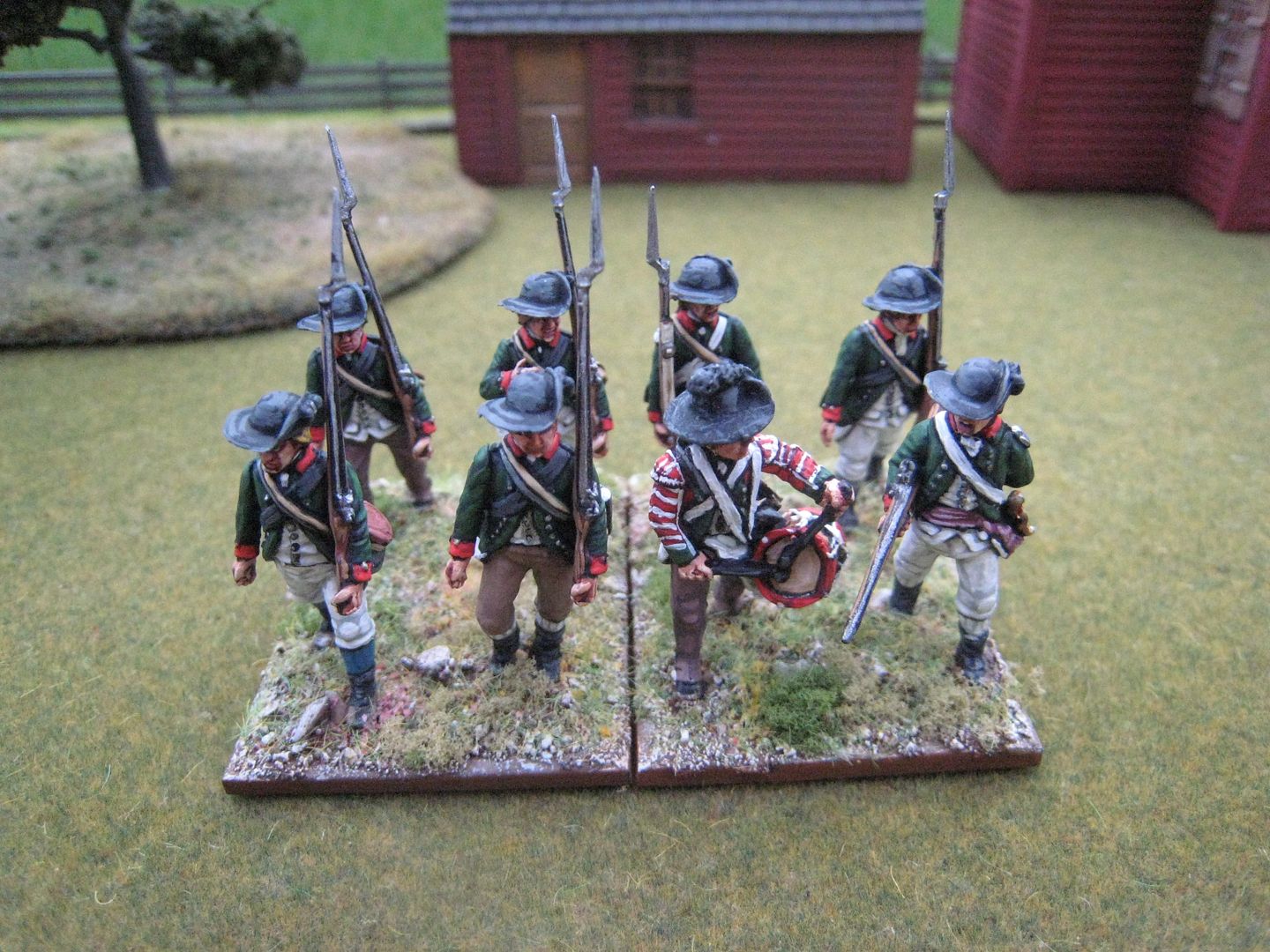
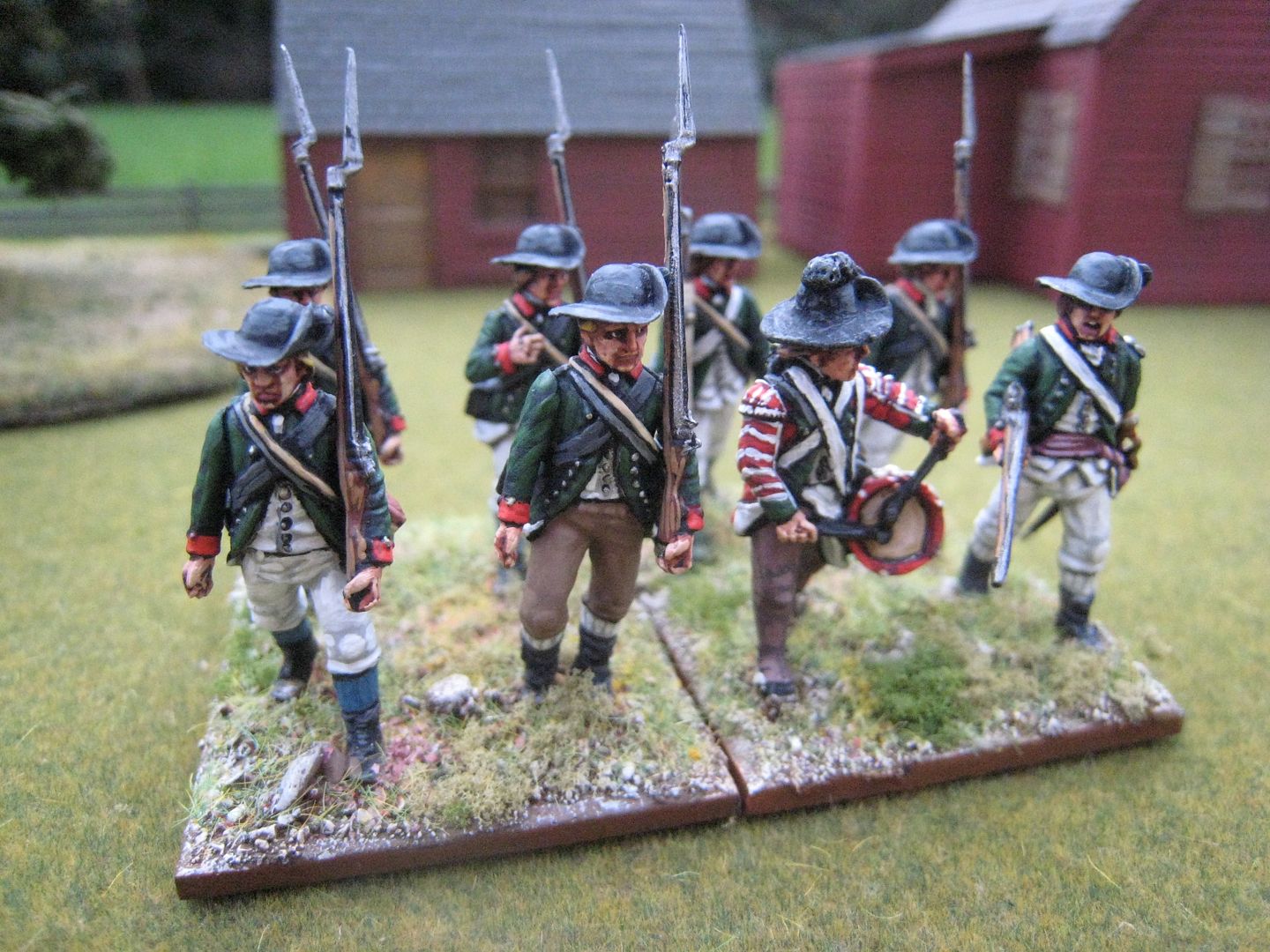
This regiment appears only once in the published "British Grenadier!" scenarios - an 8-figure unit for Savannah.  These are mainly Perry plastic Continental infantry with slouch hats from the plastic British infantry set.  The drummer is from one of the Perry metal British.  As is common with many AWI gamers, I imagine, I have lots of spare drummer and ensign figures from both sides, so it's always handy to use them up.  The drummer has lace and a plume, which none of the other figures have, but who cares, frankly - I thought it would be nice to give the unit a bit of colour, and I do like the dark green/red uniform combination.   I painted a standard flowery "GR" cypher on the drum, but you can't see it in any of the pics.  I like the pose of the officer, with his left arm calmly held behind his back.  The shoulderbelts are black to carry over the cavalry uniform - I suppose they should probably be white.  I made up the NCO without really thinking about it - he is very much an "American" NCO, with an epaulette on the right shoulder and no sash.  I was going to use this figure for something else but then decided I couldn't be bothered.  Maybe it's a temporary uniform or he lost his sash.  For a small, esoteric unit like this, life's too short to worry about details like that, in my view.   

8 figures.  Painted November 2015.


Thursday, 14 January 2016

Ninth year anniversary

Last Monday this blog reached it's 9th birthday.  It's 3 years older than Hugo and, as of 16 February, 6 years older than Monty.  I find I look back to the pre-children years much less frequently now.  I wouldn't be without the boys for anything and wargaming has now contentedly learnt to fit around them.  In a way, having children can be quite liberating as I no longer have the disposable cash to fritter away on new figures, coffee-table books and other impulse buys that are, ultimately, a waste of money: less clutter, less money thrown away.  Last year I made a deliberate attempt to buy as little as possible (I think I bought about seven Perry packs in total) and rely on the lead- and plastic-piles for my painting.  It's worked pretty well and this year I'm intending to carry on in that fashion.  I have a couple of ideas for new periods, or at least new collections; but those will have to wait until (a) my piles are almost gone and (b) funds become available that don't have to be put towards the house or the children.
So 2016 looks set to be: more AWI, particularly British and loyalist infantry; finishing off what's in the First Carlist War pile (just a couple of units, I think); ditto for the NZ Wars leadpile (more Maori and British sailors).  I don't have a burning desire to paint any more 1815 stuff at the moment, although I have a few French light infantry on the go, but I expect that will change later in the year.  In the meantime, I have several French high command stands still to base and I've just finished painting another of the Perry Waterloo vignettes.  So that's the plan for this year.  In terms of what I painted last year, I think the tally is as follows:

 - AWI: 136 infantry, 25 cavalry;
- Napoleonics: 38 infantry, 27 cavalry;
- NZ Wars: 26 infantry;
- First Carlist War: 12 infantry;
- The Sudan: 4 infantry and 1 gun;
- Other: 4 cows (yes, really).

So that's 325 "points" in total.  I painted a lot of cavalry and the majority of the infantry were plastic figures.  The painted figures came from Perry, Eureka, King's Mountain, Gringos 40, Foundry and Redoubt (for the cows), which is a broader spread than usual.  I only had one game this year, but the first I've put on myself at home - Freeman's Farm when Chook came to visit from NZ.  The photos in this post are from that game.  The only show I got to was Salute (which I see this year falls square on my birthday), and I can't see myself attending any others this year.  As well as catching up with Antipodean friends like Chook and Melbourne's John Baxter, a highlight of the year was seeing the much-awaited 4th AWI scenario book published by Caliver.

In terms of blogging, things slipped badly at the beginning of last year but the blog saw a resurgence in autumn.  I'm really going to try harder this year to post regularly.  Having a large backlog of stuff to post about will help.  If I can finish off my Stonewall Jackson command stand I'll even post about the 150-odd ACW figures I've painted over the past 4 years!  I do intend to make a real effort to post at least once a week, even if it's just boring "wip" stuff.  With that in mind, here's a bad photo of my latest Waterloo vignette.  Better photos in due course...


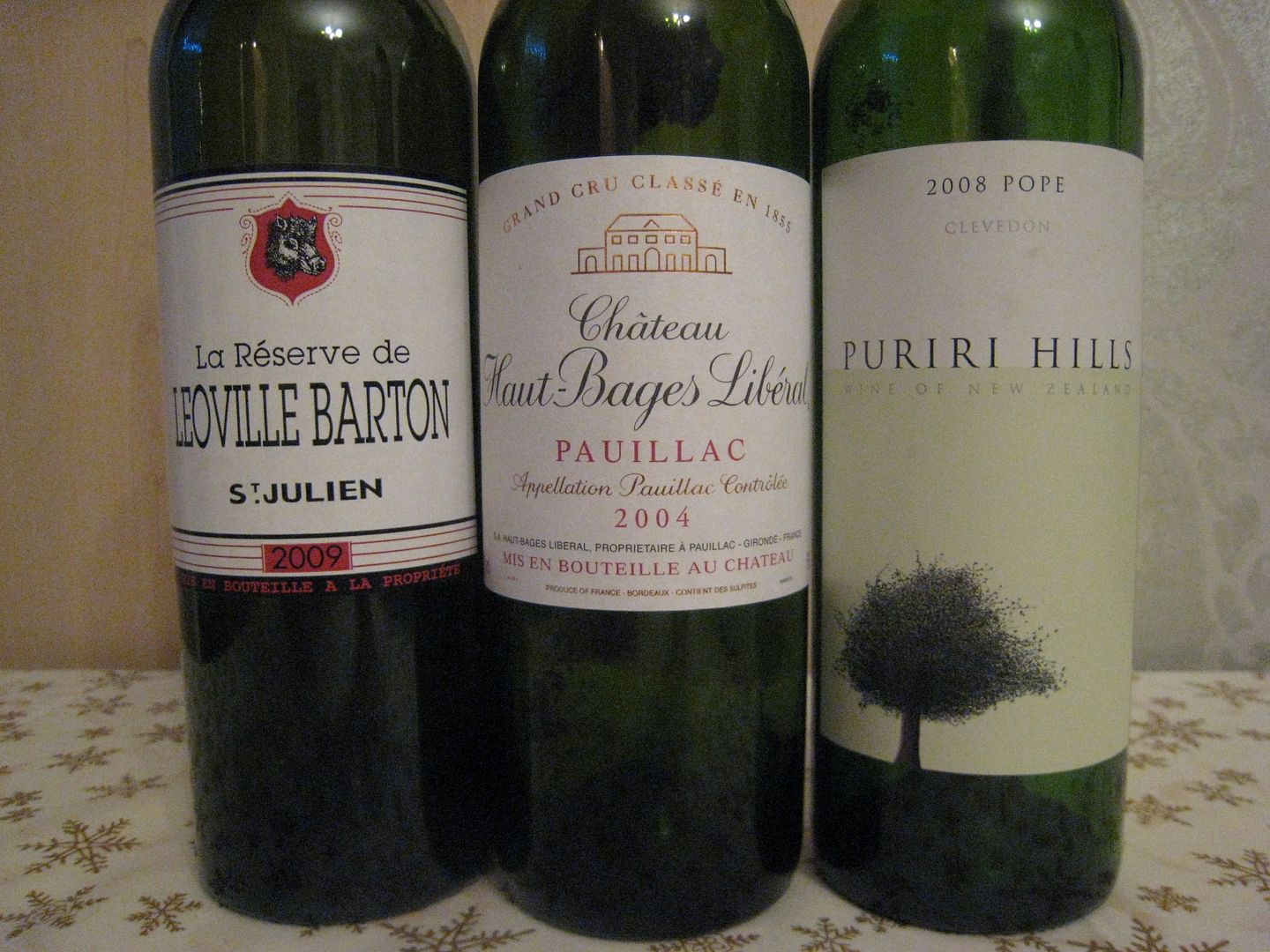
In previous posts of this nature I've made a note of the wines my family drank at Christmas.  I don't have a label for wine posts, but there are plenty in this blog.  This year's champagne was from Pol Roger and the reds included, as per usual, something from NZ boutique producer Puriri Hills.  Having had a bottle of Chateau d'Yquem 1997 each year for the past 11 years we are now down to our last year.  Due to an unfortunate accident, most of the vintage Dow's 1983 port ended up on the floor; but I had a glass and it was superb.   Happy New Year!   


Monday, 4 January 2016

East Florida Rangers

The East Florida Rangers were a band of loyalist militia raised by Thomas Brown in 1776.  Brown was born in Whitby in Yorkshire and emigrated to America in 1774, when he was 25.   He settled in Georgia and founded the community of Brownsboro.  In August 1775 he was confronted by a crowd of patriots who wanted to know where his loyalties lay.  When Brown told them that he refused to take up arms against Britain a brawl ensued and Brown suffered a fractured skull.  Apparently he was then tied to a tree where he was "roasted by fire, scalped, tarred, and feathered".  To use modern terminology, this experience "radicalised" Brown and he set about mobilising Georgia's loyalists and the local Creek indians.  He was particularly successful in securing Creek support for the Crown and in 1779  he was appointed Superintendent of Creek and Cherokee Indians.  In the meantime, however, he led a group of mounted loyalists which became known as the East Florida Rangers or Brown's Rangers.  It's not entirely clear to me why the unit's name references Florida rather than Brown's home state of Georgia.  The answer may be that the authorisation for the unit's formation came from Colonel Patrick Tonyn, the governor of East Florida from 1774 to 1783.  In 1779 the East Florida Rangers were reformed as a regiment of infantry.  More on that, and Thomas Brown's later exploits, shortly.
 
I didn't set out deliberately to paint this unit.  I saw that I had 6 standing Eureka cavalry figures left over and thought about what to do with them.  Given that the figures were in a mix of hunting shirts and uniform coats, I started looking for a suitable patriot unit.  But then I noticed that the drummer was a negro (a figure I've never seen before and I'm not even sure he's pictures on Eureka's website) and I thought that a loyalist unit might be more appropriate.  Flicking through the Osprey MAA on loyalist troops I noticed that the East Florida Rangers were recorded has having recruited some coloured men and clothing some of its men in linen hunting shirts - perfect!  Even better, the unit appears in one of the BG scenarios, Briar Creek (with 6 figures).  The only problem I could see was that I didn't have enough round hats to go with the figures - I didn't want to use Continental-style helmets and tricornes don't fit on the "at rest" figures.  But this was easily solved by using leftover slouch hats from the Perry plastic British infantry box.  The coats were painted with the Foundry "French Chasseur a Cheval Green 71" palette, with a final highlight of 70B.  For the hunting shirts I used "Raw Linen 31" - not a colour I normally use for hunting shirts, but I wanted something that would blend in with the green coats. 

This is a nice little unit, I think; it's a bit different and certainly not something I've seen modelled before.  The "look" is rather conjectural, since I moulded the uniforms around the figures that I already had.  But, as noted above, the notes in the Osprey MAA seem to fit (although the reversed coat on the drummer is artistic licence) and I think this is as good a representation as any without access to mounted figures in frontier/civilian dress.  The colour scheme of the coats looks forward to the subsequent infantry unit formed in 1779.  The officer is a bit old to be Colonel Brown himself, who was in his late twenties.  Then again, all that tarring and feathering may have caused his hair to fall out - who knows?  I was tempted to put the two hunting shirt guys on a base by themselves, for potential use in patriot units, but in the end I just mixed them in with the others.  Again, this is the sort of unit for which the Eureka Miniatures' cavalry range is invaluable.

Happy New Year, everyone.

6 figures. Painted November 2015.


Thursday, 24 December 2015

2nd South Carolina

The past month's been manic, so sorry for the late arrival of this post.  This unit is the last in my trilogy of Perry plastic American regiments (see also the 3rd New Hampshire and the 10th Massachusetts).  I painted these South Carolina chaps a good few months ago, but I failed to sort out the flag and then forgot about them.  I've wanted to paint up some South Carolina regulars since I visited Charleston some years ago and saw the uniform in the local museum (see here).  However, I couldn't find any figures with the suitable caps until the Perry plastics came along.  I chose the 2nd regiment because it features as a 20-figure unit in the Savannah scenario, the figures for which I've been building up over the past couple of years or so.  Also, the handy uniform guide in the Perry box said that the 2nd regiment may have had some men in white hunting shirts, and I thought a mix of white shirts and blue regimental coats would look quite smart.

The 2nd South Carolina Regiment was raised in June 1775, one of five regiments authorised by the state's government (so these units did not form part of the Continental line).  The 2nd's war service was largely limited to actions in its own state, although detachments seem to have served in Florida.  The regiment was part of the force that successfully defended Fort Moultrie at the Battle of Sullivan's Island in June 1776.  Sullivan's Island was in the entrance to Charleston's harbour and its successful defence denied the British fleet its intended capture of Charleston.  The regiment saw action at the American/French attack on Savannah in 1779 and the following year again took part in the defence of Charleston against British attack.  This time the British were successful and the regiment passed into captivity in May 1780.

I have a bit of a backlog of completed unit again so there will be more loyalist stuff after Christmas.  In the meantime, a very happy Christmas to all readers.

20 figures.  Painted April-May 2015.  Flag by GMB. 


Thursday, 26 November 2015

Loyalist plans

My last two posts have been about loyalist units and I mentioned that I've been doing some thinking on how to build up the loyalist part of my collection.   So I thought I'd set out my plans - this post might be useful to some people and I'd certainly appreciate thoughts and suggestions from others.  Most AWI gamers will know the basis "rules of thumb" for loyalist uniforms.  Many of the loyalist troops who were properly uniformed started out in green coats and then changed to red ones around 1777/78.  The uniform coats probably didn't have button hole lace, although some of the larger units did in their "red coat" incarnations.  For that reason, it's common for gamers to use "Continental" figures for loyalists rather than "British" ones.  Many units seem to have worn round or slouch hats.  Some of loyalist units adopted a light infantry-style of dress, with leggings or full gaiters and caps.  Gaitered trousers/overalls seem to have been very popular, as opposed to breeches and half-gaiters. 

With the figures currently available in 25mm you need to make a few compromises.  For example, if you want 25mm infantry in unlaced coats and full gaiters, like the Don Troiani Prince of Wales Volunteers here, then you're currently out of luck (I suppose you could use the Perry Hessian garrison troops, with a bit of conversion work).  Ditto if you want cut-down uniform coats, Indian leggings and round hats, like the Don Troiani Jessup's Corps of Loyalists here (you'd need to use Perry Saratoga figures and do some head swaps).  However, if you want unlaced coats, overalls and slouch hats, like the Don Troiani King's American Regiment here, then I think there are two ways to go at present: Perry plastic Continentals with hats from the British plastic set or the Fife & Drum British Guards figures (which don't have lace).  The former option isn't ideal because only half the Perry plastic Continentals wear overalls.  If you want figures that aren't in a marching pose, then it becomes more difficult and my solution is to use the Perry British plastics, even though they have lace.  I'll also mention King's Mountain Miniatures, as they have a massive range of separate heads which include several sets that are suitable for loyalists.  A further option is to be mega-creative and mix up all kinds of metal figures, as Steve Jones did with his South Carolina loyalists.

So the decisions I've made are within the contraints outlined above. I admit to not being particularly fussed about button hole lace - what's more important to me is the overall look of the unit and whether the head gear and poses suit the look I'm after.  I've also tried to double-up some units to increase their use, and that usually requires further compromise on particular uniform details.  The list isn't finite - for example, I've yet to decide what to do about Butler's Rangers and the infantry element of the Britih Legion.  As usual, references to battles are to the 4 Caliver/"British Grenadier!" scenario books.  Also worth a mention is Steve Jones' "Rebellion" supplement for the "Black Powder" rules, which contains an excellent section on loyalists and their uniforms. 

First, there are the well-known units for which particular figures have been made by Perry.

- Queen's Rangers (Brandywine, Monmouth, Germantown, Whitemarsh, Springfield, Gloucester Point).  20 figures will see you through most scenarios.
- Volunteers of Ireland (Camden and Hobkirk's Hill).  

Secondly, there are a number of other units which I propose to model with (largely) Perry Miniatures' plastic figures. These vary in size and follow the units involved in the scenarios.  There's nothing wrong in my view with painting up 24 figures in green faced red coats, or red faced blue coats, and having them stand in as generic loyalists for each and every scenario.  That would obviously save on money and painting time.  But I'm rather anal when it comes to the AWI and I appear to have accumulated several boxes of Perry plastics, so I'm going to have a stab at painting up several units which try, insofar as is possible and practicable, to be reasonably close to what the units may have looked like.  I haven't included "loyalist militia", which appear in a couple of scenarios (which I painted up last year).

- green coats faced blue, tricornes: Emmerich's Chasseurs (Indian Field, Hudson Forts), Prince of Wales' Volunteers (Newport) -  12 figures; Perry plastic Continentals; see here.

- green coats faced white, round hats: King's American Regiment early uniform (Hudson Forts, Newport) - 30 figures; Perry plastic British.

- green coats faced orange, tricornes: King's Orange Rangers (Hudson Forts) - 12 figures; Perry plastic British; see here.

- green coats faced red with green lapels and slouch hats: King's Carolina Rangers (Savannah) - 8 figures; Perry plastic Continentals with British slouch hats.

- green coats faced red, tricornes and Saratoga caps for the light company: King's Royal Regiment of New York (Oriskany) - 28 figures; Perry plastic British.

- green coats faced red, slouch/round hats: Loyal American Regiment (Hudson Forts) - 16 figures; Perry plastic Continentals with a mix of British and American hats.

-  red coats faced blue, white slouch hats: De Lancey's Regiment (Eutaw Springs; Savannah) - 18 figures; Perry plastic British.

- red coats faced blue, slouch hats: New York Volunteers (Hudson Forst, Hobkirk's Hill, Eutaw Springs), North Carolina Volunteers (Stono Ferry, Savannah, Camden) - 16 figures; Perry plastic British.

- red coats faced blue, tricornes: New Jersey Volunteers (Springfield) - 12 figures, Perry plastic British.

- red coats faced olive green, tricornes: King's American Regiment later uniform (Hobkirk's Hill) - 16 figures; Perry plastic British.

- red coats faced green, slouch/round hats: Queen's Loyal Rangers (Bennington) - 12 figures; Perry plastic Continentals with a mix of British and American hats and some metal militia.

- red coats faced yellow, slouch/round hats: South Carolina Royalists (Stono Ferry; Hobkirk's Hill) - 16 figures; Perry plastic Continentals with mix of British and American hats. [I might copy Steve and mix in a few metal militia types.]

I'm sure some will disagree with the above.  For example, should the King's Royal Regiment of New York have red or blue facings?  You can read a discussion about that on the re-enacted unit's website.  I decided to follow James Kochan and go with red, largely because I love the Don Troiani painting of the Battle of Oriskany which shows members of the regiment in light infantry caps and red facings.  There's a fair amount of work to be done in painting up the units listed above.  If I run out of plastics I might have to treat myself to some Fife & Drum Guards.  I'm already working on the King's Carolina Rangers and next in line will be the New Jersey Volunteers.

Monday, 23 November 2015

Emmerich's Chasseurs (2)

This is the infantry component of the loyalist corps raised in 1777 by the German soldier Andreas Emmerich.  For the cavalry troops see my previous post here.  Emmerich raised a rifle company, a light company and three companies of "chasseurs".  As a representation of all these infantry troops I decided to use the Perry hard plastic Continental infantry rather than mess around with British light infantry figures or attempt conversions.  In any event, the uniform is similar to that of the Lefferts painting, save that these plastic figures don't have full gaiters.  A lot of illustrations of loyalist infantry show the men in either full gaiters or Indian leggings; however, as yet there aren't any Perry AWI figures you can use to represent this uniform other than the metal Saratoga British, which of course have their particular style of headwear.  The two officers are metal figures.  The one in front, who is supposed to be Emmerich himself (at the age of 40/41 he has a bit of grey hair) is from Foundry; the chap in the second row waving his hand is by Perry Miniatures.

I wrote in my previous post that Emmerich's Chasseurs were disbanded in late 1779 due to internal friction and recruitment/retention problems.   After the war Emmerich returned to England and in 1789 he published "The Partisan in War", his thoughts on the American Revolution and the use of light infantry (see a pdf here). He then had plans to publish a five-volume autobiography entitled "Histoire Memorable de la vie du Lieutenant-Colonel-Anglois Andre Emmerich", but that didn't progress very far.  Emmerich had grown up in Hanau, a town which from 1736 (the year before Emmerich was born) formed part of the state of Hesse-Kassel. In 1806 the Holy Roman Empire was disbanded by Napoleon after his victory at Austerlitz and the Confederation of the Rhine was created in its place.  The following year, Hesse-Kassel became part of the new Kingdom of Westfalia, over which Napoleon's brother Jérôme was appointed king.  Emmerich, always in pursuit of adventure despite being in his 70s, became involved in an insurrection against the new French regime.  He was captured in June 1809 and executed by a firing squad in Kassel on 19 July, 1809.

In terms of scenarios, Emmerich's Chasseur appear in units of 4 figures for the Hudson Forts and 12 for Indian Field (in addition to 4 cavalry).  However, I also intend to use these figures for another loyalist outfit, the Prince of Wales' Volunteers, who appears as a 12-figure unit in the Newport scenario (August 1778).  The PoWV are also recorded as having green faced blue coats, at least in the early years of the war.  The paintings by Don Troiani have the PoWV with white rather than black cross belts and white tape on the tricornes (see here and here).  I confess I should have painted white lace on the hats, not least because that's a good way of distinguishing between loyalist and patriot troops.  I've been giving loyalists a lot of thought and research recently, as I'll be focussing on them over the next couple of months.  If anyone's interested, I can post a list of the units I intend to do, with notes on figure and uniform choices.  Currently on the painting desk are the East Florida Rangers (mounted) and its successor unit, the King's Carolina Rangers (foot).  The latter will be the last Perry plastic Continental infantry figures I paint for a while.

12 figures.  Painted October/November 2015.