Sunday, 21 April 2013

Salute 2013

By now, plenty of others have blogged about Salute and I don't really have much to add, certainly on the news front.  My immediate impressions on arrival were that the spacing and arrangements of tables was much better, creating more of a sense of space and providing wider thoroughfares.  I think the Warlords have cracked the venue now.  The advance tickets queue was, once again, enormous, although it did get us all in reasonably quickly.  I have felt for a couple of years that the Warlords should sell a smaller number of these tickets, and I heard one of the ushers make this point to the people behind me in the queue.  General attendance seemed up; the number of games seemed down.  As always, there were several traders I'd never heard of and others I had expected but weren't there (where was North Star?).

I felt (as did some of my companions) that the "wow factor" in the demo games was rather lacking - that's not to moan about what I know is a huge effort from anyone who goes to the trouble of putting on a game at Salute, but simply a subjective view.  With a couple of exceptions, the historical games seemed smaller and less ambitious than usual; and there were some I'm sure I'd seen before, either last year or the year before (probably because they are essentially adverts for particular products).   Also, and again with a couple of notable exceptions, there was the familiar fare of WW1, WW2, Dark Ages, ACW and Naps (plus masses of sci-fi and fantasy).  I know those are the most popular periods, but again there seemed a lot that was familliar or just a different take on something another club has done previously.  I'm not complaining - it's always a pleasure to see well-presented games; but in my view Salute can (and should) be pushing the boundaries in terms of presentation and periods and I thought this year was a little flat.  Perhaps this is just what happens when you hit middle-age...

I've also found that over the past 3-4 years I've spent far more time socialising than viewing and shopping.  I'm very happy about that, and enjoyed catching up with several internet and "real-life" chums.  I do enjoy wandering around the games with someone else, especially if their idea of wargaming aesthetics is similar to mine, and this year I did the rounds with another blogger, Malcolm Rose (also a Napoleonic expert and wine importer).  There were a few people I missed "bumping into", such as Legatus Hedlius, who I've never managed to meet at a Salute despite him being one of the tallest wargamers I've ever met and so hard to miss! (And why is it that you always "bump into" those people you've specifically arranged to meet later?)  I enjoyed several glasses of wine with Malcolm and some mates after the show, committing the school boy error of drinking on a completely empty stomach. Ouch.  I caught up with Nic Robson of Eureka Miniatures, having missed him last year - he has some interesting AWI plans.

I exercised birthday boy rights to spend a bit more than usual this year without feel
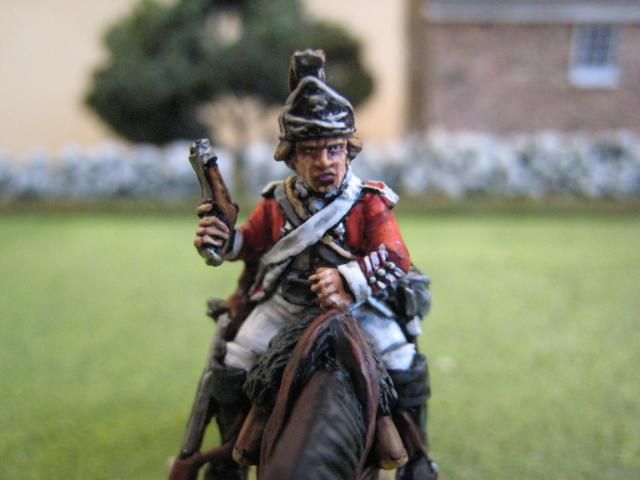
ing guilty (I'm sure Hugo doesn't really want to go to university anyway, so there's no point in saving for it): the new NZ Wars figures from Empress; more AWI cavalry from Eureka; some Galloping Major F&IW settlers for AWI militia; latest editions of various mags (I congratulated Henry Hyde on his "reverse takeover" of Miniature Wargames); the Wargamers' Annual 2013; Warlord's new "Black Powder" Waterloo supplement (an indulgence - the Perry eye-candy was too good to pass up); the new scenario book for the First Carlist War (more on this in a few days); the latest Perry AWI packs; David Bickley's Indian Mutiny rules; lots of paints.  I felt that the price of metal figures seemed to have increased - I bought a few packs of 6 figures that were nudging £10; but then I was reminded that this is about £1.50 per 25mm figure and I suppose that's not excessive.  It does, though, remind one just how important plastics are now if you have ambitions beyond skirmish gaming.

Here are some photos.  They are by no means comprehensive.  I've missed a lot of games and these are just a few I happened to pass when I had my camera out.

This 15mm Stalingrad game from Arbuthnot's Terra Firma League of Gentlemen had excellent terrain and attention to detail:


I think this was Nottingham Irregulars with more WW2 Eastern Front action, this time in 25mm:


Battlefront had Little Round Top in 25mm.  This was one of two excellent "hills" I saw:


The other excellent modelling of gradual height was the Continental Wars Society's 6mm 1866 Austro-Prussian War game.  Beautifully painted figures too:


Frothers Unite had a "Return to the Planet of the Apes" game, with well-thought out terrain:


One of my favourites was the Lance & Longbow Society's 25mm Battle of Cravant, 1423:


Not sure who thins game was from, but it seemed to be centred around a downed WW2 German bomber:


Didn't ctch the name of these guyes either, but it was an early WW1 games:


The only AWI game.  Again, I didn't catch the name of the club, but they were from the Continent.  To me it looked like Eutaw Springs:


Waterloo by the Essex Gamesters (who were all dressed in period costume).  I think they were actually playing the game, but for me there were too many French in bicornes and other anacronisms.  In 25mm, the best way to do Waterloo, in my opinion, is bite-sized chunks.  It was impressive, though:


I wasnt sure whether this was Korea or Vietnam.  Nice terrain again, though:


Finally, another of my favourites, Loughton Strike's Force's Mexixan-American War game:


Tuesday, 16 April 2013

40th Birthday

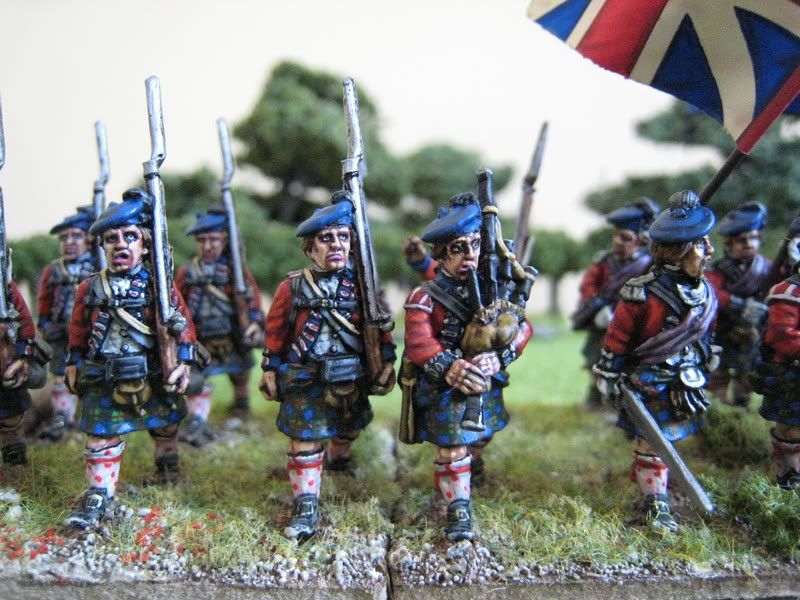
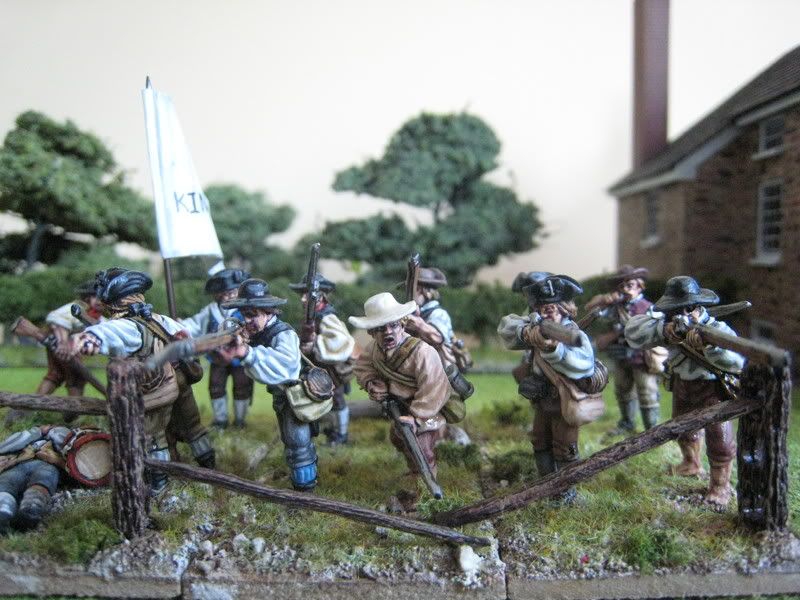
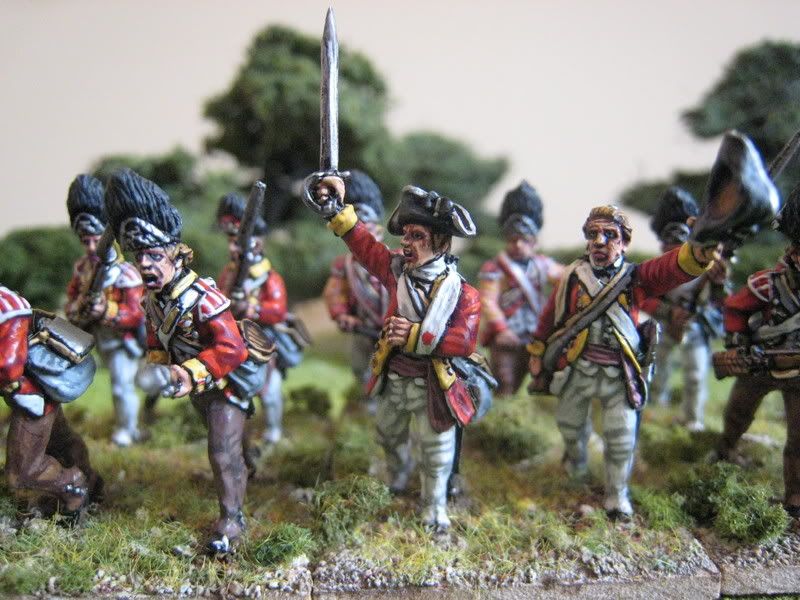
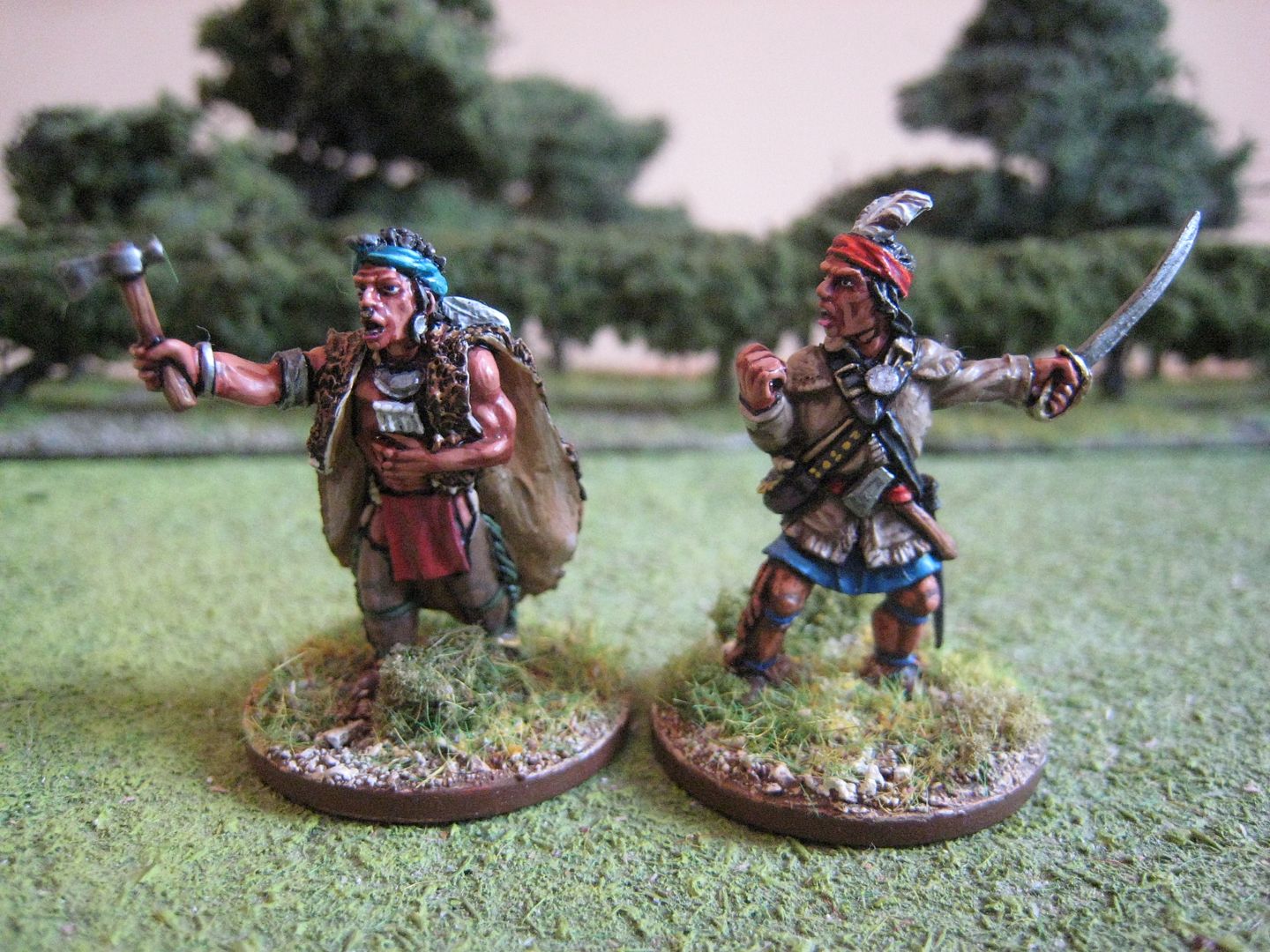
I'm 40 today, a date shared with Charlie Chaplin, Dusty Springfield, ex-Pope Benedict and, so I'm told, some bloke called Rafa Benitez.  My office desk is covered in about a tonne of glitter and someone has put up lots of photos of me as a baby/toddler with, er, "witty" captions.  I suspect the hand of the Kiwi. My birthday always tends to co-incide with Salute,  The very first Salute I attended was actually on my birthday - I think in 1986 when I was 13.  Happily, my spending power is rather better nowadays than it was when I was 13, even with 2 money-devouring children; so I'm looking forward to a couple of "birthday treats" on Saturday.  In the meantime, this seems an appropriate opportunity to thank everyone who reads, follows and comments on this blog and for the extra enjoyment of the hobby I have had from such contact.  Here are some of my favourite photos from the achives to celebrate past 7 years of blogging about toy soldiers.


Monday, 15 April 2013

3rd Chasseurs, 2nd battalion

A couple of years ago, I painted the 4th Chasseurs of the French Imperial Guard and at the beginning of this year I had the urge to paint another battalion.  One of my aims for this year is to paint the complete chasseur division of the Guard for the Waterloo campaign.  The orbat provides for 6 battalions - 1 each of the 1st and 4th Regiments and two each from the 2nd and 3rd.  The Perries give you multiple options, with figures in greatcoats and in full dress, both in standing and advancing poses.  You then have the special figures in scruffy hats which are designed specifically for the 3rd and 4th Regiments.  In order to utilise all these figures, I decided to start off with a very scruffy 4th Regiment and work backwards with each battalion looking less scruffy than the last.  Therefore, this second battalion of the 3rd Regiment uses mostly the specific figures with varied hats but also incorporates some chasseurs in bearskins.  The first battalion of the 3rd Regiment will be completely in bearskins.  Readers will notice that it's the rank-and-file who have the bearskins, and not the command figures.  I expect that any bearskins that were going would have been nabbed by the officers, but never mind.

The 3rd Chasseurs appear in the "General de Brigade" scenario on the final attack of the Guard at Waterloo, where it consists of two battalions of 24 figures each.  For the greatcoats, I used the same recipe as with my French artillery and the 4th Chasseurs - the Foundry "French Blue 65" palette with a final light highlight of "Deep Blue 20B".  I gave more of the figures grey or greying (as with the sappeur) hair than I did with the 4th Chasseurs, as I wanted these chaps to look like grizzled old veterans.  The bases are the larger ones from the Perry plastic boxes, with the edges painted brown to match the rest of my collection. Not much more to say, really.  I don't know when I'll get around to the 1st battalion, but that will then be one "brigade" finished and all the chassuer battalions I'd need for the GdB scenario mentioned earlier.   I do like these figures.  There's something very satisfying about marching French infantry in dark blue overcoats - probably because they're quick to paint! 

24 figures. Painted January/February 2013.


Monday, 1 April 2013

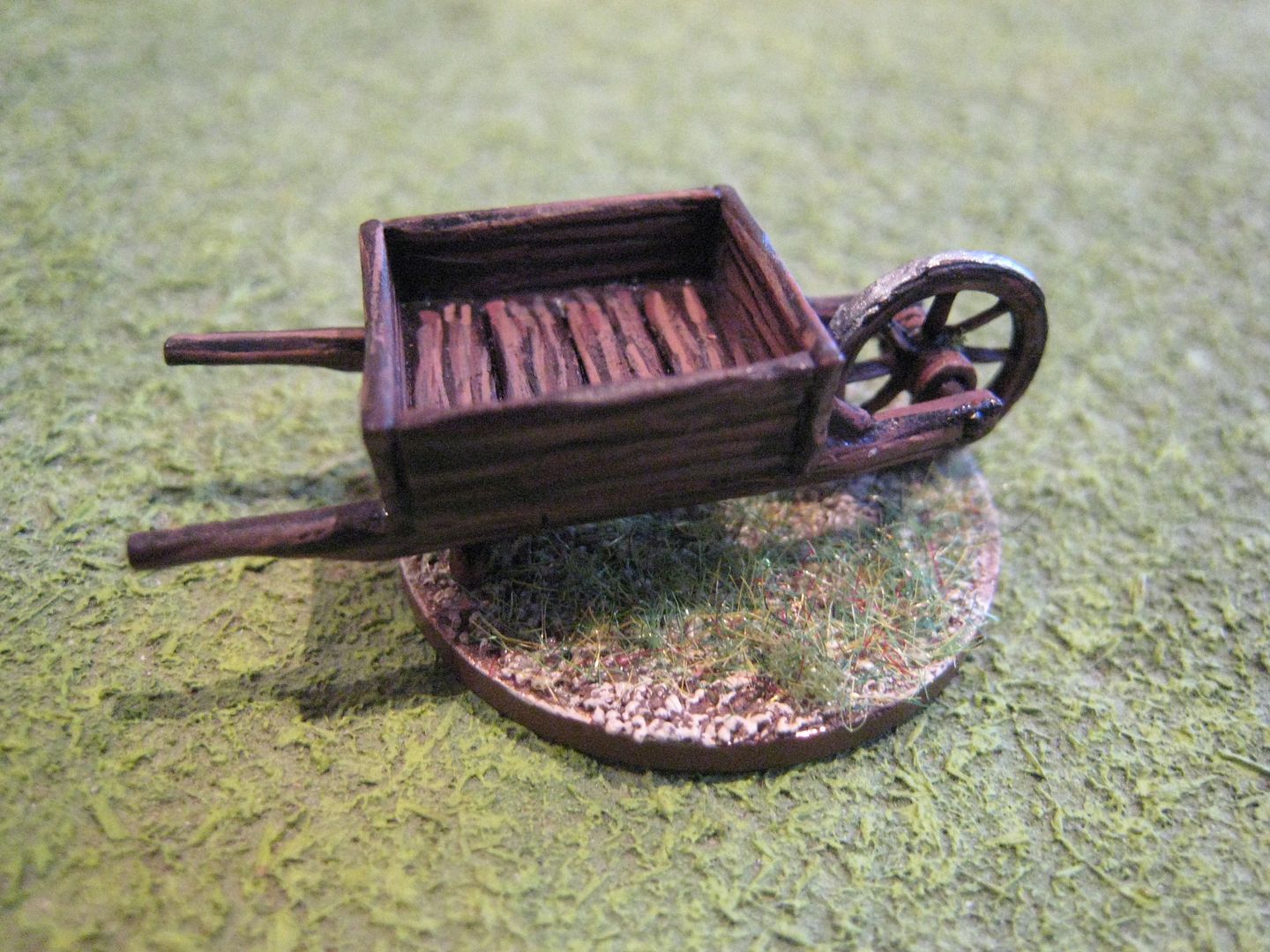
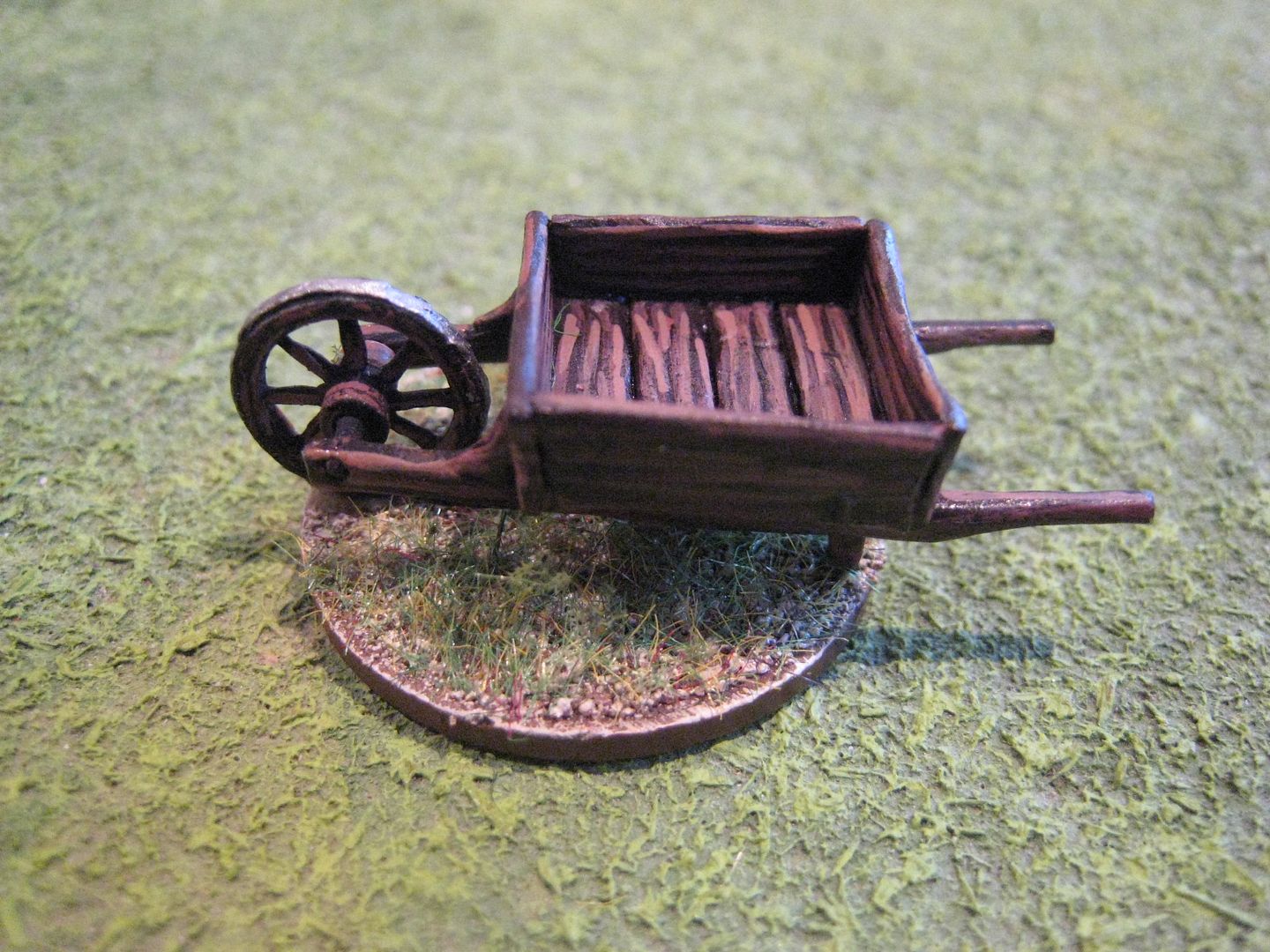
George Washington's wheelbarrow

This is something I've wanted to paint for a while.  During my trip to Boston in April 2007 the Kiwi and I visited Christ Church in Cambridge, Massachusetts.  There was a small display inside which recounted the history of the church and it stated that George Washington and his wife Martha prayed there.  The display also referred to Washington leaving his famous wheelbarrow outside the church while he prayed.  I had hoped to paint this up but couldn't find a suitable model.  However, the Westphalia Miniatures wounded Frenchman set that I bought recently came with an extra wheelbarrow.  Thinking about how to use it, I recalled Washington's wheelbarrow and so tried to find out more.

Much is written about Washington's horses, Nelson and Blueskin, but not so much about his
wheelbarrow. Washington's wheelbarrow accompanied him throughout his campaigns.  It reminded him of his Virginia plantation home and became a symbol of the independent society that he hoped his armed struggle would bring about.  He used it to transport personal items that he didn't carry on his person, such as a spare telescope, extra pistols and ammunition and fodder for his horses.  The wheelbarrow often found itself in the think of battle.  At Long Island in 1776 is was almost left behind in the American fortifications as Washington retreated across and the sergeant in charge of the wheelbarrow's safety, Ebenezer Crouch of the 2nd New York regiment, was demoted to the ranks for his negligence.  On 9 October 1781, as Washington prepared to fire the first cannon shots against the besieged British inside Yorktown, in was in his wheelbarrow that the relevant shot was brought to him.  The wheelbarrow could also turn into an impromptu soapbox.  In May 1782, Washington's army was encamped along the Hudson River and the men, bored, underfed and with pay heavily in arrears, started thinking of mutiny.  A plot developed in the 1st Connecticut regiment, whereby the men would march to the nearest arsenal, seize the cannon and then descend on the Connecticut legislature to demand their pay.  The soldier in charge of the wheelbarrow at this time was a certain Ambrose Gaylord, of the 1st Connecticut.  He tipped off Washington about his unit's intentions. Washington calmly walked to the regiment's lines, upended his wheelbarrow to create a speaking platform and gave an inspirational speech that stopped the mutiny in its tracks. 

I wanted the wheelbarrow to look like it was made from Virginian wood and also as if it had seen action.  I quickly realised I had no idea how to do either of those things, and so painted it to my standard "wood" recipe. Still, I'm glad to be able to add this old campaigner to my American forces.  I might allow it to add a +1 on morale throws when attached to an American unit.

1 wheelbarrow. Painted 1 April 2013.

Sunday, 31 March 2013

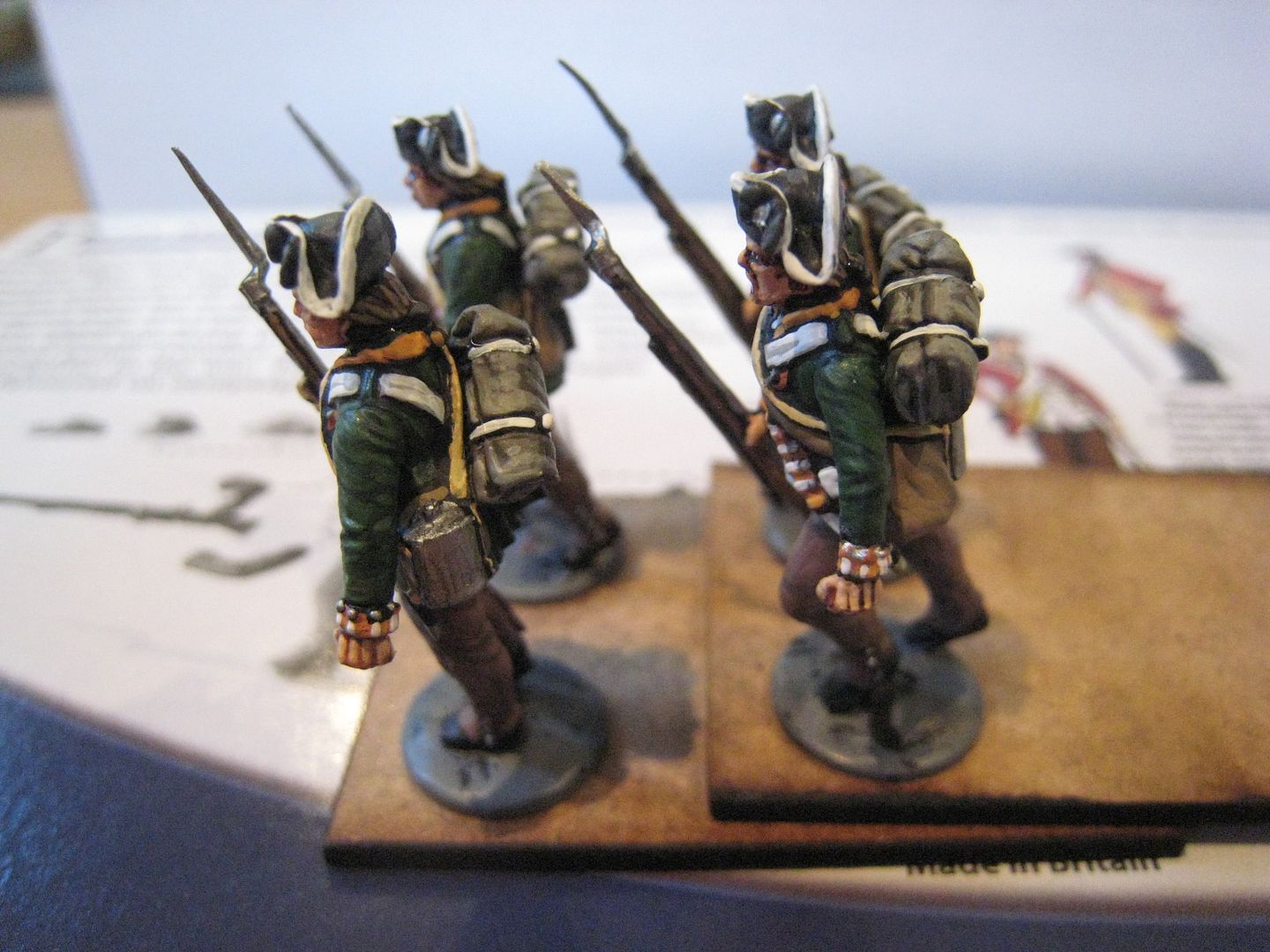
Perry Miniatures plastic AWI British infantry

A lack of painting time over the past couple of weeks means that I don't have a finished painted unit of the new Perry plastic AWI figures, but I thought I'd post some initial impressions now that I've finished painted 4 and have assembled a complete unit of 12.  Each box provides 30 hatmen, 2 NCOs, 1 drummer, 1 officer, 2 ensigns and 2 casualties.  Luckily the Perries are making the command sprue available separately, as this box provides about 2 battalions' worth of infantry at a 1:20 ratio.  The ensigns don't have gorgets, but otherwise are similar figures to the officer - i.e. no lace and no epaulettes; you could perhaps mix and match.  The ensigns don't have to carry the flags, as there are sufficient spare arms to give them swords or muskets. The key feature of this set for a collecting perspective is the different hats - tricornes, "Saratoga" hats and cut-down/uncocked hats.  This makes the figures usable across various campaigns and I very much hope that future AWI plastic sets will continue this theme, as that will increase the variety.

So, the positives: superb detailing and "casting" (I don't know what the equivalent plastic word is!); hardly any mould lines; excellent "Perry" faces; the variety offered by the command figures; ease of painting.  I also like the trail-arms pose (there is a "charging" option too).  This is a new pose in the Perry range and seems an apt one for troops moving quickly through rough and wooded terrain.  I've seen comments from some people who don't like it, but I do.  Marching and firing figures are already available in metal.  Another new feature on these figures are the "tumplines", i.e. rolled blankets in which the troops stored personal items.  These were slung across the back, but the figures are sculpted such that you can leave the tumplines off - all the other necessary straps are sculpted on to the back of the figures.  Finally, these figures are in the one-piece "gaiter-trowsers" (or "overalls" as the Americans called them), which again help on flexibility of use.

To my mind there are two negatives, although I suspect these will dissipate with practice at assembling the figures.  First, there's no obvious place where the tumplines should sit on the figures' backs.  Unlike the French and British Napoleonic infantry, for example, which have clear "bare" areas where the backpacks go, it's tricky getting the tumplines to sit naturally anywhere on the back of the figure. I was expecting there to be a flat bit on the tumplines to indicate the part that is fixed to the figures, but that isn't there either. The back of the figure itself doesn't give any indication, as it's sculpted to work without tumplines being attached. One solution is just to leave them off.  It may just be me, as Eclaireur finds that the tumplines sit well with the upper part across the ammo pouch and thinks a couple of the figures seem to be mildly recessed under the right shoulder to help the fit.  Perhaps I just need to experiment more.  Eclaireur also made the good point of having the folds of the tumplines facing upwards, as otherwise the bits of kit stored inside the blankets would fall out (I think the examples on the Perry website have the tumplines the other way around).  But as it is, I wonder whether the tumplines on the painted figures I've photographed here just look "stuck on".  Another suggestion was to dissolve or heat the bit of the tumpline which is attached to the figure, to bend it a little.  I might give that a go.  I also wondered about the straps for the tumplines, which don't appear to be sculpted on the figures - but apparently the blankets were attached to the canteen or breadbag straps.  (I also couldn't identify the bayonet scabbard belt, but perhaps that is "hidden" under something else.)    

The second issue I've had is that the different hats are very delicate and if you're not ultra careful it's easy to cut chunks out of them when you remove them from the sprue. The hardest ones to cut off are the un-cocked hats (i.e. the hats I'll use most frequently), as they are joined to the sprue by a triangle-shaped bit of plastic that needs to be carefully carved out of the hat.  Again, hopefully this will get easier in time, but it's going to be important to keep some of the leftover hats as spares, I think.

But those two points aside, I have no complaints whatever with the figures and the figures receive a hearty recommendation from Tarleton's Quarter.  The painting guide is right up there with the Napoleonic French hussars box's guide as a model of its kind (almost worth the price of the box in itself).  I had no idea that the troops' overalls came in different colours (white for summer, dark blue, brown or black for winter), and there is a helpful section on loyalist units that are thought to have worn lace on their coats, and so can be modelled with these figures (although, ironically, it seems that the officers of loyalist units often had lace, even if the hatmen didn't; so the command figures here need lace painted on).  And talking of painting, these paint up like a dream.  They are certainly easier to paint than the metal equivalents.  So they officially join the Perry plastic Napoleonic French infantry as being "figures that almost paint themselves".  

So what do I have planned?  Having started 25mm AWI back almost 10 years ago now, I pretty much have every British regiment in miniature.  I'm going to re-do a couple that require larger units for certain scenarios or which appear in "the South" and I only have them painted up in full warrant uniform, and some loyalist regiments as well (ignoring lace issues - I'm not going to bother scraping all the lace off the figures if it transpires that the King's Royal Virginia Rangers or whatever didn't have lace on their coats).  So here's the list:

- 17th Foot: 24 figures (for Princeton);
- 40th Foot: 32 figures (for Princeton);
- 57th Foot: 18 figures (for Hudson Forts);
- 63rd Foot: 30 figures (for Hudson Forts;)
- De Lancey's Regiment: 18 figures - red faced blue, which un-cocked hat;
- Royal North Carolina Volunteers: 8 figures - red faced blue; cocked hat;
- New Jersey Regiment: 12 figures - red faced blue, in-cocked hat (or I might go for the green 1777 uniform);
- Queen's Own Loyal Virginians: 12 figures (green faced red; cocked hat);
- Prince of Wales' Loyal American Volunteers: 20 figures - green faced blue, cocked hat;
- Loyal American Regiment: 16 figures - green 1777 uniform.

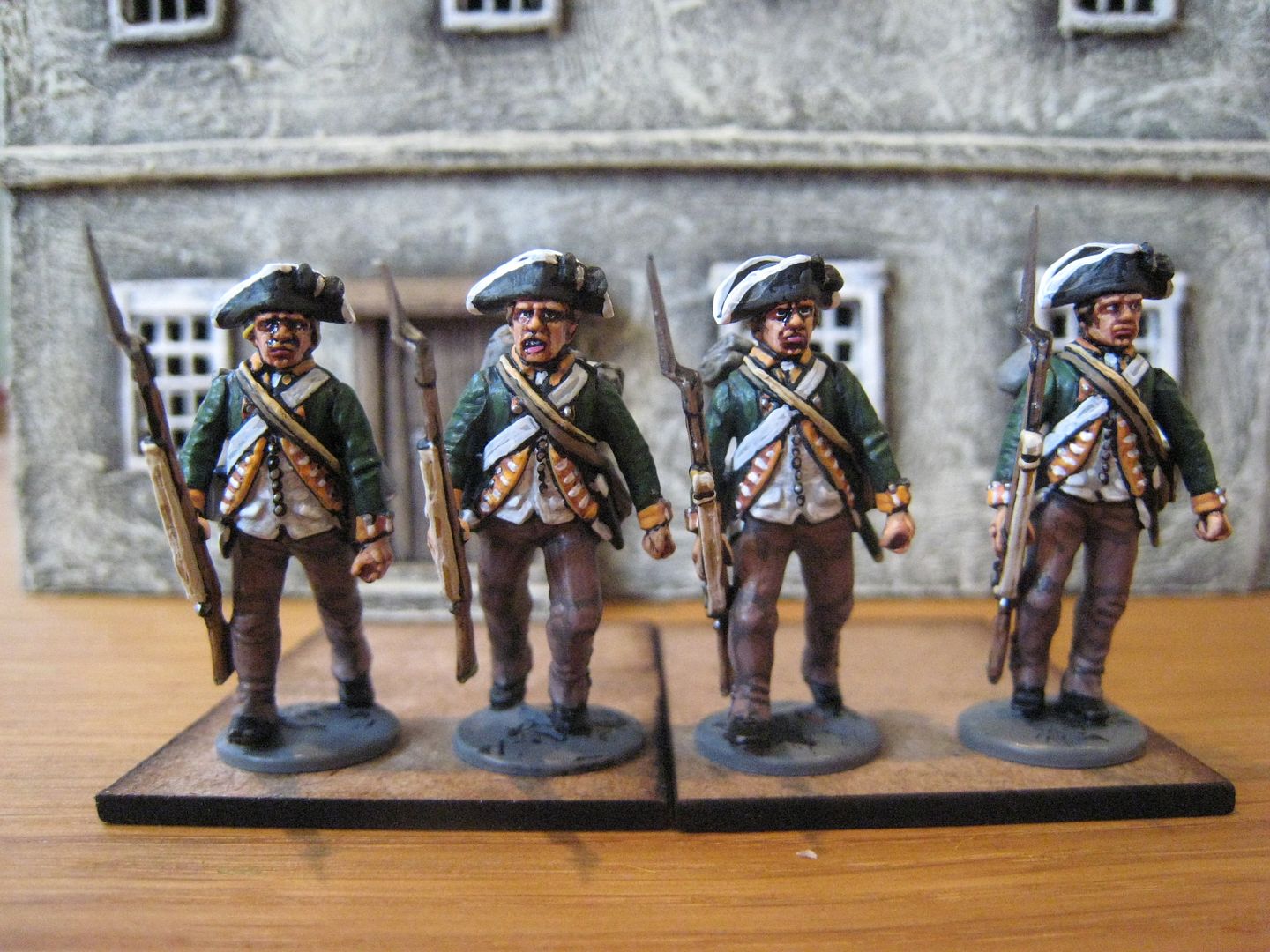
And the figures in the photos?  They are the King's Orange Rangers in green coats for the 1777 Hudson Forts scenario (in the third volume of AWI scenarios published by Caliver Books).