Thursday, 4 March 2010

Indian chiefs (2)


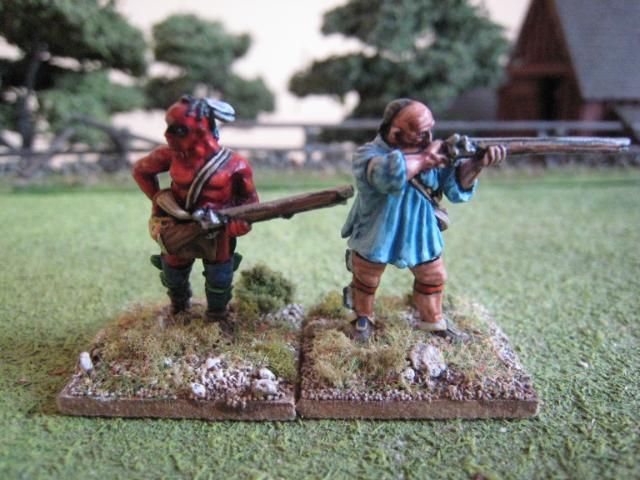
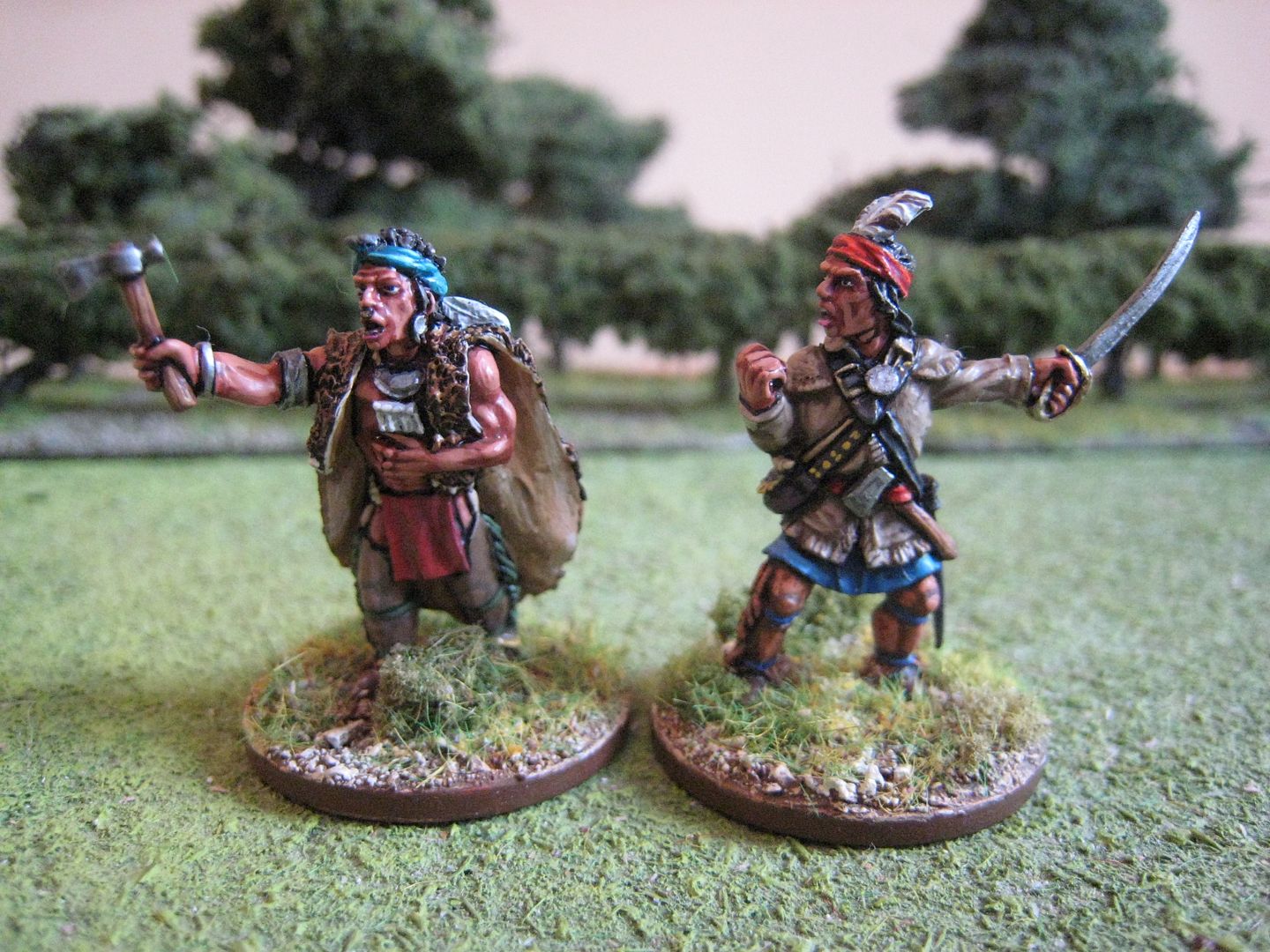
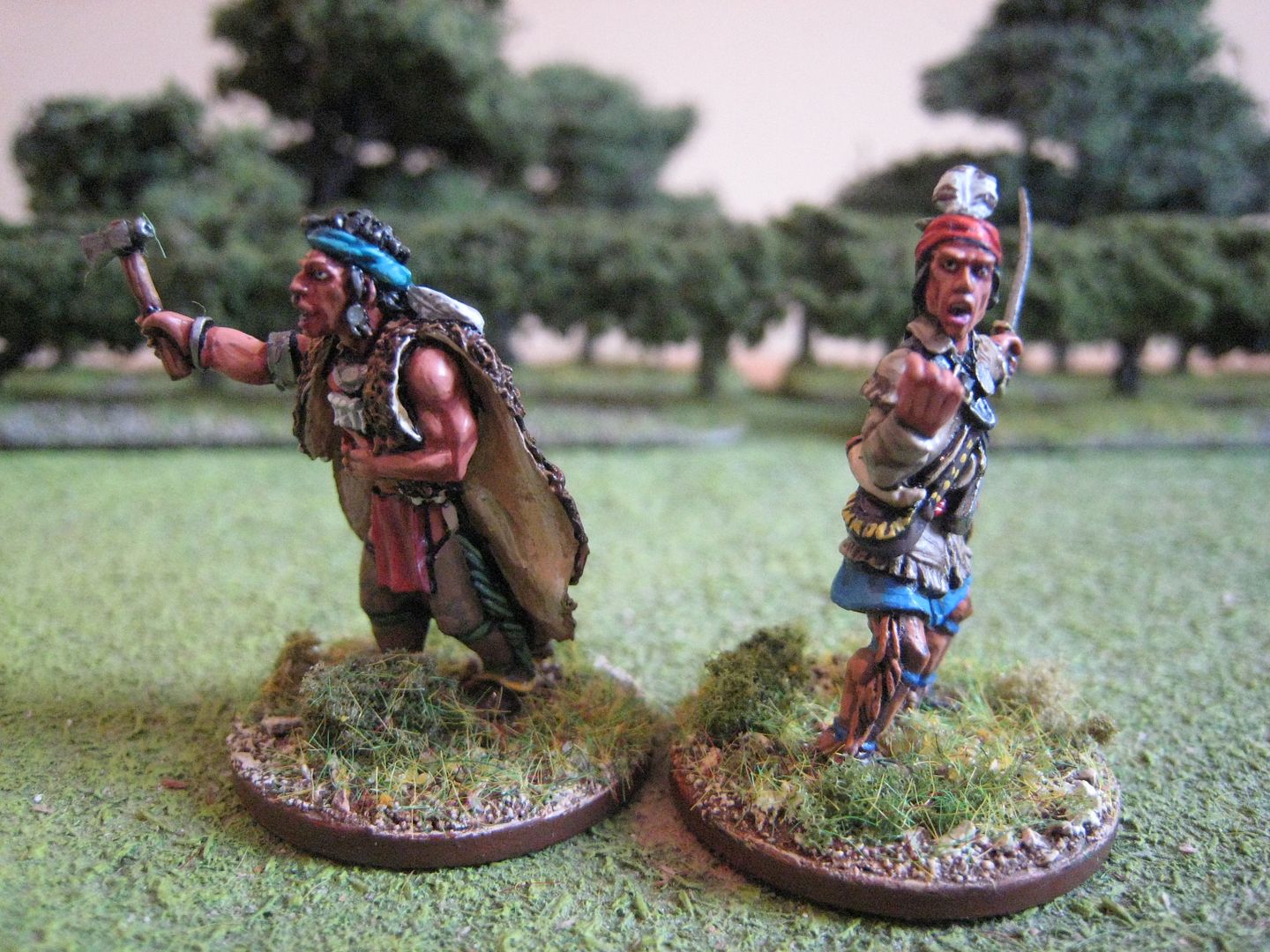
These are the Conquest Miniatures "personality" figures of Tecumseh (1768-1813) and his brother Tenskwatawa (1775-1836). As historical persons these two are out of period, but the sculpts themselves seem perfectly suitable for the AWI and I intend to use them as generic chief/leader figures (hence the round bases rather than 25mm squares). I bought these figures in the UK from North Star Miniatures. Conquest's figures are a good match for Perry Miniatures indians but are a fair bit slimmer, as the photo on the right shows.

Tecumseh was chief of the Shawnee tribe and is of course famous for his role in Tecumseh's War and the War of 1812. Tenskwatawa, also known as "the Prophet" was a religious leader who believed in a return to the indians old ways and lifestyles. Their tribe lived in Ohio, Kentucky and Western Virginia and fought on various sides during the 18th century. Red Jacket was a Shawnee chief - he advocated support for the British in the AWI. Increasing pressure on the indians' homelands in Ohio led to the various tribes forming confederations to offer better resistance to white settlers. The Shawnee took part in Little Turtle's War (1785 to 1795). After initial successes, the confederacy was defeated by forces under "Mad" Anthony Wayne at the Battle of Fallen Timbers. As a result, large parts of the Ohio territory were ceded to the US.

The Treaty of Fort Wayne in 1809 saw further territory turned over to white settlers. Tecumseh, by this point the chief of the Shawnee, immediately advocated opposition to the treaty and encouraged resistance. Discussions with the governor of Indiana came to nothing and fighting broke out in 1811. An indian force under Tenskwatawa was defeated at the Battle of Tippicanoe in November. Tecumseh rallied his confederation and joined in the British attack on Detroit the following year. Tecumseh and his force remained on operations with the British in Canada under the chief was killed at the Battle of the Thames on 5 October 1813. The indian confederacy dissolved in the wake of Tecumseh's death. Tenskwatawa survived the Battle of the Thames and took many of the Shawnee to a new home on the site of present day Kansas City. He apparently had 20 children by 3 wives.

These figures were painted with another of the new Foundry flesh palettes, "Native American Flesh 120". I have never before bothered to paint native Americans any differently to "white" Americans, but I think this palette works reasonably well. Again, perhaps another highlight or two would be handy on large areas of flesh, but the paints give a nice darker hue to the overall look and I'm tempted to use these paints in the future on more indians.

2 figures. Painted February 2010.

Monday, 1 March 2010

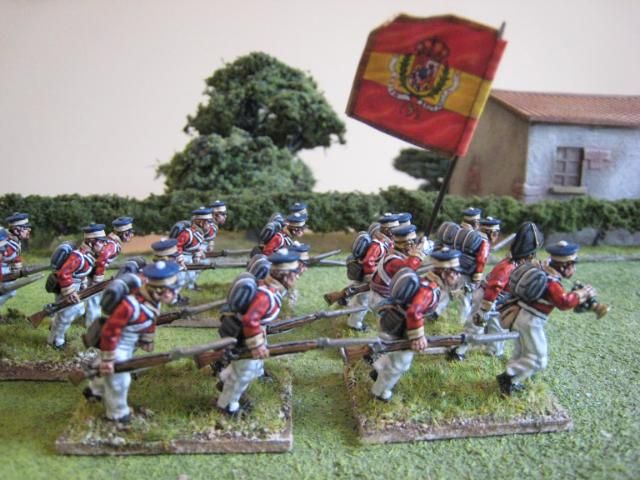
7th Battalion, British Auxiliary Legion


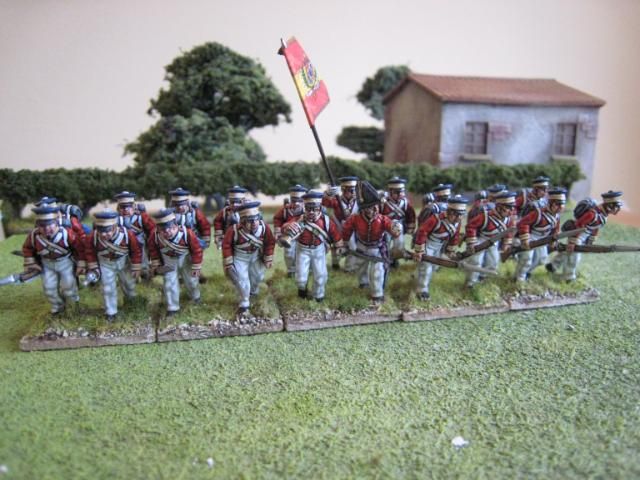
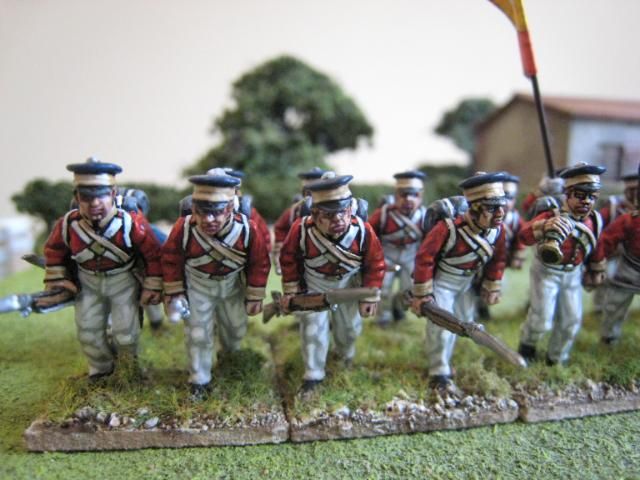
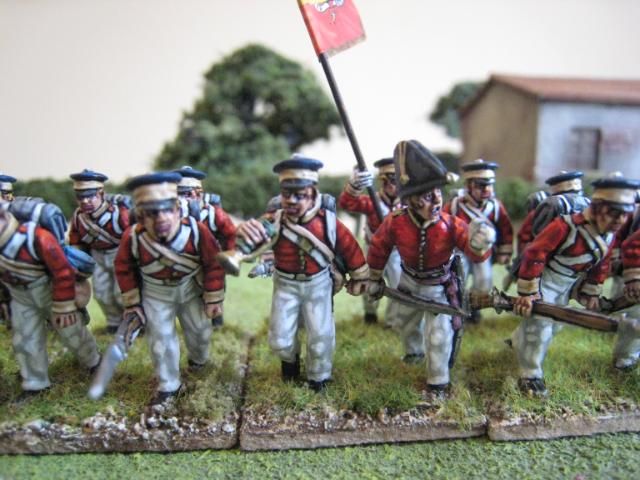
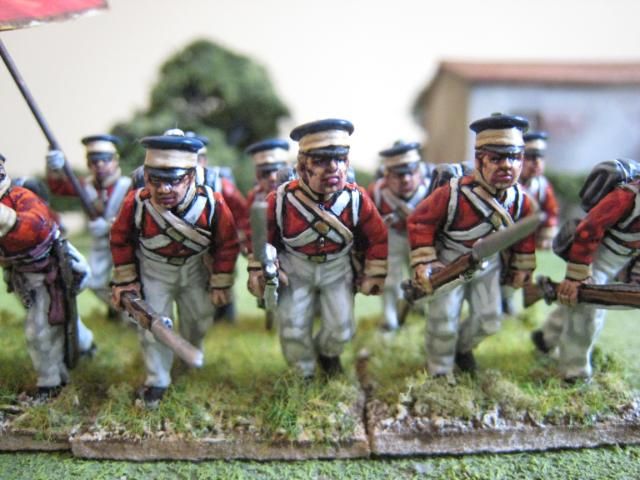
I had not intended to paint more BAL infantry so soon, but I received these figures for Christmas and so I thought I'd just jump straight in. I like these "running at trail" poses as they are quite easy to paint and look dynamic. Michael Perry clearly enjoys sculpting figures this way, as there are other running-at-trail figures in his Sudan range. Basing them is a bit of a pain, as the figures have to be angled in such a way as to ensure that the muskets are not sticking into the figures in front. That said, I used the same sized bases as usual for the FCW and I don't think these look too crowded. As with the 10th battalion I used one of the Adolfo Ramos flags for the 3rd battalion and painted over the number to add a "7".

The 7th completes the BAL's "Irish Brigade" in my collection. I gave these figures the white summer trousers as a bit of a change from the Oxford blue and campaign dress looks I used for the 9th and 10th battalions and also because there is one specific reference to the 7th in white trousers, at the battle of Ayete (see below). Some sources refer to all the Irish regiments having a green cap band, but I'm not convinced by this and simply decided to use the facing colour of each battalion. The 7th was named "the Irish Light Infantry" and so I gave the unit a bugler figure rather than a drummer.

As I've noted before, the BAL suffered dreadfully from sickness during its stay in Vitoria during the winter of 1835/6 (losses were so great that two battalions were disbanded). In the spring the Legion left Vitoria to march towards Santander and the coast. Eyewitnesses reported most favourably on the appearance of the Irish Brigade, whose soldiers seem to have best endured the hardships of winter and typhus. From Santander the Legion was taken by sea to San Sebastian with the intention of launching attacks on the Carlists' positions outside the town. The Carlists lacked the strength (and navy) to effectively besiege San Sebastian, but their presence tied down the Isabelino troops inside the town and for that reason the Crown needed the Carlists removed. So came about the battle of Ayete on 5 May 1836, the Legion's first major engagement and also its bloodiest. On the evening before the battle, Brigadier Charles Shaw, the commander of the Irish Brigade, wrote of his concerns about frontally assaulting entrenchments with untried troops. The Legion attacked the first line of positions at dawn, with orders not to fire but simply to charge with the bayonet. Many units failed to do this, being distracted by the amount of fire poured on them, but it was noted that the 7th obyed these orders and closed with the enemy very quickly. The fighting over the second line of Carlist defences was particularly bitter. The 7th and 9th battalions charged and were repulsed 3 times. Then the 10th managed to catch up with them the brigade's officers started to lead a new attack. Colonel Charles Fitzgerald of the 9th rallied the brigade with these words: "Irishmen! Tenth, Ninth, Seventh; Munster boys, bog-trotters, ragamuffins, come on with ould Charlie - I'll stand here by myself till I'm shot, if ye don't come." These words had the required effect and the second line was taken. The Carlists' next position, the fort of Lugariz, was carried by the 4th and 8th battalions and a Royal Marine battalion, which had just arrived by boat and which were supported by a well-aimed bombardment by the Royal Navy ships anchored off San Sebastian. By the close of the battle, the Irish Brigade had lost 27 officers and some 400 men. The Legion's losses were so heavy that The Times newspaper accused the BAL's commander, General Evans, of making "a Bunker Hill display". However, the Legion had acquitted itself very well and delivered an impressive victory to its Spanish paymasters.

20 figures. Painted January 2010.


Wednesday, 24 February 2010

Welcome the French


I recall Eclaireur (author of the "British Grenadier!" AWI rules) mentioning to me a few years ago that he'd asked Alan Perry whether he intended to sculpt any French figures for the AWI. The answer was "not for about 5 years", and I believe EC told me this 4 or 5 years ago. This might give an indication of how much advance planning sculptors (or some of them at least) put into their ranges, or may suggest that the Perry Miniatures AWI range is a long-term venture which will see everything one could wish for released at some stage. I mention this conversation because the Perries took a bit of flack on the TMP forum when they announced the release of their AWI French. Most Perry news releases seem to be met with replies of "why didn't you release [my pet wants] instead?", but the reaction to the French was more focused. The arguments against are: (1) there are more obvious "gaps" in the range (e.g. American light infantry) and (2) there just aren't many gameable scenarios that involve the French. To be honest, both points are reasonably made and justified. But I'm sure everything will appear in time.

Personally I'm delighted to see these figures. I'm sure that for every person who wants to see light infantry in caps or Rhode Island negro troops there's another who wants to see the French. More importantly for me, having the French allows you to wander off the American continent and look at scenarios in the Caribbean, India and elsewhere and even consider "what ifs" involving large numbers of French and British infantry going head-to-head. Those types of scenarios won't be of interest to everyone, but I'm happy to be able to stretch the boundaries of the period and learn about what the French actually did in the field, whether in American or elswhere, to assist the American war effort (and of course further France's own ambitions). Anyway, the purpose of this post is to set down a few thoughts on how I intend to approach the French forces. I should add that as well as the new Perries I have been looking at the Eureka revolutionary wars range for suitable figures.

Organisation
Following the 1776 army reforms, each regiment had two battalions. According to Rene Chartrand's Osprey, Each battalion had 6 companies - 4 fusilier, 1 grenadier and 1 chasseur. Full strength seems to have been 107 for the grenadiers and 171 for all the other companies. In addition to these, there was an "auxiliary recruit company" that was "added in wartime". I've read elsewhere, however, that each battalion had either the chasseur company or the grenadier company - a result of the regiments formerly consisting of just one battalion. The flank companies, however, were apparently used on a regimental rather than battalion level, and often placed in composite ad-hoc battalions for particular battles.

There are currently only 2 published "British Grenadier!" scenarios that feature mainstream French troops (there is a third, Gloucester Point, but that only involves Lauzun's Legion). La Vigie is a Caribbean action from 1778 that requires 6 battalions of 18 figures each (Armagnac x 2, Auxerrois x 2, Viennois and a colonial battalion) and separate combined grenadier and chasseur units of 18 figures (the chasseurs appearing as 3 lots of 6-figure skirmish units). Savannah has more complex requirements: 2 named battalions of 12 figures each (Armagnac and Dillon); 2 composite fusilier units, of 16 and 18 figures; 3 combined grenadier units of 8 figures each; and more skirmishing chasseurs amounting to 24 figures. Savannah therefore reflects the practice of French commanders gathering together elements of several different regiments into composite field units; ideally for these units I'd want each stand to represent a different regiment. The Savannah scenario also allows the French player to add the grenadiers to the various fusilier units, so I need to ensure that the poses of these troops are the same. Therefore, the approach I'm going to adopt is to paint up the flank companies at the same time as the fusilier companies.

Uniforms
Most readers will know that the French army changed its uniforms during the course of the AWI. There are two relevant "ordonnances": 1776 and 1779. The latter uniform is distinguished from the former by longer coats tails and the replacement of grenadiers' bearskins with cocked hats (although it mnay have been the case that some troops still wore their bearskins). Troops stationed out in the West Indies are unlikely to have received the 1779 uniforms before the Savannah campaign in October of that year. Therefore, the figures required for the scenarios above should be in the 1776 uniform. Troops arriving with Rochambeau in 1780 and Saint-Simon the following year would probably have had the 1779 uniform.

Incidentally, Perry Miniatures are remodelling their grenadiers, to remove the bags on the bearskins - there is an announcement on the front-page of their website (scroll beneath the plastics announcement). I'm not too fussed - I shall use the figures I have already bought for bombardiers de la marine, which did have bags on their bearskins.

Flags
I was quite confused about flags until I asked around on various fora. It seems that as part of the 1776 reforms the number of flags carried by each regiment was 1 per battalion. The first battalion carried the "drapeau blanc", i.e. the white colonel's flag (which seems to have been the same for most regiments); the second battalion carried the more colourful and distinctive "d'ordonnance" flag. This is helpful for recreating the La Vigie orbat, as GMB don't currently have colours for the Armagnac and Auxerrois regiments - I can use the drapeaux blancs from other packs. French flags were topped by a distinctive finial - these can be bought from Front Rank.

The photo above is a wip pic of the Armagnac Regiment. These were painted using a mid-grey undercoat instead of my usual black one, and I'm happy with the overall look - quite crisp and snappy, I think. Lee's Legion and the Von Mirbach regiment are finished and going through the basing process; ditto more First Carlist War stuff. If the sun ever appears again in London (this has been the worst winter on record) I might even be able to take some decent photos...
Sunday, 21 February 2010

Foundry flesh experiments (1)


I posted this on Thursday, but Blogger managed to delete it....Anyway, I've reached another basing bottleneck and in order to maintain momentum I thought I'd post on some other stuff that I've been painting. Specifically, I have been experimenting recently with the new Foundry flesh palettes. I am an obsessive buyer of paints (in the same way that some people are obsessive buyers of rules) and when I saw Foundry advertise sets for various flesh tones I didn't hesitate to buy the complete set. That was also because recently I've found myself painting stuff that falls outside the core remit of this blog and which lends itself to these new paints. Most of the sets concern a particular ethnic flesh tone: "near eastern flesh"; "oriental flesh", "south american flesh" and so on.

So I'm going to post a few observations on my experiments with these paints in the hope that people might find them useful. I've set myself some rules: I'm allowed my usual dark brown ink wash on the faces and hands, but otherwise I have to use the paints "as is", straight from the pot without any mixing or blending. I've tried 3 palettes so far, with more to come shortly.

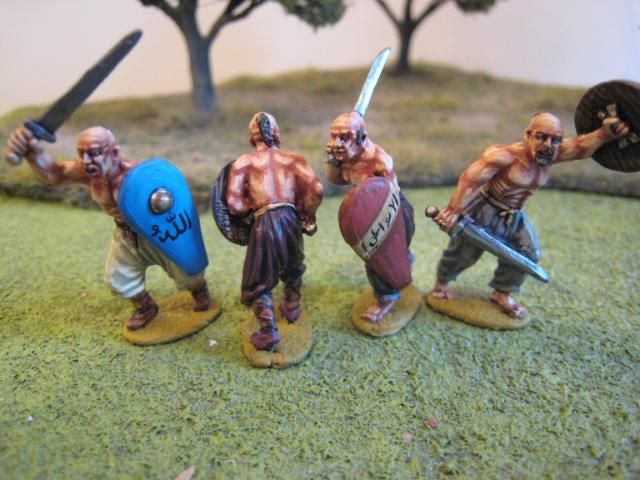
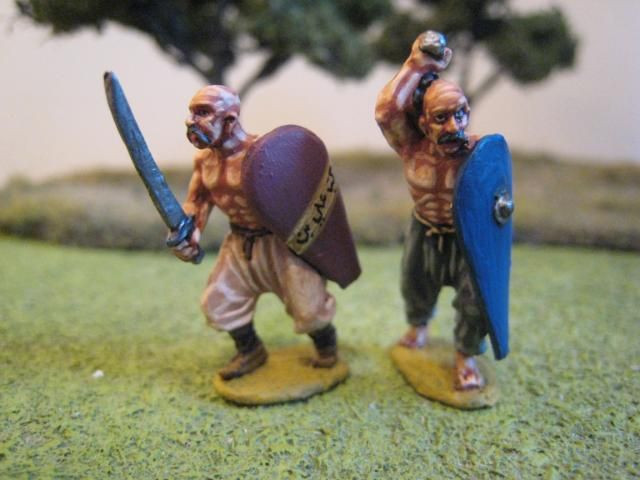
First up are some Perry Miniatures First Crusade "Azabaijani swordsmen", painted using the "Expert Flesh 127" palette. I confess that I can't find these troops in any of the First Crusade army lists I've been looking at, but I suppose they are essentially Turkish light infantry from the southern Caspian Sea area. The "Expert" palette is a double set of 6 paints, rather than the more usual 3 paints. Foundry helpfully label the dark "A" paint "Dark" and the lighter "E" paint "Light" in case you can't work out which end to start with... The "A" shade is darker (or rather, more orange) than the original "Flesh 5" palette. However, "Flesh 5A" is clearly "Expert Flesh 127B"; "Flesh 5B" is "Expert Flesh 127C" and "Flesh 5C" is "Expert Flesh 127E", so the original colours are incorporated into the set.

I found this set easy to use. The tones blend pretty well "out of the pot" and I was delighted to find that the consistency of the paints was thicker than other recent Foundry offerings - I have not been impressed with some recent Foundry purchases which show a reduction in the amount of pigment and a general watery-ness. Personally, I think that the entire palette is probably best used on larger areas of flesh and would be excessive on faces and hands (i.e. the standard flesh areas for 18th century figures). On bare torsos and the like, however, the ease of use of these 6 colours means that painting is quite straightforward, if a little "by numbers". The "F" colour is very light and you'd probably want to blend it in to the previous colour. I'm sure that the results will seem a little excessive for some, but I'm reasonably pleased with the outcome.

Lots of stuff is being based at the moment, for te AI and FCW. Here's some Lee's Legion infantry:

Wednesday, 10 February 2010

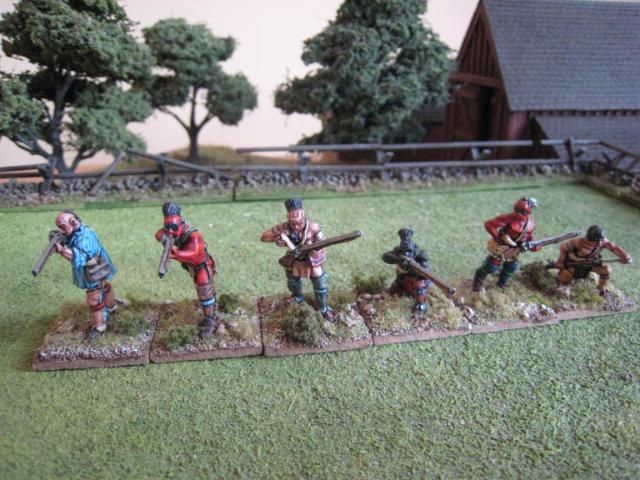
Iroquois (5)


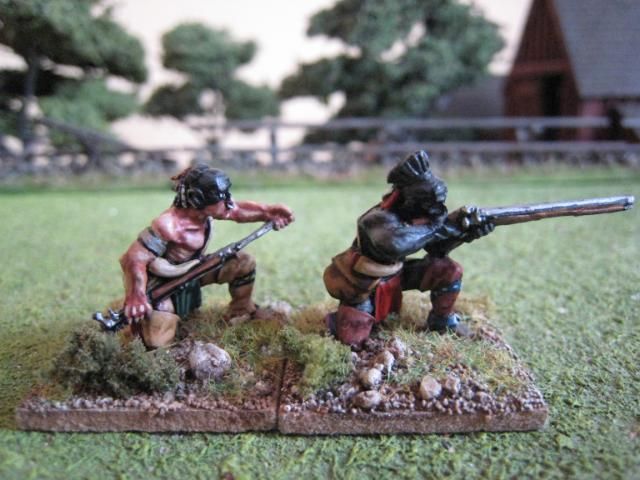
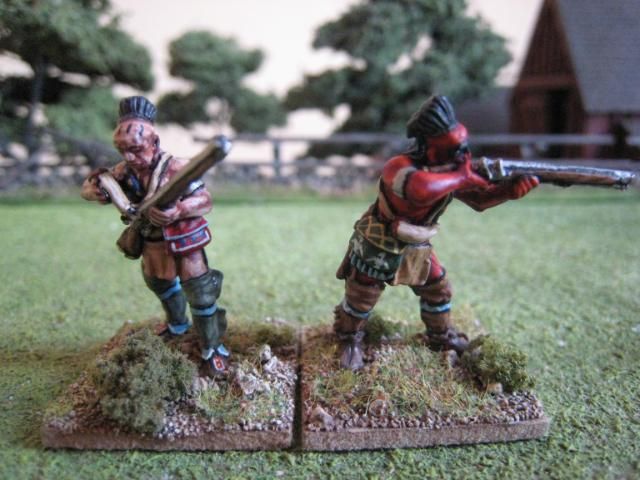
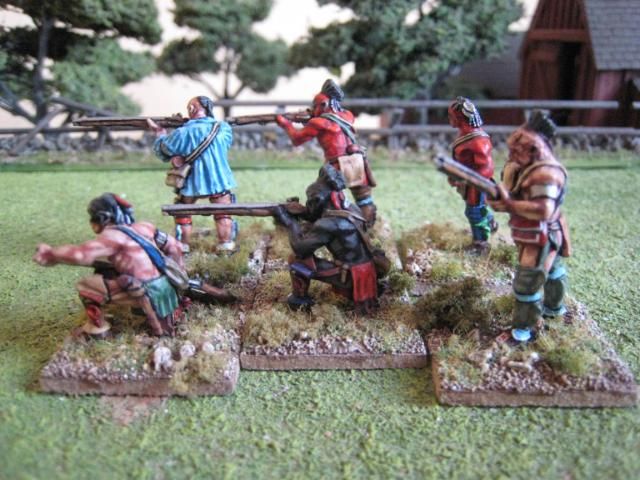
These are more figures from a couple of years ago, which I realised I forgot to post at the time. They are Perry Miniatures "woodland indians"; lovely sculpts which are full of character. As I've noted before, I base indians on 25mm x 25mm squares, this being the standard skirmish frontage in the "British Grenadier!" rules. There's no reason why you can't base them in twos or threes on larger bases; I decided to go with single bases to give me some flexibility for skirmish games as well as larger AWI engagements. I have some 60 indian figures in total now, so an inter-tribal or F&IW skirmish game is viable.

I never used to worry about "indian flesh" being different to "white flesh"; it seems to me that in this scale and on the tabletop there's unlikely to be much variation in colour between the red man and the white man and much of the flesh will be covered by markings and war-paint anyway. I imagine that different tribes from different parts of America no doubt varied in colour anyway. That said, I've seen very effective techniques for native Americans, particularly Apache and the like. Foundry have recently released a "native American flesh" palette and this post is also a prequel to my next post, which will feature two Conquest Minatures figures painted using this new Foundry palette. In fact, I've been trying out the various new Foundry flesh colours over the past few days and I'll post what I think of them over the next week or so.

The von Mirbach musketeers are currently on hold, 5 figures from the end, because I realised I didn't have their flags and so had to place an order with GMB (which usually takes a couple of weeks to arrive). Taking their place are the new Perry figures for Lee's Legion, which I'm pleased to find are quick and easy to paint (once you've bitten the bullet and decided that it's ok to paint them in bright purple...). I'm also going to be painting some French infantry, which will be a bit of a departure for me in that I'm going to use a grey undercoat for the first time and may see what happens if I ditch "black-lining".

6 figures. Painted May 2007.


Wednesday, 3 February 2010

British Auxiliary Legion Artillery (2)


As stated in my previous post on British artillery in the First Carlist War, the prohibition on regular army units serving in Spain was relaxed in order to provide the British Auxiliary Legion with trained artillery and engineering specialists. The legion did raise its own artillery crews, but these were supplemented by men from the Royal Artillery and the Royal Marine Artillery. The figures here are the Perry Miniatures pack of a Royal Marine rocket troop.


The Royal Marine Artillery was formed in August 1804, allegedly as a result of legal proceedings which held that Army officers were not subject to the Navy's orders. Its immediate purpose was to serve in bomb-vessels and gun-/rocket-boats (previously functions of the Royal Artillery) and to teach other marines and sailors how to operate guns. However, the men soon found themselves deployed in action on land at sieges and other engagements. 3 companies were raised initially but a 5th was added at the end of the Napoleonic Wars. The corps was reduced to 2 companies in the early 1830s but expanded significantly in the following decades due to the demands of the British Empire and the need for trained artillerists on ships of both the Royal Navy and the merchant navy. By 1859 the Royal Marine Artillery comprised 16 companies and was formed into a separate division. In addition to Spain in the 1830s, the artillery saw service in the Crimea, Canada, China , New Zealand, South Africa, Egypt, the Sudan and Burma, usually as part of a naval brigade. The division was particularly heavily engaged in the 1882 Egyptian campaign and the Sudan. The marines seems to have specialised in capturing enemy guns and then turning them on their former owners - they did this at Kassassin and El Teb two years later. The Royal Marine Artillery's life as a separate division ended in 1923 when it was amalgamated with the rest of the Royal Marines.

These figures and equipment were painted the same way as before - Foundry "British Gun Grey 108" for the rocket launcher and "British Royal Blue 74" and "Deep Blue 20" for the crew. It seems that the men of the Royal Marine Artillery were called the "Blue Marines" because of their uniforms. I think this is an excellent set - certainly something you don't see on the tabletop that often and adds colour to the period. Again, I imagine that it's use is not limited to the FCW.

Painted January 2010.

Thursday, 28 January 2010

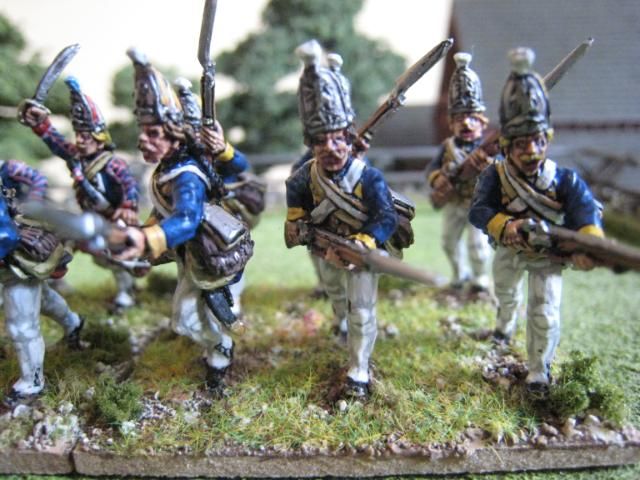
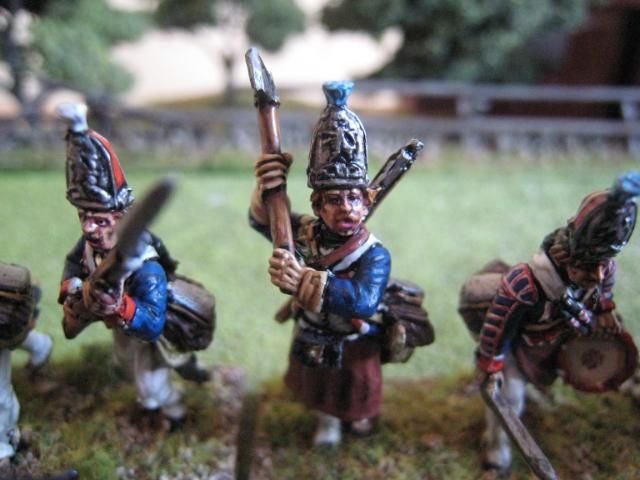
Von Linsing's Grenadier Battalion


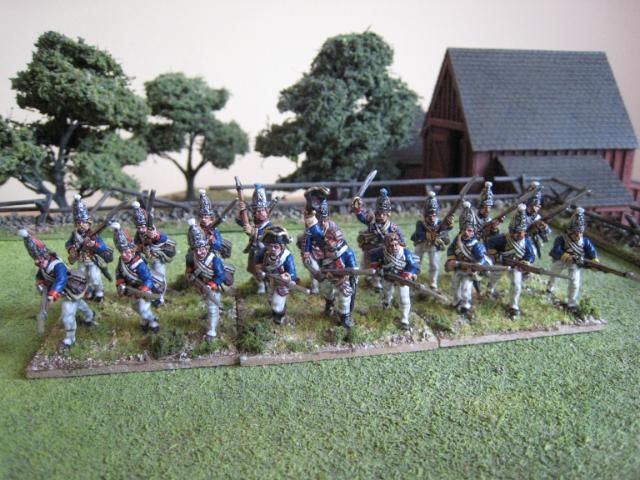
Von Linsing's grenadier battalion was one of three brigaded under Colonel Karl von Donop. The brigade was present at Long Island, White Plans, Brandywine, Germantown, Fort Mercer/Redbank, Monmouth and Charleston. When Von Donop was mortally wounded at the battle of Fort Mercer command of the brigade passed to Colonel Kospoth. The battalion recorded the highest number of casualties of all the Hessian units - 169 killed and wounded.


The assault on Fort Mercer in October 1777 (sometimes referred to as the battle of Red Bank) was a disaster for the Hessian corps. With their reputation badly damaged by Trenton, the Hessian commanders were keen to redeem themselves and show that their troops (and themselves) could make a positive contribution to the fighting. Von Donop in particular smarted from the Hessian surrender at Trenton as the troops stationed there formed part of his command. Fort Mercer was sited on the New Jersey side of the Delaware and it's destruction (together with other forts along the river) was essential to keep the Delaware open for the supply of the British army in Philadelphia. Von Donop volunteered to make the attack. The disaster that followed seems to have flowed from a mix of (1) bad intelligence, which mistakenly suggested that the fort was incomplete, (2) confusion as to the Hessians' orders, with von Donop thinking he had to assault the position at all costs and Howe assuming that the attack would cease if the defences were found to be too strong, and (3) canny fortification work by the Americans under the direction of French engineers. The assault came under heavy fire from both the defenders of the fort and ships moored in the Delaware and collapsed. Von Donop suffered a shattered hip and died 3 days later. Despite its failure, the battle illustrated the exceptional courage that the best Hessian troops could show, with both American and British soldiers remarking on the courage displayed in the attack, particularly by the officers.

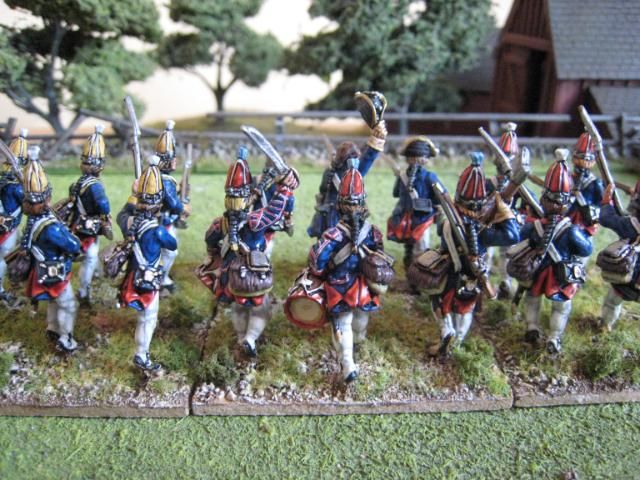
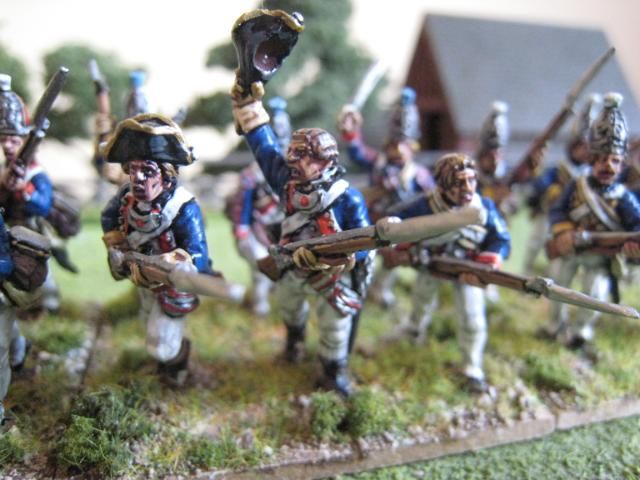
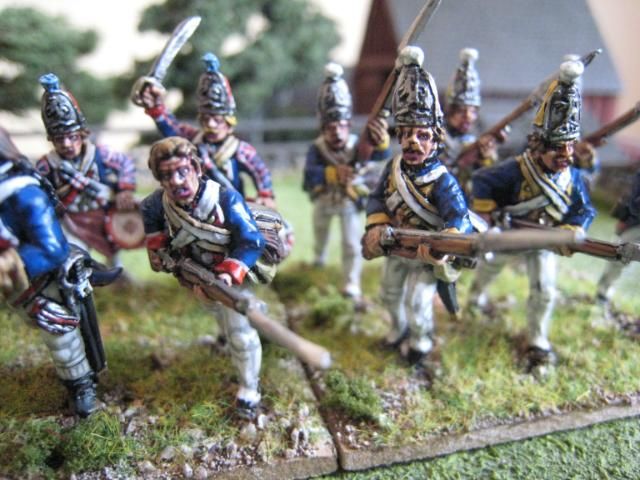
I was surprised to see that I haven't painted any Hessians since September 2008, but I'm now trying to plug some of the gaps and the von Mirbach musketeers are close to being finished. Von Linsing's regiment comprised the grenadier companies from the 2nd and 3rd Guard Regiments, the Leib Regiment and von Mirbach Regiment. For my 18-figure recreation, I just painted 3 regiments' worth - the 2nd Grenadiers on the left, von Mirbach in the middle and Leib on the right. I'm not sure why I chose von Mirbach for the command stand, given that I'm painting the rest of the regiment now, and I should also point out a couple of mistakes: the officers should have silver lace on the facings and hat, not white and gold respectively and the drum rims should be white over red, not the other way around. Silly me. On the Von Donop.org site, the Guard Regiments' uniforms look as if they have tassles on the button-hole lace. I tried to give a suggestion of this by adding white lace on the buttons in between the coat facings and turnbacks, but I saw no need to paint anything more elaborate than that.


For the published "British Grenadier" scenarios you need 18 figures for Long Island and Monmouth and 20 figures for Brandywine. I decided to go with 18, on the basis that I can always pretend it has 20 figures if I find myself doing Brandywine again. I'm still some way away from being able to field a full Hessian grenadier brigade (as far as I'm aware, only the great Eclaireur himself is able to do that), but I'm inching closer...I've been a bit slow at posting the past few days. More Carlists on Sunday and more AWI next week.


18 figures. Painted December 2009.