Tuesday, 24 March 2009

Back home...


...and married! "Sunny" Napier failed to materialise, although we were extremely lucky that the actual ceremony, which we had thought would have to be transferred to the indoor venue, coincided with the only 2 hours of sunshine that day. The officiating reverend (the Kiwi's uncle) clearly has a hotline to the powers that matter...Shelley and I had a wonderful time on the day. I was in fear at our first dance, but Shelley had realised early on that the elaborate steps we had been taught (but not in any way practised) were impossible in her dress, so we didn't really have to dance properly at all. That left my speech, which I don't mind saying was the most nerve-wracking experience of my life. It was not the thought of speaking to a large number of people that disturbed me, but rather the fact that the speech was my introduction to a substantial part of Shelley's family that I had not met before. But I quickly realised that being rude about the Australians is an easy way of raising a laugh from New Zealanders (although I had some issues the next day with the two Australians in the audience) and they seemed to appreciate a few anecdotes about the culture clash of a Kiwi-English marriage.


We had a wonderful honeymoon in South Africa, spending equal time in Cape Town, the winelands of Franschhoeck and on safari in Kruger National Park. Shelley's uncanny ability to sniff out good winebars ensured we found plenty of watering holes in Cape Town. Unfortunately we missed the opening times of the castle but we did manage to visit a newly-excavated part of the old Dutch fortifications; I will post some pics and information about that in a few days. The safari was a real once-in-a-lifetme experience, although I never really managed to reconcile the concept of being on holiday yet at the same time being woken up at 5am every morning by a burly man in uniform banging on my door: I'm pretty sure that's what happens when you're in prison, not on honeymoon. Maybe there's a metaphor for marriage in there somewhere...


As usual, a key part of our holiday was wine and it featured heavily in both New Zealand and in South Africa. In NZ, I was again impressed with the quality of the rose wines, which I had already noted when in Hawke's Bay in 2007. Rich, elegant but still light and fresh, these wines are miles away from the dreary and/or sickly European offerings that still give rose a bad reputation (I think the best Kiwi roses are those made from merlot and malbec in the North rather than from pinor noir in the South). But South Africa was a revelation. Expecting bland whites and reds that were marred by "burnt rubber", we found wonderful wines of real character. During the course of visits to 27 wineries in Stellenbosch and Franschhoeck (which together with 13 in NZ made a grand total of 40 wineries visited, which aint bad..) and numerous bars and restaurants I noted only half a dozen red wines that exhibited earthy, "burnt rubber" characteristics, mostly at the lower end of the market and always either in cabernet or pinotage (although I think the latter variety might possibly benefit from the smokiness of "burnt rubber"). But the reds were universally much better than I had expected; the Bordeaux blends were particularly impressive. As for the whites, whilst I found SA's sparklers a little flavourless the sauvignon blancs were extremely good, capturing a tasty middle ground between the acidic Kiwi style and the more minerally Sancerre style - perfect for a lunchtime picnic of chicken and seafood. We were also bowled over by the quality, luxury and size, of the SA winery cellar doors. This is clearly a country with a wine industry that has ambition, and the recent requirements for the (predominantly white) producers to put something back into their local communities made for enlightening cellar-door conversation.

So for those who are interested in such things, wine highlights were as follows. In NZ: Unison Hawke's Bay Cabernet Sauvignon 2006; Te Phau "The Point" 2006; Kennedy Point Waiheke Island Rose 2008; Mission Estate "Jewelstone" Chardonnay 2006; Elephant Hill Rose 2008; Vidal "Soler" Syrah 2005; and pretty much anything by Craggy Range. In South Africa: Waterford "Kevin Arnold" Shiraz 2005; Springfield Special Cuvee Sauvignon Blanc 2008; Diemersdal Estate Single Vineyard Sauvignon Blanc 2007; Vilafonte "Series C" 2005; Ataraxia Sauvignon Blanc 2008; Rustenberg "Five Soldiers" Chardonnay 2006; Vergelegen "The Red" 2000; Alluvia "Ilka" Sauvignon Blanc 2008; Le Riche Cabernet Sauvignon 2003; Rupert and Rothschild Baroness Nadine Chardonnay 2006; Fairview "Primo" Pinotage 2007; Beaumont "Ariane" 2004; Cordoba "Crescendo" 2003.

A few random photos are below, for what they're worth; I now appreciate just how difficult a job wildlife photographers have. I have been inspired to dig out my old Foundry/Copplestone Darkest Africa figures, so more wildlife photos might appear as and when I get around to painting some animals.


Thursday, 26 February 2009

No more posts for a while...


...because I'm off to get married! A week on Saturday in (hopefully) sunny Napier in New Zealand, and then a honeymoon in South Africa (combining sun, wine and safari). Luckily I return a couple of days before Salute. I'll be skint, but it will be a great day anyway. I had hoped to post some pics and a short history of the 6th Continental Regiment before I left, but they will have to wait until I return. I am still enjoying playing around with Seth Warner's regiment, but didn't manage to finish it in time. Only 7 more figures to go, though. Here, just for Steve, is a photo of my almost finished Sudan Beja horde. 50-odd figures counting as 6 bases of 10. Back in 4 weeks!

Sunday, 22 February 2009

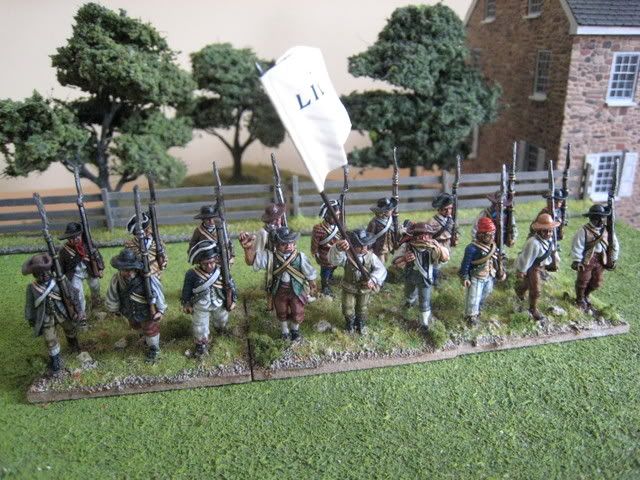
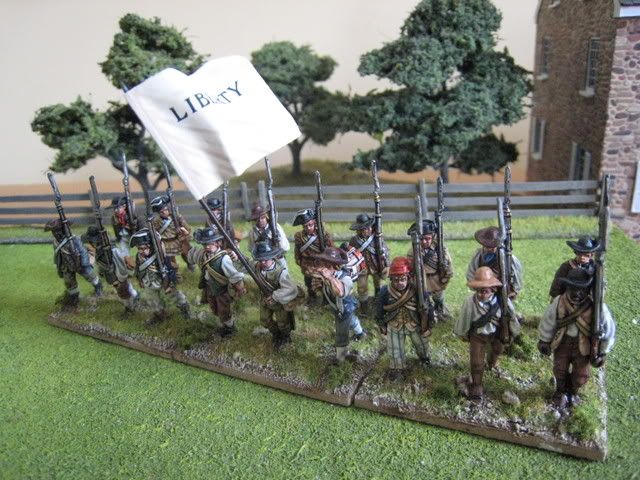
American Militia (6)


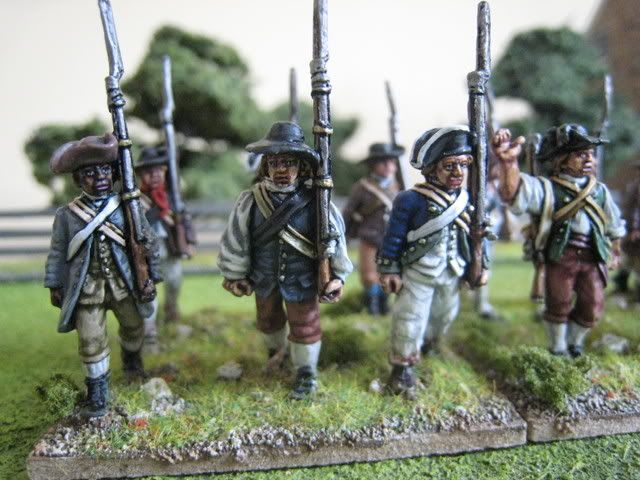
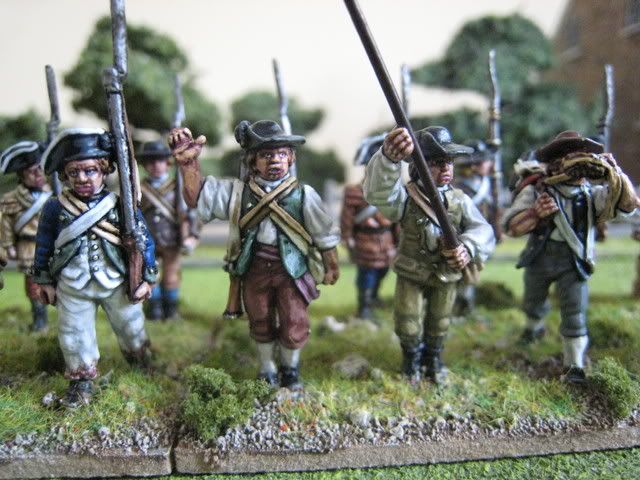
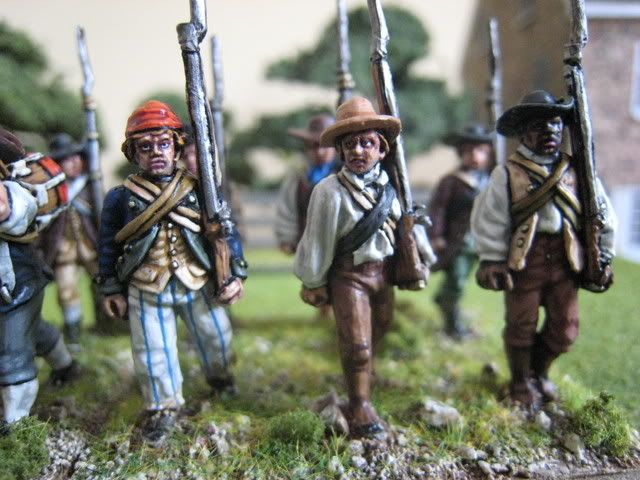
This is another unit of figures taken from the latest Perry "southern militia" packs, this time with a couple of negroes and uniformed ex-Continentals thrown in. I took the idea of blue faced green coats for the Continentals from this Don Troiani painting of a Virginia militiaman at Cowpens - it's hard to tell if the coat is a tattered uniform coat or just a civilian one. However, there are a couple of regiments which are thought to have had blue faced green coats at some point. One of those was the 10th North Carolina, so this unit nominally represents militia from that state.

I probably have almost enough militia now, although I'd like to add a couple of more "northern state"-looking units; hopefully Perry Miniatures will release some more figures for these at some point. In terms of militia numbers for the southern theatre, looking at the "British Grenadier!" scenario books I see that Guilford Courthouse requires 4 x 16 figure units and 2 x 18 figure units; Cowpens needs 3 x 20; Hobkirk's Hill, 1 x 18; Savannah, 1 unit each of 16, 18 and 24 figures; Spencer's Ordinary 2 x 20; Eutaw Springs, 2 x 12, 1 x 14 and 2 x 16; and Gloucester Point 4 x 20. So about 60 figures will suffice for most engagements. (I've left out Camden because it's an enormous scenario at the 1:10 figure ratio that appears in the first BG scenario book - you need 270 militia figures!). The skin tones on the "men of colour" were painted with the Foundry "Dusky Flesh" palette over a basecoat of Coat D'Arms "Negro". I find the final Foundry colour, "6C", too light on its own, so I mix it with the B colour as the final highlight.

18 figures. Painted January/February 2009. Flag by GMB.


Wednesday, 18 February 2009

Current wip


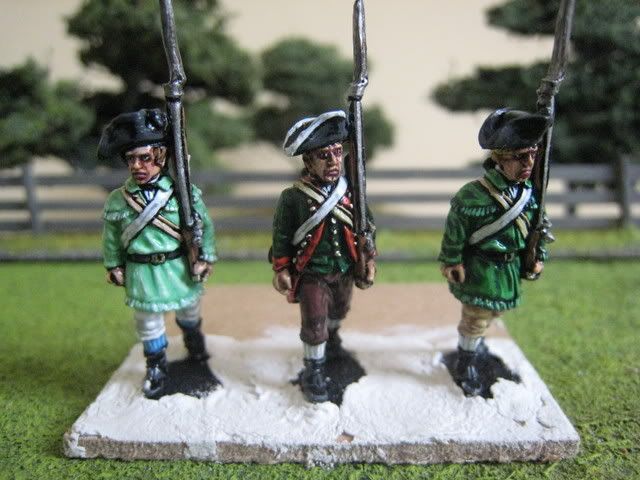
Apologies for the lack of posts of late. Running out of command figures necessitated a quick order to the Perries (which arrived within 3 days - phew!) and as a result I find myself with 3 units nearing completion at the same time, said completion delayed by a weekend away and ongoing prep for the big trip to Kiwiland and South Africa. So above is a wip shot of Seth Warner's "Green Mountain Boys" ("GMB"). I'd be interested to know what readers think of the colour scheme. I found the recreated GMB's website last week (see here)and that shows the men in a mix of the green faced red coats that sources refer to and hunting shirts in a variety of greens, mostly very pale greens. These 3 chaps are "test" figures insofar as I wanted to see which look I preferred. As it is, the figures I am painting now are in different shades to these, so the end result is going to be what Whistler might have called "Symphony in Green. It's been good fun though - it's always tempting to paint hunting shirts in browns, beiges and whites; largely because, I suppose, those are readily available colours. But hunting shirts came in all colours, and the colours I am using for the GMB are all "self-mixed".

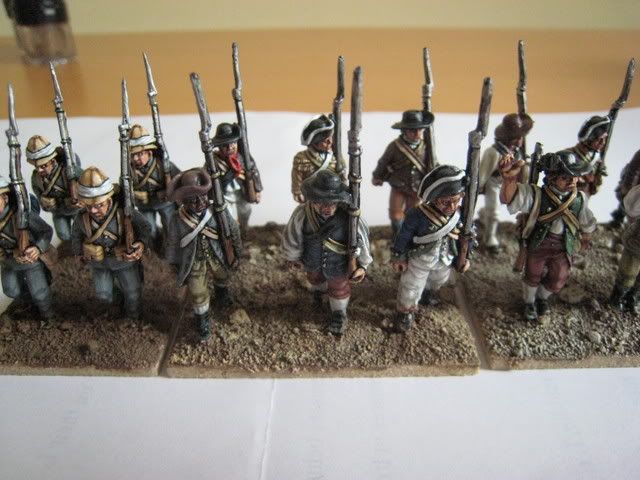
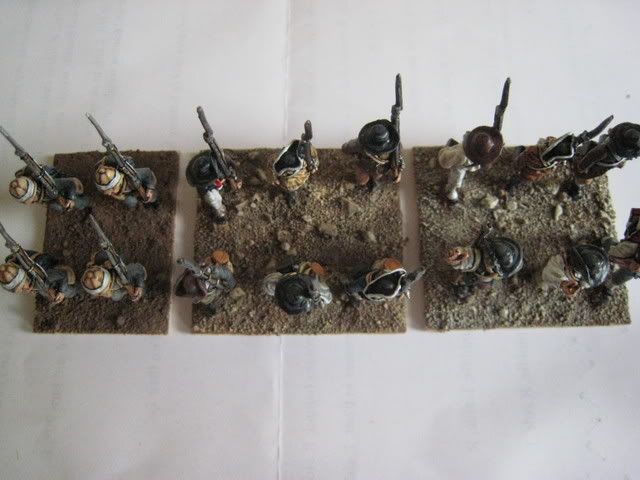
The GMB aside, I thought I'd use this post to say a few words about how I base figures. This is in reply to a couple of email discussions about the colour of bases. When I first started basing my AWI figures (about 2 months after I started painting them) I wanted a look that was quite "bright", so reflecting my own painting style and conveying the impression that the figures were in American meadows; I thought this would capture a "New World" feel. So the colours I use are these (after covering up the metal bases with Polyfilla and adding Games Wokshop or other grit/stone mix : the base coat is GW "Graveyard Earth"; first highlight is Foundry "Base Sand 10B"; second highlight is Foundry "Boneyard 9C". I then use a variety of Woodland Scenic stuff, mainly "bushes" and "coarse earth", with some flower scatter and then whatever static grass I've picked up at shows. You can buy seasonal grass these days, but as said above I like to have a summer meadow look so mid-green is fine for me.

The pics below show, left to right, "Graveyard Earth", then the first drybrushed highlight and the then second of "Boneyard C".

Friday, 6 February 2009

72nd Ligne (2)


I painted the 72eme Ligne backwards, so this is the first battalion. Again, it is minus its flag because having bought the correct GMB flag I then lost it. I found it again this evening, so once I've attached it I might post pics of the two battalions together. This will be the last Napoleonic post for a while. I'm enjoying work on more American AWI units, and I think I have benefited from the diversion of Naps. Having decided that I have enough American figures, I have changed my mind and now have plans for another half dozen regiments. This volte face is largely the result o GMB's new issues of American flags. Two of these new units are all but finished now, the 6th Continental Regiment of 1776 and some more militia, and this weekend I will start on Seth Warner's Green Mountain Boys; working out how to paint pale green hunting shirts should be interesting (the regiment will be in a mix of green faced red coats, hunting shirts and civvies).

The 72eme are again a mix of plastic and metal Perry figures. The command base are all metals. The rank and file have more head swaps than the second battalion. I tried different mud effects on these figures - on the greatcoats, for example, I used a lighter brown (Foundry's "Dusky Flesh C") to suggest old, dried mud underneath the newly acquired darker-shaded mud. I'm not sure it works, but it adds a bit of interest I suppose. I have really enjoyed painting these plastic figures. One can only hope that the Perries have plans for lots more.

28 figures. Painted December 2008.


Friday, 30 January 2009

1st Voltigeurs


These are the Perry Miniatures "Young Guard resting on their packs" figures. They are wonderful little sculpts, full of character, and I just couldn't resist painting a few up; it's packs like these that make it difficult for me to escape the lure of the Perry 1815 range. These figures are very much for decoration. I can't imagine anyone would use them in a tabletop "combat" situation, and I certainly don't intend to: I think you can just about get away with using "at ease" standing figures, but not ones that are sitting down.  With hindsight, I wouldn't have placed the muskets on the ground, as you see here.  Since painting these figures I've seen other units where the muskets are tied together in front of the seated troops - that's more realistic and I would have done the same if I'd given this more thought!

So the idea is that these figures will represent where Barrois' Voltigeur brigade is on the table whilst they are waiting in reserve. Once the regiments move into action, I would replace this unit with full regiments in a different pose. As these figures are largely decorative, I couldn't see the point of painting a full 1:20 regiment (the "General de Brigade" Waterloo orbat gives a total of 112 figures for the 1st and 3rd Voltigeurs!). I thought about painting 24 figures, but then settled on 16 on the basis that I just couldn't see the point of painting any more. After all, few Napoleonic tables are ever large enough to accommodate troops held in reserve anyway, as there is often barely enough space for those in combat. I have one figure left over, so may well at some stage paint up a similar 16-figure unit to represent the Tirailleurs.

When I originally wrote this post the was missing its flag because I bought flags for the Tirailleurs instead of the Voltigeurs.  I've now added a newer photo with the correct flag.  The figures are based on the larger plastic bases that come with the Perry plastic French infantry set. I had these left over as I'd based the 72eme Ligne in fours rather than sixes. You need the larger bases for these figures as the muskets take up extra space. I am not a huge fan of green coloured bases, so I painted the edges of these ones with GW "Bestial Brown".

16 figures. Painted January 2009.


Friday, 23 January 2009

Markers for "British Grenadier!"


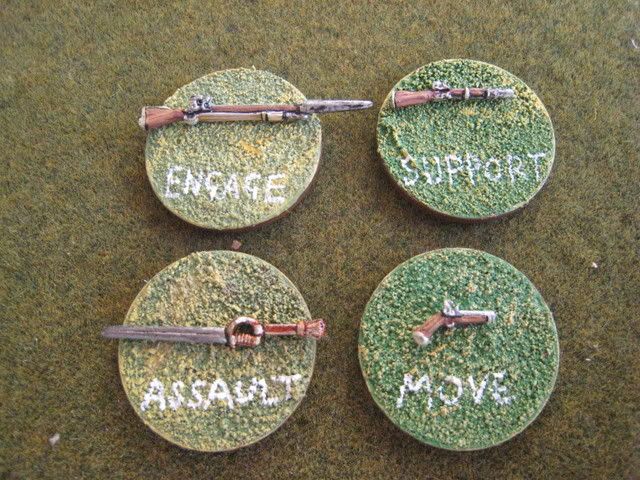
I've received a couple of queries over the past few weeks asking what I use for markers for "British Grenadier!" games. There are two types of marker that are important. First, a means of recording disruption points ("DPs"). DPs are accrued from movement and receiving fire; they represent a unit's disorder before it starts taking casualties. The number of DPs a unit has will be a minus modifier on things like melee, firing and morale scores. Once a unit reaches 3 DPs, it begins to take actual casualties (a unit will never have more than 3DPs at any one time). Secondly, a record of what orders a brigade is on - whether "engage", "assault", "hold" etc. This is important as a brigade's orders will often determine what the constituent units of that brigade must do. For example, if a brigade is on "assault" orders, then at least one unit must advance or charge towards the enemy in each turn; and, generally speaking, only units on "assault" orders can declare a charge. So players need to keep a close eye on what orders their brigades are on and ensure that generals are on hand to change orders as required. Most BG players will have experienced the frustration of trying to change a brigade's orders when your c-in-c is on the other side of the table.

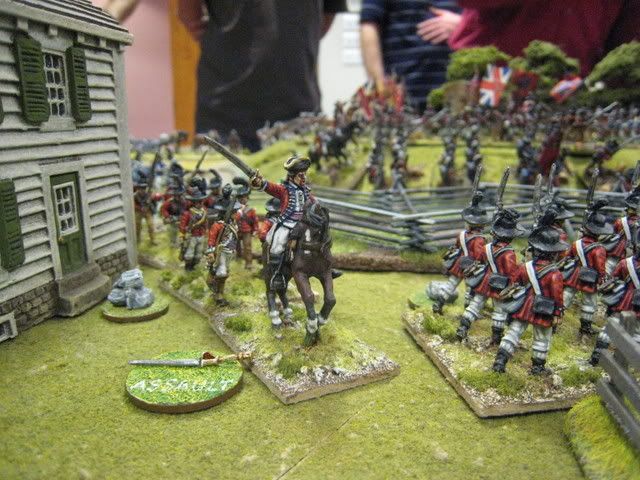
The BG rules come with printed order markers which can be used perfectly well as sold or in a laminated form. I created some more durable markers using two pence pieces and a variety of weapons, as sold by Front Rank. Each order has a designated weapon, such as a sword for "engage", a musket for "assault" and so on. The relevant order is then written in white underneath the painted weapon. I texture and paint the two-penny piece first. The colours for the base are, GW Goblin Green for the base coat, then dry-brushed highlights of Foundry "Ochre B" and "Ochre C" - not my standard base texture colours, but a combination that seemed right at the time. The Front Rank packs of weapons are relatively cheap and there is a decent variety to choose from - carbines, sabres and pistols in addition to muskets and swords. Texturing the base can make the white lettering go a bit wonky from time to time if you're not careful. It's probably most appropriate to attach the marker to the brigade commander figure.

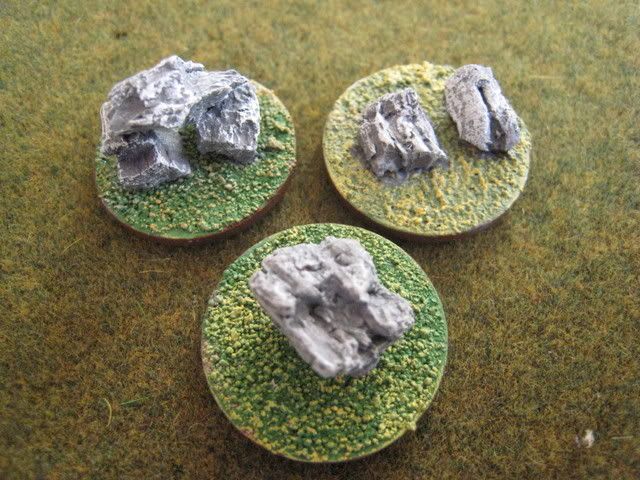
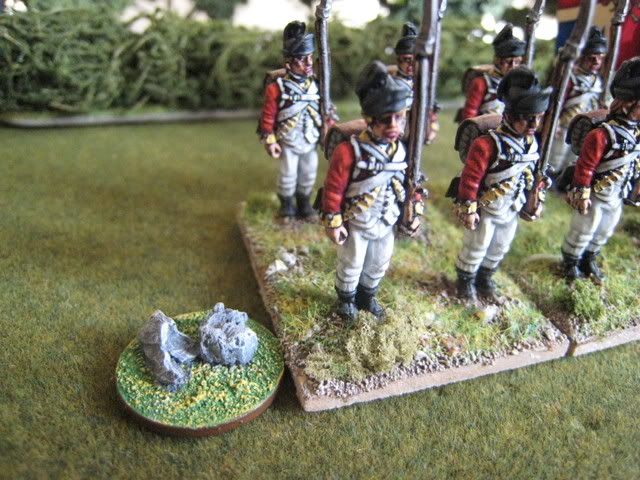
There are various ways you can do DP markers: different numbers of dots on a washer, a casualty figure with different numbes on the sides of the base etc. My method is to build little cairns of stones, using the same method as for the order markers: a lightly textured and painted/dry-brushed base (in the case of DPs, a one pence piece) with small pieces of cork added in ones, twos or threes. I forget the exact paint combination for the cork stones, but I used a GW grey for the base colour and then dry-brushed with a lighter grey and finally white. The bag of cork used came from Modelzone; the cork pieces are in various sizes, so large pieces can be used on 1 DP markers and the smaller pieces combined for 2 or 3 DP markers.

I think these markers look ok. There are pretty unobtrusive, quite simple to make and don't fly around as bits of paper are wont to do. I made dozens of each type of marker a few days before last November's Long Island game, when work required me to stay up all night twiddling my thumbs whilst waiting for various things to happen....