Tuesday, 15 April 2008

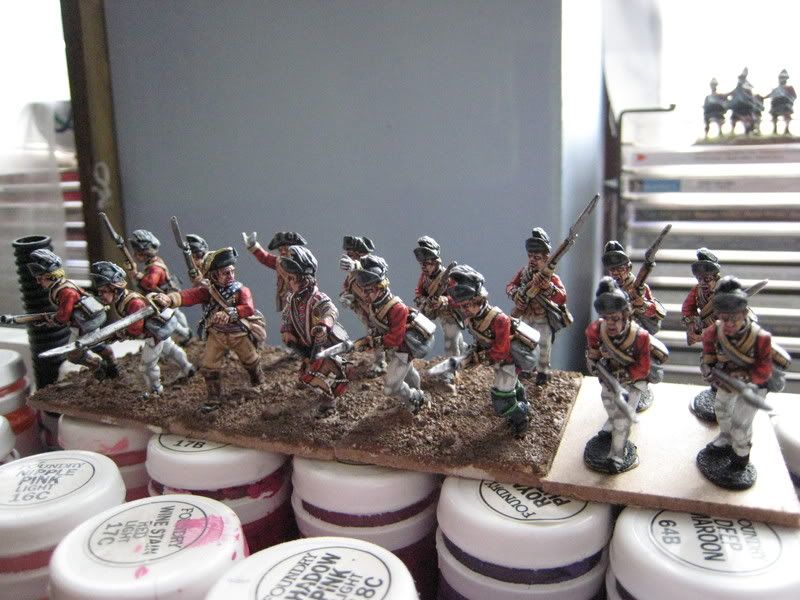
62nd Foot


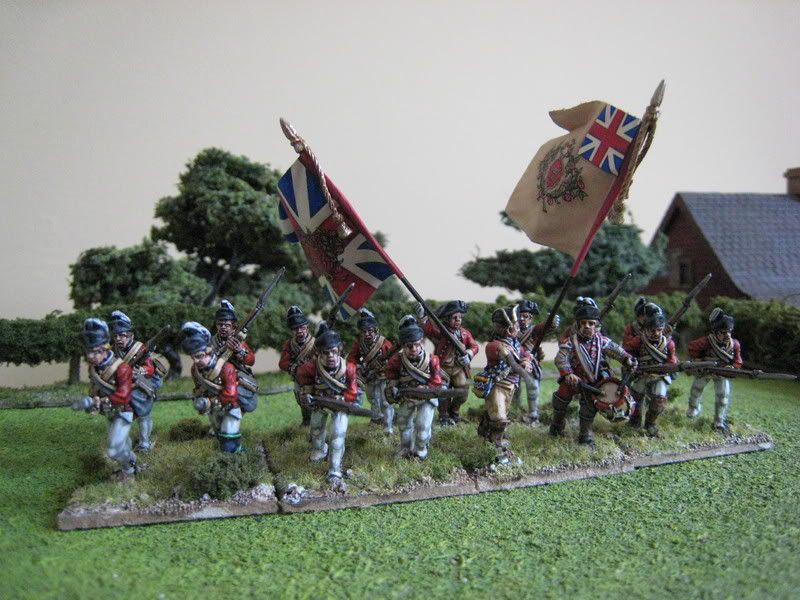
As its numbering suggests, the 62nd Foot was a relatively new regiment, raised in 1756 as the second battalion of the 4th Foot. It was re-designated the 62nd Foot only 2 years later, by which time the regiment was in Canada and it took part in Wolfe's epic attack on Quebec the following year. After a period at home the regiment returned to Canada in May 1776 and joined Burgoyne's Saratoga expedition of the following year, during which it was brigaded with the 20th and 21st regiments under Brigadier General James Hamilton. The regiment fought at both Freeman's Farm and Bemis Heights.


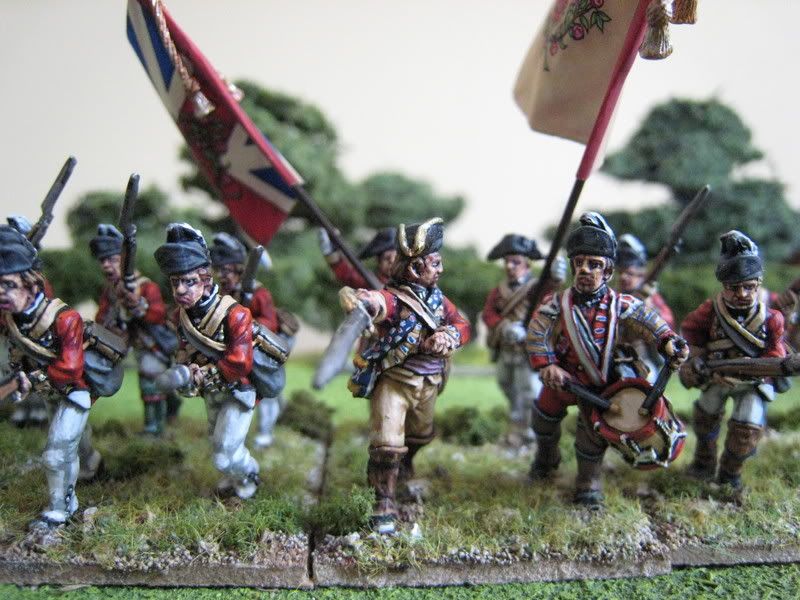
This is my fourth Saratoga British regiment and after two battalions in "firing line" poses and a third in "march attack" I decided to use "charging" figures. 16 figures are required for the regiment in the "British Grenadier!" Freeman's Farm scenario (contained in the rulebook). As you can see, the unit's facings are buff. To add some more colour to the unit I gave the officer a patterned Indian bag. I painted most of these figures in February and finished them off in March I only made up the flags at the weekend and nver thought this regiment would take so long to reach the blog! I have one Saratoga regiment left to go now, the 9th Foot (which, incidentally, are the only figures I bought at Salute last year which I have not painted). What's on the painting desk? A few figures of the 84th Foot to finish off and I am also working on two units of Continental/militia regiments using a mix of Perry hunting shirt figures and the new militia. These should be finished fairly quickly after Salute, together with my first ACW Reb regiment.


16 figures. Painted February/March 2008. Flags by GMB.

Thursday, 10 April 2008

Boston


I found Boston a rather odd place. It was very quiet, perhaps because we were there over the Easter weekend and many places seemed to be closed as a result. Finding a drink was hard work (and I'm talking about in the late afternoon onwards here, not at breakfast time or anything); I put that down to the city's puritan origins, but I was told that it was more due to the area of town in which we were staying, the Back Bay (which at the time of the AWI really was a bay). Those bars that were open seemed to be obsessed with basketball, which is a game I have never understood - where's the fun/skill in it being played by people of over 6.5 feet in height, who seem to just stroll up to the net and drop the ball in it? Having players of 5 feet and under would make it far more entertaining. I liked the cheerleaders though; demo games at wargames conventions could usefully benefit by having some.


Anyway, the highlight of revolutionary Boston is the Freedom Trail, a gentle, if long, meander through the oldest buildings in the city. We walked the trail on a day that was wonderfully sunny, but which was also the coldest, windiest day in my memory. The Kiwi suffered particularly, as the New Zealand climate simply doesn't reach the kind of wind-chill that we experienced. But as Nelson might have said, the love of history kept us warm and we kept going whilst other Freedom Trail travellers dropped out to spend the afternoon in those faux Irish pubs that New England does so well. I have one tip to pass on to those who visit Bunker Hill in the presence of someone who insists on walking the route that the British advanced up from the beach near Moulton's Hill: leave the Freedom Trail, helpfully marked on the pavement by a wide red line, and you can quite easily find yourself on the "wrong side of the tracks". Standing in down-town Charlestown in a blazer and tweed overcoat, and turning a map every which way to try to work out where one is does not engender feelings of safety. On the plus side, I did begin to get a sense of how men wearing bright scarlet coats must have felt whilst marching through the Massachusetts countryside...


But Boston was a fine place. It has some wonderful sights and Paris-grade shopping. In its restaurants we discovered the American habit of presenting you with your bill (or "check") as soon as you finish eating, which is much appreciated; in the UK you can often ask for it at least 3 times before it is finally brought to you, at close to 11pm. Boston has plenty of world-class restaurants and a major feature of our holiday generally was drinking good American wines (which are very hard to find in the UK); so for those who are interested in such things, wine highlights were: Terra Valentine 2004 Cabernet, Spring Mountain District (Napa); Duckhorn Wines' "Paraduxx" Meritage 2005 (Napa); Silver Oak Cabernet 2003 (Sonoma) and Stag's Leap "Artemis" Cabernet 2005 (Napa).


Photos: above are (1) the Old State House, built in 1713 and the seat of colonial government until the AWI. The Boston Massacre of 5 March 1770 took place just to the left of the photo. (2) and (3) The house of Paul Revere, the original "midnight rider" who rode to Lexington to warn that the regulars were leaving Boston and marching on Concord. In a future post I will have pics of the first house where he arrived with his news. This house dates from 1680. (4) The "Warren Tavern", dating from 1780. This was supposedly one of the first buildings in the rebuilt Charlestown, which had been torched during the battle of Bunker Hill. The tavern was named after General Warren, who died at Bunker Hill. Below are (1) Paul Revere himself (1885), with Old North Church (1723) in the background and (2) the Bunker Hill monument, in front of which is a statue of General Prescott.


Monday, 7 April 2008

Name that tree....


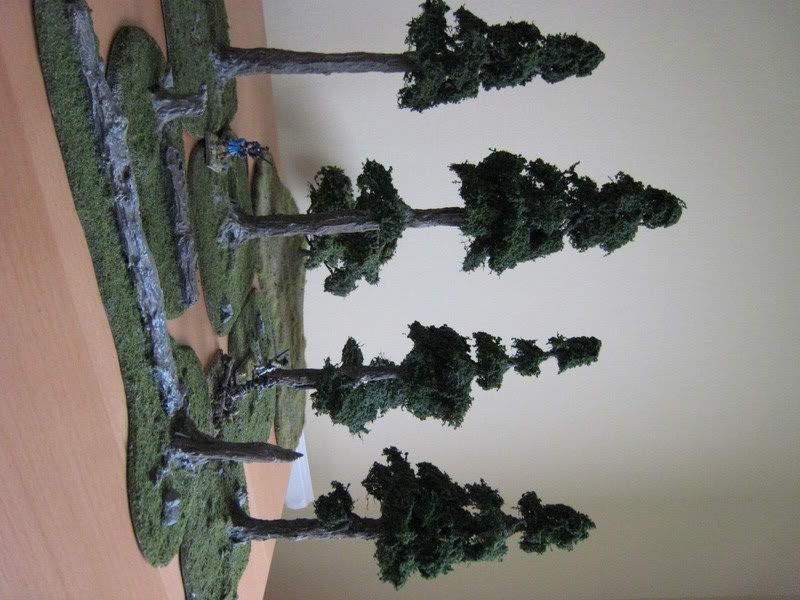
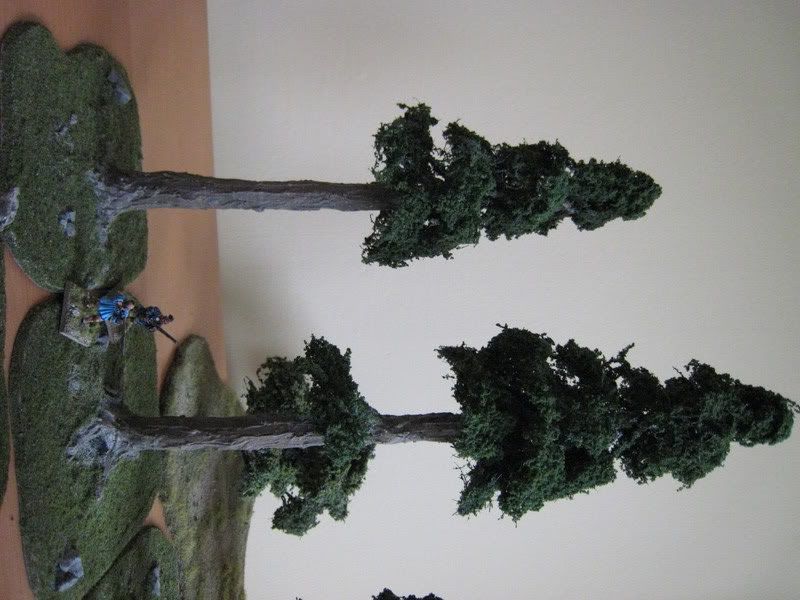
Before I get stuck in to some photos of my recent AWI-themed holiday, I thought I'd post about some rather spectacular terrain pieces I recently acquired. I liked Barry Scarlett's vines so much that I asked him and his colleague Mark (both of Murray Bridge Trees and Terrain, here) if they'd be able to make some of those huge trees that appear in paintings and photos of American landscape. I was thinking particularly of Robert Griffing's paintings of the Ohio and Hudson valleys, which often feature enormous trees of varying kinds. Pictures of the ACW's Wilderness campaign also spring to mind. In my last post I referred to giant redwoods, and I appreciate that those trees are only found on the Pacific coast. I suppose that's generally what I had in mind, absent any other specific genus. But to be honest, I'm not really that fussed about what species of tree these are; I just wanted something large to float at the back of my terrain and heighten the impression of a battlefield that was a long way away from old Europe. That said, answers on a comment post if you think you may have a convincing idea as to what these trees could feasibly be in upstate New York....There are no prizes - it's a serious question!


The largest tree, on the right of the second photo, measures 36.5 cm high. Golly. The figures are of course 25mm Perry sculpts, to give a sense of scale. In the background is the wooded base I usually use for my photos - these are "small" trees from Realistic Modelling. Mark added a couple of bases of broken trunks; the shape of the larger one is, I think, a practical joke...I also bought some sachets of differently coloured "flower scatter" which I will add to the 84th Foot's bases when that unit is finally finished. When I painted the 55th Foot a few years ago I liberally added to the bases the crystals from a Woodland Scenics lavender field mat - the result worked ok; I must take some photos of that regiment at some stage.


Anyway, if you fancy some sequoia, or whatever they are, drop Barry and Mark a line. Each tree and base cost Aus $47.50, which is about £22 or US $44 (the trees were based at my request; the chaps can supply the trees unbased for less). That includes a "prototype discount" since the lads hadn't really made any before; but I think the price is very good value given the size of the trees, at least compared to UK-manufactured trees of a similar quality. Postage to the UK was a substantial Aus $90 for the lot (2 boxes' worth), so I suppose that adds an extra £10 on to the price of each tree, although I also received the two bases of logs and 5 bags of flower scatter. I have to say that the packaging was excellent. Overall I'm delighted with these products and I certainly don't mind paying a premium for postage to receive such excellent items from Australia, especially when I've never seen anything similar in the UK or come across modellers so eager to jump into a new challenge. In any event, I buy large amounts of wine from Australia, so why not wargames terrain? It could be Australia's next big growth export if marketed properly....

Thursday, 3 April 2008

Back home...


...and a fortunate wargamer indeed to have visited the sites of the first shots fired in both the AWI and the ACW. We spent the Easter weekend in Boston itself, with a trip out to Salem, and then stayed a couple of nights in Concord (in a tavern that dates back to the 1740s), which allowed for a day-trip down Battle Road to Lexington. We then headed off to Charleston in South Carolina (I will never forget the Kiwi's plaintive mumble at Boston airport that "it will be nice to get away from all this military stuff"...), where much fun was had in various museums, including the fascinating Confederate Army Museum which is curated by the rather rum-sounding "Daughters of the Confederacy". By this stage in the holiday I realised that telling the Kiwi all about the significance of Forts Moultrie, Sumpter and Wagner would probably result in the cancellation of certain wedding plans, and so we only admired the scenes of those actions from Charleston Harbour. As always with holidays, the excitement of visiting much-anticipated places was counterbalanced by the disappointment of finding some closed (such as most of the witch-trial places in Salem and the American gallery of Boston's Museum of Fine Arts). But all-in-all it was an excellent holiday and any guilt I felt at innocently planning a route that just happened to pass some of the milestones of military history was more than assuaged by the amount of shopping that the Kiwi managed to fit in (including a certain handbag which has dramatically reduced the amount of cash I will have available for shopping at Salute...).


In addition to seeing where the AWI began, my main concern on this trip was to photograph as many period buildings as possible so that I could build up a decent source of reference for scratch-built models. I'm not likely to want to create a miniature Boston or Charleston, although if I did I now know exactly what buildings I'd want and where I'd place them. More usefully though, Charleston, Concord, Lexington and Salem provided a rich seam of colonial architecture from which a host of models can be mined. Salem in particular has entire streets of houses that date from revolutionary and "Georgian" times, all helpfully marked with plaques that identify for whom the house was built and when. The basic architecture of residential New England doesn't seem to have changed much over the past 200 years, but after a while and some careful examination you begin to work out what's period and what's modern addition. Charleston architecture reflected the wider mix of people who lived there - "English" houses that are broadly similar to those in New England rub shoulders with more continental-looking, Huguenot buildings.


Whilst the Kiwi was busy buying clothes and bags I was filling my suitcase with various books - a history of the F&IW by Fred Anderson (of "Crucible of War" fame); a privately-published biography of General Stark; histories of the two attacks on Charleston and Benedict Arnold's 1775 assault on Canada; David Wilson's new "The Southern Strategy", which deals with the South Carolina and Georgia campaigns of 1775-1780; Buchanan's chatty but very well-researched "The Road to Guilford Courthouse" (which I found second-hand in Harvard); "Taming Democracy" by Terry Boulton, which considers how popular conceptions of "freedom" and "liberty" were handled by the American politicians during and after the AWI; an account of Salem's colonial architecture; and finally a history of the Charleston Light Dragoons in the ACW, a militia unit that was drawn from the planter and merchant elite and which elected its new recruits, even after being taken on to the Confederate establishment. Lots of interest stuff in these, I'm sure. One final thought - the people we met in New England and Charleston were, without exception, some of the most polite and helpful people I've ever come across, passionate about their history and eager to welcome those who share an interest in their country. America up close and personal (and this was only my second visit, the first being to New York several years ago) is a far different place than some sections of the world's media would have us believe.


I won't bore readers by posting all the photos I took (about 200), but over the next couple of weeks I will post items that might be of interest. These will be largely museum pieces; for for example, in Charleston Museum I saw 2 of apparently only 9 extant Continental Army 6-pounders, which answered the question I posed recently as to what the tops of the ammunition cases were made of (even the Kiwi felt my joy at this discovery; in fact half of Charleston probably heard it). But I will also post pics of some of the period buildings, because they were beautiful and other AWI gamers may find such references useful. The two photos above show the two statues of George Washington that I came across, the first on Boston's Common and the second in Charleston. I believe that the former is the first statue of Washington that was erected (or the first on a horse, or the first in public, or something like that...) You can see the difference in climate between the two cities!


As for painting, March was pretty much a write-off. The 62nd are based, but have no flags. The 84th are half-finished, but need another week at least. My Confederate infantry regiment (as yet unidentified) is coming along nicely, but I need to buy the figures to finish it off at Salute. However, today I received from Barry and his chums in Australia four giant redwood trees that I asked them to make - photos of those will be up in a couple of days. They are huge.
Wednesday, 19 March 2008

Off to the USA


Thanks to the ever-increasing demands of work I haven't managed to finish off the basing of the 62nd. And I haven't finished painting the 84th. Annoyance. In fact, as I'm now going to be away until 2 April my tally for March will be only 13 painted figures. What I did manage to do, however, was start on a regiment of Rebs for the ACW. I have long been interested in this war and bought my first Dixon Miniatures figures about ten years. I painted about two dozen shortly thereafter but they have sat in their box until fairly recently (actually, that's not entirely accurate - they did form part of a display that I put up in the office I sat in as a first year trainee; my supervisor had all kinds of toys on his desk so I thought I had better contribute something). The impetus for digging these out was the release of the Genereal de Brigade variant "Guns at Gettysburg". I have enough painted figures for 3 regiments and I will slowly tart them up over the next few weeks.
So in the absence of anything else I thought I'd put up some work in progress shots. Three of the figures were painted over the past couple of weeks, the others 8-odd years ago and touched up slightly. People seem to either love or hate Dixon figures. I love them as they are dead easy to paint and the variety in their ACW range is staggering. At 95 pence per figure they are also at the cheaper end of the UK metals market. Some have said that the advent of Perry plastic ACW figures will be the death-knell of other ACW metal ranges. I do hope that is not the case and I doubt that it will be.

I'm flying off to America tomorrow so no more posts for 2 weeks. We have a week in Boston and then a few days in Charleston. When I return I will be armed with dozens of AWI themed photos!

Wednesday, 12 March 2008

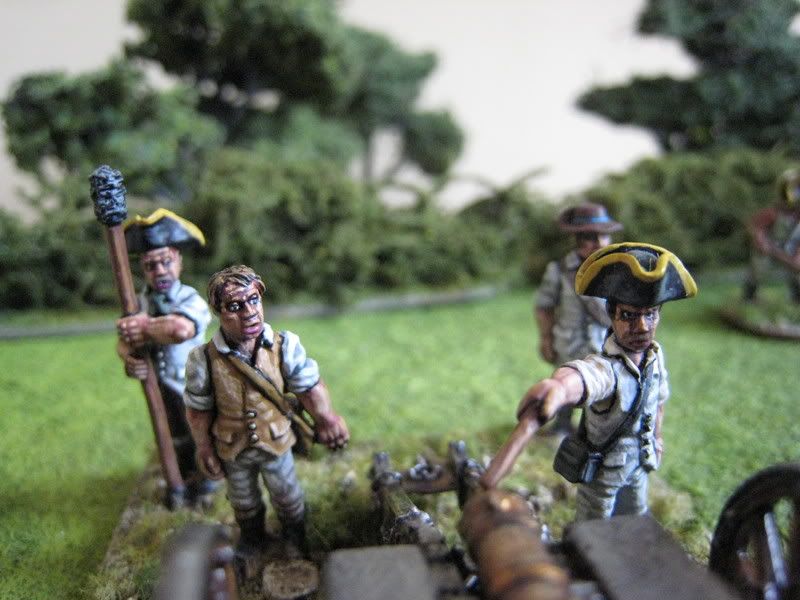
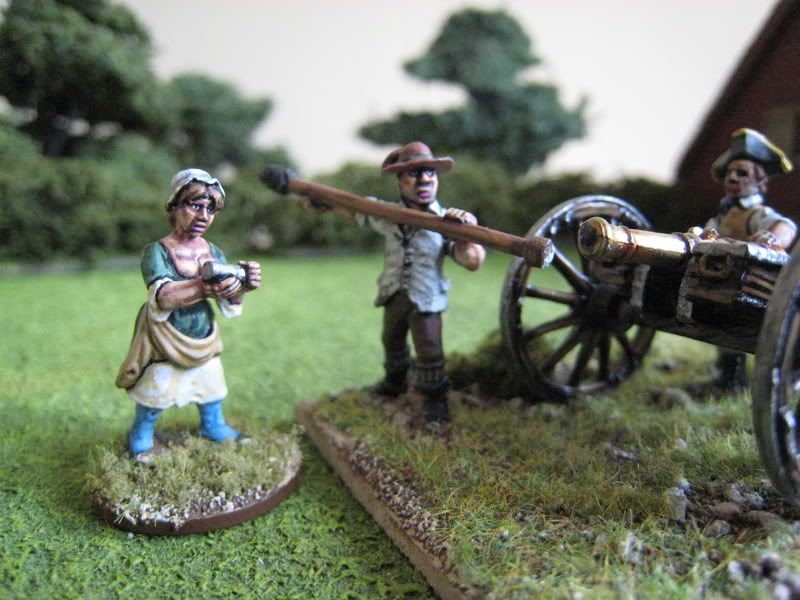
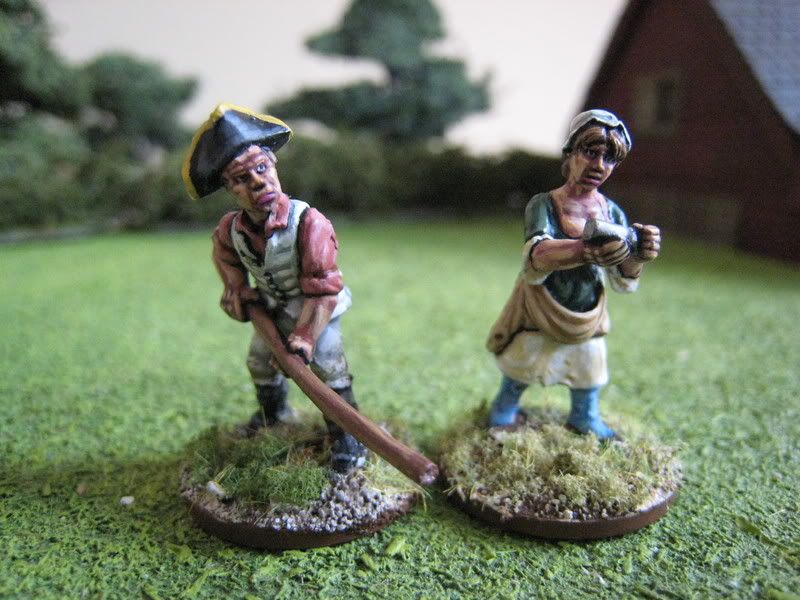
American artillery (3)


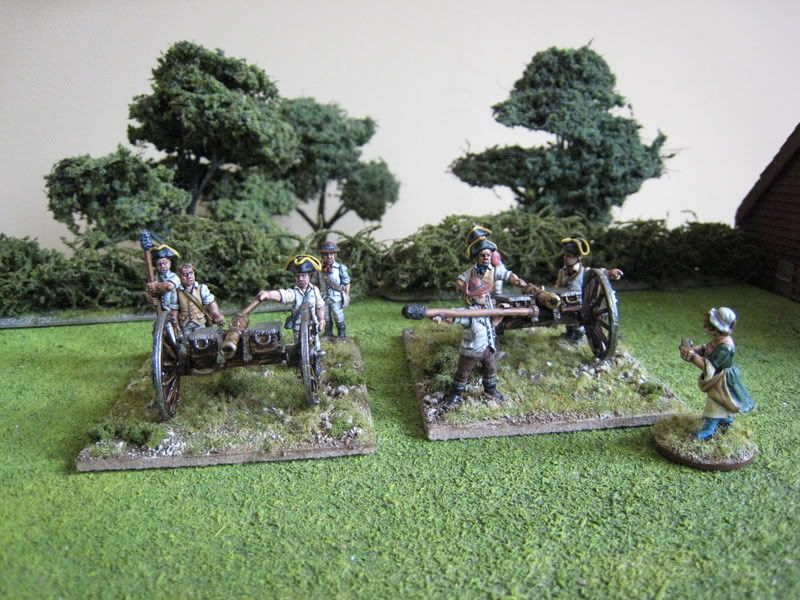
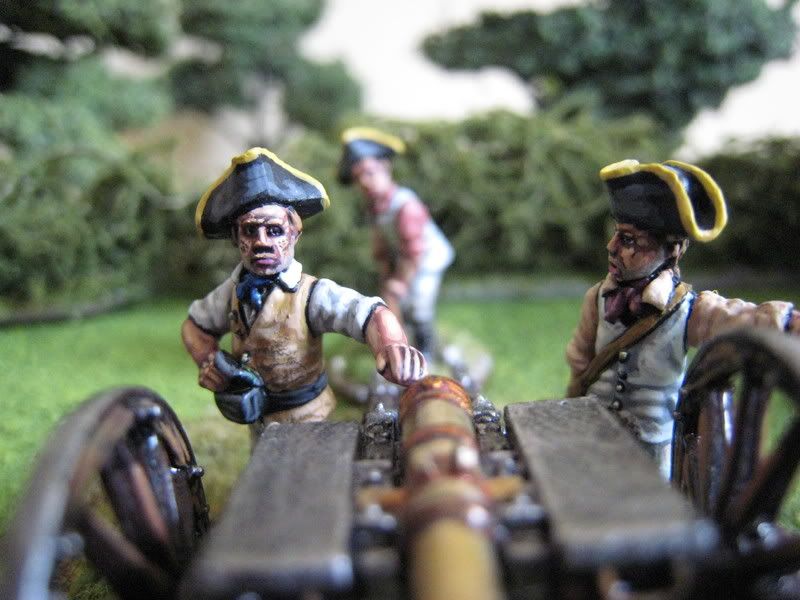
Nic Robson gave me permission to put up these photos of the forthcoming Eureka "Molly Pitcher" and Continental artillery figures. The gun pieces are by Foundry but all the "humans" are Eureka figures. There are two crews, one loading and one firing. The figures are in shirt sleeves and I think capture very well the look of artillerymen in the thick of action. I strongly suspect the poses are taken from the Don Troiani painting of Molly Pitcher at the Battle of Monmouth; see here. Note the pose of the chap with the ramrod who is in an "overarm" position rather than the usual "underarm" pose that most manufacturers use; this pose just looks so much more intense and makes me wonder why the underarm pose is more common. I particularly like the shirtsleeves look - these figures could be used for militia gun crews and add variety to the Foundry/Perry crews in uniform coats.


I can't quite put my finger on it, but these sculpts just look the business. That's why I decided to paint them in a more "weathered" look than usual, with lots of soot, dirt and stains on their uniforms; I also tried to add some powder burns to the faces of a couple of the gunners. There's a certain nervousness in the poses and faces, that I think expresses the look of men in the middle of battle. It's hard to explain - sometimes sculpts just seem to come alive. I gave the figures all stubble to help suggest that "been at it all day" look of the Troiani painting. As for the faces, see if you can spot Homer Simpson and British actor Geoffrey Palmer..... The colours of Molly's clothes are taken directly from the painting. In short, a lovely set. I understand that Eureka are looking at a summer release for these figures. They deserve to shoot to the top of any AWI gamer's wants list. Many thanks to Nic and John Baxter for giving me a sneak peek.


9 figures. Painted February 2008. Guns by Foundry.


Saturday, 8 March 2008

Current wip


Work is continuing to play havoc with my painting schedule. Paiting time during the week has all but stopped and next weekend I will be away on business in Scotland. The following weekend is Easter and from then I will be on holiday for 2 weeks. The Kiwi and I are going to Boston followed by a few days in South Carolina - AWI heaven. Apparently the Kiwi has always wanted to visit Boston; even after I'd spent about an hour telling her about the beginnings of the Revolution she was still keen to go there....My particular aim is to take plenty of photos of period buildings, as reference for those excellent chaps at Tablescape. I see there's a tavern at Lexington (or is it Concord?), a model of which might look good on a wargames table.


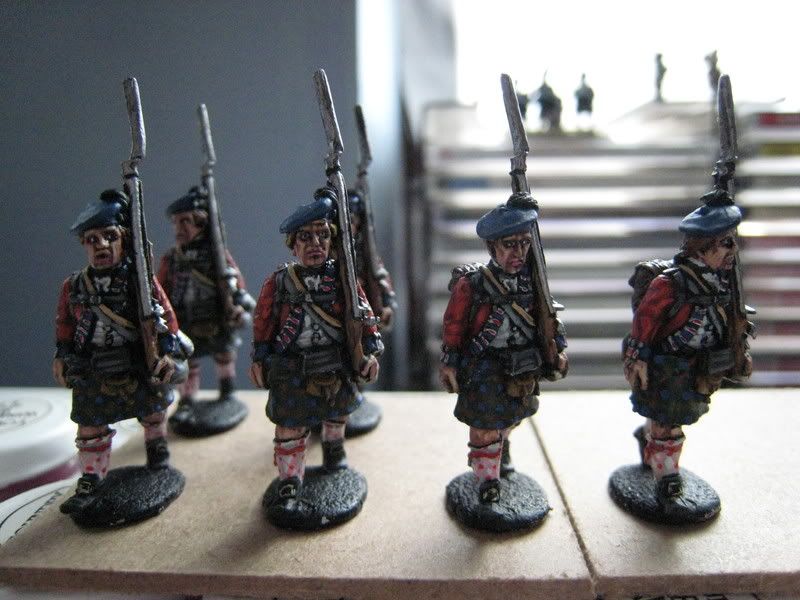
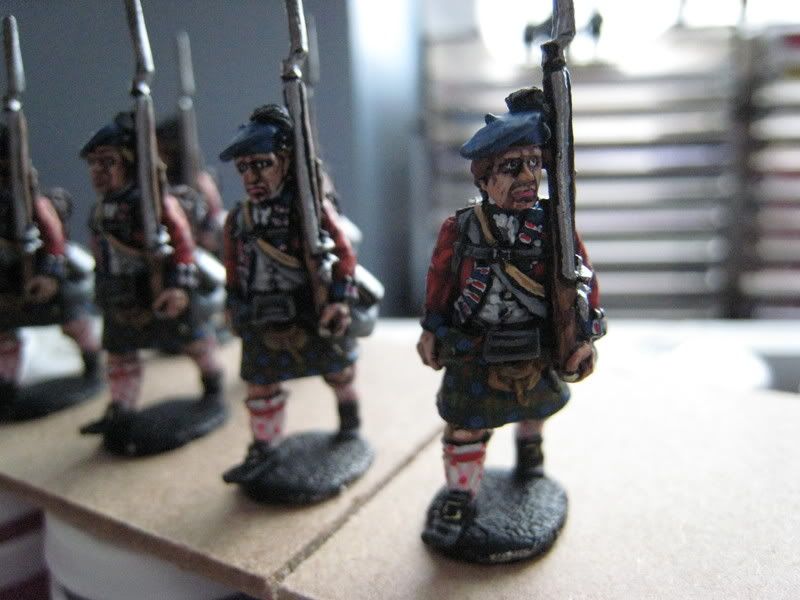
I have some photos of the soon-to-be-released Eureka Continental artillery to post next week, but here are a couple of (not particularly good) photos of what's on the desk. In the last week of February I changed my mind about having a bash at another Saratoga regiment. I didn't manage to finish it before the end of the month, but the 62nd Foot (above) is now all ready for the final stages of basing. Proper pics might be up by the end of the next week. When I visited Perry HQ at Christmas I was particularly taken with Alan's 24th Foot that also comprises these charging figures; Dave Woodward had done a fantastic job on their faces, giving them proper, and not a little bit scary, grimaces. Below are two pictures of my current regiment, the 84th Foot or "Royal Highland Emigrants". I felt like painting some highlanders again as my painting style has changed a bit since I last painted some (the two battlions of the 71st back in 2006). The immediate inspiration came from the Eutaw Springs scenario in the new "British Grenadier!", which requires a battalion of the 84th; I think also we have a reader who had an ancestor in the regiment? Whilst I was painting the first batch I posted a step-by-step on painting the tartan plaid on the WD3 forum, which may be of interest: see it here.


As a couple of readers have noticed, the current issue of "Battlegames" magazine has some photos of my collection. Henry Hyde asked me to send him some pics of the Battle of Guilford Courthouse to accompany an article by Bob Barnetson and his team which assessed various AWI rulesets. Unfortunately "British Grenadier!" came in for some sharp criticism (I am penning a very short rebuttal to go in the next issue), but the article is a good read. If you haven't heard of "Battlegames" have a look here; it's a truly excellent publication, which seems to have acquired the (fully deserved) tag as "the thinking man's wargames magazine". Finally, look out also for the next "Touching History" publication, due next month, in which Paul Darnell will tell us how to make terrain features and buildings for the AWI, F&IW and ACW. A few weeks ago I packed my collection into the car and drove off to spend a fun morning with Paul and his camera at his former pad near Chelmsford. More on that anon...