Wednesday, 30 June 2021

Brazil: 1st Infantry


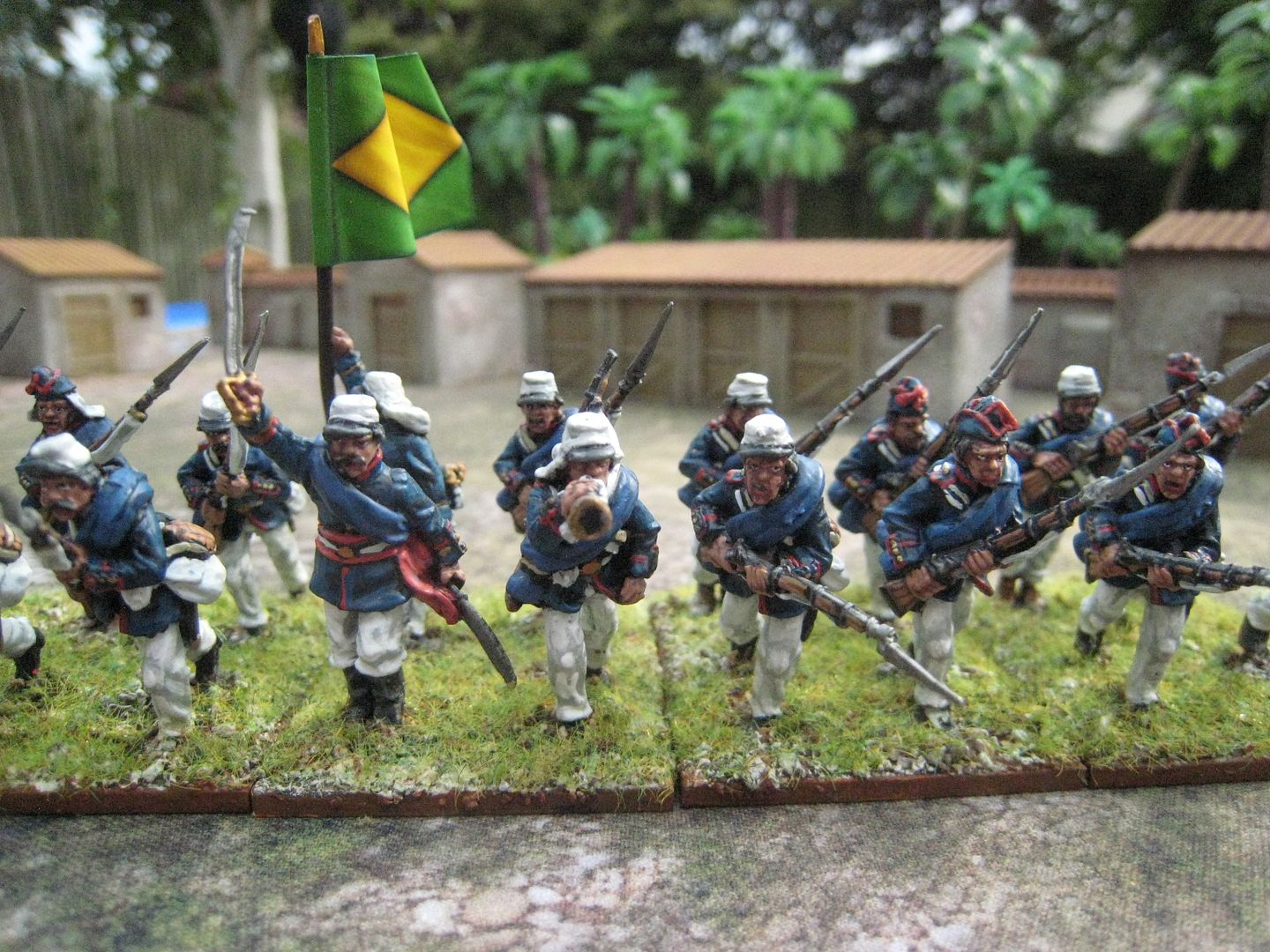
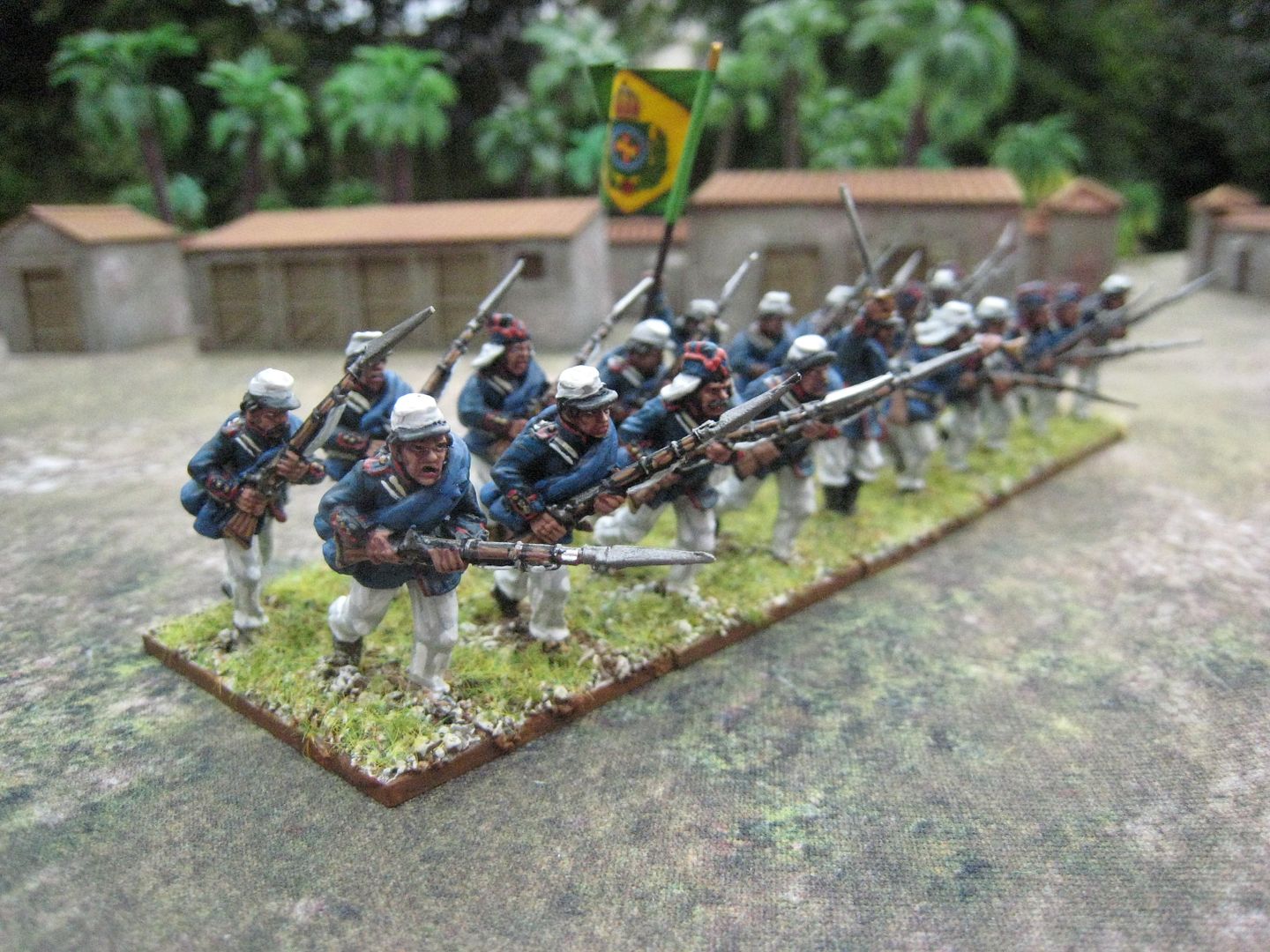
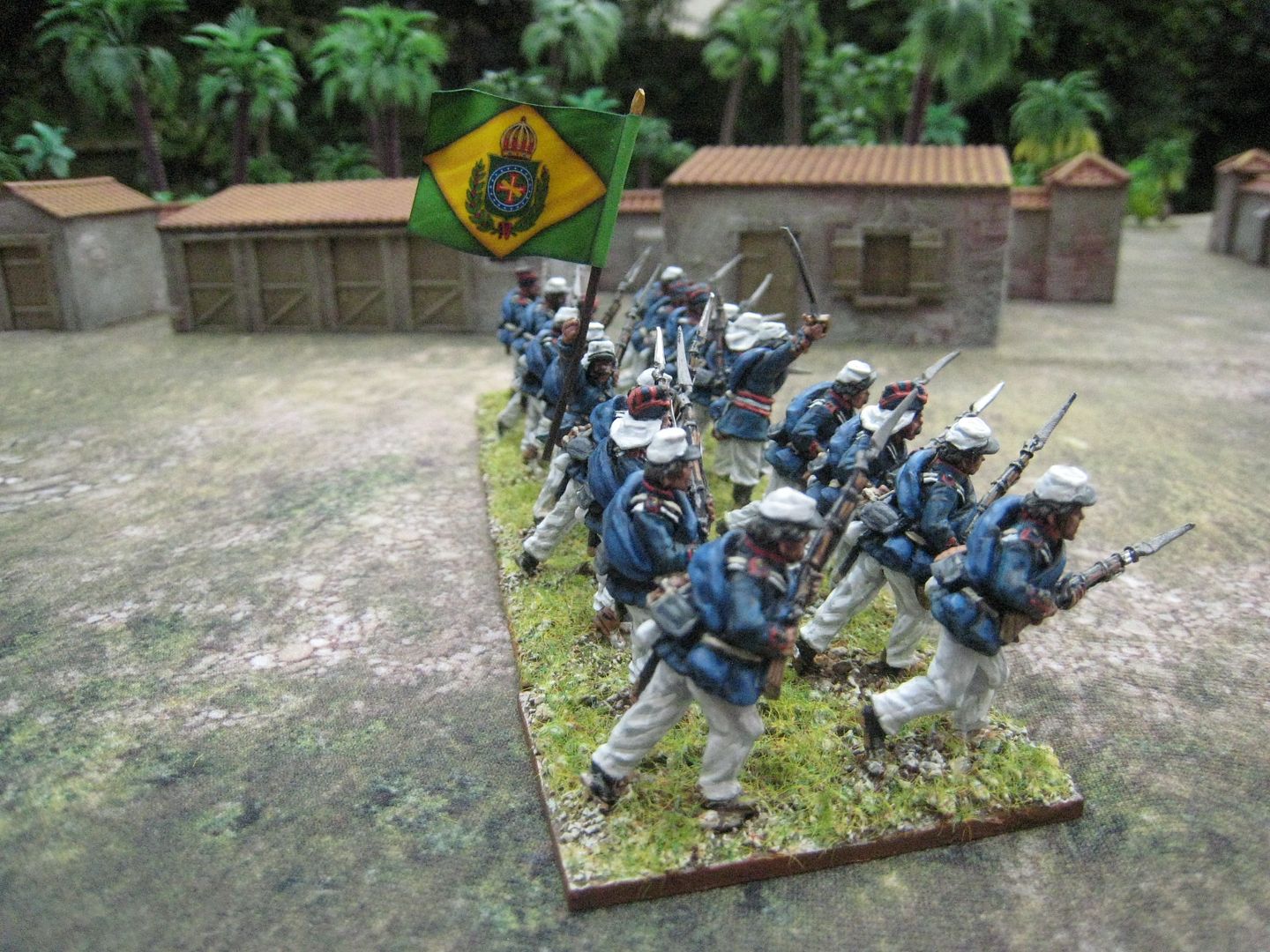
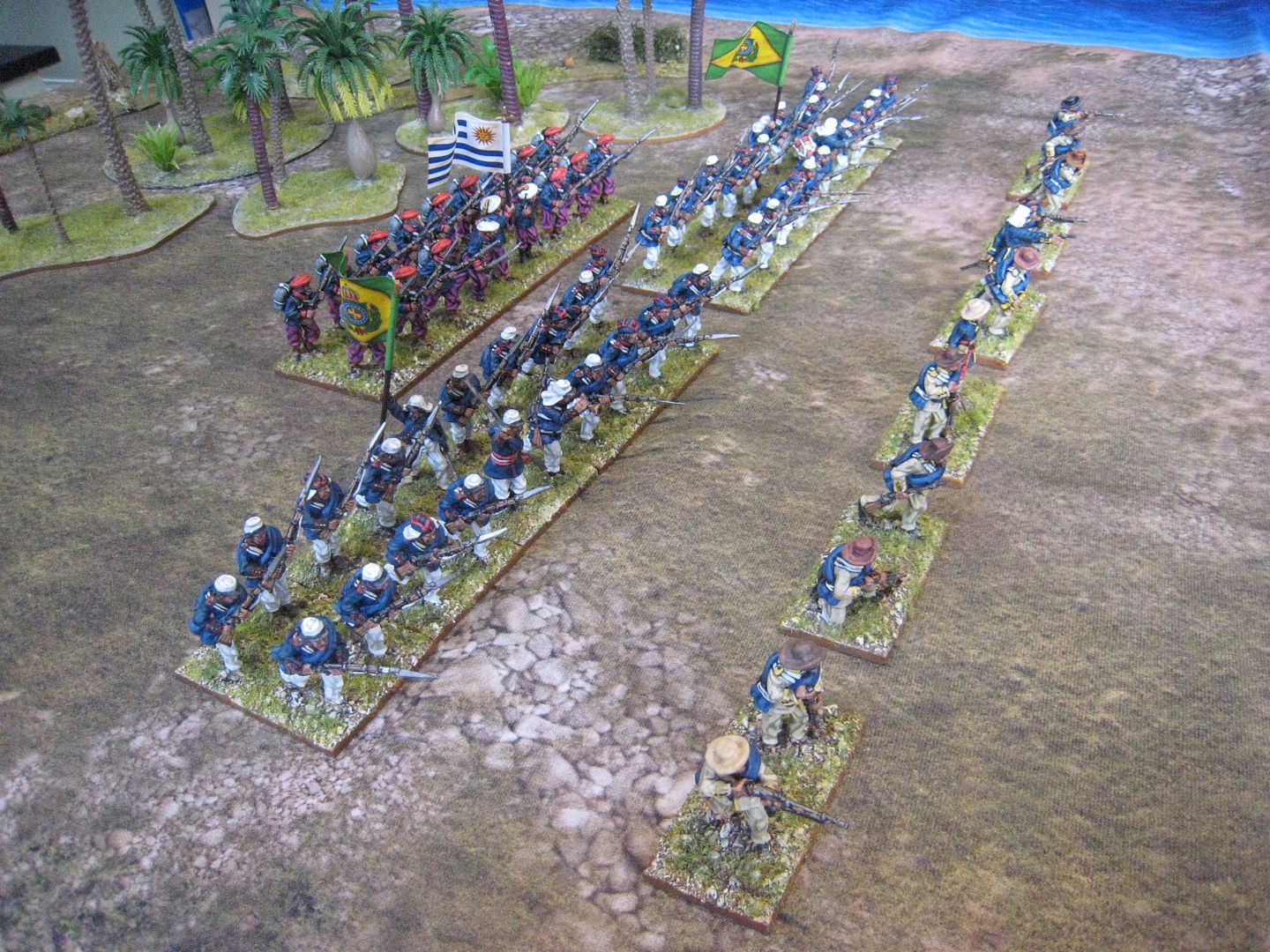
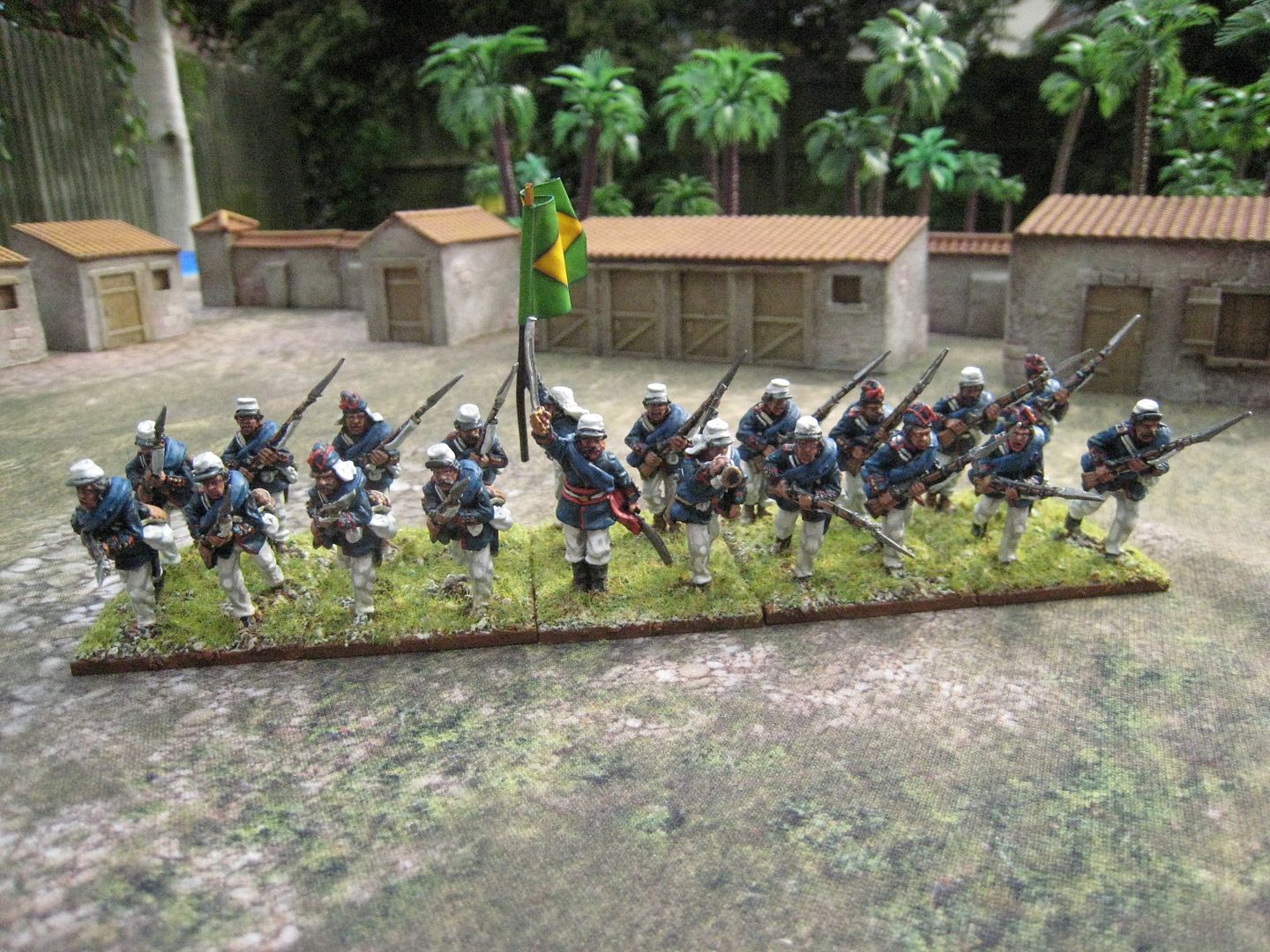
This is the first battalion from Brazil, which supplied the largest contingent of troops for the War of the Triple Alliance.  As with my Paraguayans, I'm simply assigning numbers to these units in consecutive order.  Brazilian line infantry battalions did have regimental distinctions up to February 1866, when the decision was taken to modify and simplify uniforms in light of the expansion of Brazil's army as a result of the war.  That expansion saw the regular infantry increased to twenty-two battalions, of which the first seven were fusiliers and the remainder "cacadores".  In addition to these units, Brazil could field a large number of national guard and local provincial troops.  The "paper" strength of each fusilier battalion was 882 men in eight companies; so I've modelled them as being 20 figures, which give a scale of about 1:40 (allowing for some battle casualties).  That said, the Allied order of battle for 1865/66, as provided by Hooker in his Foundry book on the war, gives strengths between 370 and 500 for the Brazilian regular battalions, which brings us closer to 1:20.  I'm still in two minds over unit strengths - I've already decided to drop the Argentinians down to 16 figures; I might do the same with the Uruguayans.

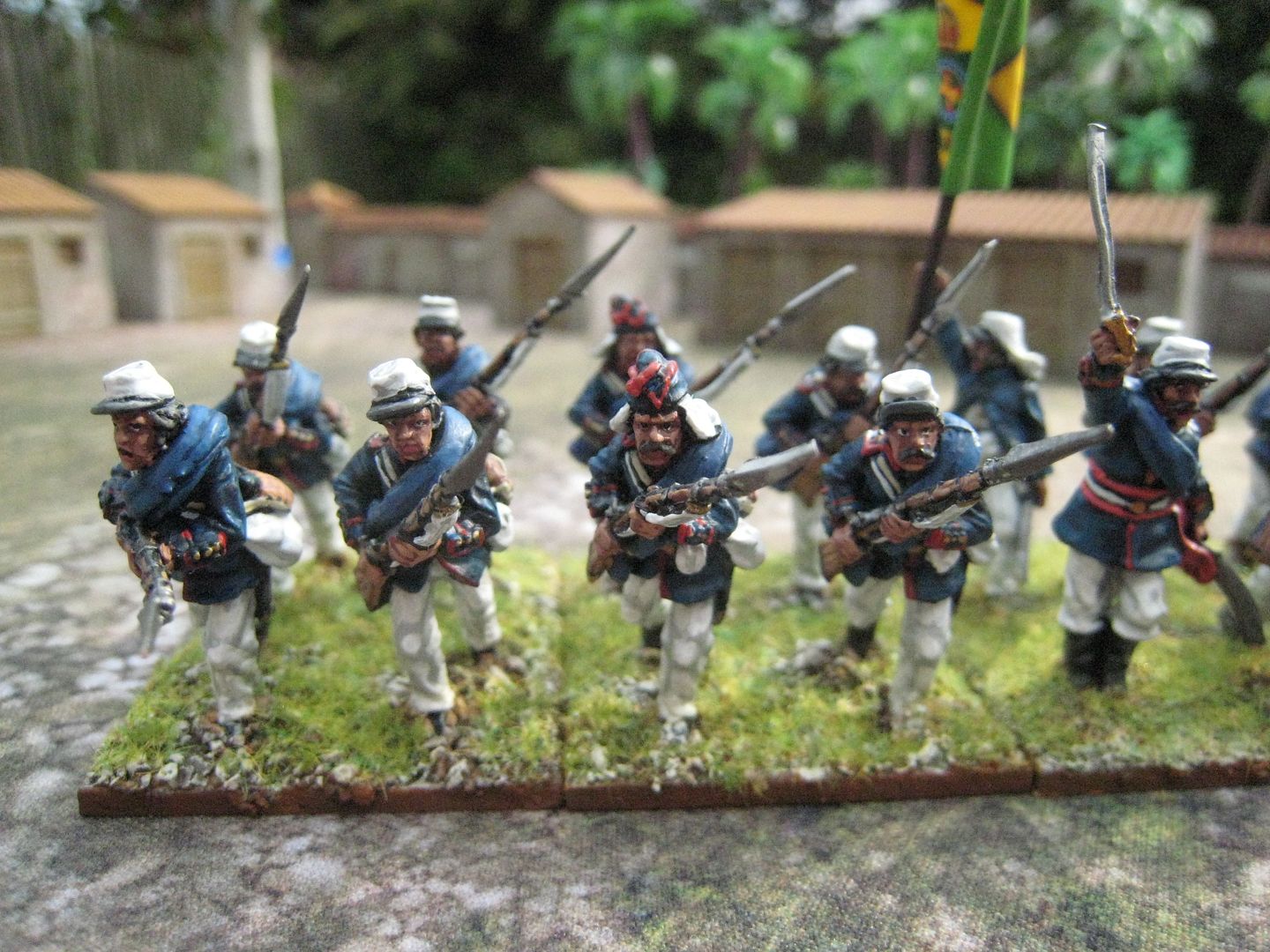
These are Perry Miniatures figures.  Their website shows the various options for painting these figures.  I've gone for the dark blue service dress tunic with white, summer trousers.  The barrack caps probably should have white middles to them.  I used the Foundry "Union Blue 111" palette for the tunic and the "Deep Blue 20" palette for the blanket rolls (to add a bit of variety between the blues).  For the flesh of all the troops in this war, I use "South American Flesh 119" palette.   The "Union Blue" palette has become my default dark blue, which I've also been using for Argentinian infantry and, naturally, ACW Union troops.

20 figures.  Painted November 2020.  Flag from Flags of War.


Tuesday, 29 June 2021

Paraguay: 2nd Infantry


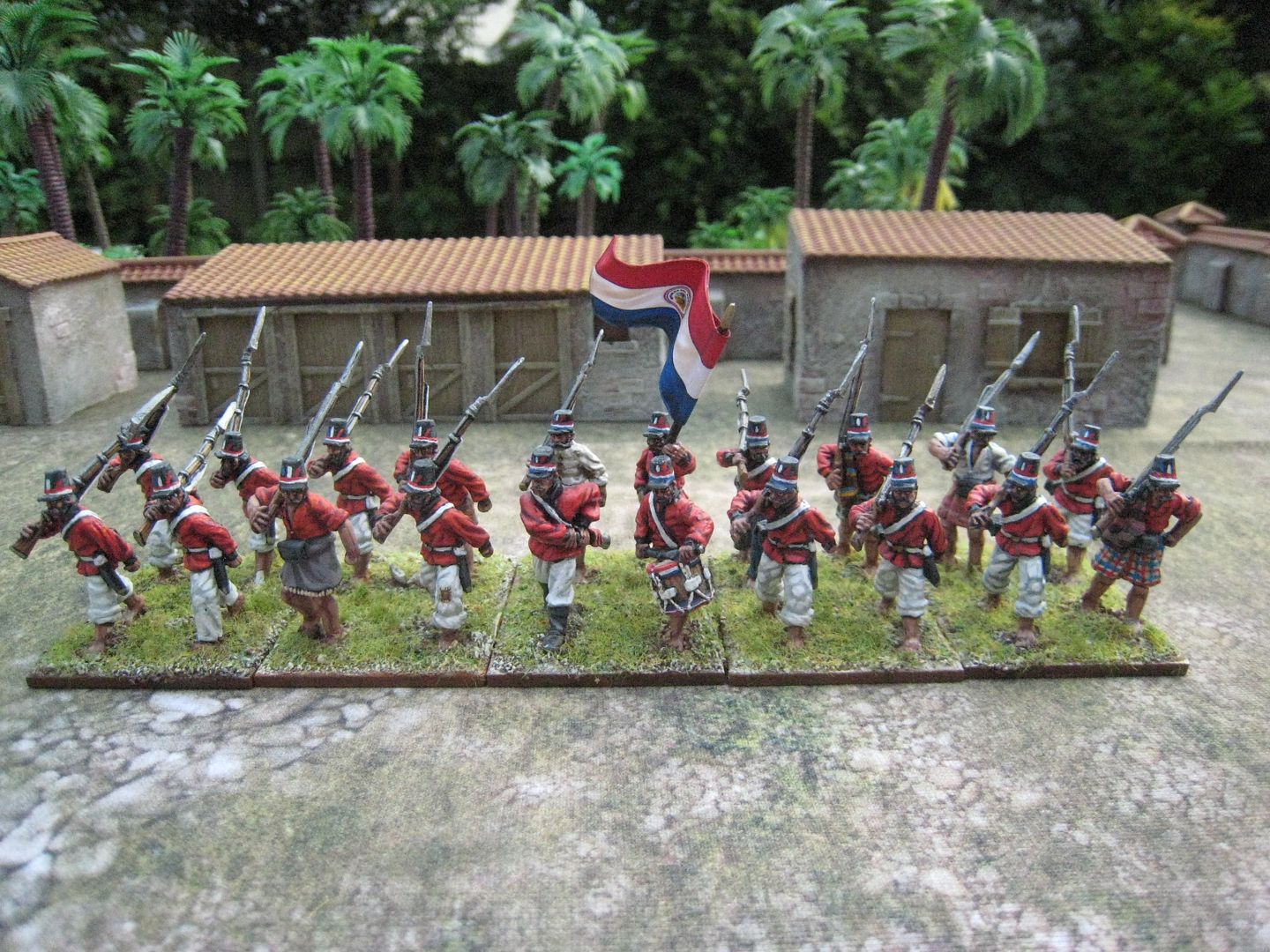
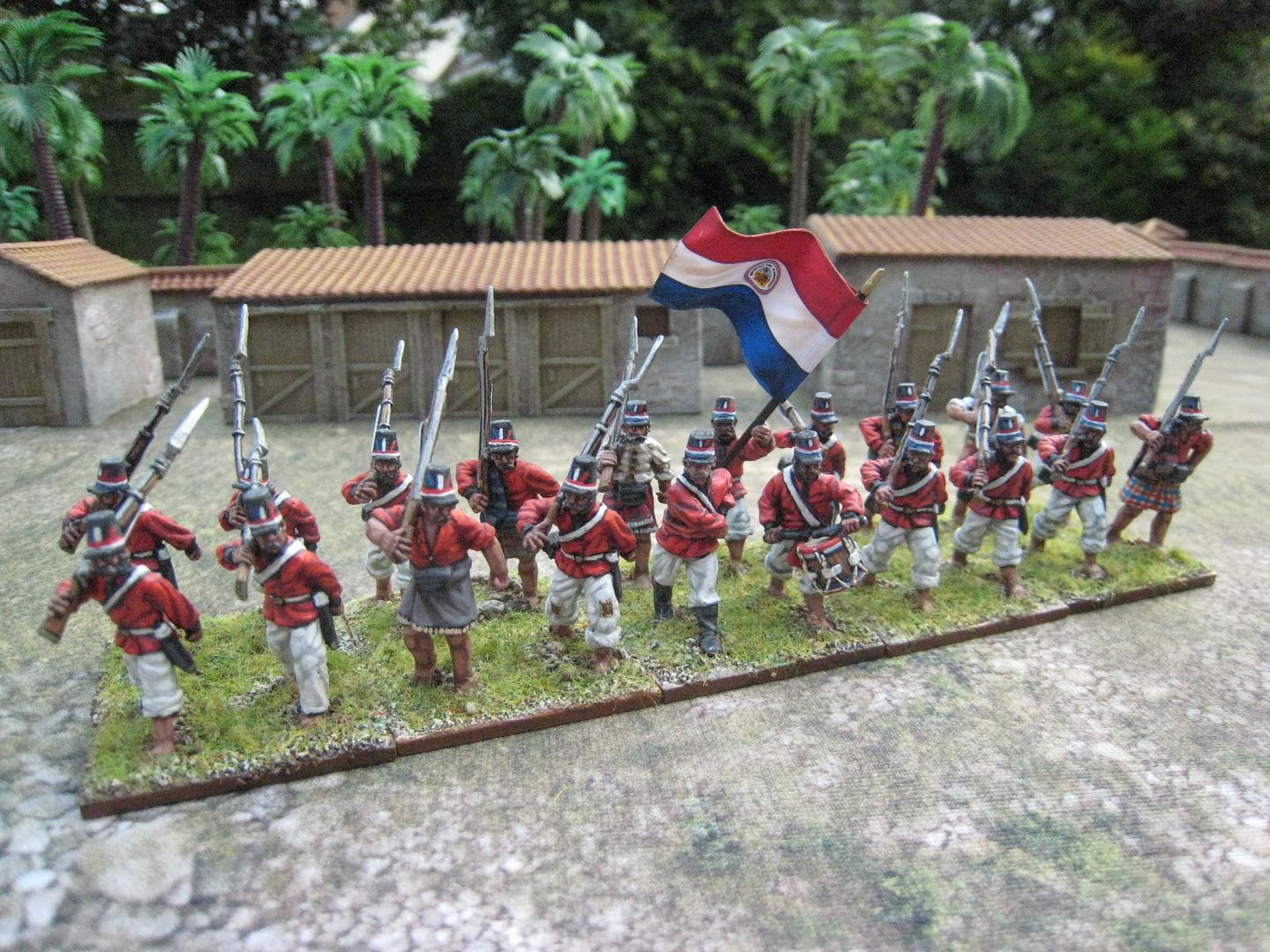
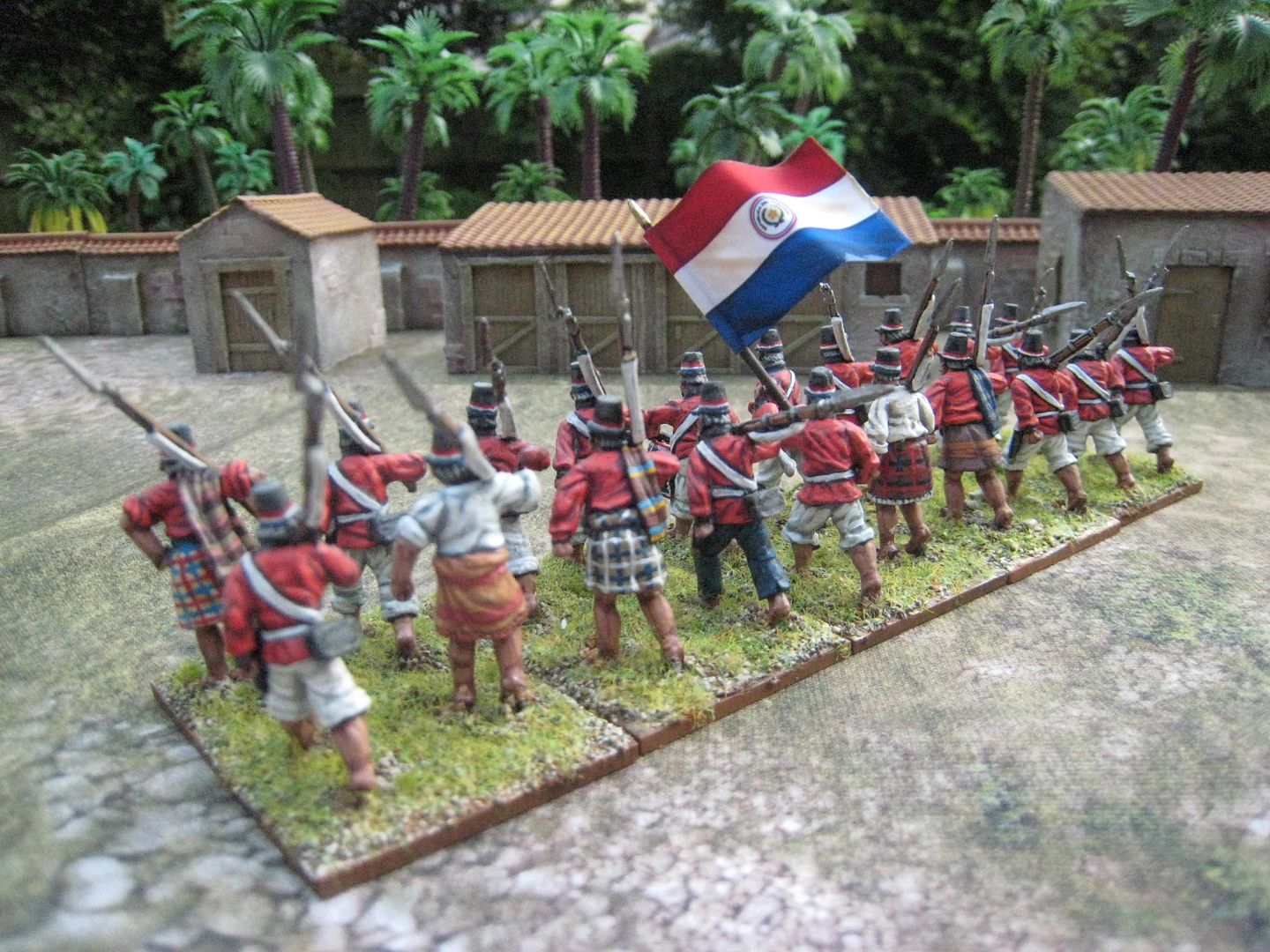
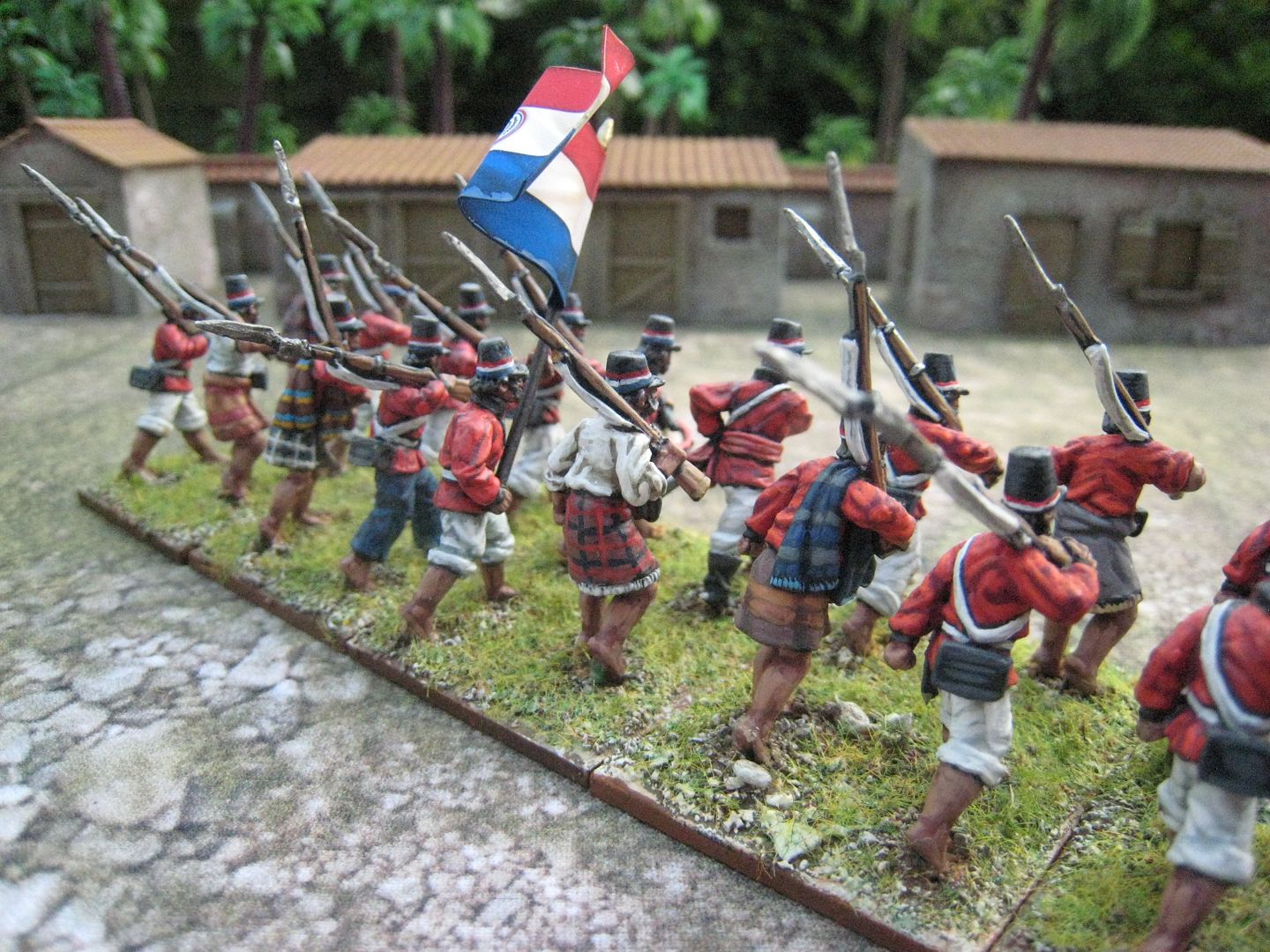
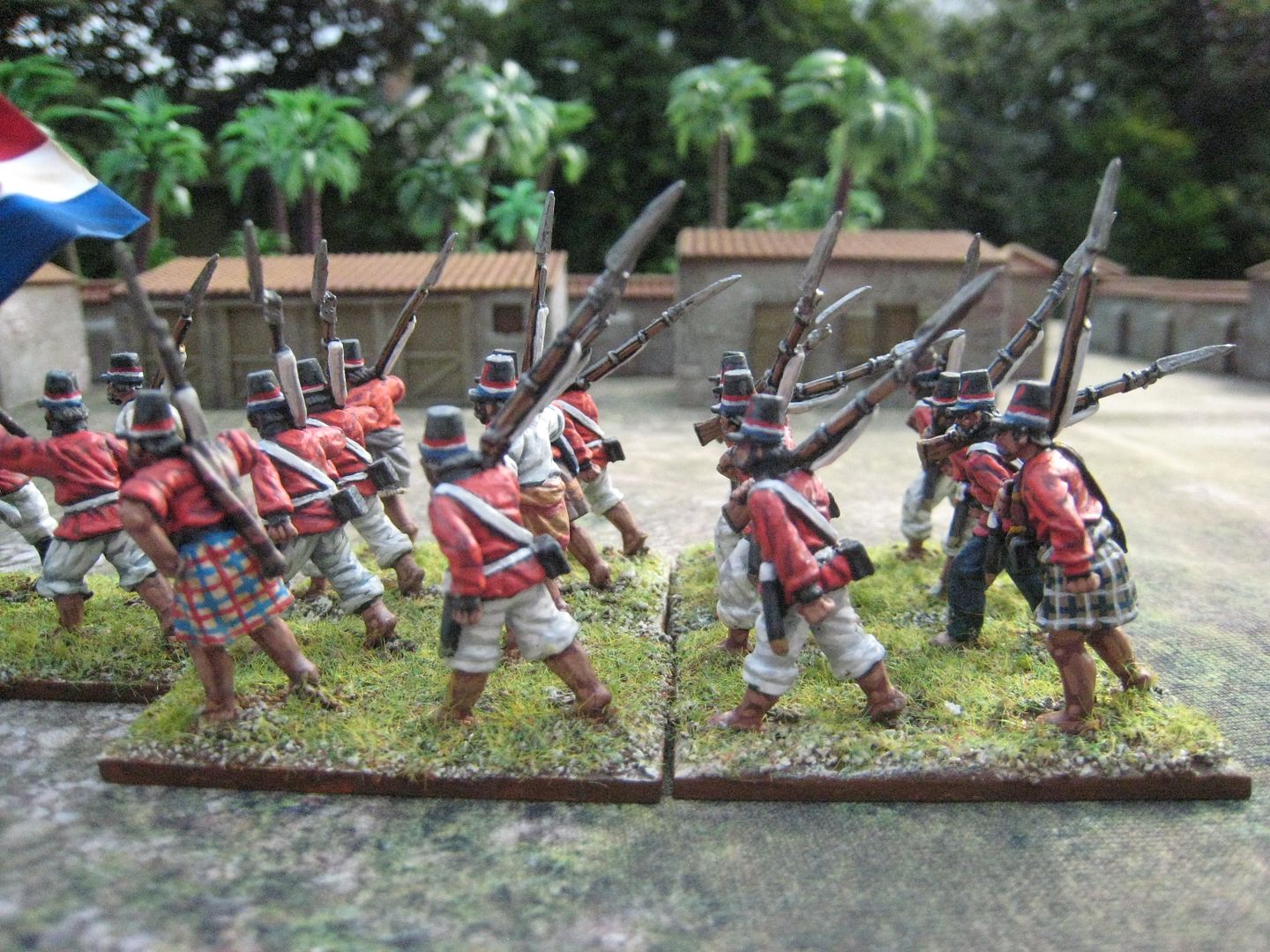
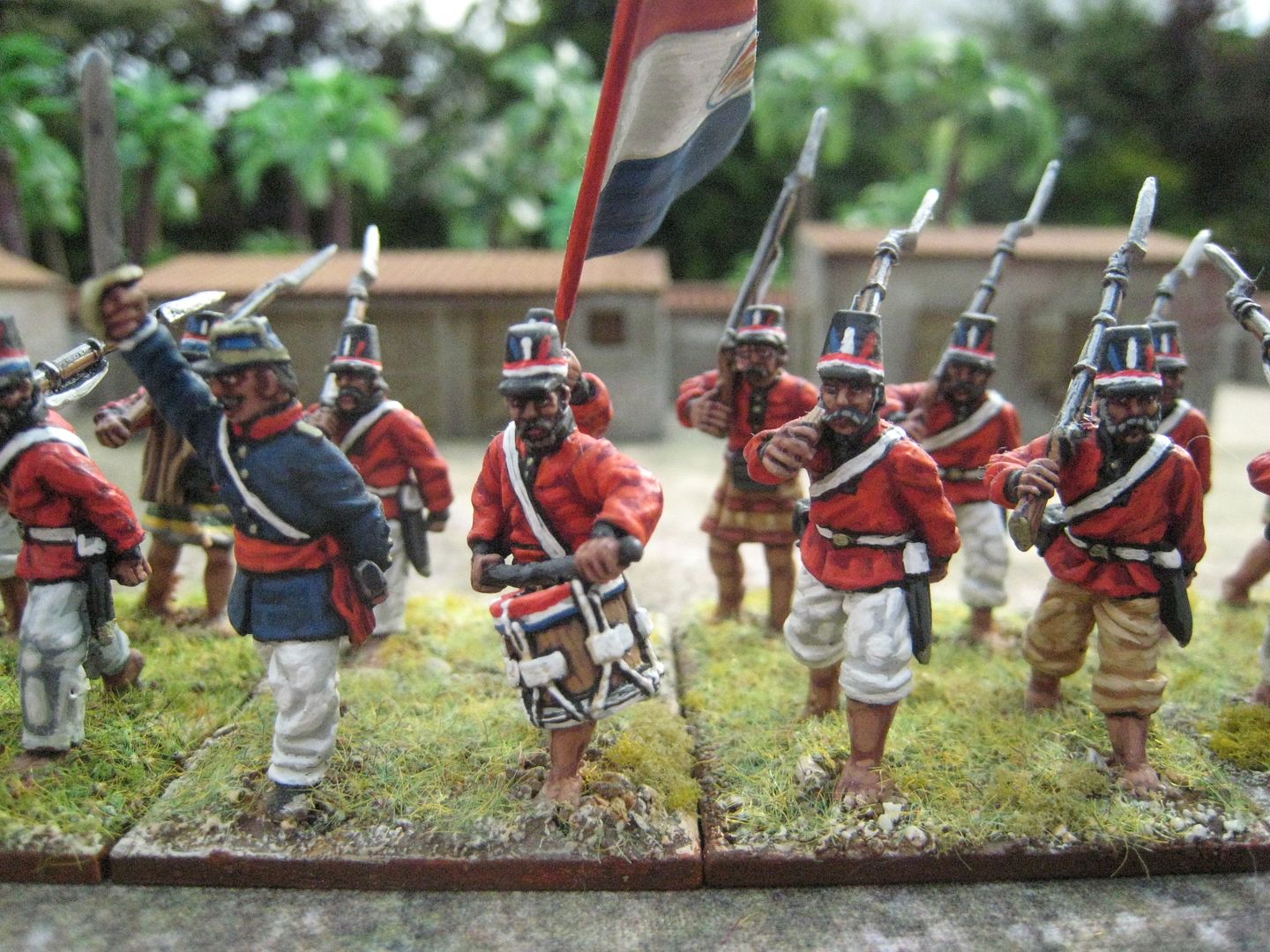
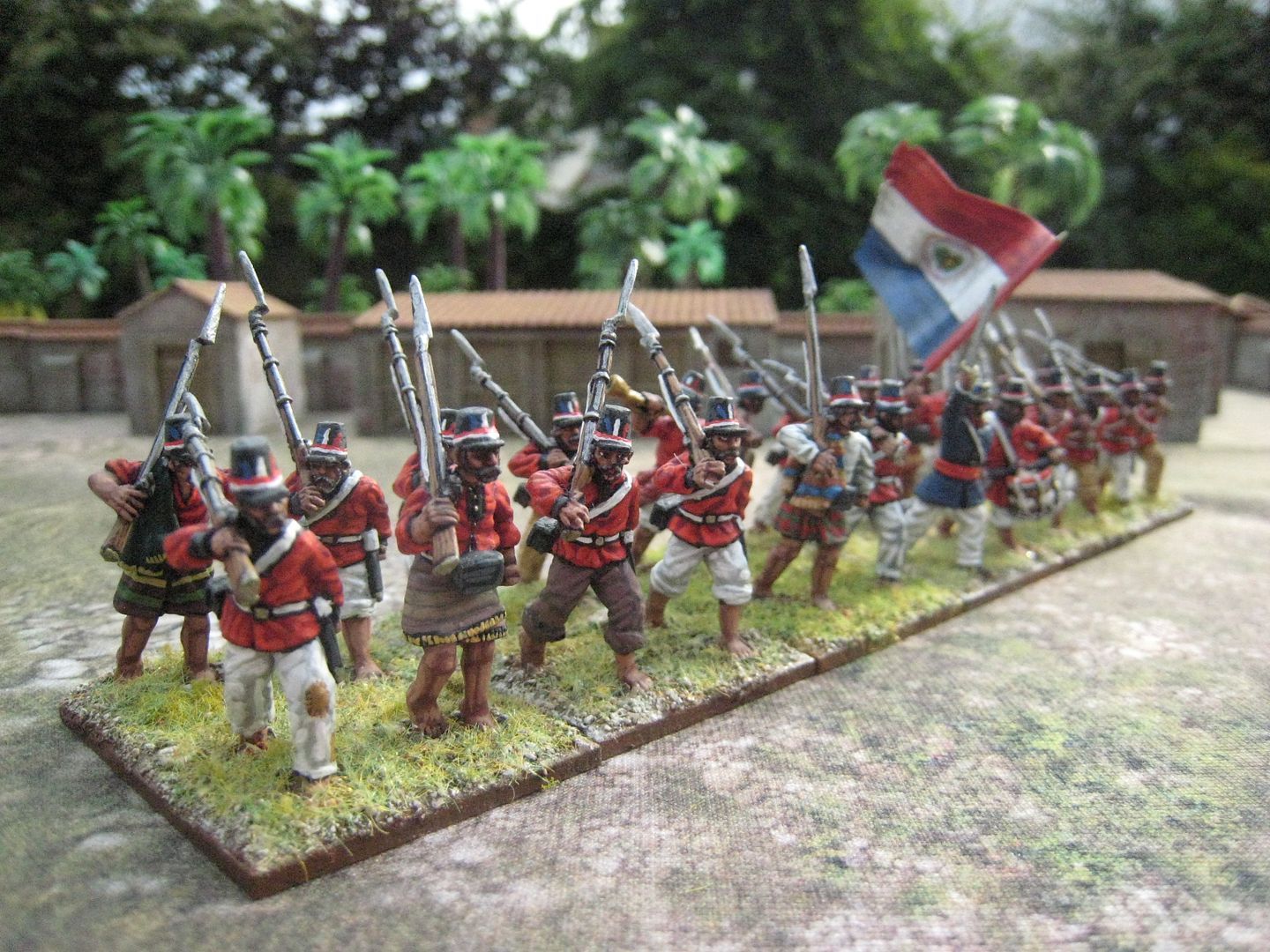
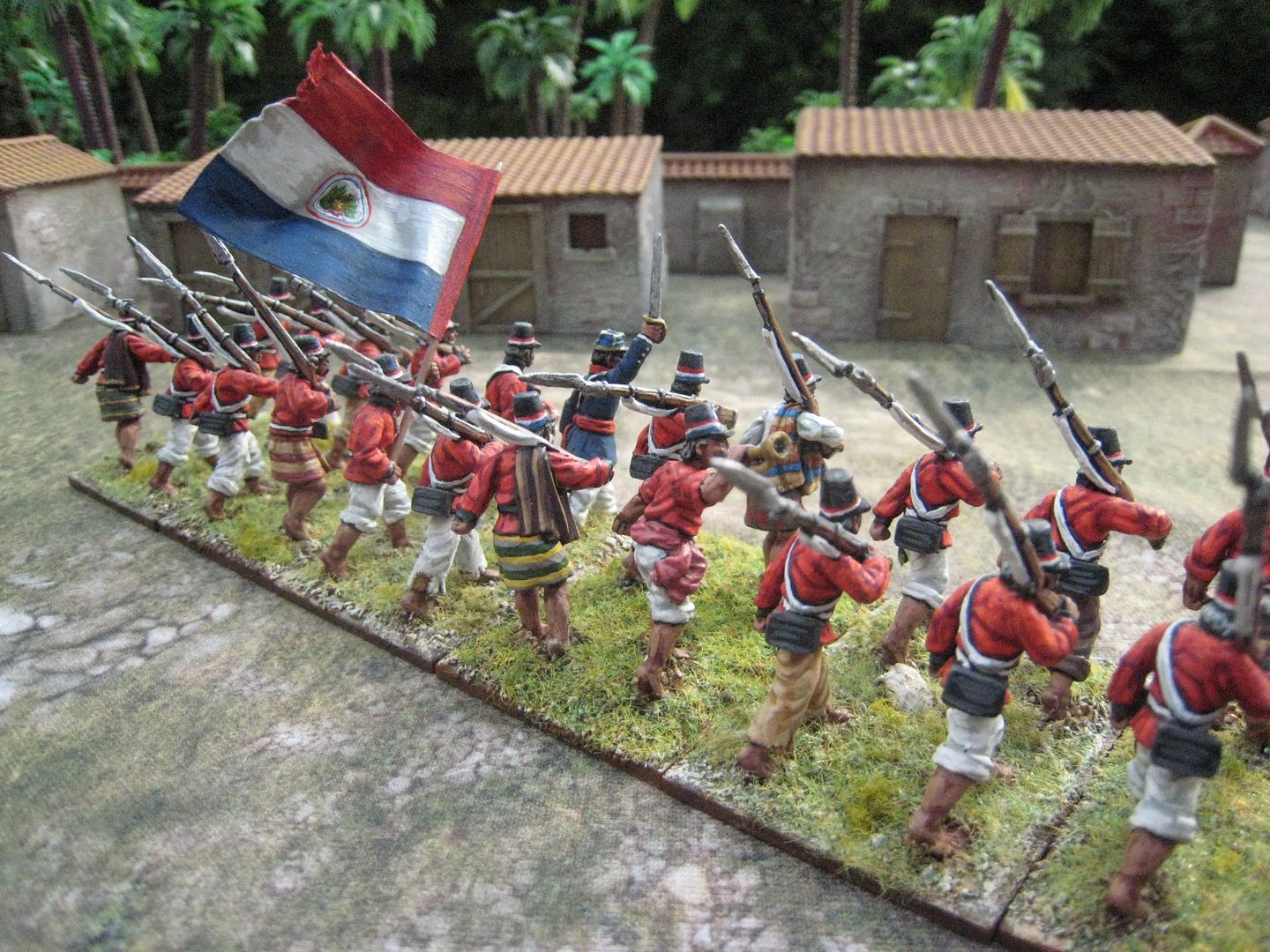
This is the second battalion of Paraguayan infantry, again using the older Kingscarbine figures.  The only substantive difference from the 1st battalion is the different officer figure, who here wears a red shirt rather than a dark blue frock coat, and a couple of soldiers wearing white civilian shirts.  I suppose this makes the unit look a bit more like militia than regular army, but in my Paraguayan forces there isn't really any distinction between "line" and "militia".  One of things I've noticed about building Paraguayan units is that you end up with figures in the back row which are wearing the kilt-like "chiripa".  This means the colourful designs on the chiripas are difficult to see when taking photos of the front of the units.  

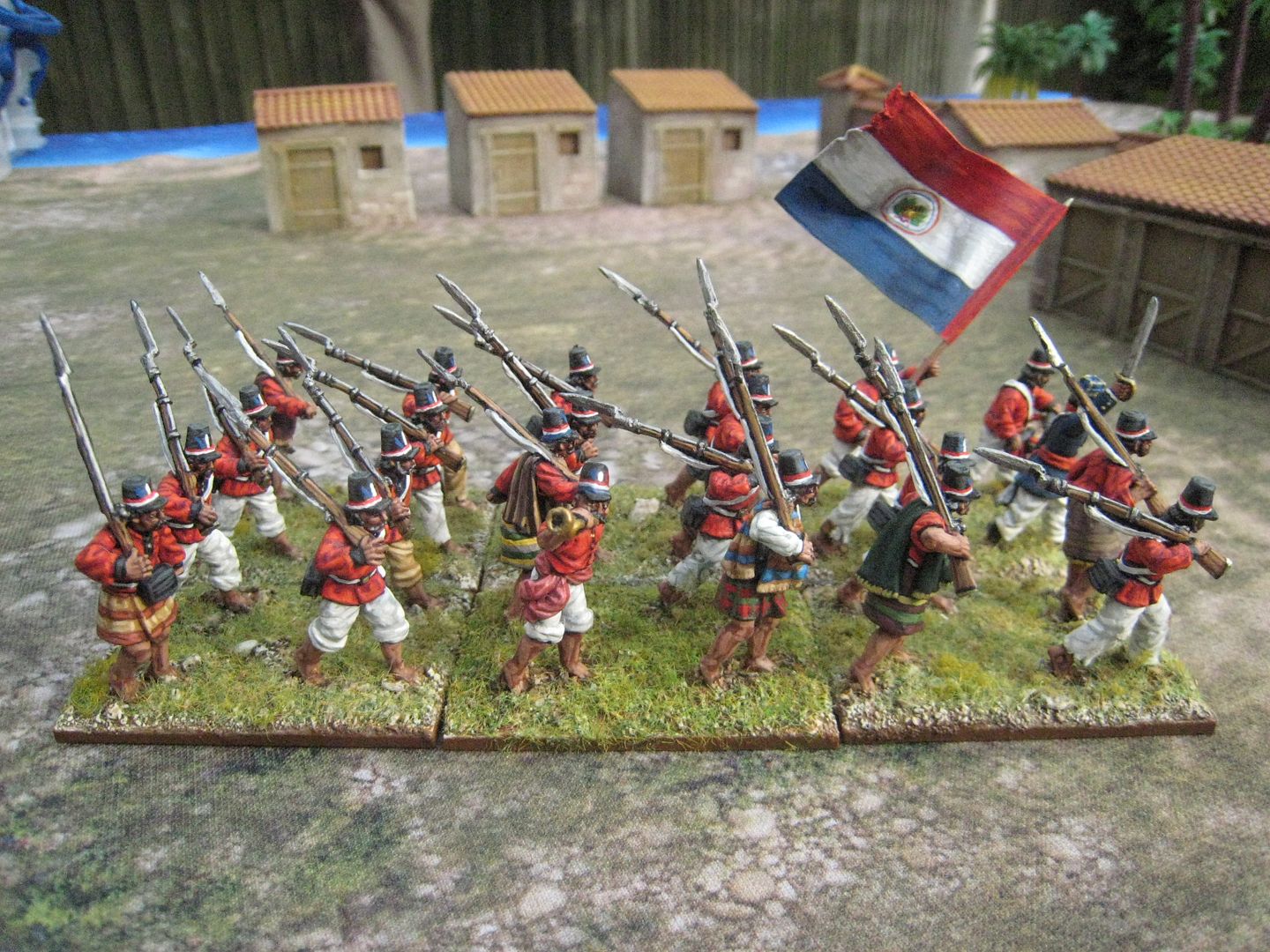
When I painted the first unit of Paraguayans I didn't really bother with fancy designs on the chiripas, but then Alan Perry put out photos of his figures sporting very colourful chiripas and I thought I'd better up my game a bit.  Also, the Paraguayan figures are all going to look the same, so the chiripa is the only way to add some variety to the overall look of the figures.  So now I make much more of an effort, which means each post will feature photos of the back row of the figures.        

20 figures.  Painted September 2020. Flag by Flags of War.


Monday, 28 June 2021

Paraguay: 1st Infantry


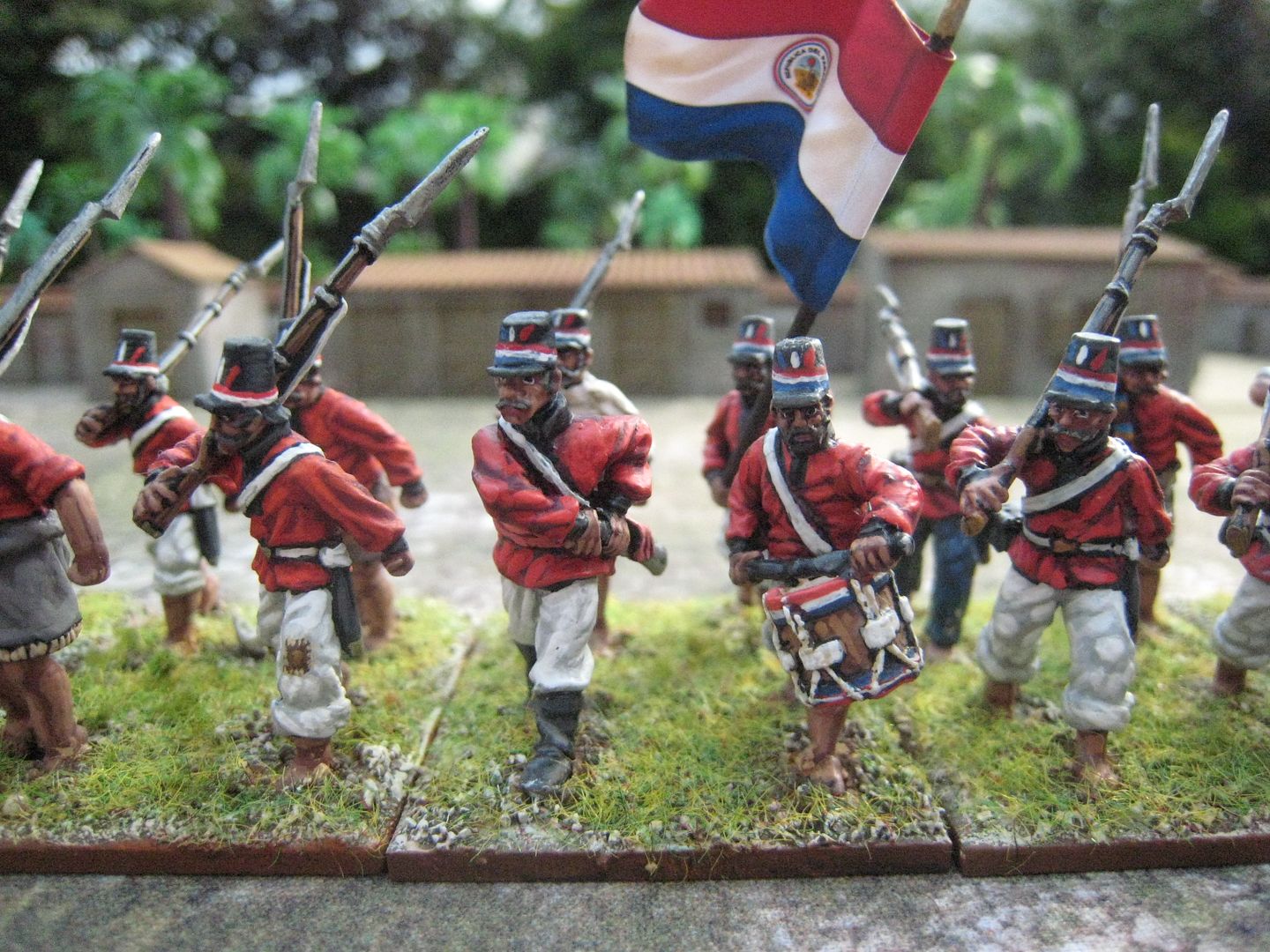
This is the very first unit I painted back in 2013 (and originally featured here).  I've added a few more figures and I think a new blog post is in order given that this unit kicked off what became a rather slow-burning project until the Perry Miniatures range came out in 2020.  The figures are from Nuno Pereira's King'scarbine Miniatures, and sculpted by Steve May.  These figures are currently out of production, but may return to the market at some stage.  Nuno's on Facebook and will no doubt say when the figures become available again.

I like these figures.  They are a bit slimmer than the Perry figures but are perfectly compatible.  I probably wouldn't mix the two ranges in the same unit, but they look absolutely fine together on the tabletop.  The poses are different - these are perhaps more proper "marching" rather than the more fluid "advancing".  The Paraguayan Army of course had numbered battalion of infantry, although from what I can tell there were no units distinctions - they all wore the same clothes.  I've numbered my units consecutively, but with no attempt to replicate the units in real life.  This "1st infantry battalion" is a unit of 20 figures, which does chime with the strength of 760 men that Hooker gives for unit in 1865-66.      

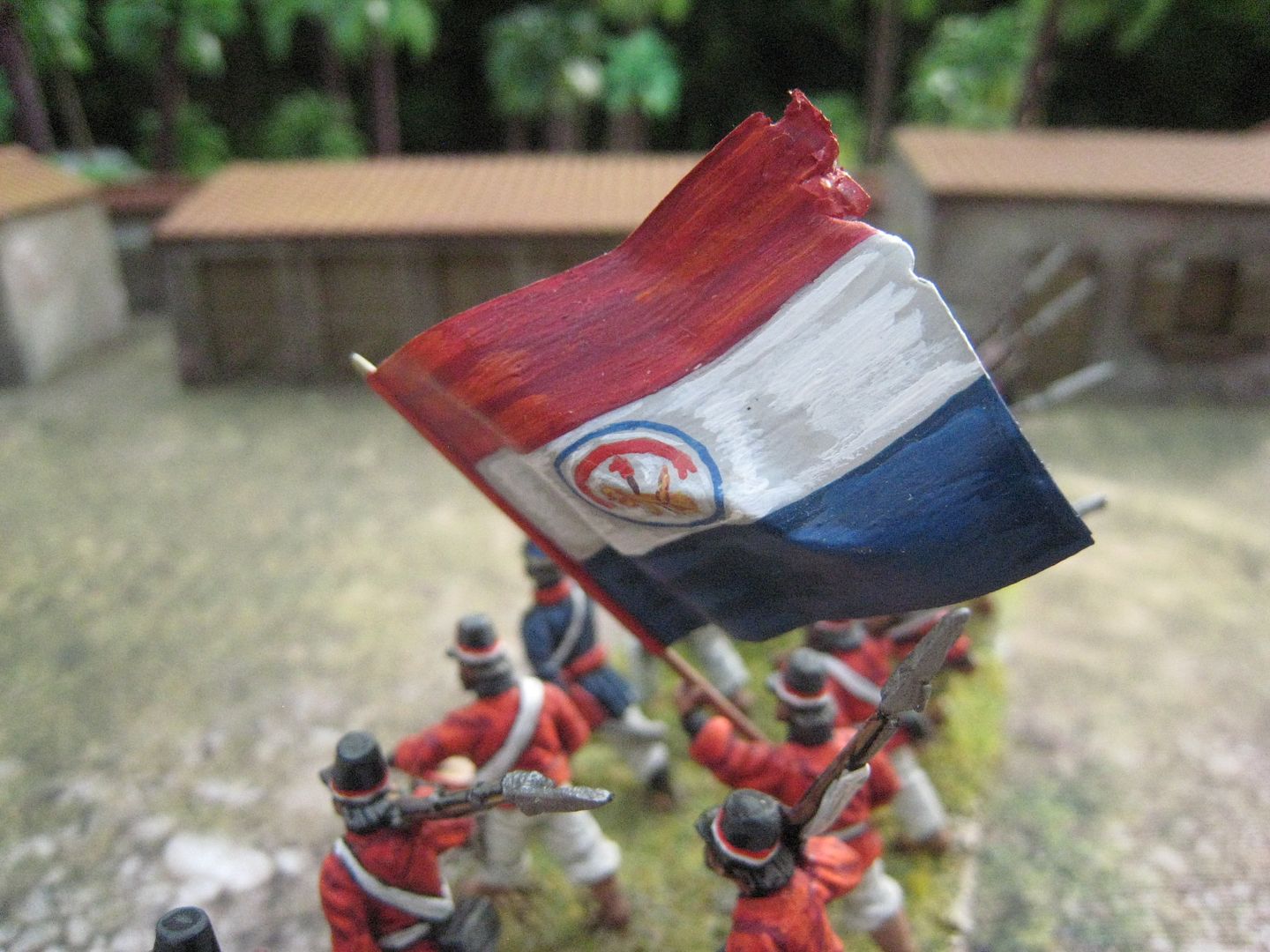
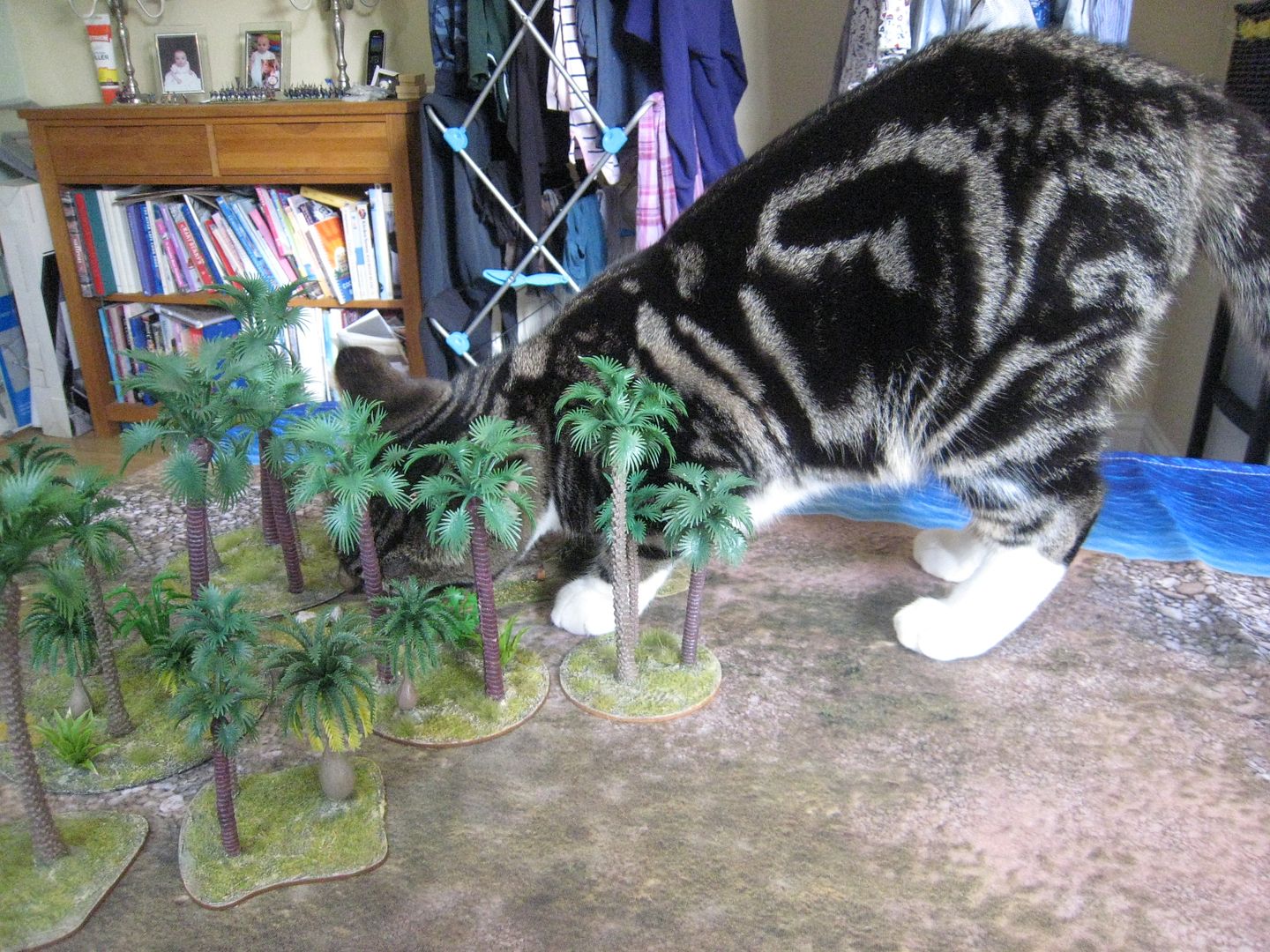
The flag is hand painted because back in 2013 no one made the Paraguayan flag in 25mm (nowadays the excellent Flags of War have a full range for the War of the Triple Alliance).  The obverse side has the the national coat of arms of Paraguay (a yellow star surrounded by a green wreath capped by the words REPUBLICA DEL PARAGUAY), all within two concentric circles, while the reverse has a yellow lion below a red Phrygian cap and the words Paz y Justicia ("Peace and Justice").  It was a bit of a pain to paint, I recall.  Something my family acquired during Lockdown is a cat, Millie.  I made the mistake of leaving this unit out on the kitchen table after taking the December photos, and when I was putting it away I noticed that our little kitten had been nibbling the corner of the flag.  I was mortified at first, but then I thought that it adds a bit of battle damage; so never mind. 

A chewed flag

The culprit

These look quite chewable as well


This is the first of 3 Paraguayan units using the Kingscarbine figures.  They are all in the same pose as only 3 packs of infantry were released (as well as 2 very good Brazilian officers; I've painted them and intend to create some sort of command vignette).  These were painted before the Osprey MAA and Winged Hussar books came out, and before the Perries released all their stuff.  So I made up bits of the uniforms as I went along - hence brown and buff "civilian" trousers, which in reality should have been just white/off-white.  

The buildings are from Tablescape's Mediterranean range; the mat is Tiny Wargames' "coastal"; the cat was £300 from a family in Chelmsford (much cheaper than a puppy). 

20 figures.  Painted November 2013.


Sunday, 27 June 2021

The War of the Triple Alliance (2)


 I honestly didn't think it had been January since my last post.  I was aware that I wanted to post all my Napoleon in Egypt figures before posting about anything else, but those went into my basing backlog and nothing happened as a consequence.  But today I took proper photos of all my completed Great Paraguayan War/War of the Triple Alliance units to date, so I'll be writing about those over the next couple of weeks or so (14 posts' worth).  Since I posted some initial "group" shots last December, I've added another Brazilian infantry unit, the Uruguayan "Libertad" infantry regiment, and I've completed the Paraguayan cavalry unit.  I've recently finished some artillery for both sides and more Paraguayan infantry, and have started by first Argentinian infantry battalion.  Before that, I spent most of February to May painting Dixon ACW - loads of stuff, including Federals and artillery, that's also stuck in the basing pile.   

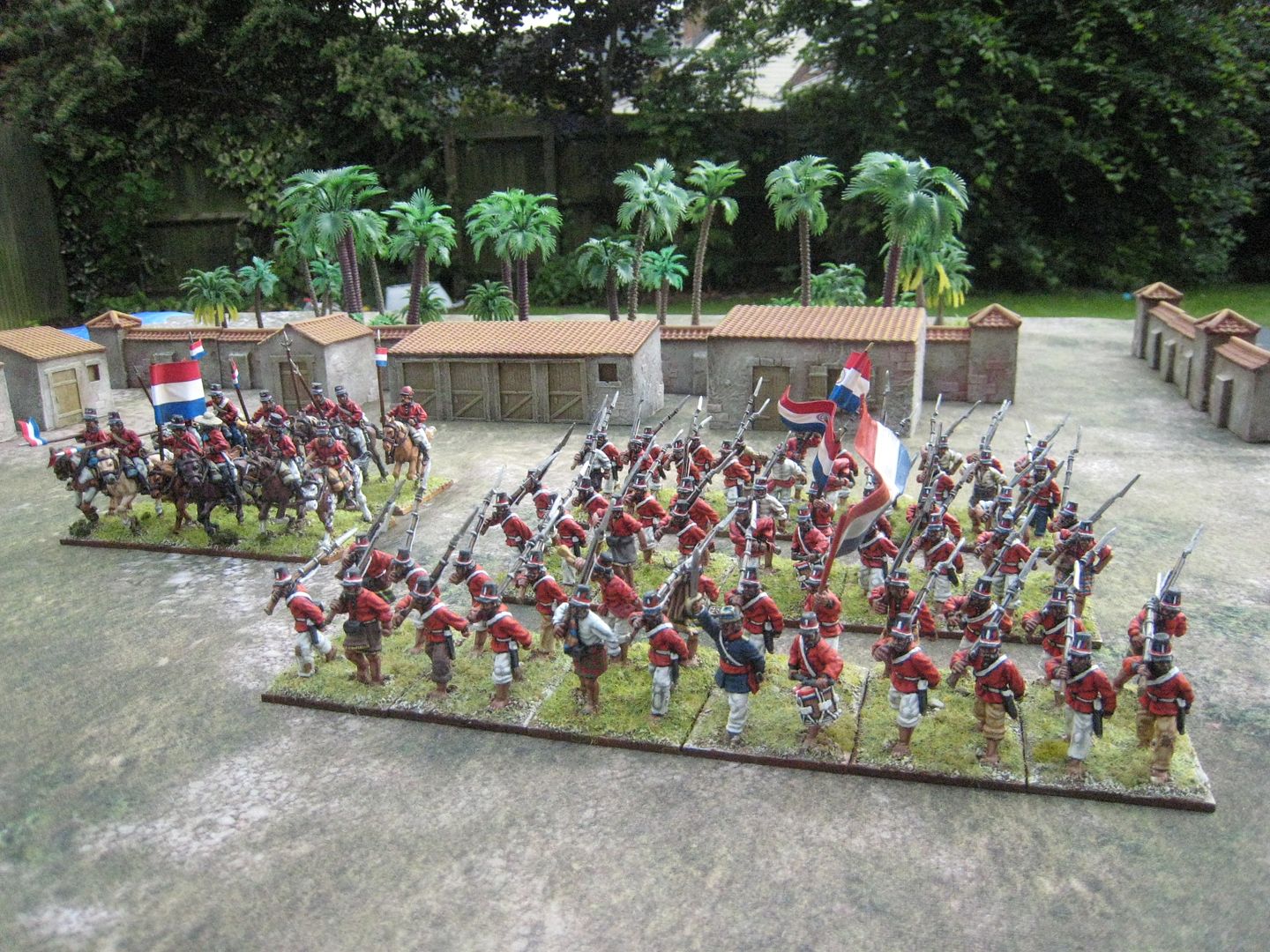
Another view of the Alliance forces to date


A brigade of Kingscarbine Paraguayan infantry with a Perry cavalry unit

So things are finally back on track, I think.  For those interested in this period, I can recommend the new book "Borders of Blood" by Victor Barone, published by Caliver and also sold by Perry Miniatures.  This gives a run down of the history of the war, organisation information in respect of the various armies, and has loads of photos from the Perries and the author's gaming group.  But the bulk of the book is a set of rules for the period and some scenarios.  I haven't digested the rules themselves yet, but they have a card activation deck that looks interesting and the rules take account of details specific to the period such as the effects of the weather (heavy rain and half the Paraguayan muskets don't fire) and the marshy terrain.  The book also collects in one place all those uniform guides from the Perry website.

The section on army organisation made me think that my units strengths aren't quite right.  I was aiming for 18-20 figures for each unit across all combatant nations, but it seems clear that Brazilian and Paraguayan units should be larger than those from Argentina and Uruguay (at least for the earlier part of the war).  I'll touch on this in other posts, but I think I might use the following strengths:

- Paraguay: 18-24 figures;
- Brazil: 18-20 figures;
- Argentina: 16-18 figures;
- Uruguay: 12-18 figures.

If anyone has other views, please do let me know.  Finally, as I'll be blogging about this period for a while, Kiwi wargamer Mark Strachan has a fantastic collection on this blog (amongst lots of outstanding collections: his WTA stuff is here.     

Monday, 25 January 2021

Napoleon (2)


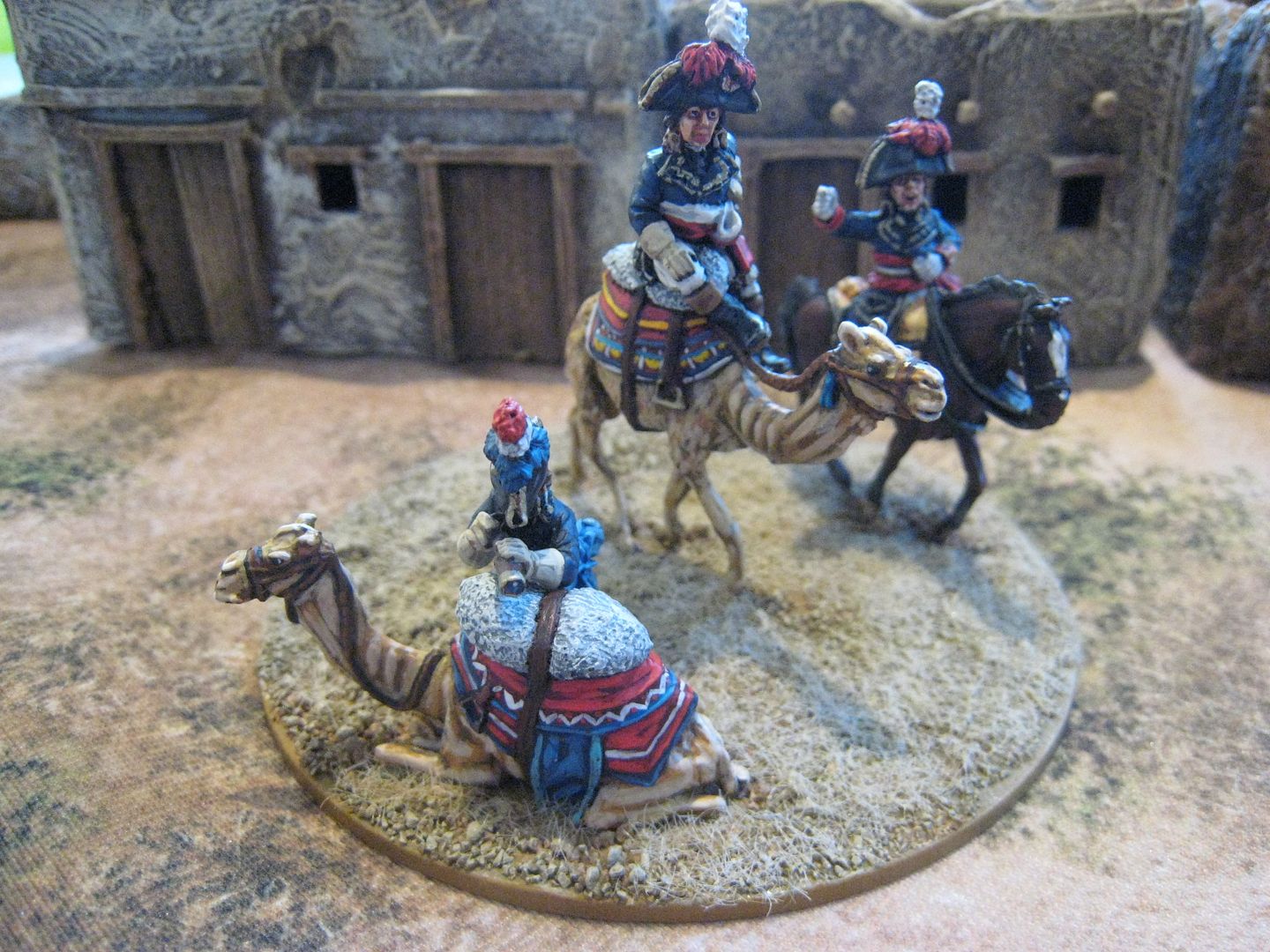
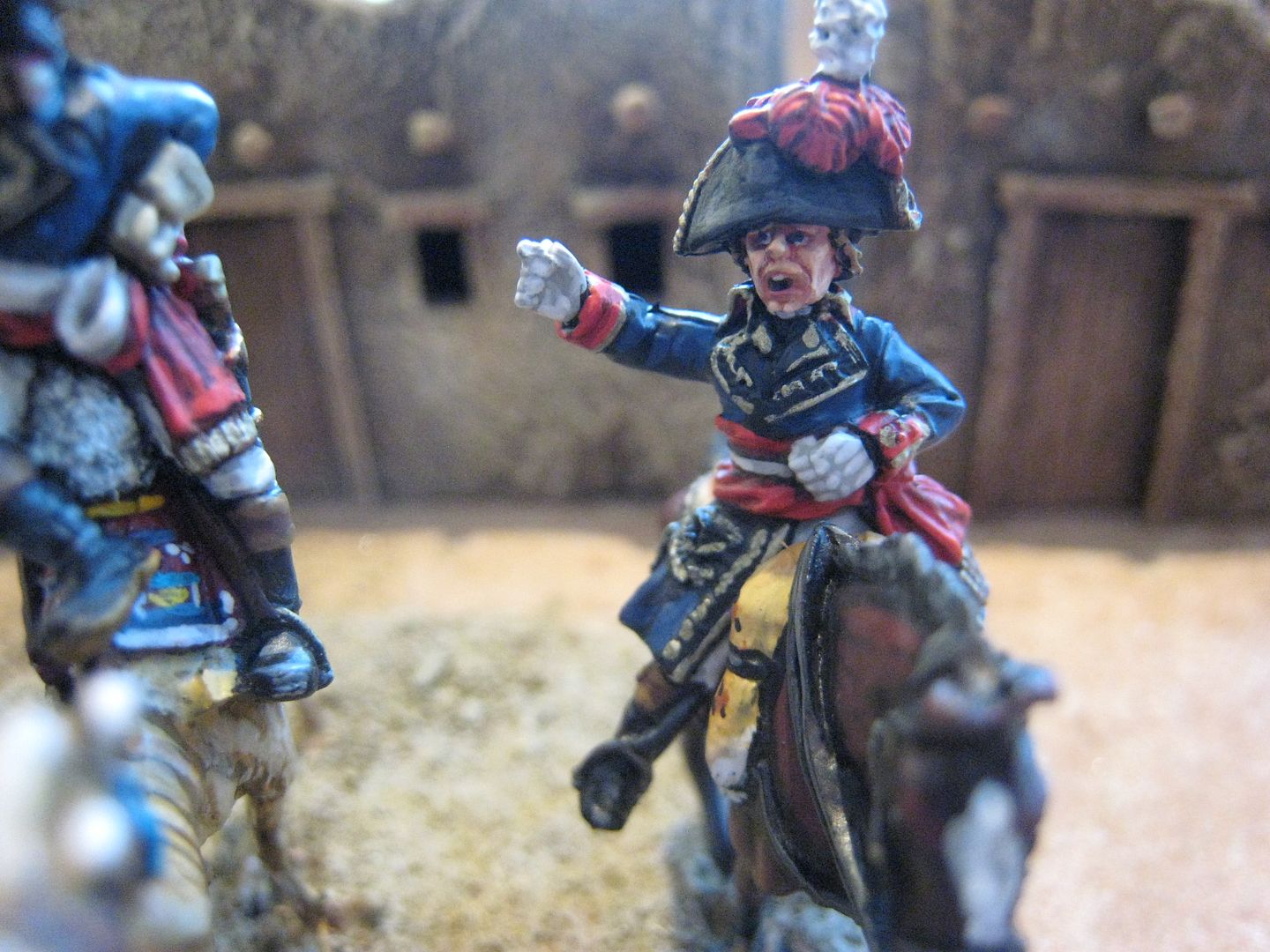
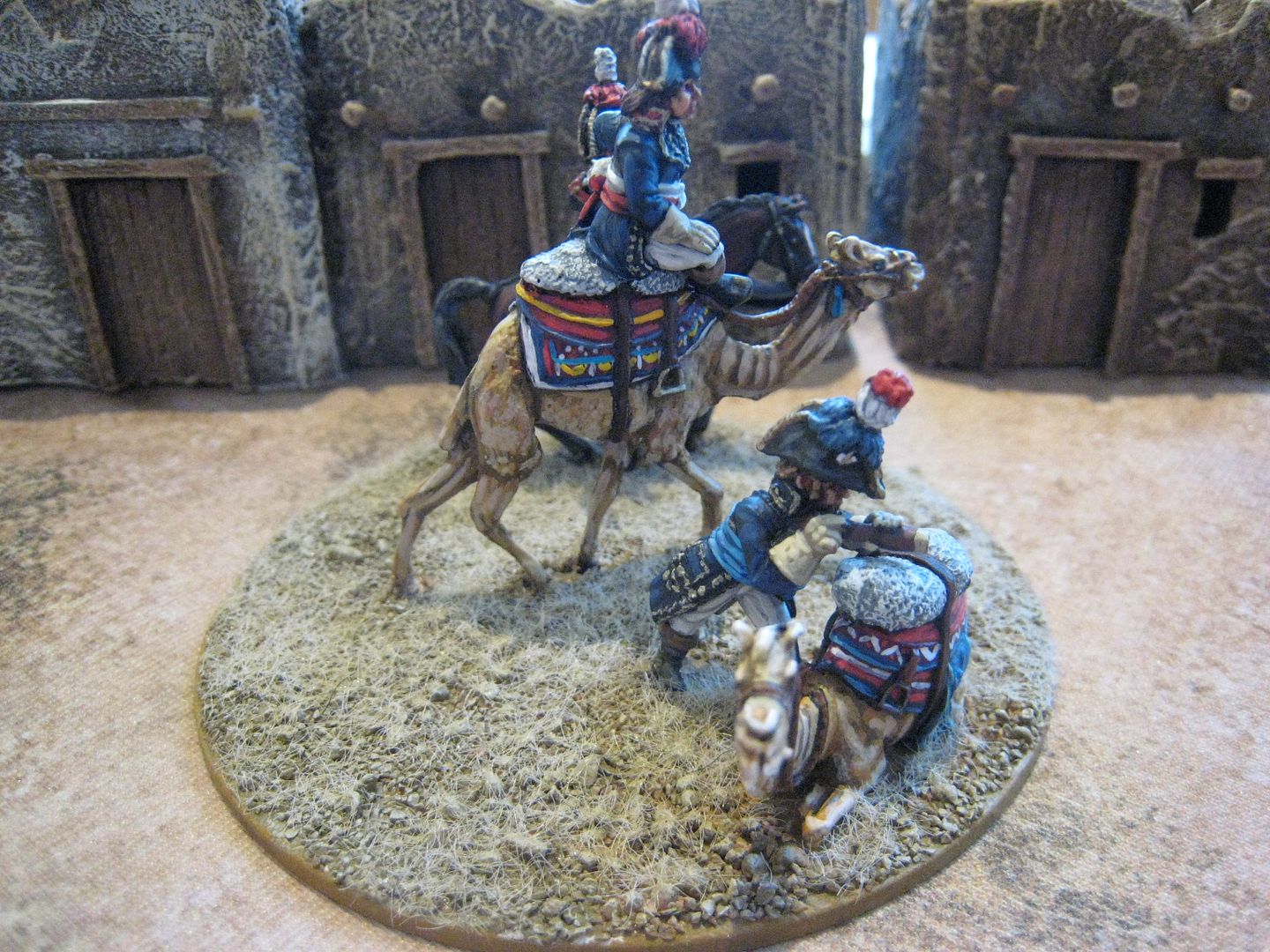
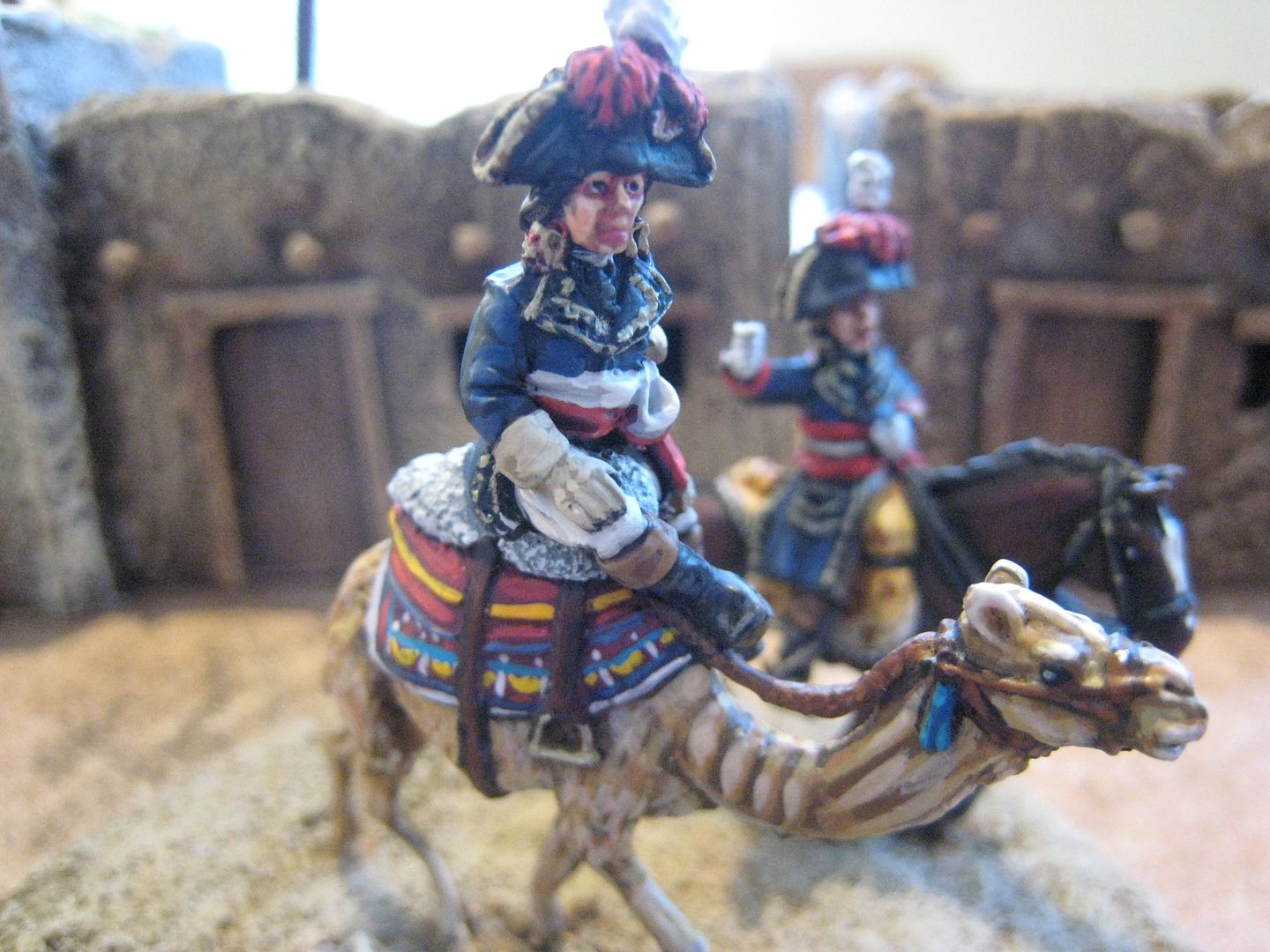
This is the Napoleon in Egypt personality set from Brigade Games.  Perry Miniatures don't have a Napoleon figure in their Egypt range, presumably because the range is more orientated towards the British intervention after Napoleon's departure in August 1799.  Before Christmas I put in an order with Brigade Games to take advantage of a sale and to buy some of their new(ish) AWI figures, and I couldn't resist this set and a couple of other Egyptian campaign things.  I was going to blog next about my recent ACW units but thought I'd just finish off these French bits first.  This is my second attempt at Napoleon, after the rather massive piece I did for a Salute Waterloo game many years ago (see here).  I won't both with any sort of potted biography of Napoleon, even one limited to the Egyptian campaign, but rather will post some observations on the paints and colours I used, in case of interest, and some inspiration.      

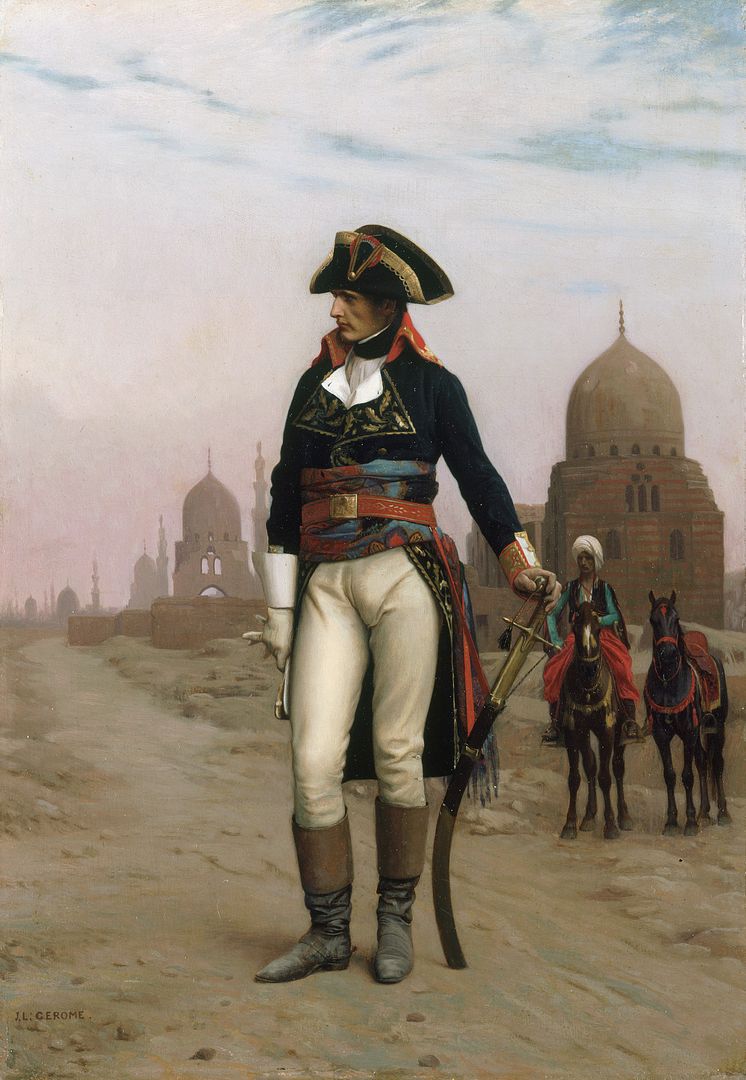
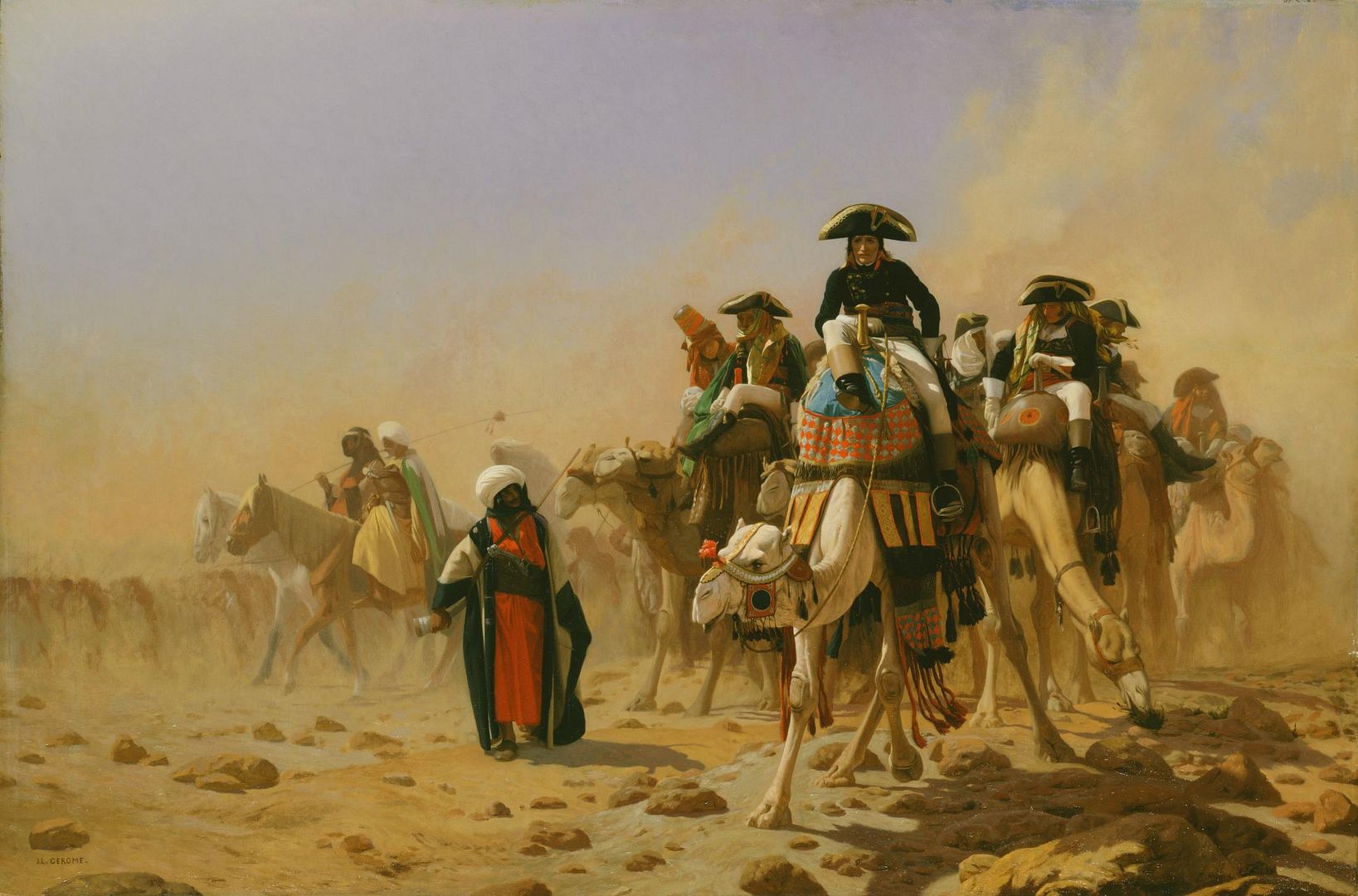
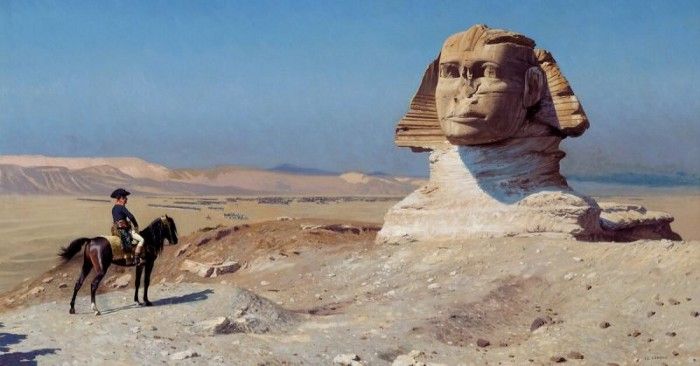
Back in 1799 Napoleon was 30, trimmer and fitter than at Waterloo.  His Egyptian adventure captured the imagination of French artists, and Jean-Léon Gérôme painted three depictions of Napoleon in Egypt which show a young man who is quite different to the corpulent Emperor of several years later.  Gérôme painted a number of middle eastern scenes and had travelled in the region in the 1850s.  His three best known Napoleon paintings are below.  These are very atmospheric paintings, a long way from heroic battle scenes like the work of Horace Vernet, for example.  Commentators have noted how these paintings are quite psychological, with Napoleon seeming deep in thought or contemplating some aspect of his destiny (there's a good analysis of the second painting here).  I found these quite inspirational. 

Napoleon in Egypt, circa 1863

Napoleon and his General Staff in Egypt, late 1860s

Bonaparte Before the Sphinx, 1886

I had to re-find the paints I'd used for the Dromedary Corps vignette.  The base coat was Citadel XV-88, then various layers/touches of Tau Light Ochre, Bestigor Flesh, Ushabi Bone and Foundry "Base Sand" and "Boneyard" paints.  I had to look up the colour of Napoleon's hair, which apparently was dark brown (I had thought it was black).  

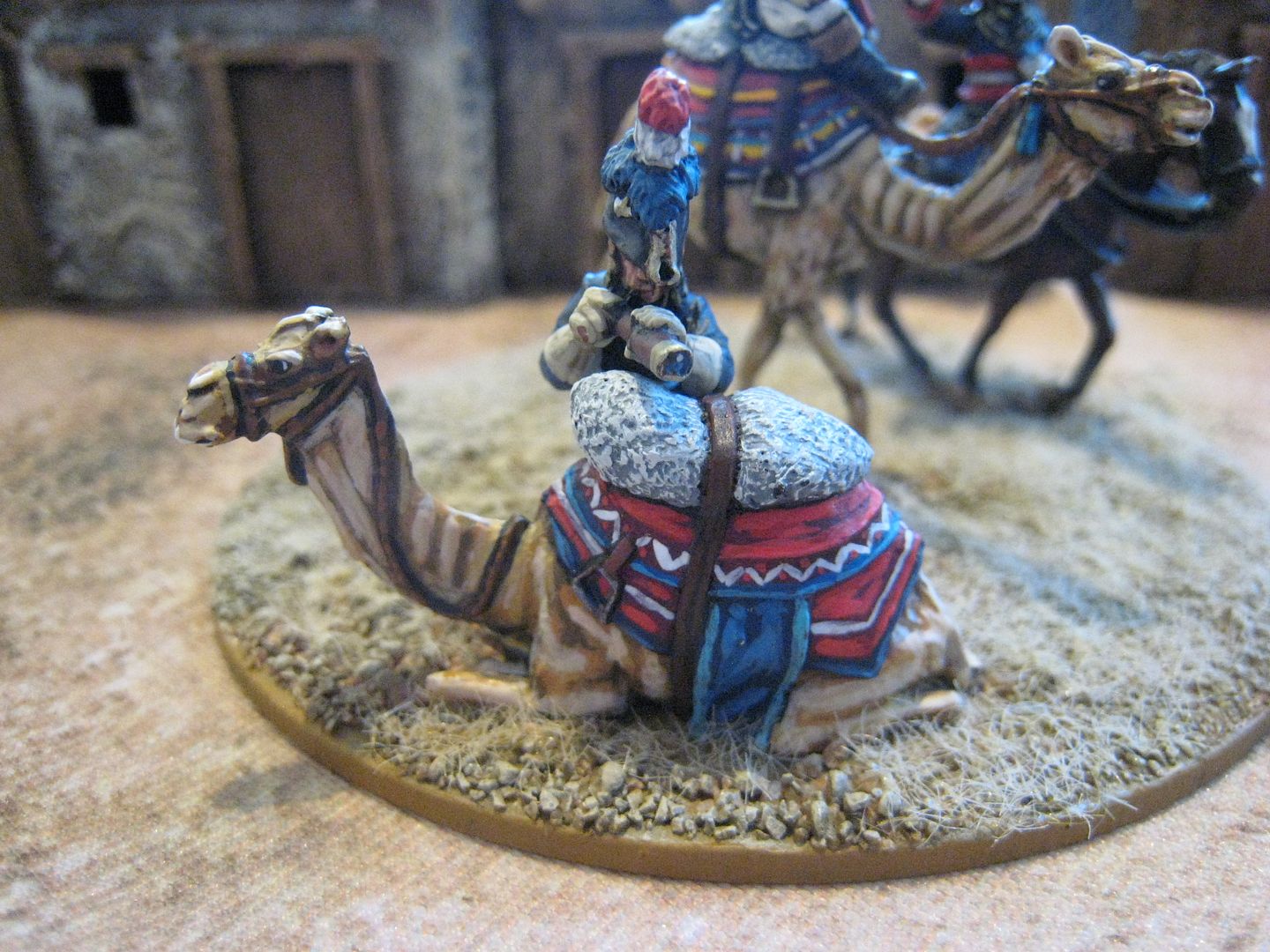
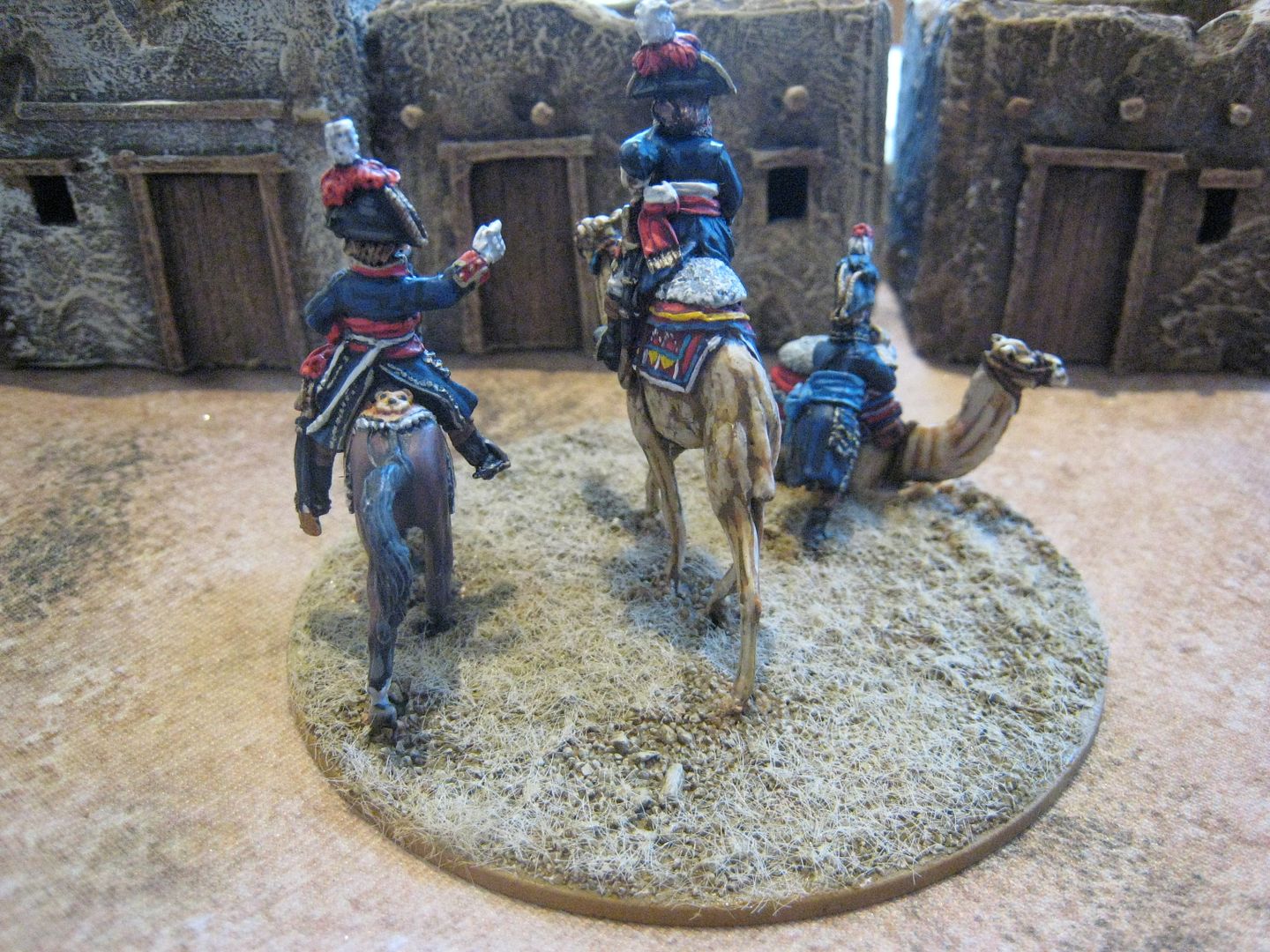
Uniform information was sourced from the Osprey MAA and the first volume of Charles Grant's "Napoleon's Egyptian Campaign".  Those books suggested that the uniforms of the high command were often adapted at the whim of their wearers, particularly the hat plumage.  The chap with the telescope is supposed to be a general de brigade (hence the light blue sash) and the mounted figure is a general de division (hence the red sash and plumage).  I tried to paint as much decoration on the camels' saddle cloths as I could without over-cluttering.  The cloths on Napoleon's saddle are sculpted such that there's a lot more cloth on the left of the figure than the right, so the pattern looks a bit uneven.  I wasn't entirely sure what sort of animal the skin on the horse was supposed to be, but a leopard looked appropriate.  I had originally intended to place a few bricks and perhaps a bottle cork at the back of the base to suggest some ruins, but decided that would look too busy.  So I'm sure more could be done with this set to jazz it up, but I'm pleased with how it came out and it didn't take long to do.          

3 figures, 1 horse and 2 camels.  Painted January 2021. 


Tuesday, 12 January 2021

Regiment des Dromedaires (1)

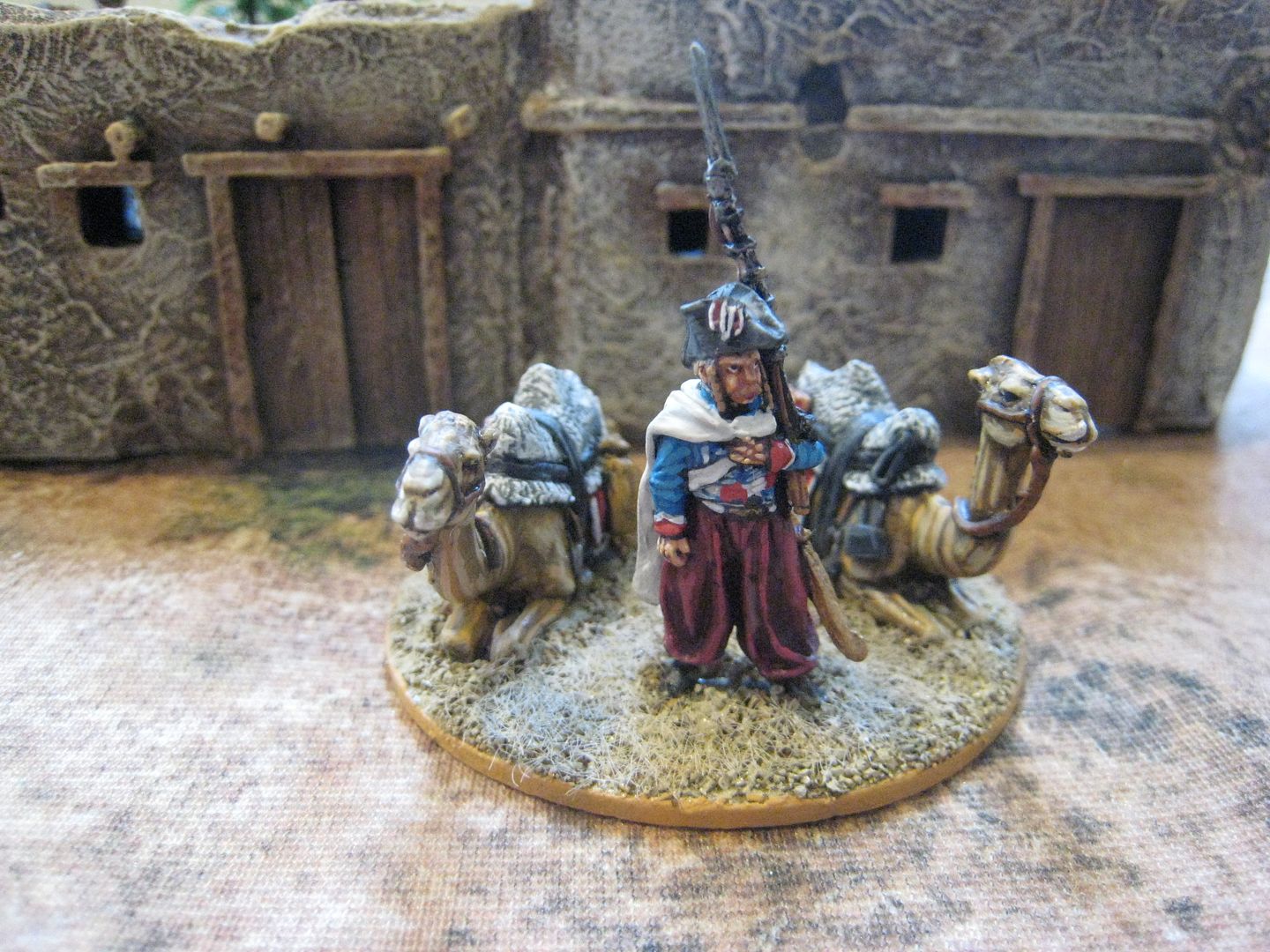
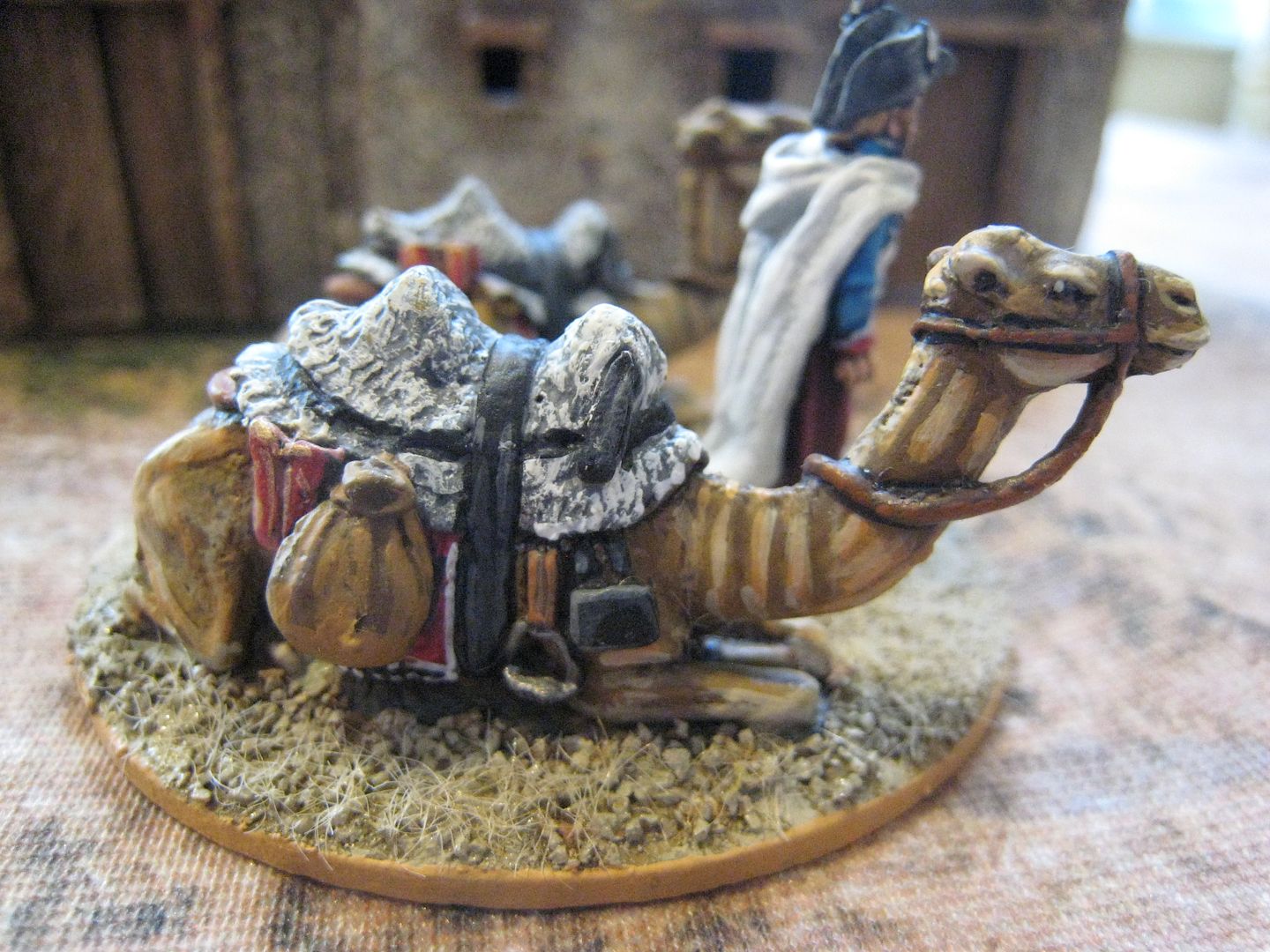
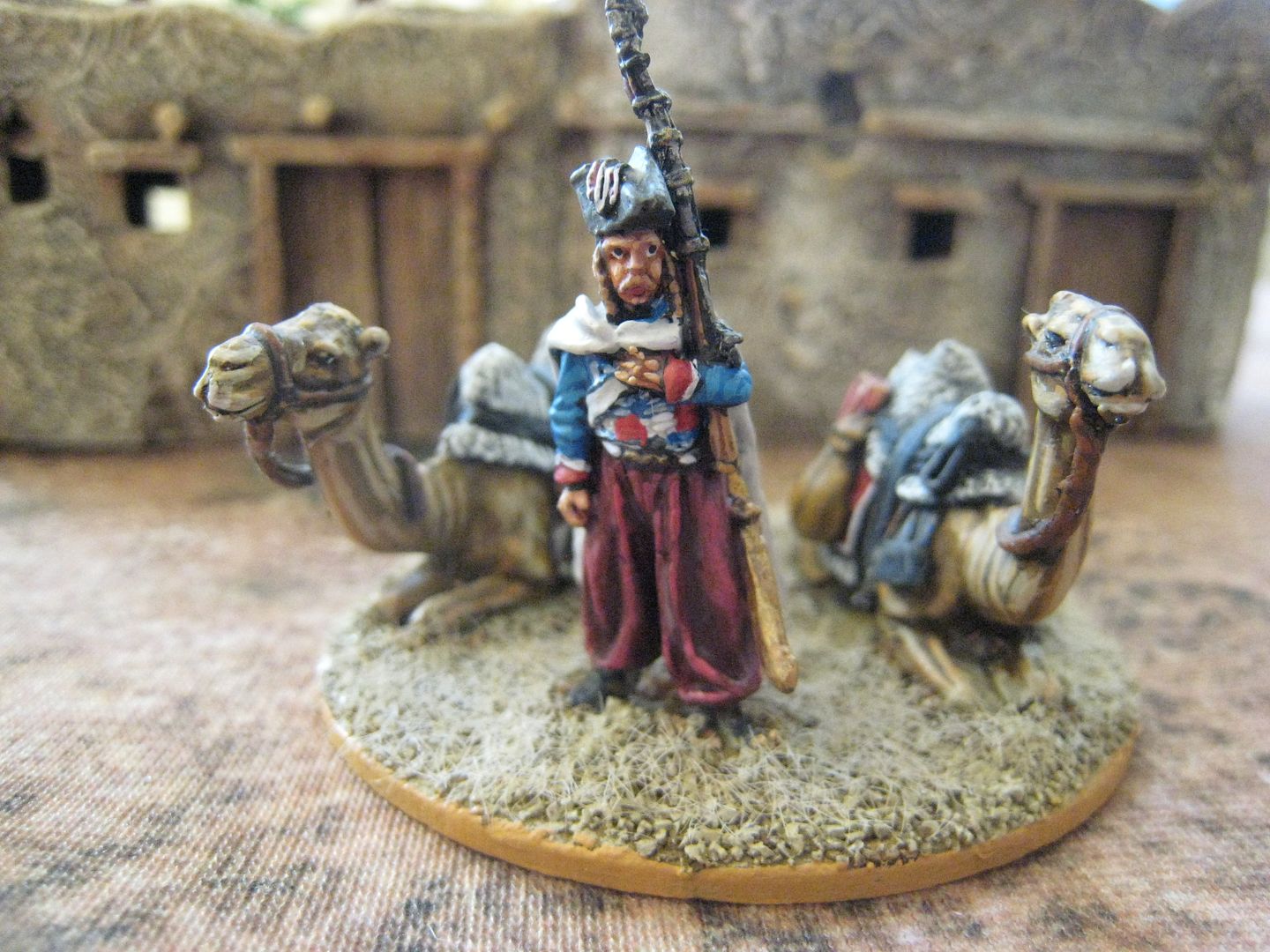
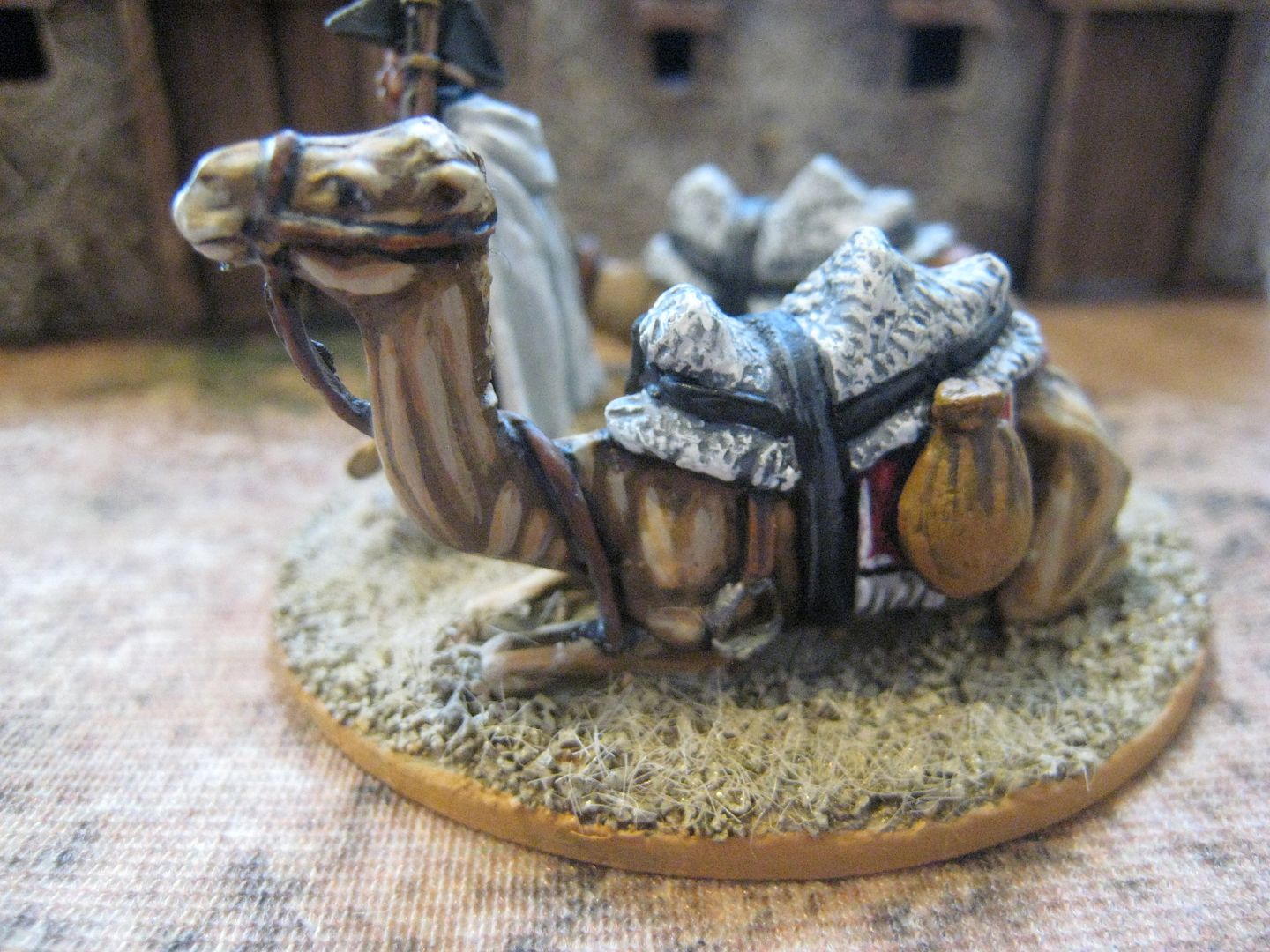
As a coda to my current batch of Napoleonic French, this is the Perry pack of sitting camels and guard from the Régiment des Dromedaires, the camel-mounted unit created for service in the Egyptian campaign.  This was quite small, being two squadrons each of about 250 soldiers, and fought as mounted infantry.  Perry Miniatures have mounted and dismounted figures, and Brigade Games have some nice models as well.  This set is clearly the equivalent of a cavalry horse-holder.  Two camels doesn't really cut it if you have a unit of 12 figures on the table, and I did think about whether I should buy a second set and make a larger base; but in the end I just went for this "as is", given it is likely to be a while before I paint more of the Dromedary Corps.  

This set had lain half-finished on my painting for the best part of 2 years, and I finally finished it off at the beginning of the Covid lockdown.  I really wish I could remember what paints I used for the camels; it was a number of Citadel paint mainly, I think, with some Foundry highlights.  I really need to write things like this down in a notebook.  I owe thanks to wargaming and wine-loving chum John Baxter in Melbourne who emailed me an excellent article (in French) about the regiment and its uniforms a while back.

1 figure and 2 camels.  Painted February 2020.


Friday, 18 December 2020

The War of the Triple Alliance

I'm behind with basing and photos (I've painted 13 different units since August) but I did manage to assess the current state of my Great Paraguayan War/War of the Triple Alliance project and so thought I'd post them here.  I can't believe the first unit of Paraguayans was painted 6 years ago.  On the Paraguayan side there are three infantry units of Steve May sculpts for Kingscarbine Miniatures (which aren't currently available), two Perry Miniatures firing line units, and the beginnings of a 12-figure cavalry unit.  On the Allied side, I have one regiment of Brazilian infantry and with another on the stocks.  In fact, my pre-Christmas schedule is to finish this off and the Paraguayan cavalry.  Then it will be on to some Uruguayans and whatever's in the two boxes from the Perries that arrived addressed to my wife the other day....   

The flags are mainly from Flags of War.  These are a total lifesaver, as I wasn't relishing the prospect of painting more flags (the larger Paraguayan flag is one that I painted 6 years ago, and which got nibbled the other week by our cat, Millie) and I was having problems with the flags uploaded on the Perry website.  Flags of War also do lance pennants in any colour you want.  The palm trees and broken walls in the photos are all scenic bits I made for Frostgrave: Ghost Archipelago last year; I think they look ok-ish for South America.
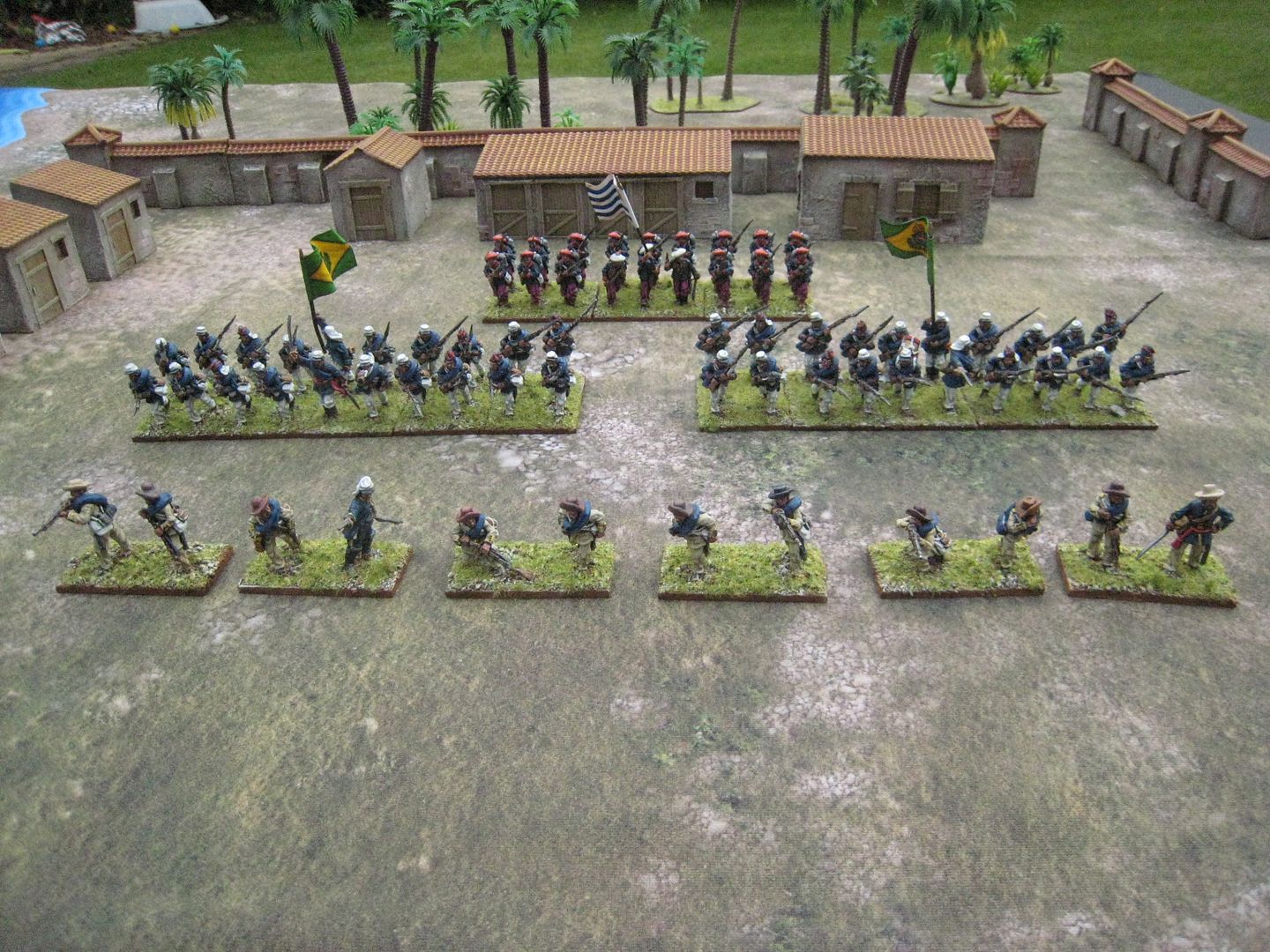
My immediate plan is to get to 10 infantry units per side (perhaps a couple more on the Allied side to reflect the three different contingents), a bit of cavalry and then take stock.  All infantry units will be between 18 and 24 figures and cavalry units will be 12 figures.  That's not particularly historic, but provides a manageable set-up.  I'll post about these units separately in due course, and will start with the original one again as I added more figures to it.