Sunday, 18 January 2009

9th Foot


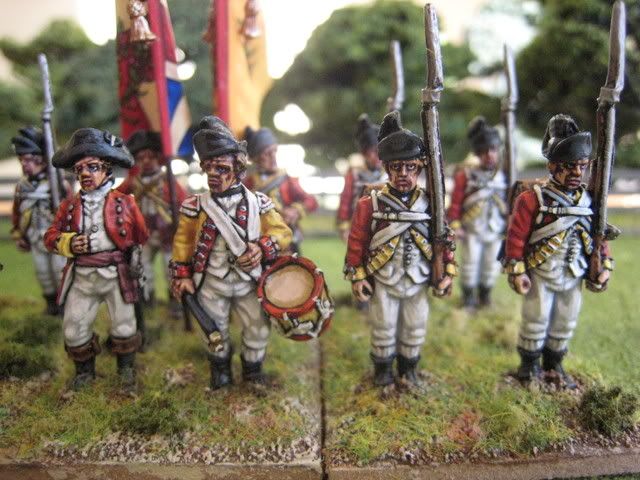
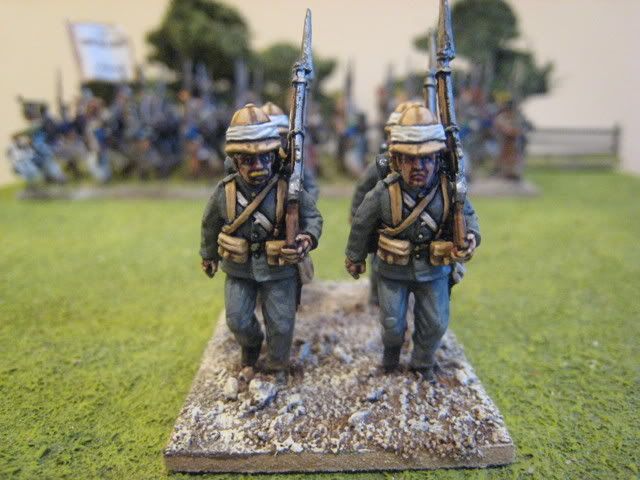
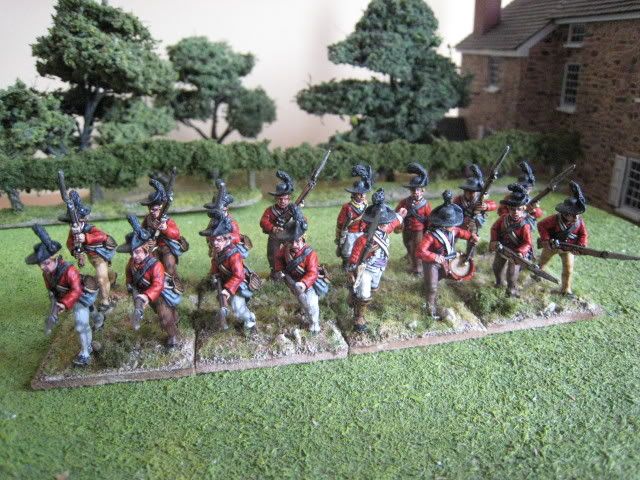
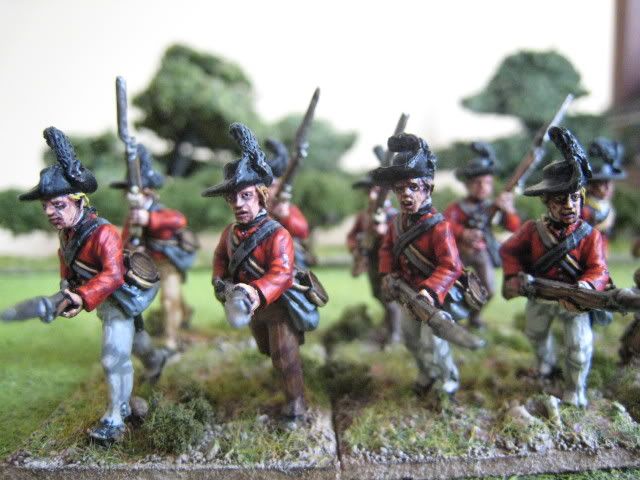
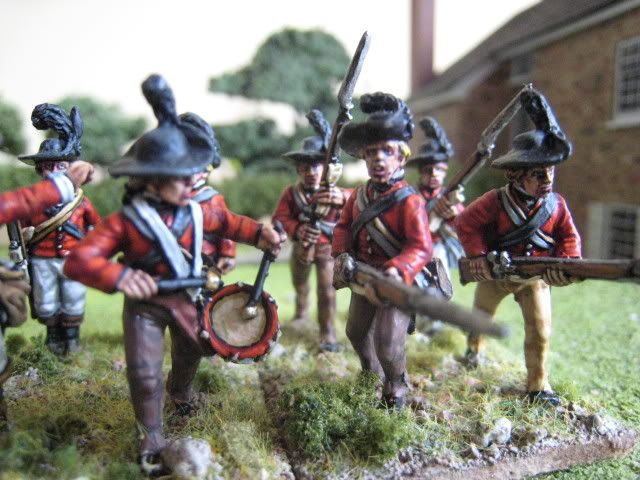
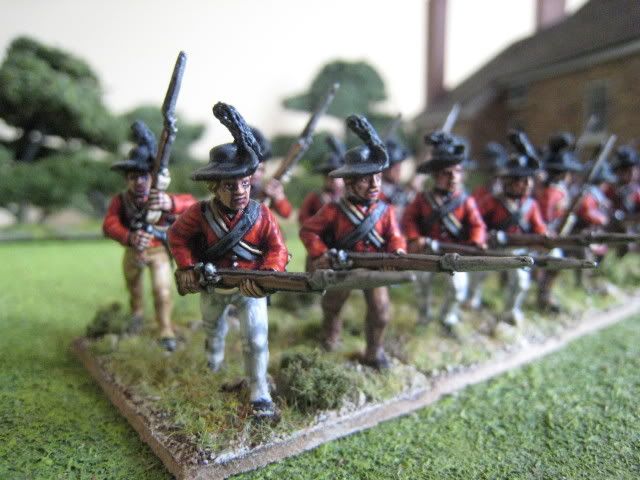
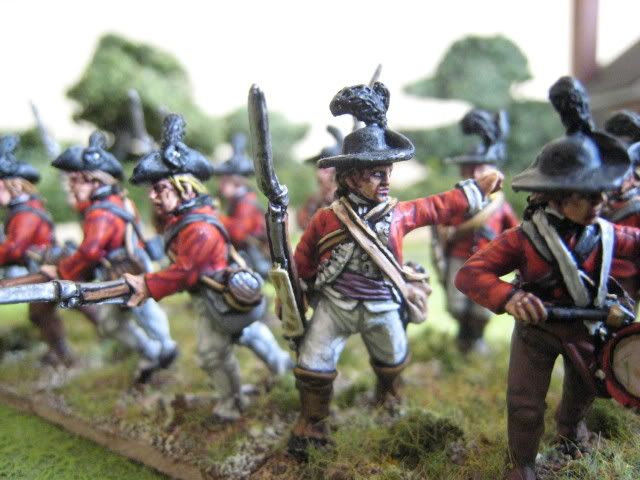
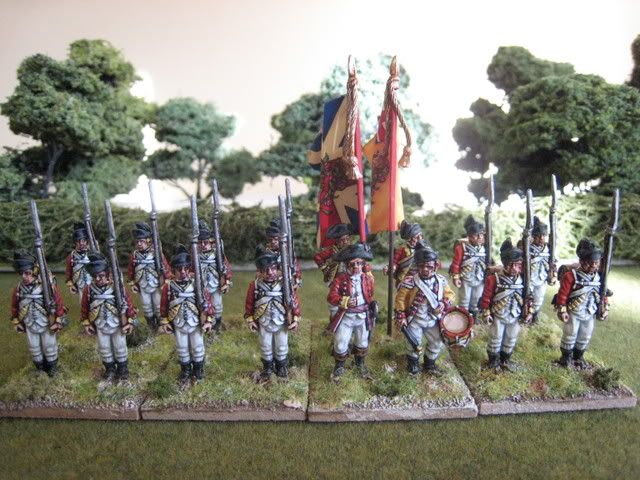
The 9th Foot is my last (of five) "Saratoga" regiments. The 9th was raised in 1685 as Colonel Henry Cornewall's Regiment of Foote. In 1751 it was designated the 9th Regiment of Foot and became The Norfolk Regiment in 1881. It was posted to Canada in 1776 and joined Burgoyne's campaign of the following year. One of the very few references to colours being carried in the Saratoga campaign is the story of how the 9th's commanding officer, Lt. Colonel John Hill, apparently removed the flags from their staves and hid them in his luggage after Burgoyne had surrendered at Saratoga. These colours were presented to King George upon Hill's return to England and allegedly remained in Hill's family's possesson thereafter.

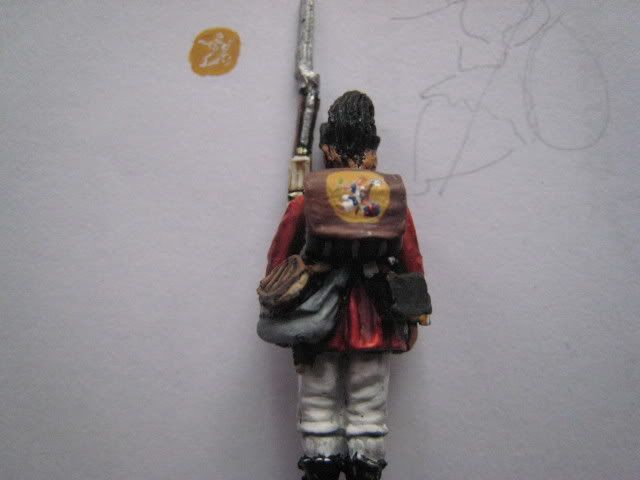
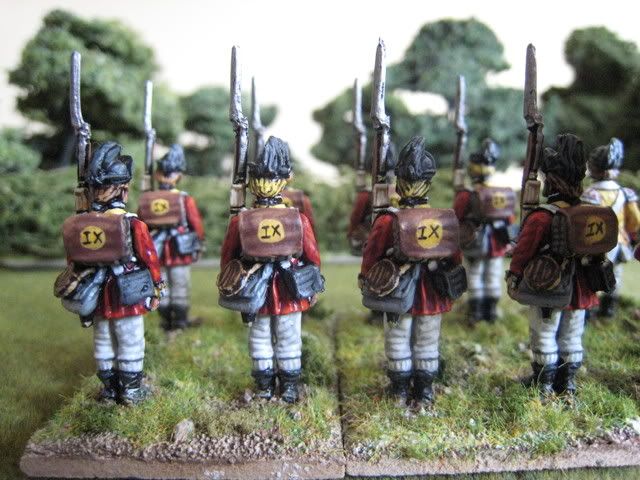
A unit of 16 figures is required for the British first line in the "British Grenadier!" Freeman's Farm scenario. I chose standing pose figures simply because my other Saratoga regiments are in firing, charging and advancing poses. These figures wear backpacks and the flap on the backpack is a tempting canvas for a distinctive regimental motif. Brendan Morrissey's Perry website article on the Saratoga troops (indespensible if you are modelling this campaign, as is his Osprey Campaign book) refers to a "Britannia badge". A bit of research suggested that whilst Queen Anne may have awarded the figure of Britannia to the Regiment for gallantry displayed at the Battle of Almanza in 1707, it was not until 1799 that the regiment was given official permission to use Britannia as a badge. This information notwithstanding, I tried to paint a representation of the Britannia badge on the flap of the figures' backpacks (for the illustration of Britannia that I used, see here). However, in 25mm the "canvas" is just too small for a meaningful and deciferable representation. I knew what I'd painted, but my test was the Kiwi who, whilst usually fairly perceptive (although admittedly not knowledgeable about British Army insignia), just couldn't work out what the painting was supposed to be. So I added a Roman numeral motif instead, and the Britannia badge lives on only in the photo below. The Britannia motif was fun to do once, but I did feel relief at abandoning the prospect of painting 16 of them; and anyway, sometimes less is more...


After my Napoleonic sojourn I am not back on AWI big time. On the works are 2 Continental/militia regiments and some Saratoga artillery. Posts of the last French Naps should be up fairly soon (and I will need readers' advice on the Young Guard Voltiguers...).


16 figures. Painted December 2008. Flags by GMB.

Monday, 12 January 2009

Current wip


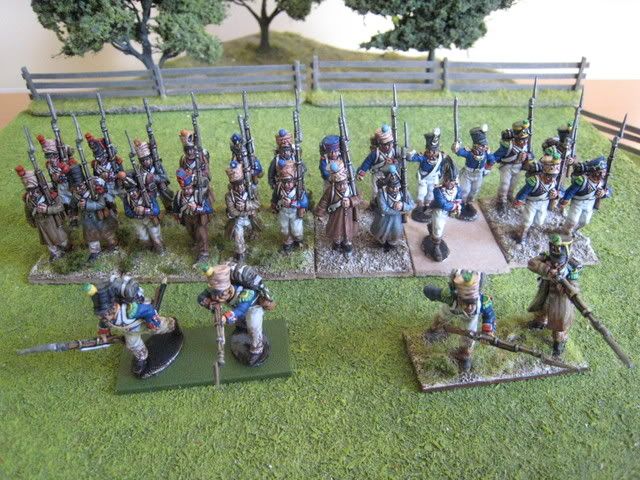
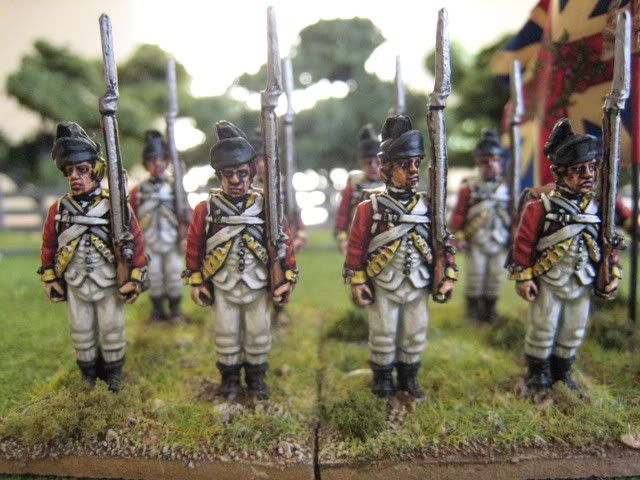
I have reached one of those moments when I have lots of stuff waiting to be based but nothing finished to put up. Also, it is difficult to take decent pics at the moment because the light in London is very bad and it remains dark until after I have left for work, so all photos have to be taken under artificial light. So here, in the absence of anything else, are the current wip shots of the first battalion of the 72eme Ligne (actually now finished and in the basing process) and the Young Guard 3rd Voltiguers (the command base is now completed with a fifer and drummer). By the end of the week I should have proper posts on the 9th Foot and more British artillery for the AWI and the 72eme Ligne. 60-odd Sudanese Beja are waiting in the wings.

Once these units are finished, which will require the balance of this week, I will be returning full time to the AWI for a while. Consequently, I have been giving some further thought to what I might paint up over the next 6 weeks (i.e. until I head off to New Zealand again). For the past couple of years I have planned out my painting schedule about 2-3 months in advance - I find doing so controls the purchasing of new lead and gives me something to aim towards. So here is what I have planned for the next few weeks:

- a northern-states militia unit (20 figures);

- 17th Light Dragoons in southern dress (6 figures);

- Von Mirbach Musketeers (24 figures);

- more Iroquois indians (12 figures - a mix of Perry and Conquest).

That should be enough, especially as I want to finish some Sudan stuff too. And, horror of horrors, I have been told that "dance lessons" are going to impact on my evening painting time over the next few weeks....

Monday, 5 January 2009

Second year anniversary


Tarleton's Quarter celebrated its second year yesterday, and I'll use this at an opportunity to say a big "thank you" to everyone who reads this blog and posts comments. Ultimately all blogs are "egotistical" to a greater or lesser extent in that they presume that others are interested in what the blogger has to post, and so I've always been surprised at how many people think this blog is worth a look. I suppose the answer is that I myself greatly enjoy following other gamers' blogs, seeing what they are up to and hearing their musings on the hobby. Looking back on the state of the wargaming blogosphere as at 4 January 2007, there are now considerably more blogs and personal sites around; at times it seems that there cannot be too many gamers left who do not have a permanent internet presence, whether via their own blogs or as a regular poster on a forum. For people such as myself who are not affiliated to a club, and indeed for wargamers generally, this must be a Golden Age of wargaming cameraderie and information sharing.


So what will 2009 hold for Tarleton's Quarter, aside from a month's closure whilst its barman heads off to the Pacific to get married? The AWI is still a core concern, but readers will know that I have been moonlighting with other periods since November and I confess that I am enjoying this. I'm not bored with the AWI by any means, but rather I'm acutely aware that marriage brings less time for painting and, whilst I'm not quite yet in the last chance saloon, I can't help but feel that my gaming options should be expanded beyond one period. I know I have said this many times before, but the recent Long Island game made me realise that there comes a point when you can have too many figures in a collection; and on reflection, that point is much closer than it seemed a few weeks ago. That said, the AWI is a large period and there are various gaps I need to fill: cavalry for both sides, more militia, a revisit to Howe's northern army to pick off some random British line regiments, lots more Hessians, anything new that Messrs. Perry or Eureka release over the next few months. So there is still much work to do, but I am going to dilute the AWI postings with appearances from other periods. At the moment, those periods will be 1815 and the Sudan. I hope hard-core AWI readers will forgive this indulgence... but at least it means I will be able to string out my AWI stuff for longer than if I spent all my time on it.


2008 was a good year, highlights being the Long Island game and seeing some of the AWI collection in "Battlegames" and Touching History book 4. On the painting front, the year's output is as follows: foot/cavalrymen - 438 (360 AWI; 52 French Naps; 12 Sudan Beja; 4 Sudan Brits; 10 ACW); horses - 17; carts & limbers - 7; guns - 6. So that's 468 pieces, which isn't too shabby (about 9 a week on average). Above are a couple of wip pics - Young Guard Voltiguers from 1815 and the Royal Irish Fusiliers from 1885. Happy New Year!

Tuesday, 30 December 2008

4th Grenadier Battalion


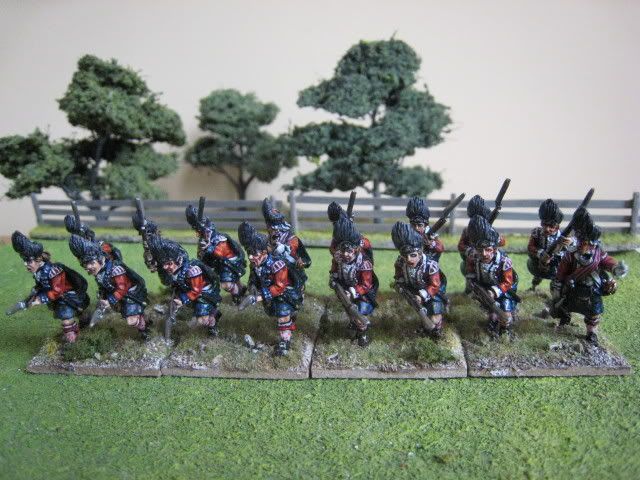
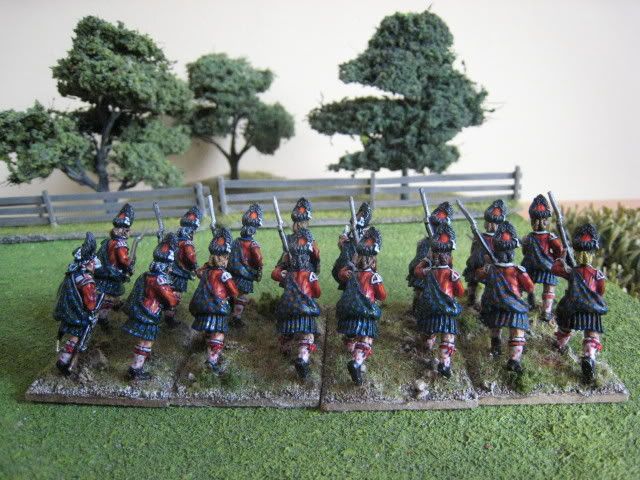
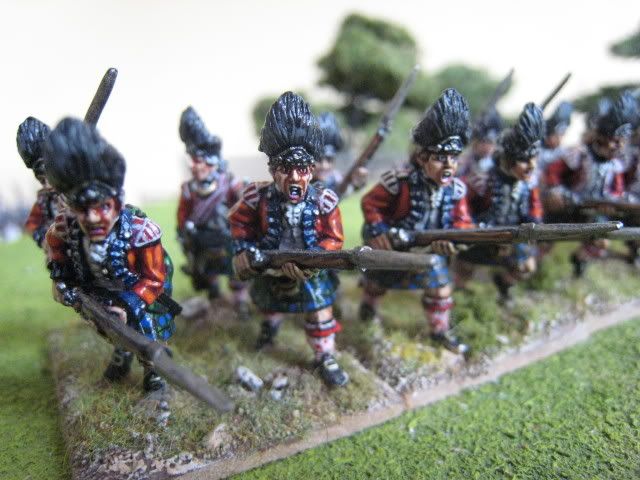
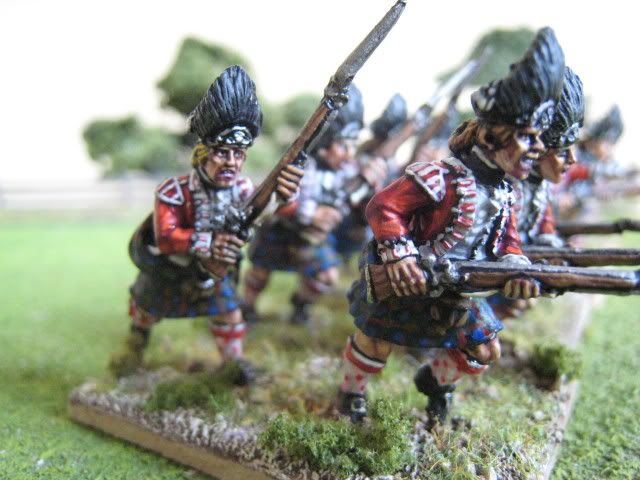
Another more unusual unit that I had to prepare for the Long Island game was the 4th combined grenadier battalion. This was comprised of highlanders from the 42nd Foot and the 71st Foot. Given the 3 battalions of the latter regiment, the strength of the regiment was some 320 men in 4 companies. Although brigaded historically with the other grenadier battalions, in the Long Island game this unit was detached and added to the main British attack (I forget in which brigade). It was the Perry charging highlander figures that first tweaked my interest in this period; I think the faces have some of the finest expressions that Alan Perry has made. Whilst I know some readers will wince at the full plaid (hi Bob!), you can't deny that a full battalion of charging jocks in highland dress is a stirring sight.


I originally painted a 6-figure base of 42nd grenadiers in 2004 and then added a couple more 4-figure bases a year or so later, another 42nd and one for the 71st. For this unit I rebased them all and generally smartened them up a bit. Noting that I had too many Black Watch and insufficient Fraser's, I repainted the facings of 4 figures to bring them within the 71st. I then had to paint a further 2 figures from scratch. As a result, one base contains the earliest Brits I ever painted for the AWI from 4 years ago and the most recent from October (see the close-ups below)! The difference in painting style is most apparent in the faces - back in 2004 I was using the "black eyeliner" method for painting eyes. I changed from that a year later, as it seemed to me that all my figures looked as if they'd just had a make-up trial at Selfridges. Since then I paint eyes by painting the whole face in the flesh base colour, adding a dark brown wash to pick out the eye sockets, painting white eyeballs and finally adding black pupils and, if appropriate, top eyelids; I think this looks a bit more natural that painting the eyes in black and then adding white etc. Half the figures have a black stripe in their tartan and the others have red - this is an attempt to divide the figures into the first and second battalions of their respective regiments. I have no idea if this is in any way correct - some references I have seen to AWI/government sett tartan state that grenadiers had a red stripe whilst others say they had black.


These chaps did well at the Long Island game, making it into the Brooklyn lines before being thrown out shortly thereafter. For the "British Grenadier!" later Monmouth scenario, which requires two grenadier units of a staggering 32-figures each, this unit will be combined with the 16-figure 3rd Grenadiers. My "1st Grenadiers" is only 24 figures strong (see here), so at some stage I will need to add 8 more figures to it. As I've noted before, you don't need so many grenadiers for most AWI scenarios; one unit of 20-24 figures will suffice for most engagements. Still, you can't quite beat a full battalion of highlanders in full plaid....


16 figures. Painted various times from 2004-October 2008.

Friday, 19 December 2008

British Light Infantry (2)


I actually have three battalions of light infantry, two of which are "doubled-up" in both close and skirmish order. I have found with practical gaming experience, however, that one usually uses light infantry as elite "shock" troops and that units tend to remain in close order on the tabletop. This battalion was painted up for the Long Island game as the 3rd battalion in Brigadier General Alexander Leslie's light infantry brigade (which at 1:20 has 3 units of 20, 20 and 16 figures respectively). The 3rd battalion comprised the light infantry companies from the following regiments: 15th, 28th, 33rd, 37th, 46th, 54th and 57th.


The battalion had taken part in Clinton's unsuccessful attack on Charleston. It was commanded by Major The Hon. John Maitland, who seems to have been either from the 71st Foot or the Marines. This in fact makes no difference as both regiments had white facings. So the commanding officer is painted as Maitland in the white facings of whatever regiment he belonged to! The rank and file are in campaign dress of roundabouts and slouch hats rather than Royal Warrant uniform because I thought the former more appropriate to a unit that had just arrived from the Carolinas. Another reason is that this campaign outfit is much quicker to paint....

Many thanks again to Brendan Morrissey for his help with information on this battalion, in particular its commanding officer.

16 figures. Painted October 2008.


Wednesday, 10 December 2008

72nd Ligne (1)


I have fallen behind in posting photos of the units I painted in October for the Long Island game, largely because of work but also a lack of decent photos! So whilst I had hoped to maintain chronological integrity in my postings, I am leaping forward to November, leaving behind for later use three lots of pics of AWI stuff I painted in October. After the Long Island game I decided to see how many Perry Napoleonic French, both plastic and metal, I could paint in a month. The result was "34", a little down on what I might reasonably have expected, but enough for just over a battalion's worth. I chose the 72nd Ligne (of Campi's brigade) because I have always been drawn to the Quatre Bras orbat and I wanted battalions that in 1:20 ratio equated to 24 figures (I can't face units of 36 figures, plus skirmishers). So here they are, the second battalion of the 72nd Ligne.


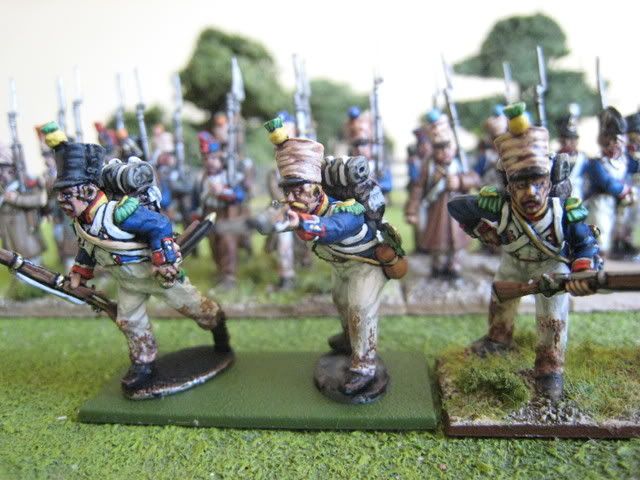
This battalion is a mix of plastic and metal figures. The plastic figures require minimal assembly; in most cases, i.e. for all the attack march poses, you just need to affix the backpack/cartridge case - you need to ensure that you choose the correct ones for figures wearing greatcoats and the flank companies (the former don't require the rolled-up greatcoat, whilst the latter need the short sword). The drummer, officer and skirmishers need more work. The only figure I had difficulty with was the firing voltiguer - it's difficult to get him to fire level, and instead looks as if he's shooting at something in the sky (or a mounted officer?). You can then do head swaps - there are plenty of spare heads with different headgear, battered shakos, "enthusiastic" expressions etc. These include the collars are very easy to affix to the figures, although again you have to ensure that you don't put a greatcoated head on a habit-veste figure etc (I'm sure there is a difference - the greatcoat collars are larger, and this can be seen on the spare heads). The generic nature of the backpack items leads to a couple of anomolies. All the cartridge cases have a pokalem attached - which makes no sense if you use the heads that are wearing pokalems. The cartridge cases do not have any company distinctions, but you can paint those on.


As for the sculpting, there is a slight loss of definition along the sides and the detail is not as crisp as with metals (as you'd expect). I had an undercoat disaster on my first batch of figures, in which I oversprayed and the paint erased much of the detail. But even with the loss of detail suffered as a result I was still pleased with how the figures looked. Occasionally I had to guess where a cross belt should have gone, but generally these figures paint up very well. The faces, in particular, are very well sculpted. The metal figures are pretty easy to spot once you notice the things they have that plastics don't! The mud effect on the trousers was applied largely with pastels, which have the advantage of "running" when varnish is applied, so resulting in quite a pleasing effect.


Aside from the fact that the metal figures have far larger bayonets and are a bit thinner across the front, the only significant uniform difference between the metals and the plastics is that the former have "2nd/3rd battalion" disc pompons on their shakos whilst the latter have "1st battalion" solid pompons. This is my main quandary - do you just paint everything in a solid colour and forget about the battalion distinctions? I suspect that's easier, although you could of course use the plastics for first battalions and metals for other battalions.


But all in all, these are lovely figures. They paint like a dream, cost about 35 pence each and have just the right amount of detail. The speed with which you can paint them means that units can be built up double-quick, which, frankly, is what counts most when building up Napoleon's armies . So why buy anything else? And as for the all-important question of whether I preferred painting the plastic Frenchies to the metal ones.....it's no contest - I preferred the plastics, and I never thought I'd ever say that. The second battalion is progressing nicely, with half completed now. Any readers who despair that I have been seduced by the Dark Side of Naps may like to know that the 9th Foot, in its Saratoga uniform, is well under way as well...


28 figures. Painted November 2008. Flag by GMB.


Tuesday, 2 December 2008

Smallwood's Marylanders


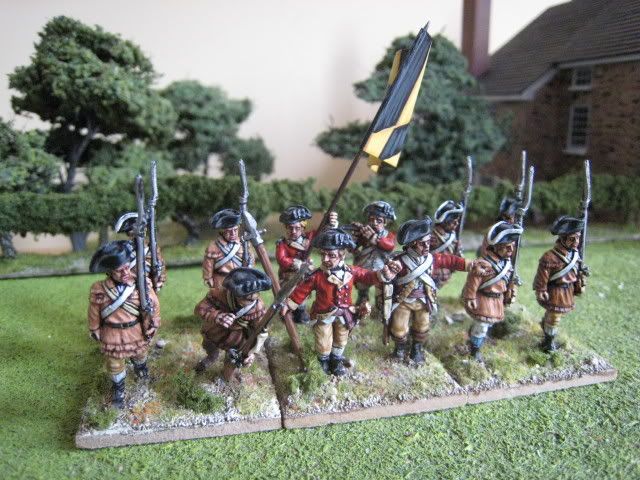
The Maryland Battalion was formed in January 1776 as the state's contribution to the Continental Army; it consisted of 3 companies from Baltimore and 6 from Annapolis. It was commanded by William Smallwood (1732-92), a prominent local politician and F&IW veteran who ran a tobacco plantation on the Potomac. In December 1776 a further 6 battalions of Maryland troops were raised and Smallwood's unit was redesignated the 1st Maryland Regiment. The regiment fought at Long Island, White Plains (at which Smallwood was wounded), Brandywine, Germantown, Monmouth, and then campaigned in the south until it was disbanded in 1783. Smallwood ended the war as a Major General, apparently the highest promoted Marylander in the army. He went on to be the fourth governor of Maryland and a senator. The regiment distinguished itself at Long Island in August 1776. Itwas assigned to the brigade of William Alexander, Lord Sterling, along with the Delaware Battalion of John Haslet, and was instrumental in holding up the British advance to allow the rest of the American army to escape.

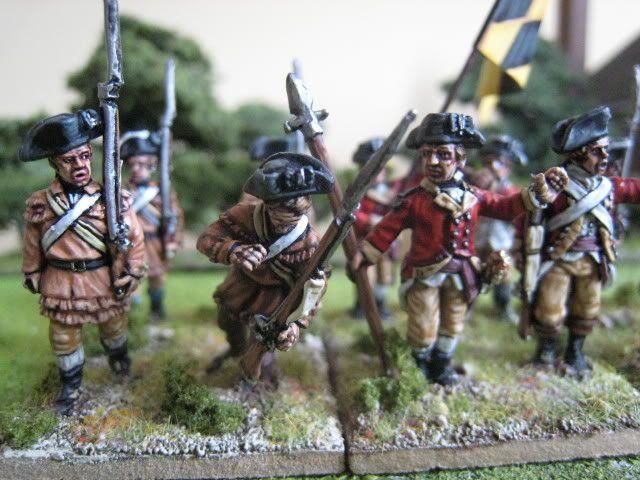
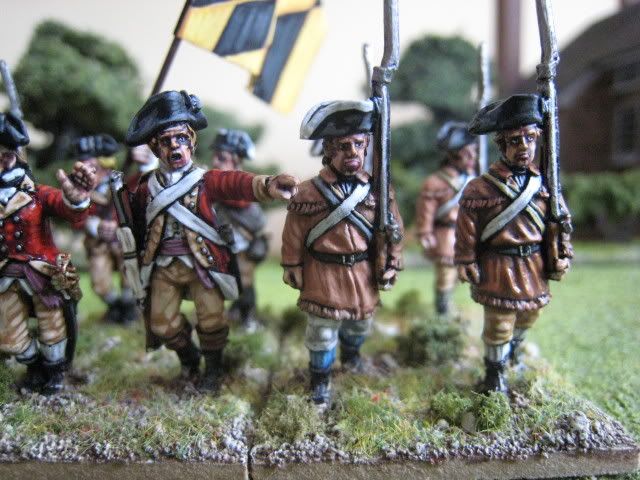
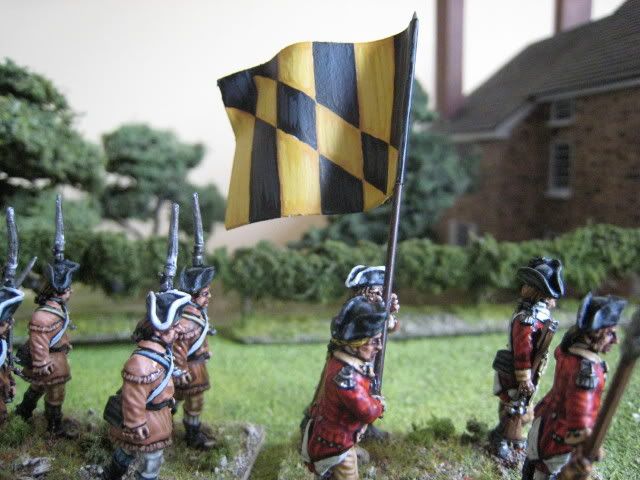
I painted a "1st Maryland" a few years ago, in blue faced red coats. However, that seems to be the regiment's 1777 uniform and in 1776 Smallwood's men were recorded as wearing tan hunting shirts over buff breeches, with officers in red coats faced buff. Given the unit's distinctive uniform, I decided to paint it up for the Long Island game. The orbat required 24 figures but by using the rank and file I had already painted for the 1st and 2nd North Carolina I only needed a further 8 hunting shirt types and then the command figures in their red faced buff coats. There is an excellent painting of the regiment fighting at Gowanus in the "New York 1776" Osprey Campaign book, and this was the look I wanted to capture. So I added a casualty and used officer figures who look as if they are trying to calm down and reassure the men. The chap with the spontoon is in fact a Foundry British officer. The flag is home made and is based on the family arms of Lord Baltimore. There is evidence that this flag was used for the state from the 1600s until the AWI (see here). There were other options, but this black and yellow lozenge design is very distinctive and certainly stood out on the table! Many thanks to Brendan Morrissey for his help with the uniform and flag details of this unit.

So, given the "1st Maryland" I painted a while ago, these 12 figures represent the first AWI regiment that I have painted twice, in its 1776 and 1777 incarnations. I noted a few posts ago that the range of 25mm figures now available means that you can model reasonably accurate armies for specific years of the war; a Continental Army of 1776 will look rather different to its 1777/78 equivalent and you can, if you want, use a different mix of figures for each army (and if you want a summer 1778 Continental Army you should probably have them all in shirt sleeves!) . So I may have to revisit the notion that I have "enough" American regiments...

12 figures. Painted October 2008.