Monday, 27 April 2009

Chavonnes Battery, Cape Town


My recent honeymoon in South Africa did not afford many opportunities for military tourism, not least because we were in the wrong part of the country for any Zulu or Boer War action. We missed the Castle of Good Hope because we arrived too late in the day (relaxing in a wine bar for 2 hours after lunch has its advantages, but efficient sight-seeing is not one of them). However, on our first day when we were just looking around the Victoria and Albert Waterfront area, where we were staying, we passed the Chavonnes Battery Museum. I think I was allowed inside only because it was the first day of the honeymoon proper and I had just pre-paid the hotel bill.


The museum contains the foundations of part of stone wall fortifications that the Dutch East India Company built in the early 18th century to protect its small harbour outpost. These defences were built on the order of the governor, the Marquis de Chavonnes, to protect the right flank of the castle. What de Chavonnes constructed was essentially a large battery that was atop a promontory at the sea's edge and so which had a commanding position to fire on ships approaching the harbour or trying to land soldiers. The battery took 11 years to build and was completed in 1726. It was the first step in a significant expansion of Cape Town's defences. The battery held 16 guns which were armed with a variety of shot. There were two ovens immediately behind them in which round shot could be heated to cause maximum damage to shipping. Apparently these guns were never actually fired in anger.


In 1860 the battery and other parts of the defences were largely demolished during the construction of the Alfred Basin and what remained was built over. However, the Chavonnes site was rediscovered in 1999 during further building work and the authorities decided to create a museum around what was left of the foundations. The museum describes the history of the Dutch defences in Cape Town and contains a large variety of 18th century artillery equipment, which are shown below. I was very impressed with the size of some of the implements - they were much larger than I had expected. The model of the gun platform is a useful guide for modelling. The uniform is that of the 22nd Batavian Infantry, a regiment formed in 1802 from Dutch marines specifically for service at the Cape. The final photo shows the Kiwi examining a late 19th century mountain gun. These were much used by the Portuguese up the eastern coast. Anyway, I thought these photos might be of interest.


Tuesday, 21 April 2009

Warner's Extra-Continental Regiment


The "Green Mountain Boys" were militia largely in the area of what is now Vermont but which in 1775 was territory called the New Hampshire Grants and claimed by the state of New York pursuant to an order of the British government that the territory was property of New York rather than New Hampshire (Vermont declared its independence in 1777 and was admitted to the Union in 1791). These men were staunch defenders of independence from the control of the New York state's government and seem to have taken active steps to prevent the exercise of the state's authority (taking pot shots at surveyors, that sort of thing). The Green Mountain Boys' founder and leader was Ethan Allen, who in May 1775 led some 200 of them in the expedition against Fort Ticonderoga and other British posts on the Canadian border. Seth Warner, Allen's cousin, was also involved in that operation.


In June 1775 Congress authorised a regiment to be raised from the Green Mountain Boys for service in the Continental Army. Further to a local vote, command was given to Seth Warner rather than Ethan Allen, much to the latter's disappointment.  The unit was an "Extra" Continental regiment rather than an "Additional" one like Henley's Additional Continental Regiment, for example. The regiment returned to Canada for continued operations, but suffered during the winter and as a result of a smallpox epidemic and was down to a hundred effectives by March 1776. The following year the regiment was heavily engaged in the Saratoga campaign, notably at Hubbardton and Bennington. During 1778-9 the regiment operated in the Lake George area. It seems that recruiting became a problem, largely due to political interference, and the regiment was disbanded in January 1781 as part of the wider re-organisation of the Continental Army.


The direct inspiration for painting this unit was the website of the re-enacted regiment, here. I was immediately taken with the photo on the main page of men in a variety of clothing, but most of it green of some hue or another. Of particular interest were the light green, pistachio-coloured hunting shirts; I have seen pictures of dark green hunting shirts, for example on the 1st Continental Rifle Regt., but not of such light ones. The photos also show differently-cut uniform coats, some with white turnbacks and some with red ones, and men in civvies or shirtsleeves. So I decided to paint the figures as shown in these photos - a mix of hunting shirts of various shades of green and uniform coats, with a couple of new recruits in civilian clothes or perhaps just a green waistcoat. The idea was to capture a unit with troops wearing a combination of different issues of clothing, but which keeps green as a unifying colour. So the uniform coats have subtle differences in colour (you can't really see on the photos, but some have brighter highlights than others), and the hunting shirts were all painted with different mixes of green. This approach seemed a good one for representing the regiment as it might have looked during the Saratoga campaign - some old sweats from the Canada expedition wearing faded hunting shirts and coats and new recruits in freshly-dyed ones. I went for 18 figures because the Hubbardton scenario in the second "British Grenadier!" scenario book requires the regiment to be split into two wings of 18 figures each (this scenario is at 1:10 troopscale). At some stage I will have to paint a second 18-figure green coated regiment for the other wing.


These are all Perry Miniatures figures. The colours used for the coats were the Foundry "Bright Bottle Green" palette with additional highlights to a varying degree of "Bright Green". The pistachio hunting shirts were painted with "Bright Green C" mixed with a lot of white. The other hunting shirts used the darker "Bright Green" colours mixed with "Forest Green" and some of the new Napoleonic greens. My favourite hunting shirt colour is actually the chap behind the drummer - this was painted with the "French Chasseur a Cheval Green" and "French Dragoon Green" palettes, and is the colour I'll probably use for the 1st Continental Rifles. Some of the breeches and waistcoats also use the new Foundry "authentic Napoleonic" colours - I might review these in detail when I next paint a militia unit; my initial impressions are rather mixed, as quite a few of the colours are useless (either because the paint is so thin, there is no difference between the shades or the tones are simply too dark). The basing has a sprinkle of "bluebell" scatter from Realistic Modelling, which shows up mainly as lumps of blue. I pulled some of this off with tweezers after taking a couple of photos as the clumps of blue seemed far too large for patches of blue flowers. It may be a bit ott, but at least the blue blends in with the general colour scheme of this unit.


This is my last regiment of Continental line for a while. There are a couple of others that I will get around to in the fullness of time, but with over 35 units of regulars I have enough for now. I need to focus on cavalry and Hessians, some more command vignettes perhaps and a couple more artillery stands. And that's when I'm not painting First Carlist War stuff...


18 figures. Painted February/April 2009. Flag by GMB.


Tuesday, 14 April 2009

6th Continental Regiment


I wanted to paint another American battalion in a mix of shirt and coats for use predominantly in the early phase of the war. Having painted one such unit in blue faced red coats and wanted to paint the second in brown faced red ones. This unit is designed to be the 6th Continental Regiment of 1776. The previous year it was raised as Colonel John Brewer's Massachusetts Regiment and at some time after 1777 the unit became the 13th Massachusetts Regiment. The unit was present at the Siege of Boston, went up to Lake Champlain, then fought at Saratoga, Monmouth and Rhode Island. The regiment seems to have disbanded in 1781. I chose the 6th simply because there are records of its soldiers wearing brown coats faced with red (or white).

For "British Grenadier" scenarios, I see that the 13th Massachusetts appear with 16 figures at Monmouth and Newport (i.e. the main 1778 Rhode Island battle). The flag is from "Flag Dude" and is one reported as being carried by General Sullivan's "life guard" at Rhode Island in 1778. Whilst this regiment is not Sullivan's guard as such, I have the flag lying unused and thought it might be appropriate for a unit that did eventually fight in the campaign. Incidentally, there is an interesting account of Sullivan and the Rhode Island campaign here. The figures are all from Perry Miniatures, a mix of various packs and with a couple of "freed men of colour" thrown in.


20 figures. Painted February 2009. Flag by "the Flag Dude".


Tuesday, 7 April 2009

First Carlist War test figures


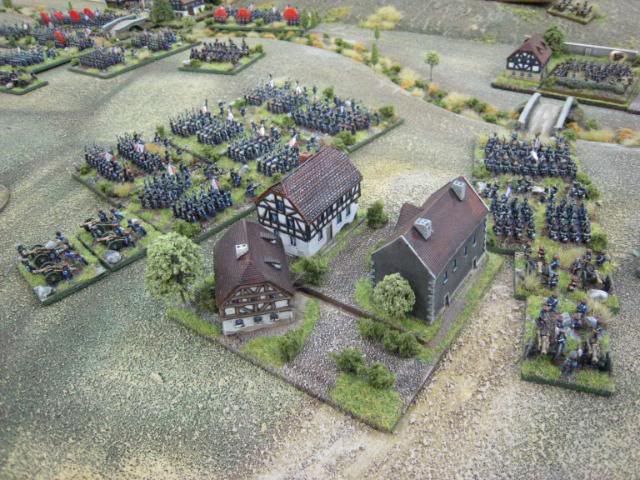
Just because Andreas asked...this is where my first Isabellino unit currently stands after a week of painting. This is a battalion of regular army line infantry. It will be 20 figures strong, which is about a 1:30 figure to men ratio. At 1:20 I would have 32 figures for a battalion at full strength. However, I want to keep the units down to 20/24 figures (i.e. in line with my AWI stuff) and I imagine that battalions were rarely at full strength anyway - if both sides have this sort of ratio then it should be fine. Current rules plans are the GdB variant "There are your guns". Anyway, I still have plenty of planning to do and, when I have a couple of units painted up, a new blog will emerge... The buildings were bought ready-made from "Tablescape" at Salute.

Plenty to come for the AWI - the 6th Continentals, more buildings, a second British limber, a discussion on colonial fence styles and the Green Mountain Boys when they are finished. I have some 17th century stuff from South Africa to post on as well and plastic Perry Brits. Incidentally, am I the only person who feels overwhelmed by the range and quality of figures available at the moment? Even if I gave up work and painted 24/7 (ignoring the financial consequences for the time being) I still don't think I would have time to paint everything I'd like to do...

Sunday, 5 April 2009

Salute 2009


My apologies - I had meant to write this up last Sunday but foolishly left it to the next day and then work intervened. So I won't bother giving a detailed account of the show as plenty of others have done so in the meantime (see TMP passim), but set out a few thlughts below, and of course the obligatory "wot I bought" feature.

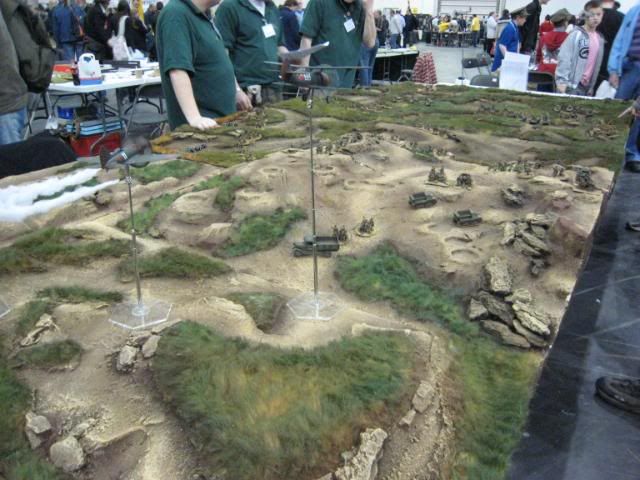
I thought it seemed quieter than in previous years and there was certainly a fair amount of empty space, but I gayher that the hall was larger than last year so this may have been the reason. Certainly a couple of traders told me that they were doing very well (and both said that internet sales were booming, recession notwithstanding). The Perries, Warlord, Victrix and lots of others seemed rushed off their feet. Smaller traders seemed to be doing well - part of the joy of shows like this is in stumbling across traders one hasn't seen before. The games were largely of a high standard - some had incredible hand-crafted scenery, whilst others made effective use of rugs and "battle mats". I noticed a large number of youngsters enjoying the participation games, which was good to see. Aerial combat games and WW1 seemed to be this years "in-periods". The show's obsession with WW2 German armour of whatever scale (the larger clearly being the better) manifested itself this year in remote controlled tanks buzzing around. As always, I missed out on several games despite being certain that I walked down each aisle at least 3 times - such is the vastness of Salute these days.

I left before they announced the painting competition winners, but I noted that the "wargames unit" categories still attract more plinth-mounted vignettes than anything you could actually use in a game. Call me old fashioned, but if you can't lift an entry from the display cabinets and plonk it straight on the wargames table then it doesn't belong in the "wargames unit" category (I had no entries so this is not sour grapes!).

Shopping was good, if a little down on last year due to the absence of a few people. Purchases were: two pre-ordered AWI farm buildings from Tablescape, plus a couple of Spanish 25mm houses; from the Perries a box of the new plastic Nap Brits, the plastic American farmhouse (despite having no idea how to paint it) and the Carlist Wars sourcebook; Carlist Wars figures from Dave Thomas; rules and scenarios books from Caliver for ACW and, er, the Carlist Wars; a ploughed wheat field from "Products for Wargamers"; and some other bits and bobs. I was quite restrained really, especially given the quality of products on display; there were about half a dozen periods I could willingly have started.

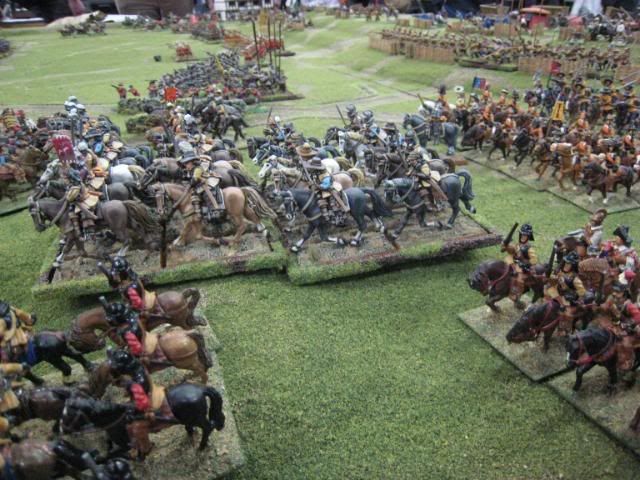
Some photos of the games are are below. The late arrival of this post will, I hope, be compensated for by half a dozen AWI posts that I have ready to go over the next couple of weeks. Oh, and the Carlist Wars stuff....The pic above is from Warlord Games' ECW affair - lots of juicy plastic new releases on the table.

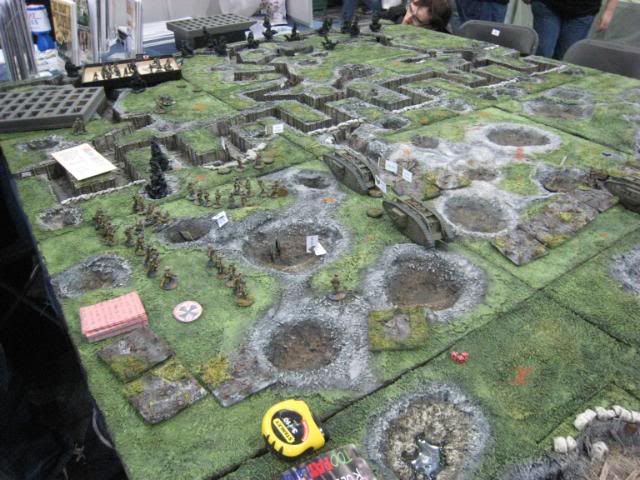
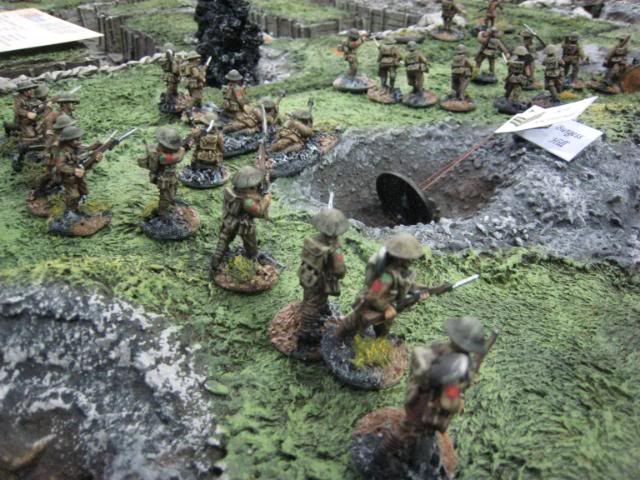
The WW1 game from "Too Fat Lardies":


Best of Show: Japs v Russians in 1939:


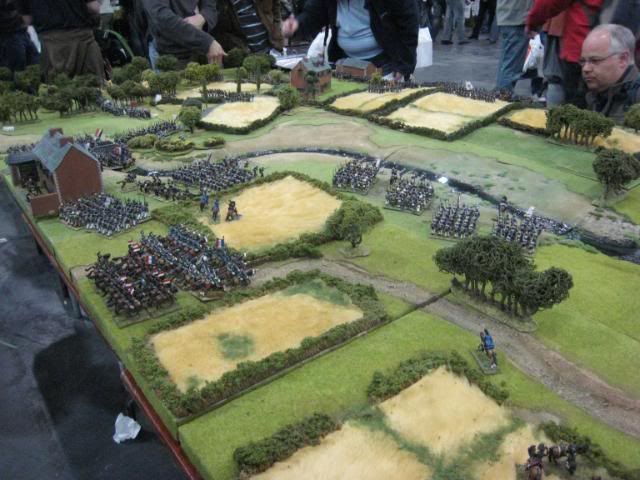
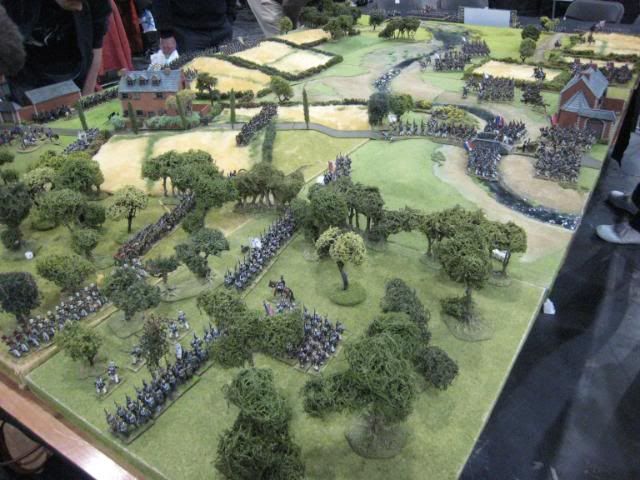
The Perries' Quatre Bras game:


Loughton Strike Force's "Reichstag 1945" (note how the roads actually have kerbs - the attention to detail on this game was meticulous):


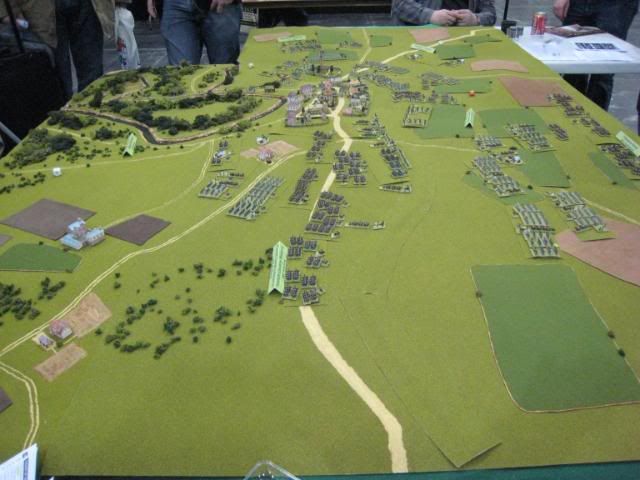
Two examples of Naps in 6mm:


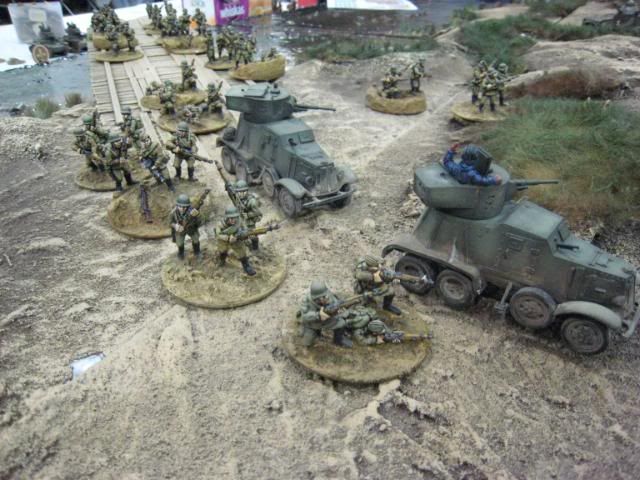
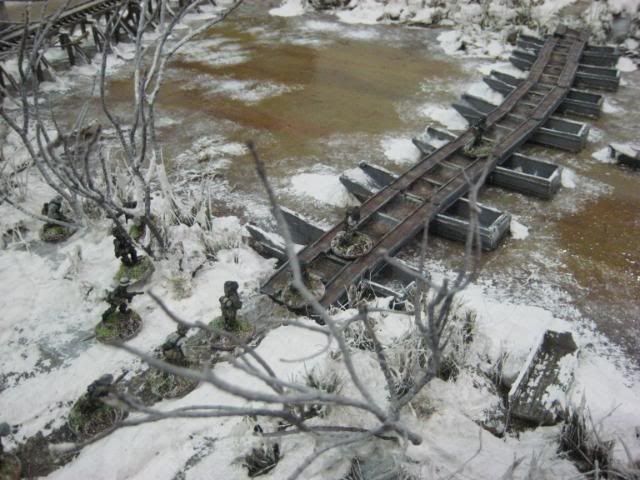
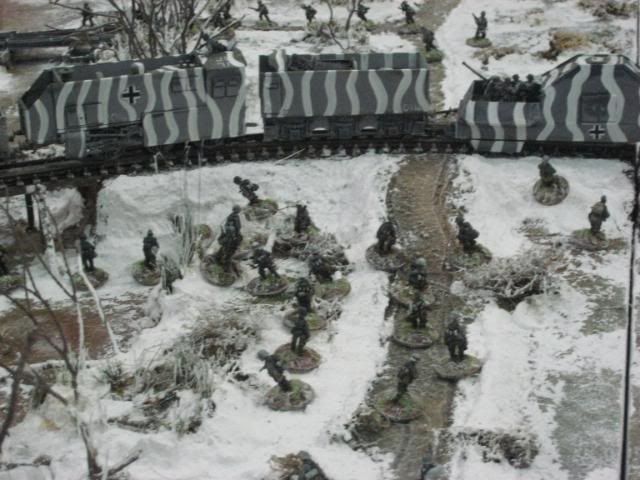
Partisans in the Russian forests, WW2:

Tuesday, 24 March 2009

Back home...


...and married! "Sunny" Napier failed to materialise, although we were extremely lucky that the actual ceremony, which we had thought would have to be transferred to the indoor venue, coincided with the only 2 hours of sunshine that day. The officiating reverend (the Kiwi's uncle) clearly has a hotline to the powers that matter...Shelley and I had a wonderful time on the day. I was in fear at our first dance, but Shelley had realised early on that the elaborate steps we had been taught (but not in any way practised) were impossible in her dress, so we didn't really have to dance properly at all. That left my speech, which I don't mind saying was the most nerve-wracking experience of my life. It was not the thought of speaking to a large number of people that disturbed me, but rather the fact that the speech was my introduction to a substantial part of Shelley's family that I had not met before. But I quickly realised that being rude about the Australians is an easy way of raising a laugh from New Zealanders (although I had some issues the next day with the two Australians in the audience) and they seemed to appreciate a few anecdotes about the culture clash of a Kiwi-English marriage.


We had a wonderful honeymoon in South Africa, spending equal time in Cape Town, the winelands of Franschhoeck and on safari in Kruger National Park. Shelley's uncanny ability to sniff out good winebars ensured we found plenty of watering holes in Cape Town. Unfortunately we missed the opening times of the castle but we did manage to visit a newly-excavated part of the old Dutch fortifications; I will post some pics and information about that in a few days. The safari was a real once-in-a-lifetme experience, although I never really managed to reconcile the concept of being on holiday yet at the same time being woken up at 5am every morning by a burly man in uniform banging on my door: I'm pretty sure that's what happens when you're in prison, not on honeymoon. Maybe there's a metaphor for marriage in there somewhere...


As usual, a key part of our holiday was wine and it featured heavily in both New Zealand and in South Africa. In NZ, I was again impressed with the quality of the rose wines, which I had already noted when in Hawke's Bay in 2007. Rich, elegant but still light and fresh, these wines are miles away from the dreary and/or sickly European offerings that still give rose a bad reputation (I think the best Kiwi roses are those made from merlot and malbec in the North rather than from pinor noir in the South). But South Africa was a revelation. Expecting bland whites and reds that were marred by "burnt rubber", we found wonderful wines of real character. During the course of visits to 27 wineries in Stellenbosch and Franschhoeck (which together with 13 in NZ made a grand total of 40 wineries visited, which aint bad..) and numerous bars and restaurants I noted only half a dozen red wines that exhibited earthy, "burnt rubber" characteristics, mostly at the lower end of the market and always either in cabernet or pinotage (although I think the latter variety might possibly benefit from the smokiness of "burnt rubber"). But the reds were universally much better than I had expected; the Bordeaux blends were particularly impressive. As for the whites, whilst I found SA's sparklers a little flavourless the sauvignon blancs were extremely good, capturing a tasty middle ground between the acidic Kiwi style and the more minerally Sancerre style - perfect for a lunchtime picnic of chicken and seafood. We were also bowled over by the quality, luxury and size, of the SA winery cellar doors. This is clearly a country with a wine industry that has ambition, and the recent requirements for the (predominantly white) producers to put something back into their local communities made for enlightening cellar-door conversation.

So for those who are interested in such things, wine highlights were as follows. In NZ: Unison Hawke's Bay Cabernet Sauvignon 2006; Te Phau "The Point" 2006; Kennedy Point Waiheke Island Rose 2008; Mission Estate "Jewelstone" Chardonnay 2006; Elephant Hill Rose 2008; Vidal "Soler" Syrah 2005; and pretty much anything by Craggy Range. In South Africa: Waterford "Kevin Arnold" Shiraz 2005; Springfield Special Cuvee Sauvignon Blanc 2008; Diemersdal Estate Single Vineyard Sauvignon Blanc 2007; Vilafonte "Series C" 2005; Ataraxia Sauvignon Blanc 2008; Rustenberg "Five Soldiers" Chardonnay 2006; Vergelegen "The Red" 2000; Alluvia "Ilka" Sauvignon Blanc 2008; Le Riche Cabernet Sauvignon 2003; Rupert and Rothschild Baroness Nadine Chardonnay 2006; Fairview "Primo" Pinotage 2007; Beaumont "Ariane" 2004; Cordoba "Crescendo" 2003.

A few random photos are below, for what they're worth; I now appreciate just how difficult a job wildlife photographers have. I have been inspired to dig out my old Foundry/Copplestone Darkest Africa figures, so more wildlife photos might appear as and when I get around to painting some animals.


Thursday, 26 February 2009

No more posts for a while...


...because I'm off to get married! A week on Saturday in (hopefully) sunny Napier in New Zealand, and then a honeymoon in South Africa (combining sun, wine and safari). Luckily I return a couple of days before Salute. I'll be skint, but it will be a great day anyway. I had hoped to post some pics and a short history of the 6th Continental Regiment before I left, but they will have to wait until I return. I am still enjoying playing around with Seth Warner's regiment, but didn't manage to finish it in time. Only 7 more figures to go, though. Here, just for Steve, is a photo of my almost finished Sudan Beja horde. 50-odd figures counting as 6 bases of 10. Back in 4 weeks!