Monday, 19 October 2015

Colonel Louis Marc Antoine de Noailles

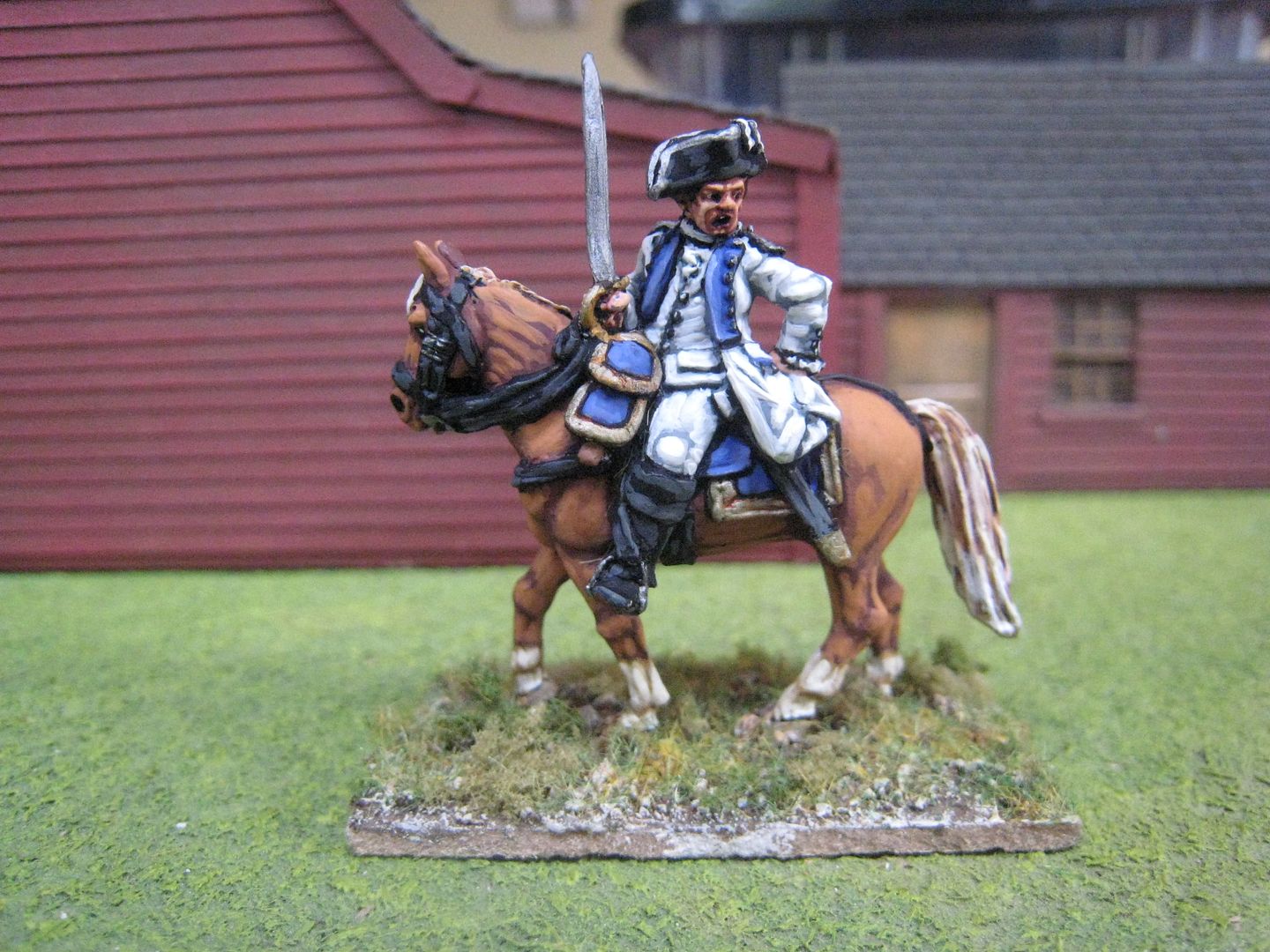
Louis Marc Antoine de Noailles was born on 17 April 1756 into an established, very well-known aristocratic family.  The family held a dukedom, created in 1663, and it produced a long line of soldiers, which included several marshals of France - the French army defeated at Dettingen in 1743 was commanded by the third Duke de Noailles.   The family's links to the monarchy (one of the senior female members was a maid of honour to Marie Antoinette) ensured that it suffered during the French Revolution.  Some members were executed and others were forced to emigrate.  One of the grand-daughters of the fourth Duke escaped the guillotine only as a result of the personal intervention of the American ambassador, James Monroe - she was the wife of the Marquis de Lafayette.  

The family's future misfortune could not have been imagined when young Louis Marc Antoine arrived in America in 1780 with Rochambeau's expedition, preceded by his friend and brother-in-law Lafayette.  At this time, de Noailles appears to have been colonel of the Soissonnais regiment (at the age of 24).  He participated in the siege of Yorktown and helped arrange the terms of Cornwallis' surrender.  By all contemporary accounts, he was a brave, energetic and intelligent young man.  Like the Marquis de Rostaing, de Noailles was elected to the Estates-General in 1789 and was at first a keen supporter of reform.  However, the increasingly violent and extreme nature of the revolution persuaded him to leave the country, as he emigrated to the United States.  There he became a partner in the Bank of North America in Philadelphia.  This was the new nation's first central bank, given its charter by Congress in May 1781; it was liquidated in 1908.  De Noailles seems to have grown bored with life as a banker as he accepted an offer to join the Vicomte de Rochambeau's expedition to Haiti (then called Sainte Domingue) in 1802.  That expedition was intended to deal with the ongoing slave revolt on Haiti, but in May 1803 war broke out again between Britain and France and Rochambeau's force found itself in combat against a British squadron under Rear-Admiral Sir John Duckworth.  De Noailles acquitted himself well in the ensuing battle, but while travelling to Cuba afterwards his ship was attacked by and English frigate and de Noailles was severely wounded.  He died of his wounds in Havana on 9 January 1804.

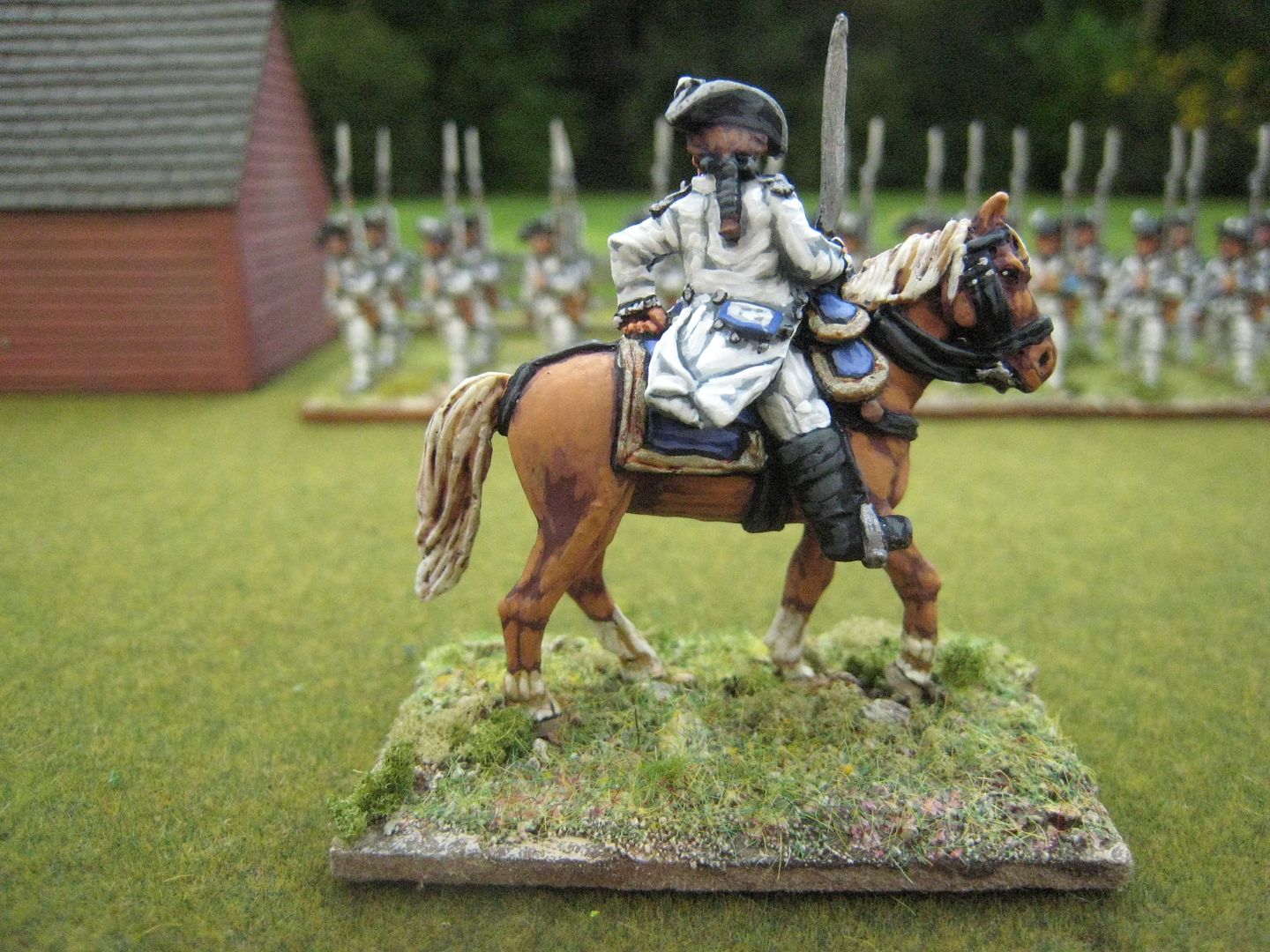
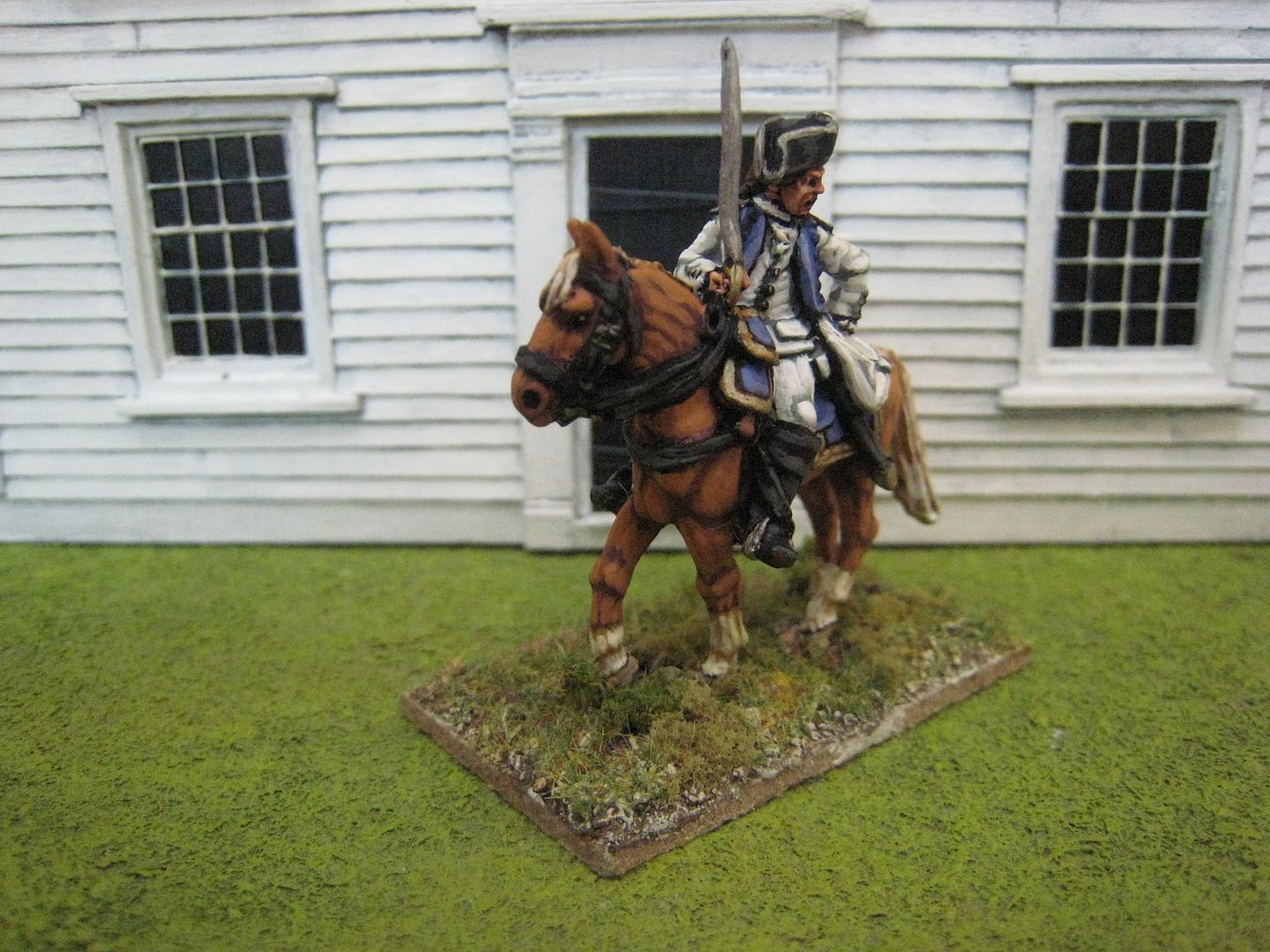
De Noailles is painted here as a senior officer in the Soissonnais regiment, which had maroon facings.  I haven't yet painted that regiment and it doesn't seem to feature in the "British Grenadier!" scenarios.  As for de Noailles himself, in the published "British Grenadier!" scenarios he appear as a brigade commander in the Savannah scenario (with a "poor" rating, which seems a bit of a shame).

1 figure.  Painted August 2015.


Saturday, 17 October 2015

Colonel Just-Antoine-Henry-Marie-Germain de Rostaing

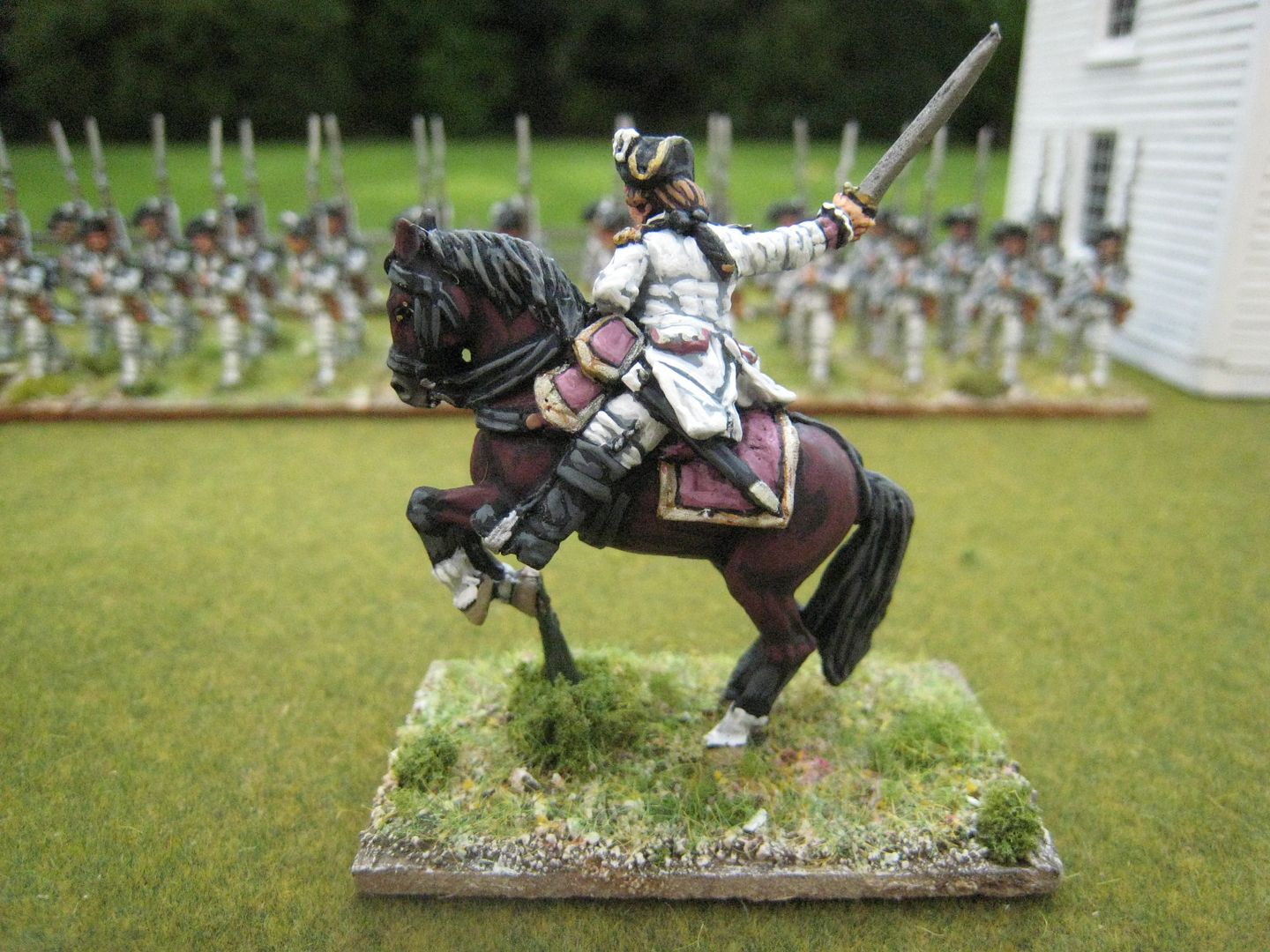
This is the Marquis de Rostaing, the first of a trio of French officers for the AWI who I'll be posting about each day from now to Monday.  He is from the Perry Miniatures set AW148, "mounted French colonels", and I have painted each of the 3 figures as a specific individual. 

Born on 24 November 1740, Rostaing was a page of Louis XV and joined the army in his late teens, joining the cavalry as a lieutenant.  He then transferred to the infantry, becoming colonel of first the Auxerrois regiment and then the Gâtinais regiment in 1778.  His service in the AWI and, in particular, during the Yorktown campaign earned him promotion to brigadier rank in 1781 and then to marechal de camp.  After the war Rostaing, along with many senior military officers, was elected to the Estates-General of 1789, a meeting of France's three "estates" (i.e. the clergy, the nobility and the general populace), which was summoned by Louise XVI to help resolve France's financial problems.  This blog is not the place to go into the how's and why's of the French Revolution, but the meeting of the Estates-General in May 1789 was not a success and the Third Estate, representing the commom people, broke off to form a National Assembly with a view to governing France.  Two months later the Bastille was stormed.   Rostaing may not have been a fervent revolutionary, but he was clearly a man who saw that things had to change.  He served in the National Assembly and was appointed to the important Comité militaire  which supervised the new Republic's military affairs.   In 1792 he was promoted lieutenant general and seems to have retired soon afterwards.  He died in 1826.

I have painted Rostaing as a colonel of the Gâtinais Regiment (which I painted in 2011 - see here), hence the purple facings.  He remained colonel of the regiment until 1782, by which time it had been renamed the Royal-Auvergne regiment, as recognition for its heroics in taking Redoubt No.9 at Yorktown (the regiment eventually became the 18th Line).  Rostaing and his regiment were present at Savannah and Yorktown, so at the former battle he would have been 39 years of age.  This Perry sculpt looks about right for that age, I think.  I will be using these three mounted officer figure for, in effect, brigade commanders.  In the "British Grenadier!" scenario books Rostaing appears as a brigade commander in the Yorktown redoubts scenario (in the forthcoming 4th "British Grenadier!" scenario  book from Caliver).

1 figure.  Painted September 2015.


Wednesday, 14 October 2015

Général de Brigade Baron Pierre-François Bauduin

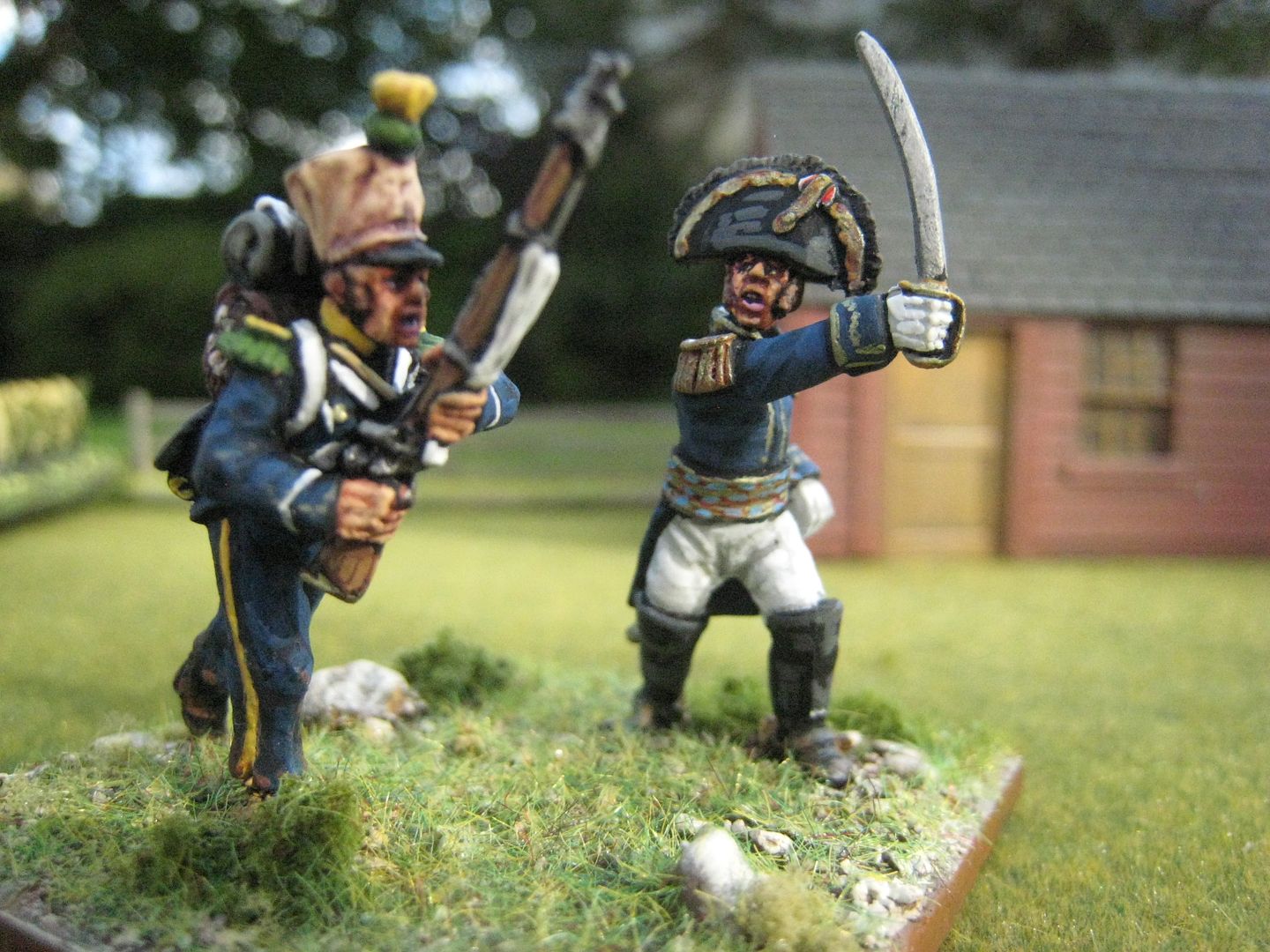
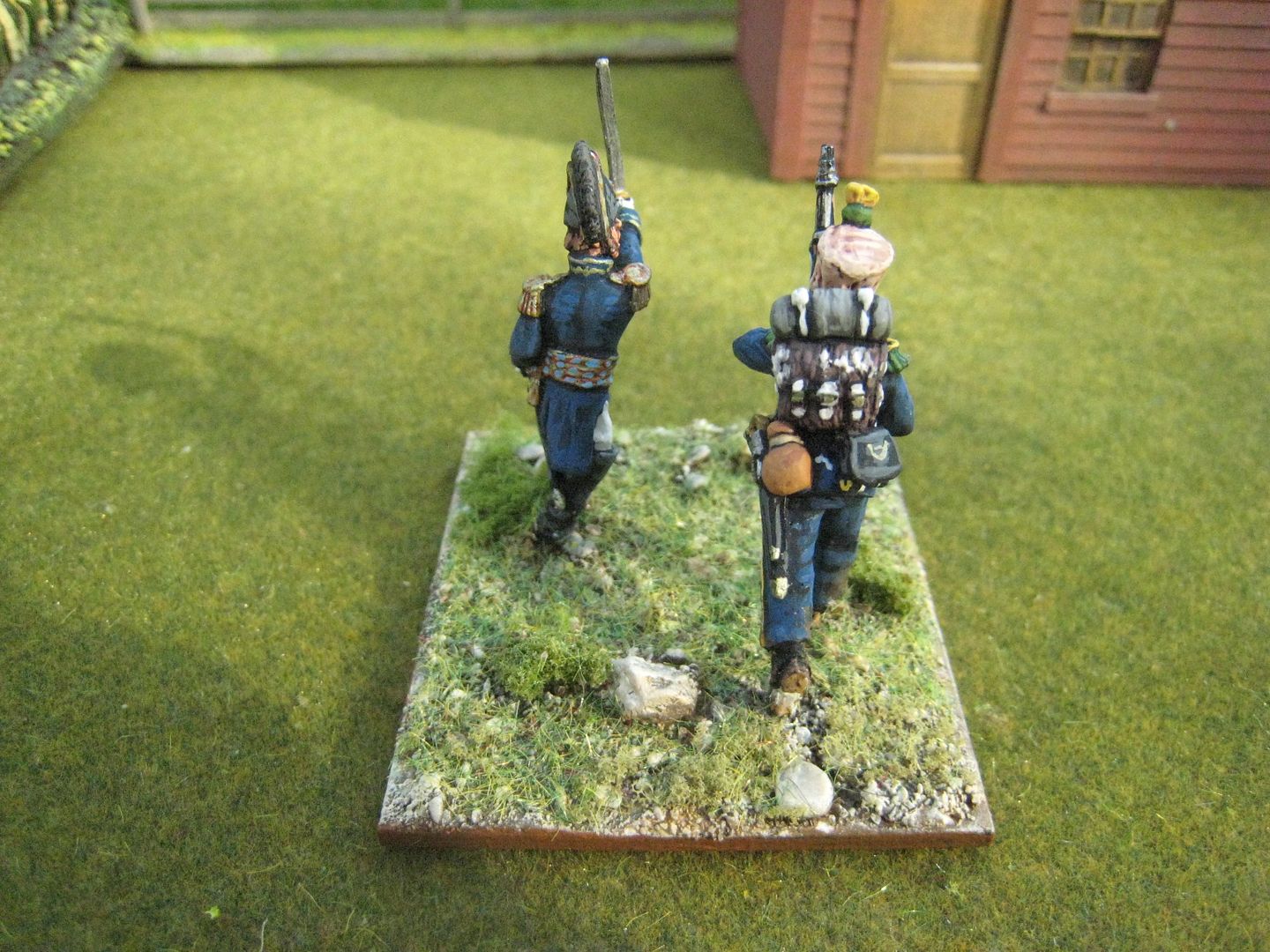
Bauduin was born on 25 January 1768 and joined the French army in September 1792 as a sous-lieutenant with the 59th Line.  He was present at the siege of Toulon and fought with Napoleon's army in Italy, serving on the staff of General Herbin.  Bauduin distinguished himself at the battles of Montebello and Marengo, where he was wounded, and was given command of a battalion for his troubles.  He fought in the major campaigns of 1807-1809 and was created a Baron of the Empire in 1810, by which time he was colonel of the 93th Line.  He was wounded again at Borodino but survived the retreat to be promoted to Général de Brigade rank in 1813.  During the final campaigns prior to Napoleon's abdication, Bauduin commanded a brigade attached to the Young Guard.  He was decorated by Louis XIV but re-joined Napoleon for the Hundred Days, which saw him in command of the 1st brigade of the 6th division in Reille's II Corps.   It was in that position that he was mortally wounded while leading an attack on Hougoumont at Waterloo. 

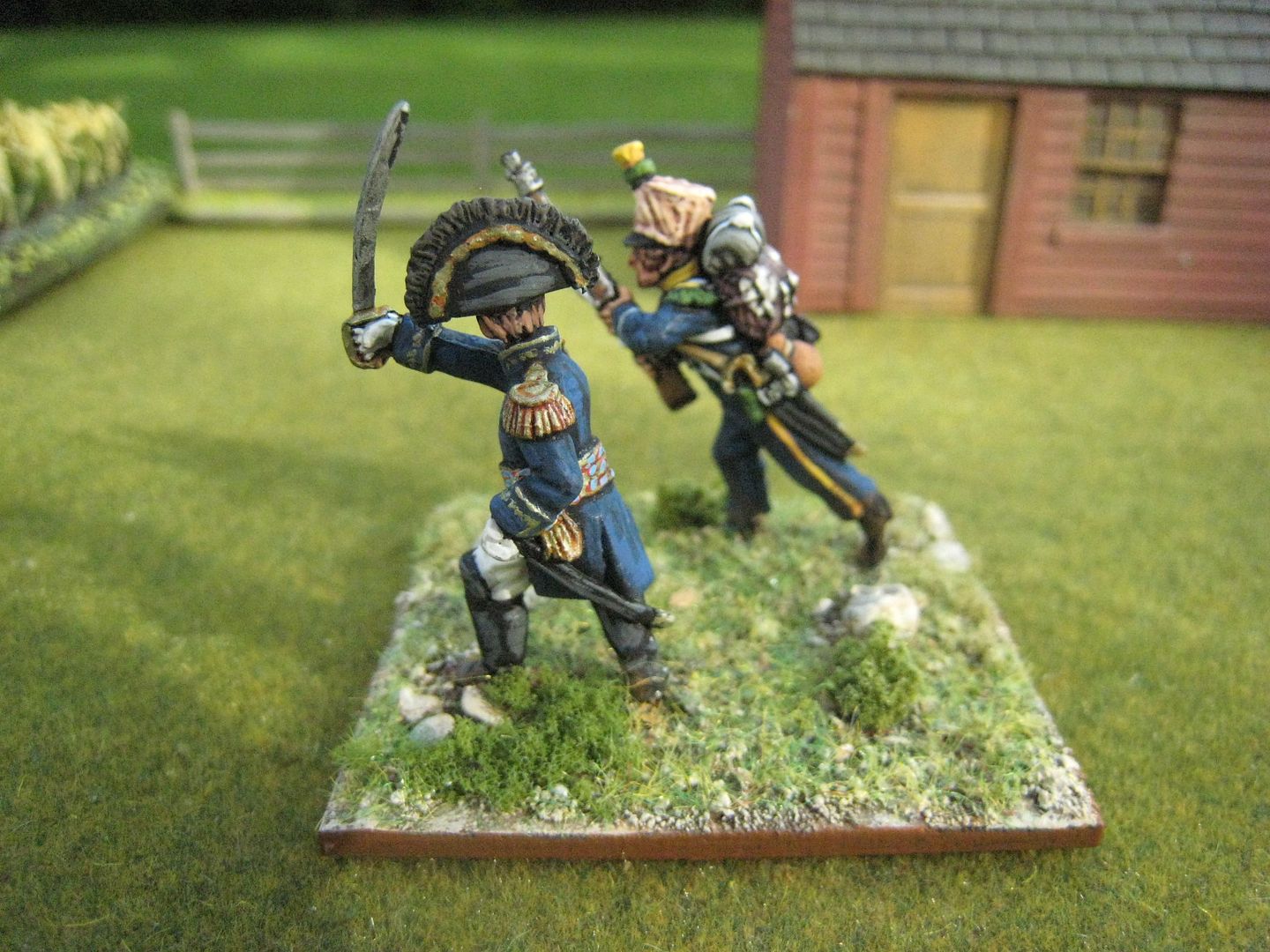
This sculpt of Bauduin was a freebie at this year's Partizan wargames show (and many thanks to John "Levied Troop" Francis for giving this to me).  It's a nice little figure (sculpted by Bill Thornhill, I believe), although with minimal uniform detail so you have to paint on all the fancy general's braid.  His companion is a light infantryman from Perry Miniatures.  Bauduin's brigade consisted entirely of French light infantry (from the 1st and 2nd regiments).  I don't know exactly how he died, but leading a charge seemed an appropriate use of this figure.  I was going to have two infantrymen with him, but the base looked a little crowded so I stuck with just the one.  It will be a good while until I get around to painting up this chap's brigade.  Next up are a series of posts on more AWI French.

2 figures.  Painted August 2015.


Monday, 12 October 2015

3rd New Hampshire

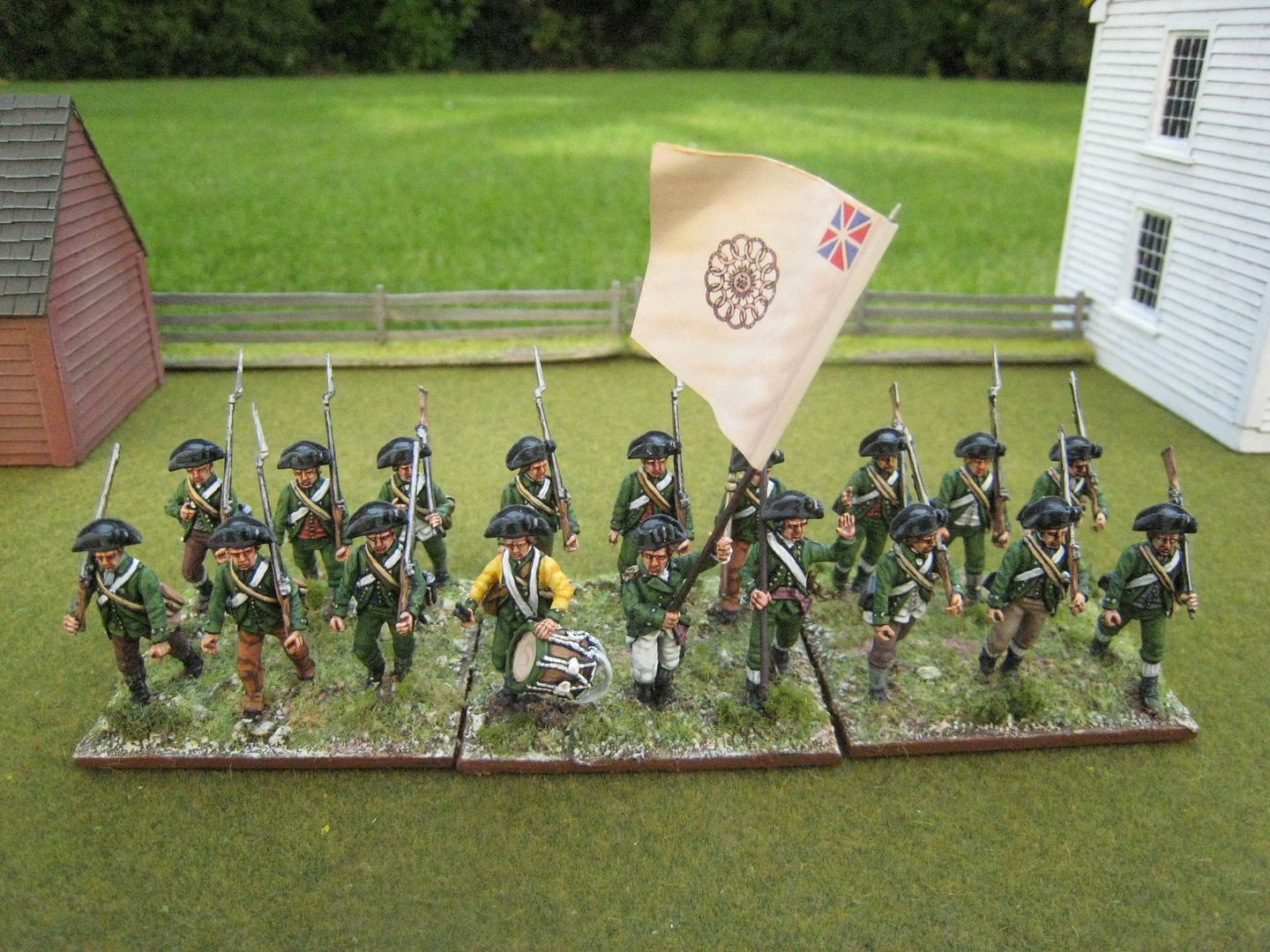
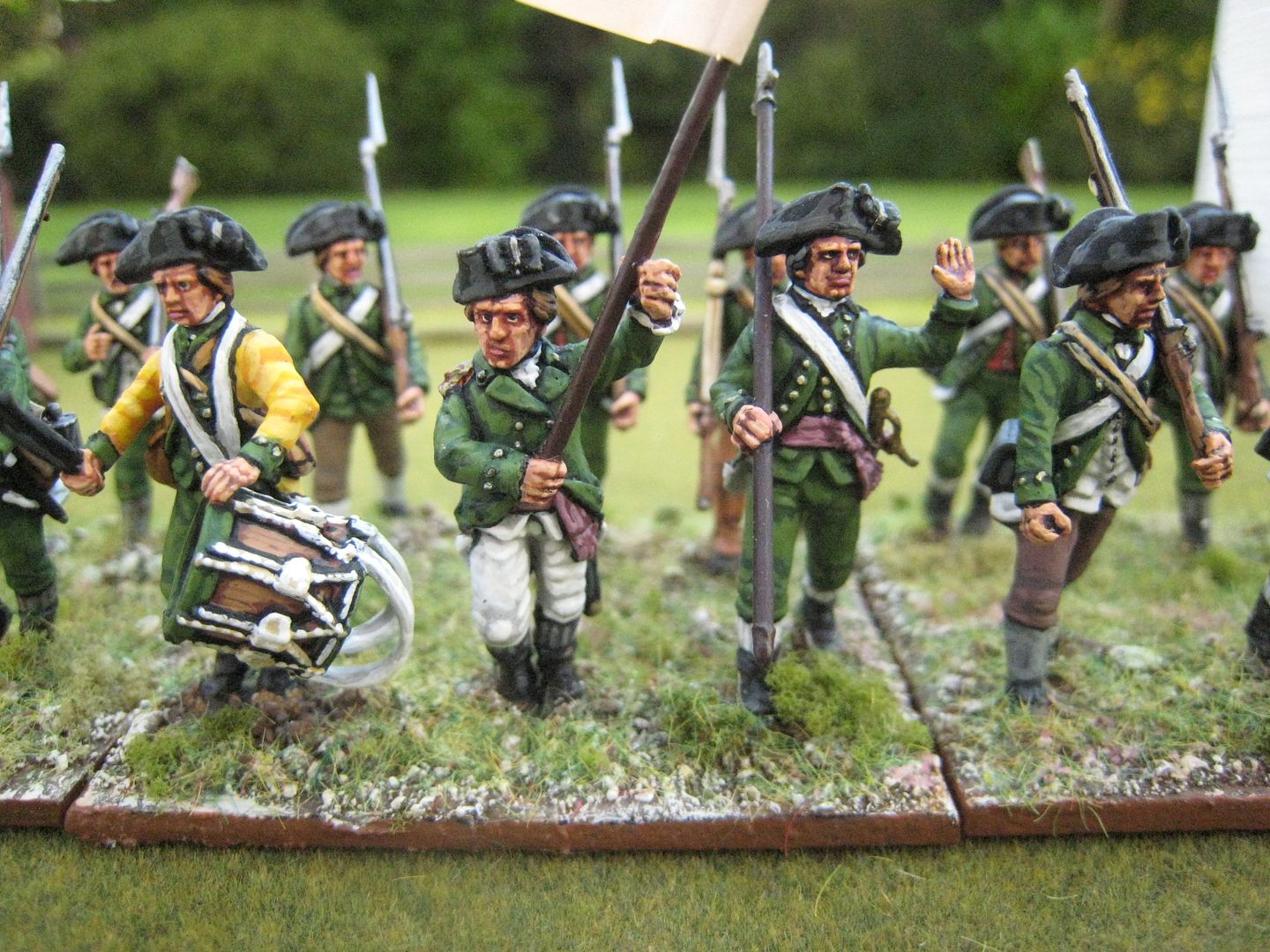
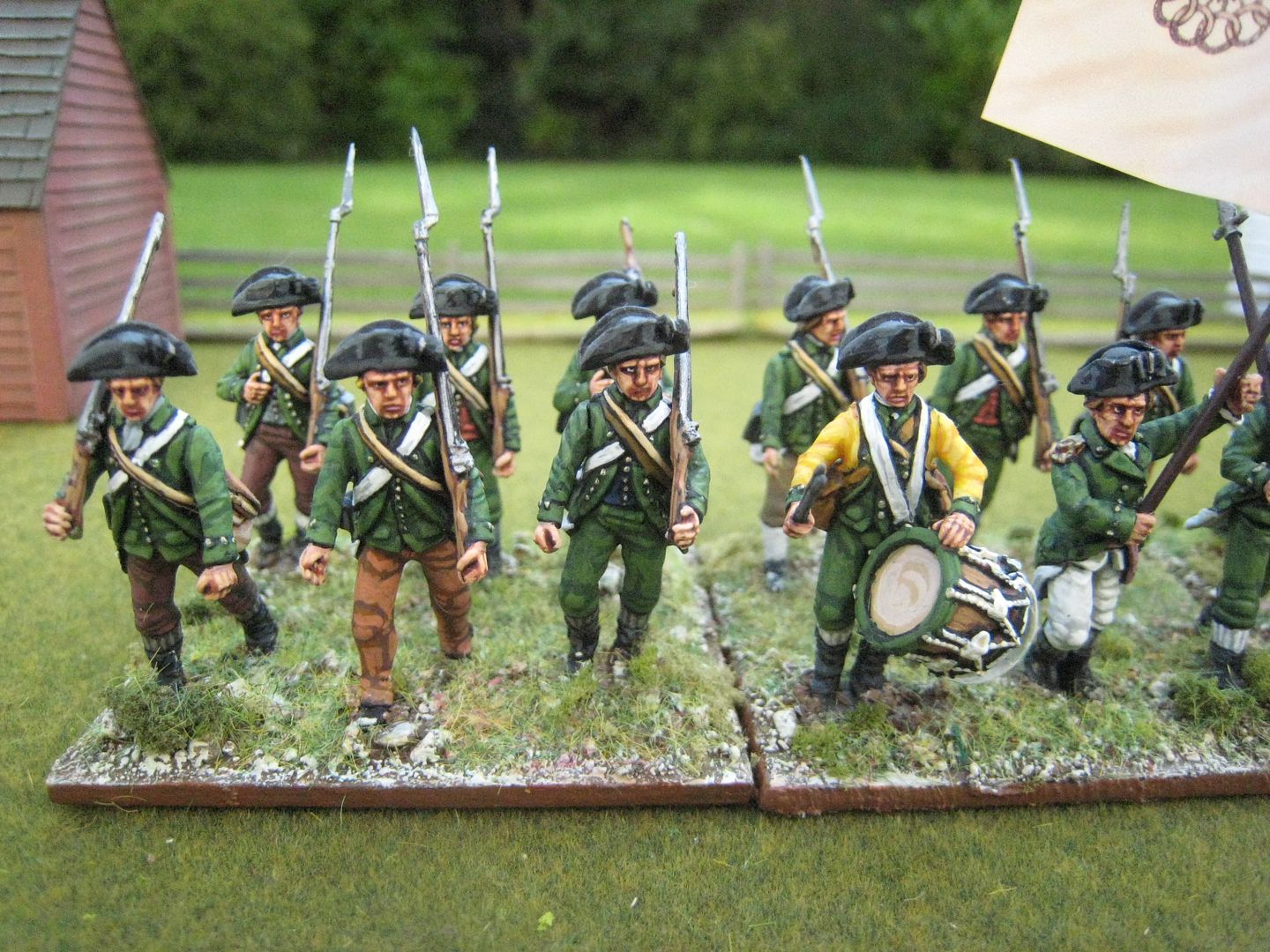
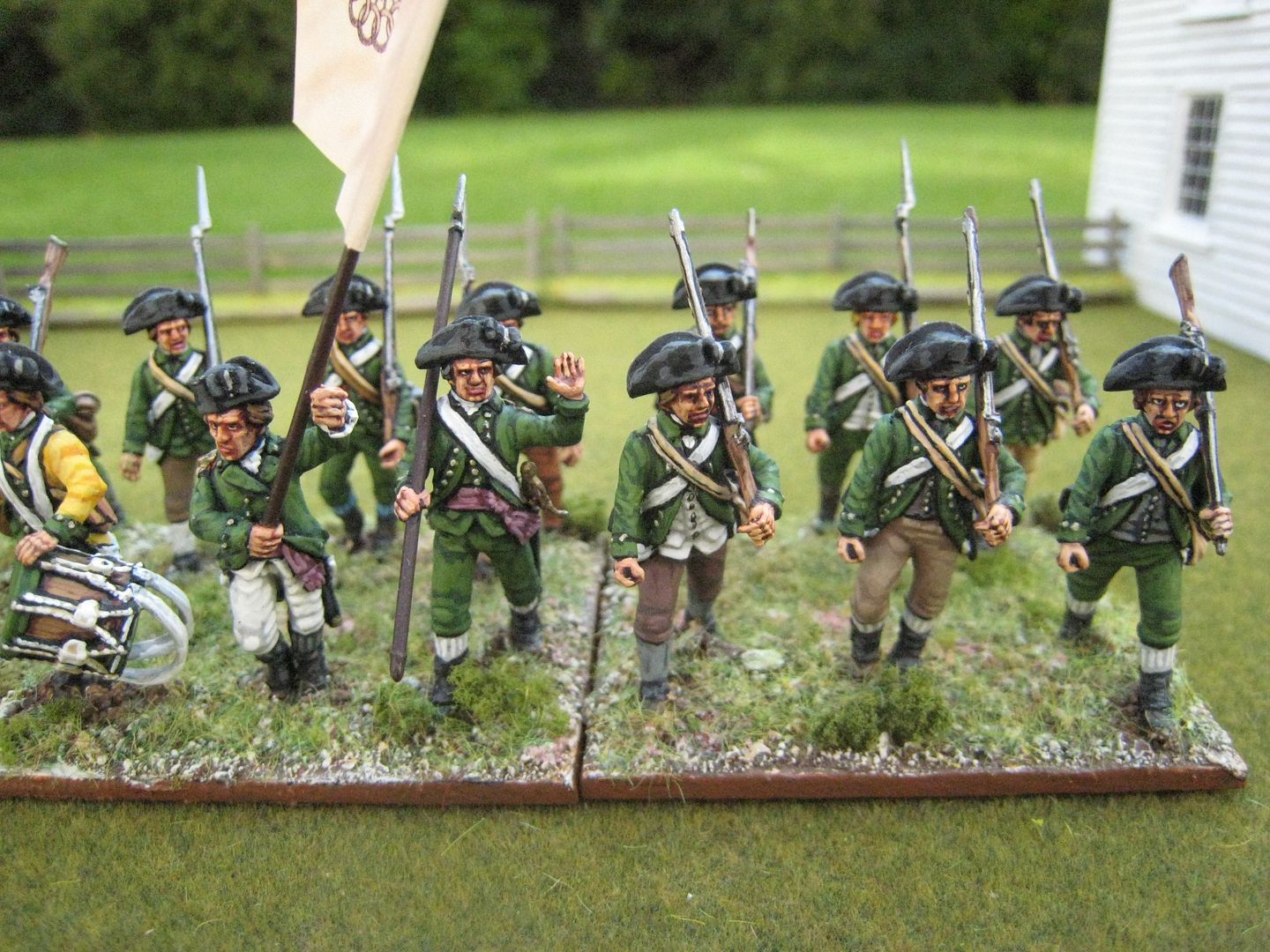
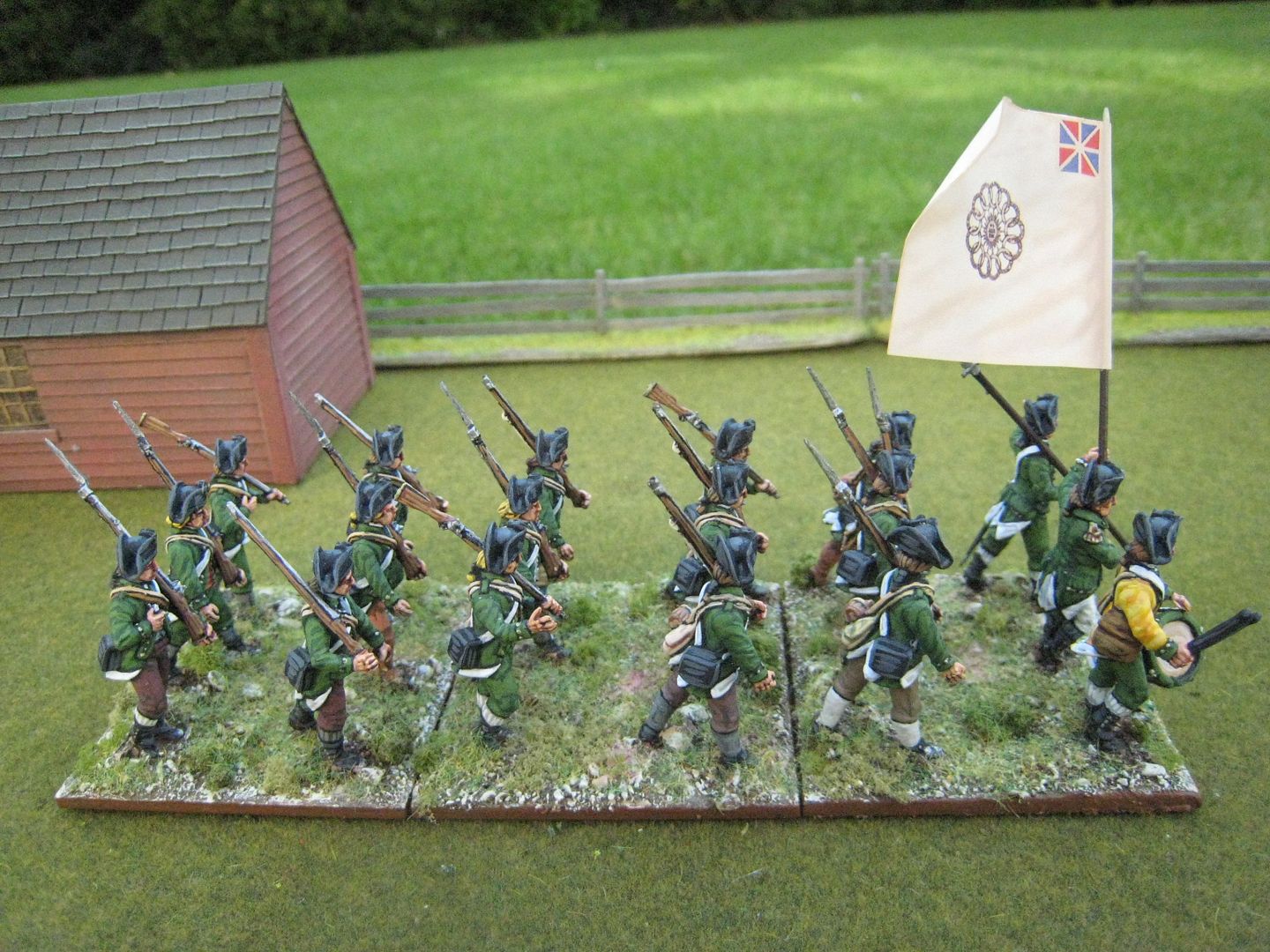
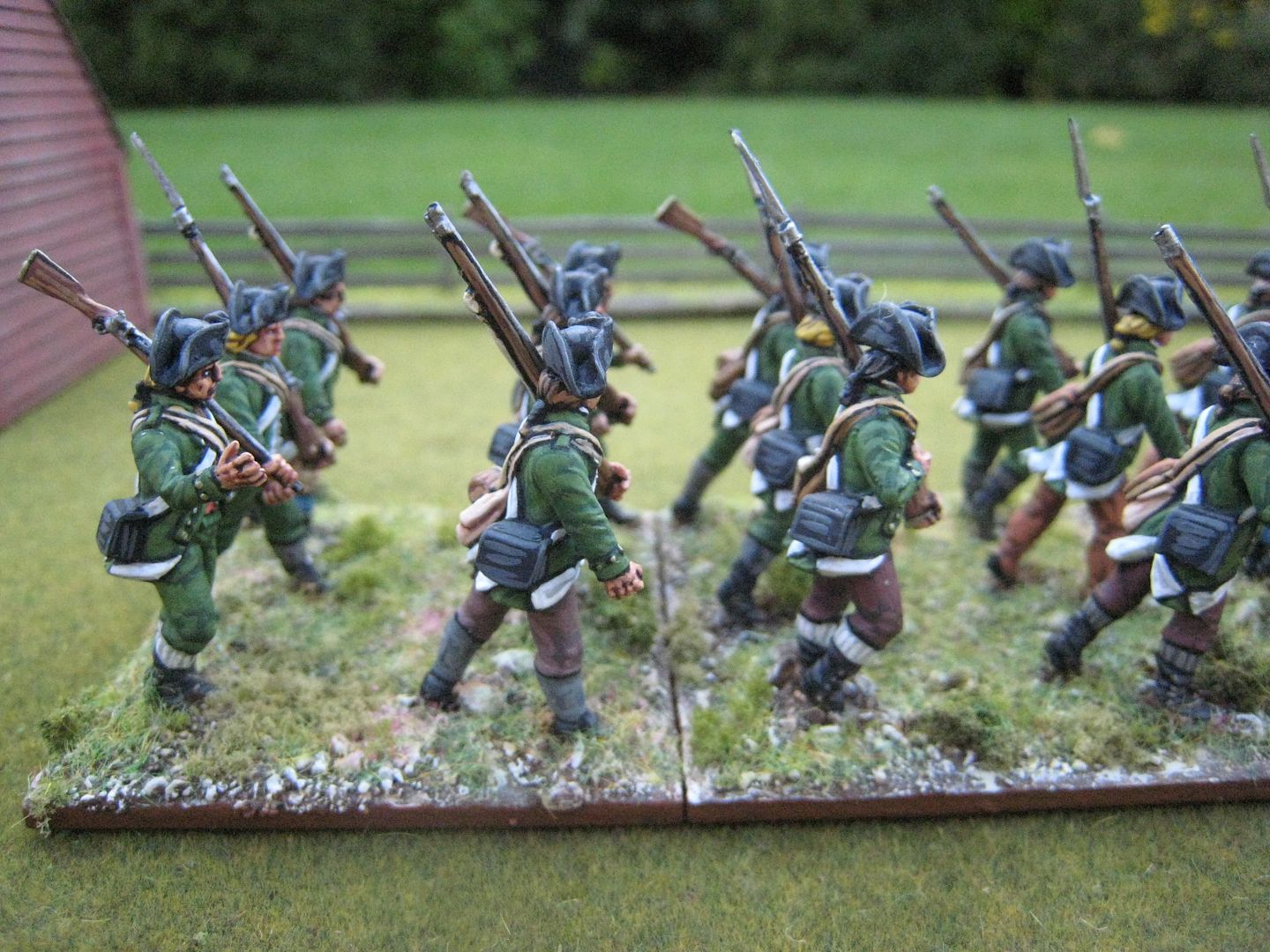
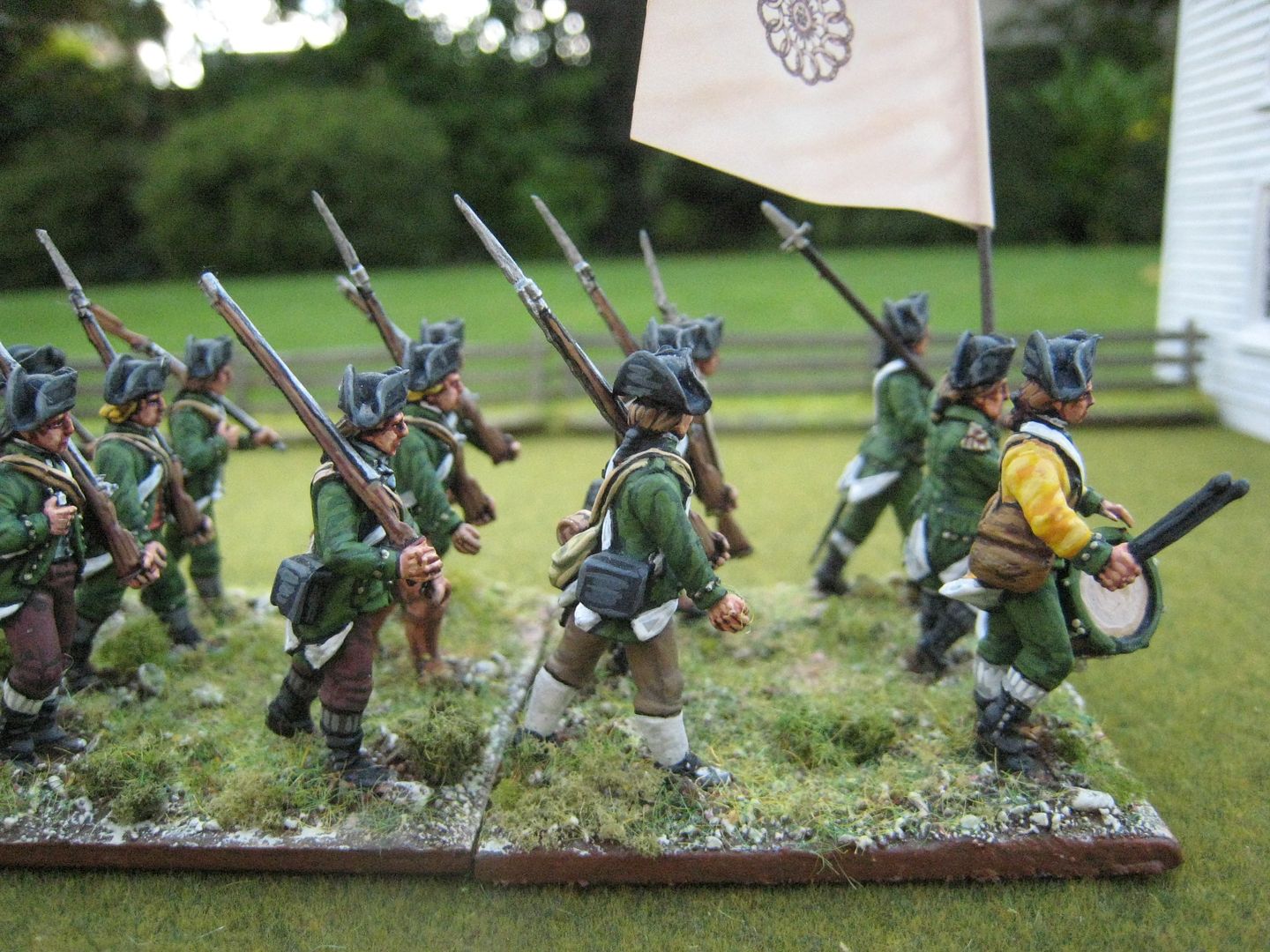
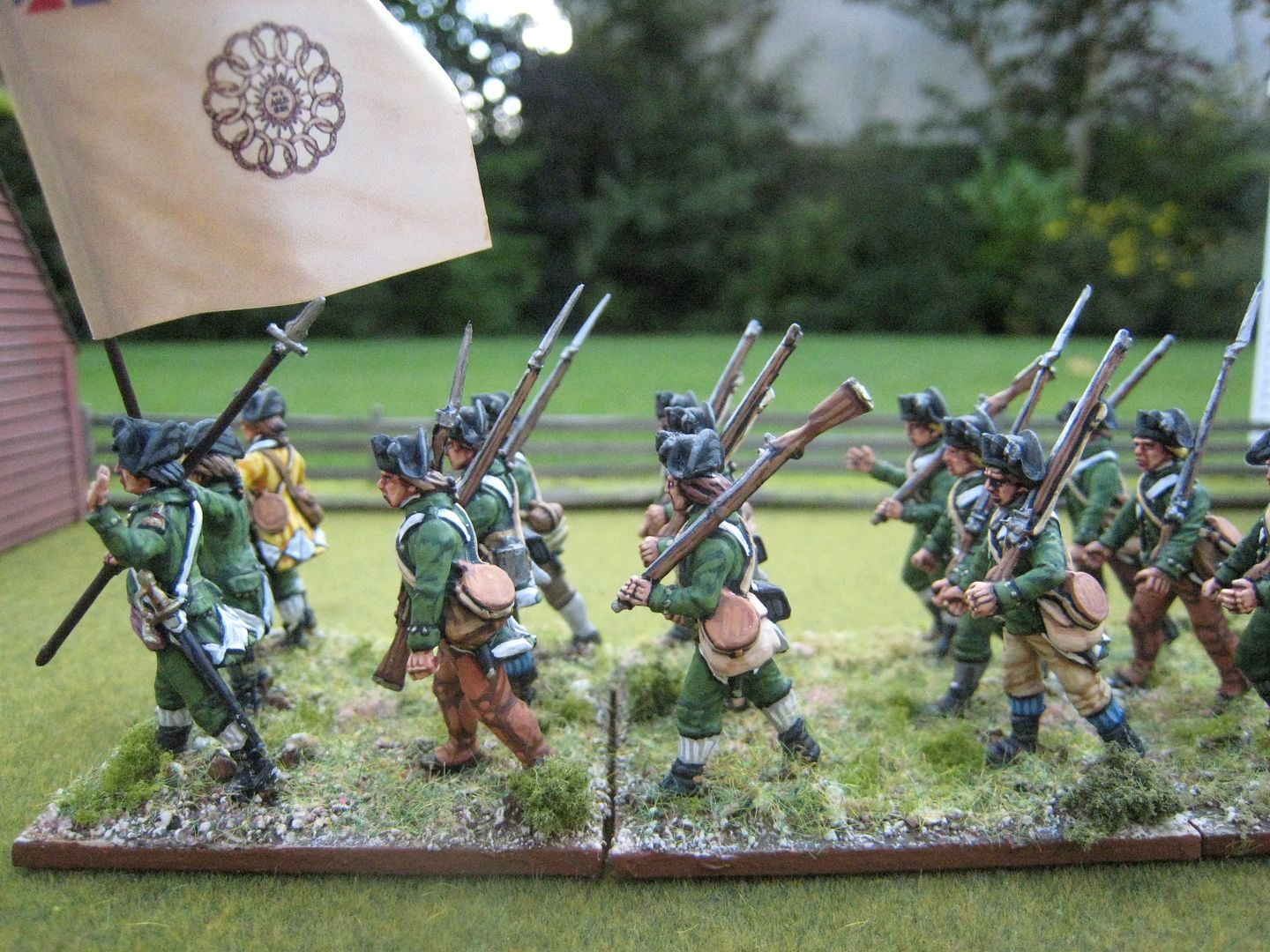
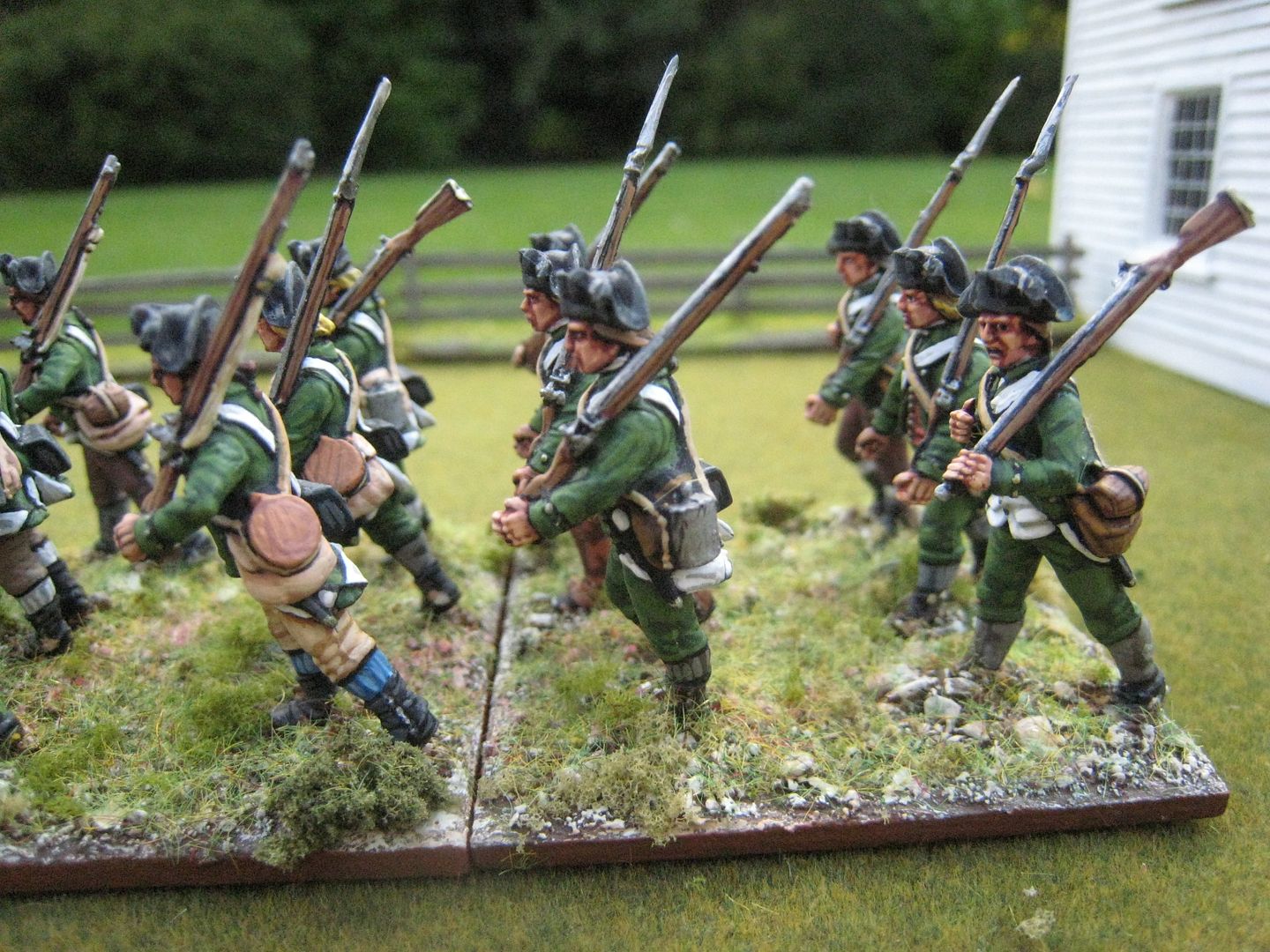
This is my second unit of American troops using the Perry plastic Continentals set.  I have a finished third, a South Carolina regiment, but I need to sort the flag out.  With each unit I've tried out a different set of hats.  The first, the 10th Massachusetts, used round hats and the Carolinians wear peaked caps.  These New Hampshire chaps have tricornes.  I painted the 2nd New Hampshire almost 8 years ago and decided to paint the 3rd simply because I liked the look of the uniforms.  The uniform leaflet in the Perry box shows this green coat and breeches outfit for the New Hampshire regiments and I thought it looked rather neat - it certainly makes a change from brown or dark blue coats.  Online references include brown faced red coats (which were issued at the end of 1778)  and even blue faced green, but I'll happily go with the Perry/Brendan Morrissey information, which I think works for the pre-November 1778 period.  I particularly like the yellow coat of the drummer. 

New Hampshire raised three infantry regiments in 1775 from the state's existing militia, which were quickly taken into the Continental line.   Then, in November 1776, the regiments that had become the 5th, 8th and 2nd Continental Regiments reverted back into being the 1st to 3rd New Hampshire Regiments.   The 3rd Regt saw heavy action during the Saratoga campaign and was present at Monmouth in 1778.   The regiment was disbanded in January 1781.

The standard bearer is a Foundry metal figure, but all the others are Perry plastics.  The green coats were painted with the Foundry palette "70 French Dragoon Green ".  The reason why some of the figures are "march attack" and others are "marching casually" is simply because I wasn't paying attention when putting all the figures together!  For the flag, I used one of my left over 2nd New Hampshire flags - in the relevant GMB pack you get a blue flag and a buff one, and I'd already used the former.  Quindia Studios have a very nice 3rd New Hampshire flag which I should have used (had I spotted it earlier)!

I've just emerged from 4 of the most difficult weeks I've ever had at work, and posting has suffered as a result.  I have a massive backlog of stuff now so I'm making a firm attempt to post at least twice a week.  So coming up are lots and lots of AWI French and Napoleonic French generals.  I've just finished the 2nd Continental Dragoons and currently on the workbench are the loyalist Emmerich's Chasseurs. 

18 figures.  Painted March-May 2015.  Flag by GMB.


Friday, 9 October 2015

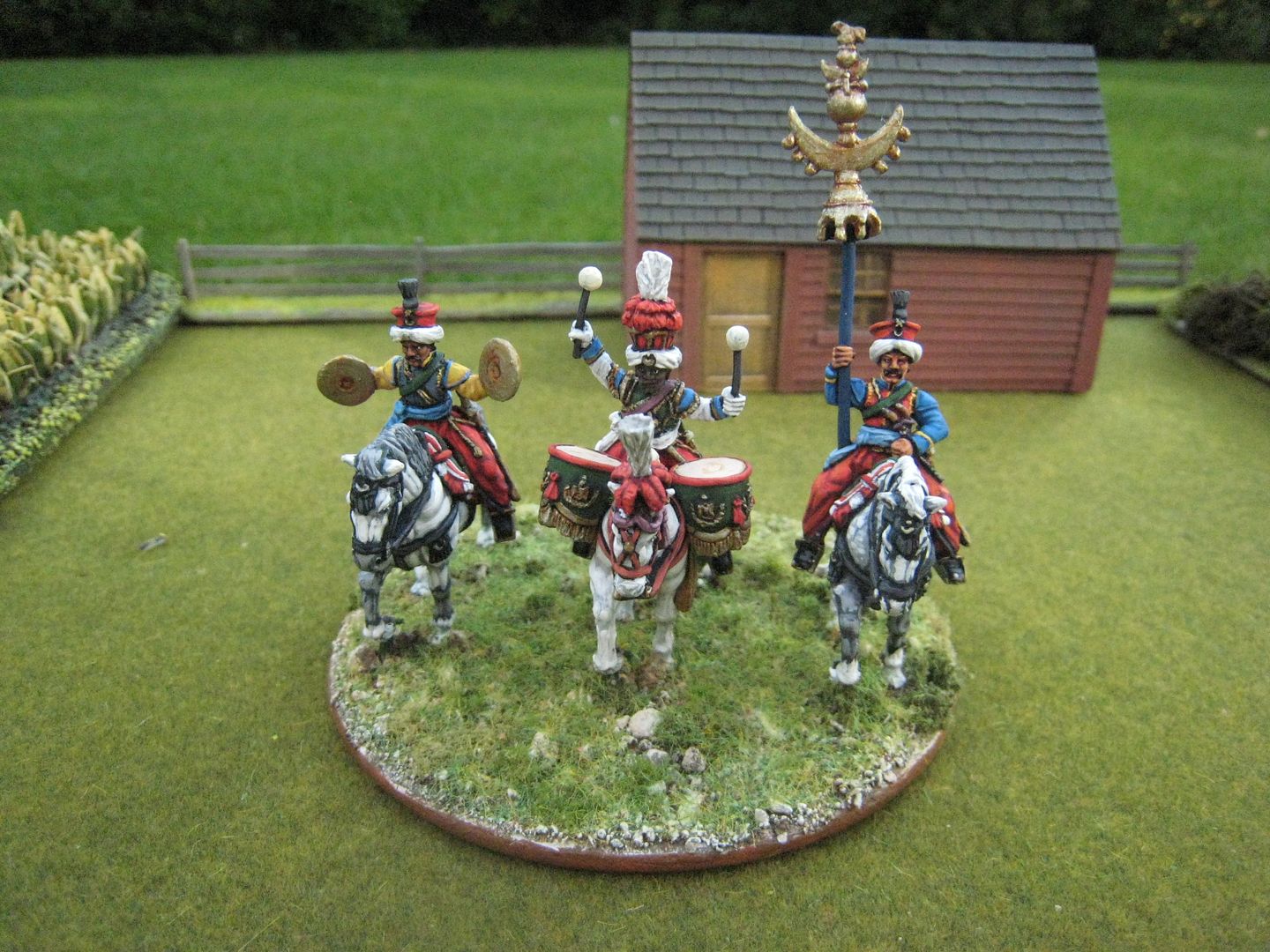
Mameluke Band

Napoleon's Mamelukes need little introduction.  Upon his escape from Elba, Napoleon ordered the reformation of the Mamelukes, to consist of one squadron to be attached to the Chasseurs of the Guard.  Sources appear to disagree on whether this squadron fully materialised and, if it did, whether it was actually present on the Waterloo battlefield and, if so, in what capacity.  120-odd Mamelukes may have charged with the Guard Chasseurs...we can't say for sure.  If they did, it's highly likely that the men were French rather than Turks or other men of Asian origin.   

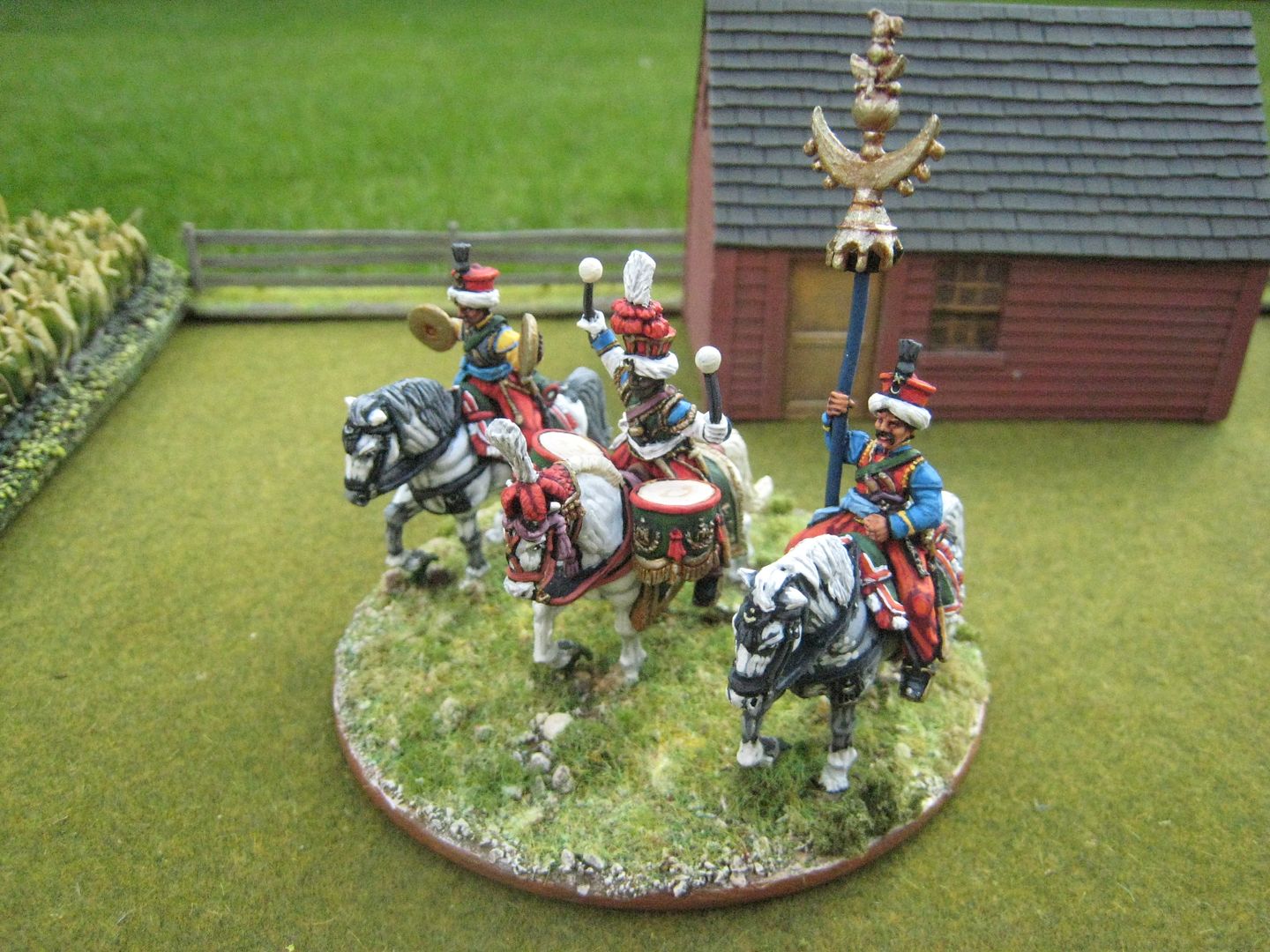
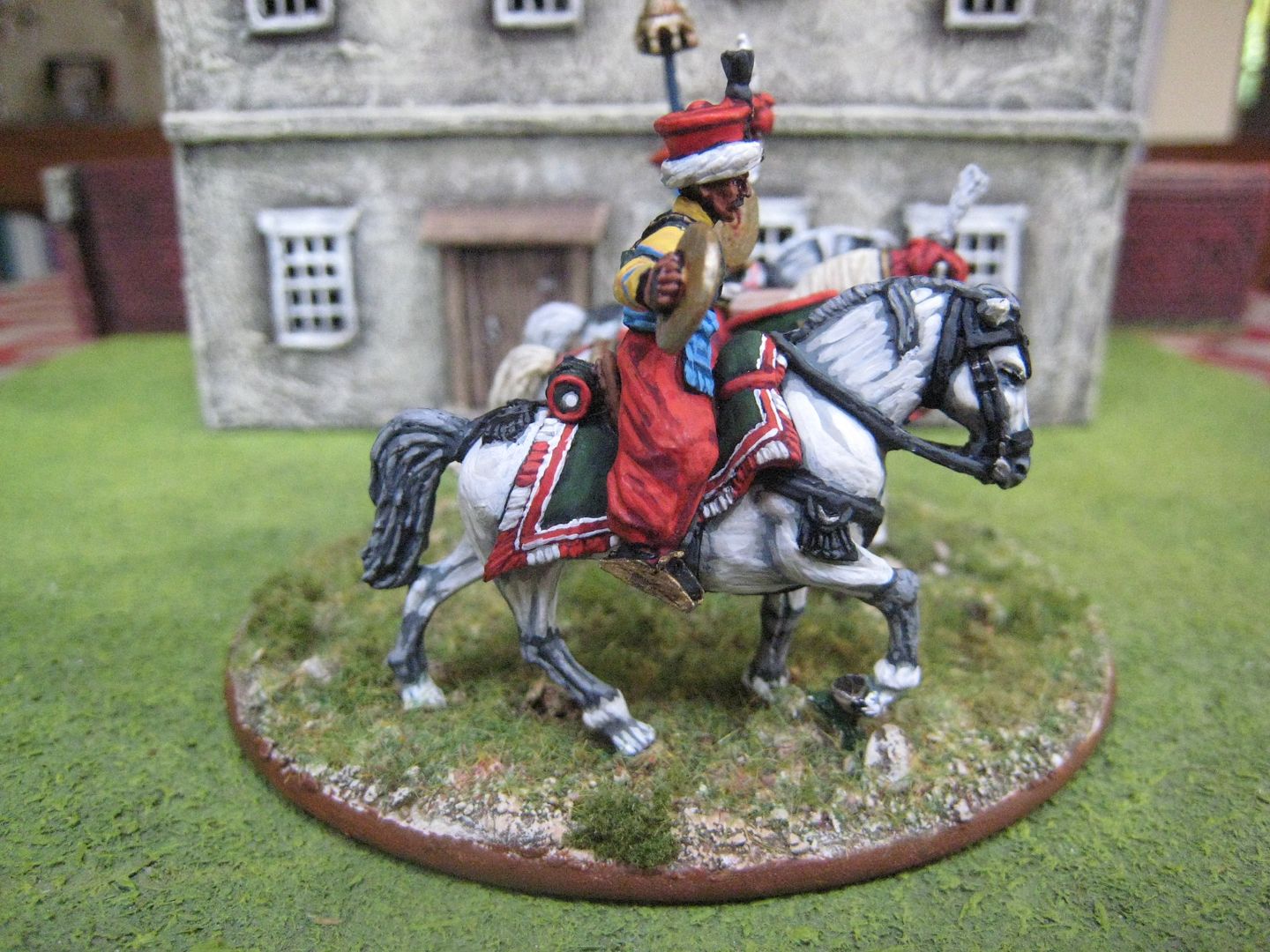
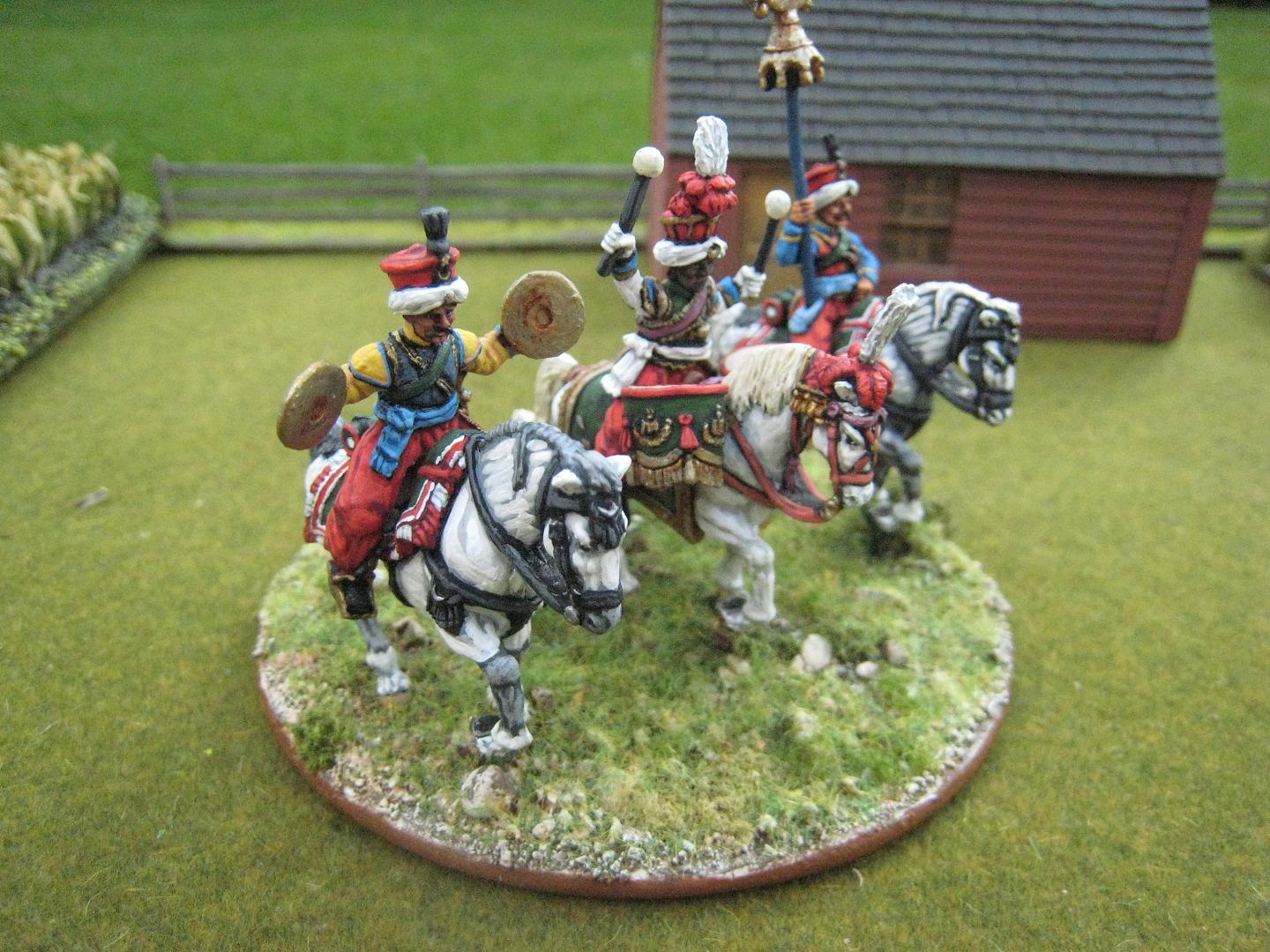
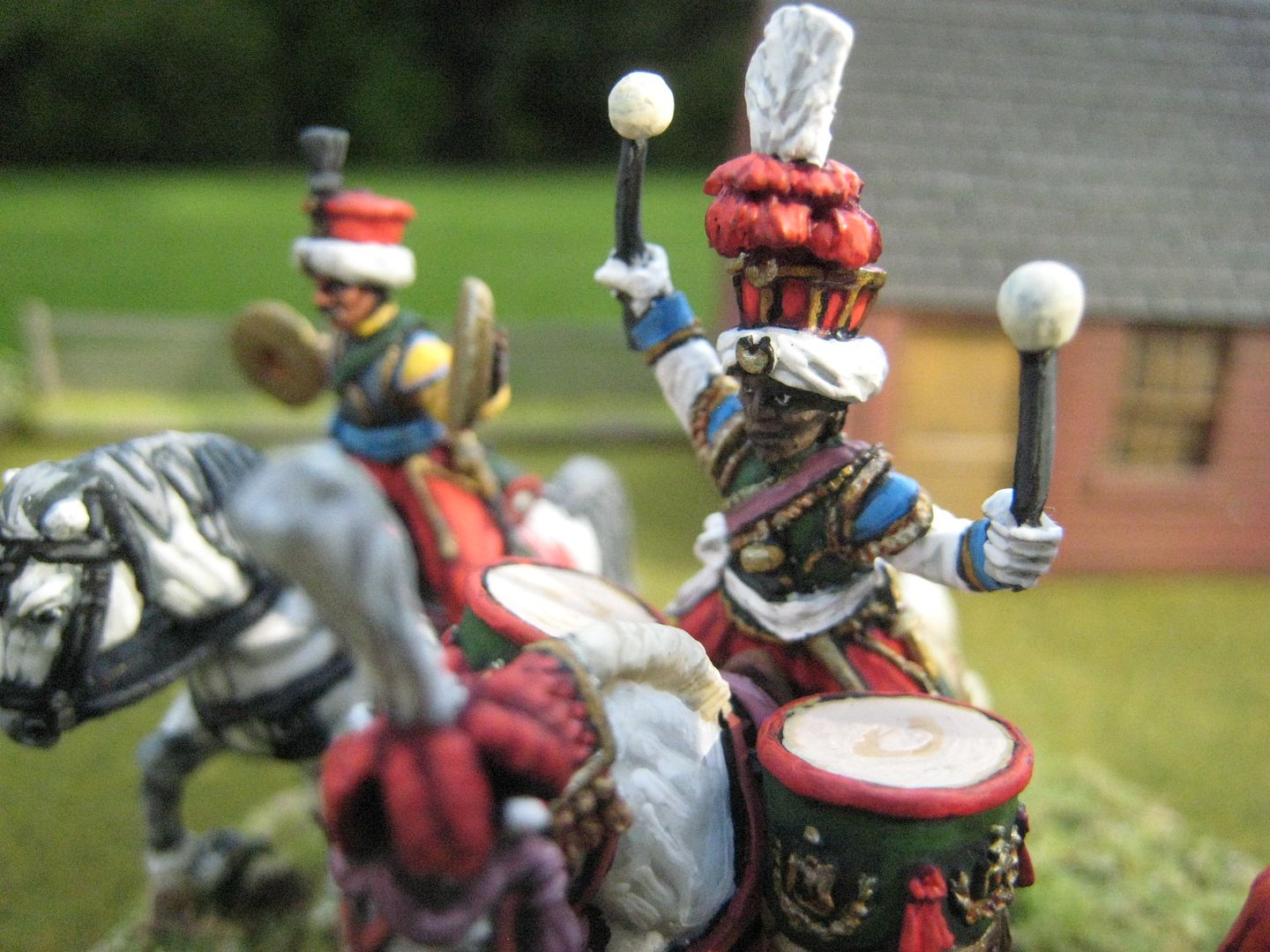
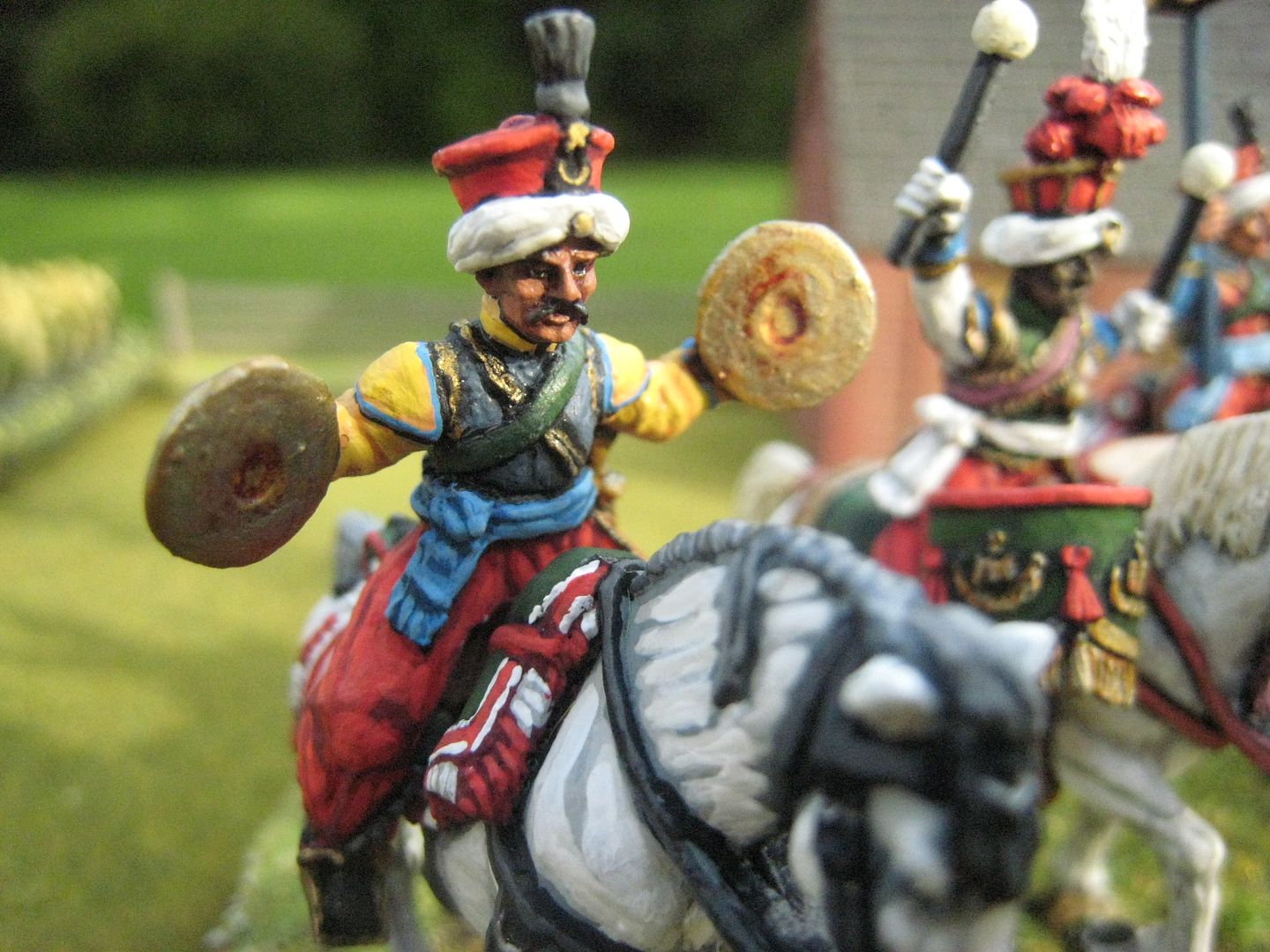
These rather lovely figures are from Gringo40s, who have a small range of off-beat Imperial Guard types (I recently painted some of their engineer figures).  The also do Mamelukes and I believe Lithuanian Tartars are forthcoming.  The Mameluke figures are on a mix of walking and charging horses.  The walking figures include various musicians and I thought it would be fun to put together a small band.  The figures aren't cheap - the kettle drummer costs £5.95 and the other ones are £4.50 each, but I think they are beautiful sculpts and make a nice little vignette.  The other figures in the range include a "normal" drummer, an eagle-bearer, a standard bearer and a charging trumpeter.  I wanted the kettle-drummer to be centre stage, and thought another drummer figure would look a bit odd so I bought the cymbalist and the chap with the "jingling johnny".  This Asian instrument was used by Ottoman armies from the 17th century and made its way into European bands in the mid-1800s.  Apparently it is still carried by bands in the German Army and the French Foreign Legion.

For uniform reference I used the Osprey MAA on the Mamelukes and the relevant volume of the Histoire et Collections series on the Imperial Guard.   I didn't want the figures to be identically uniformed, but I used the same general scheme of red trousers and light blue to tie them together.  I decided to paint each of the horses as slightly different greys, given that the riders are all musicians.  The horses are all in the same pose, although the kettle-drummer's horse has more furniture and ornamentation.  By 1815 it seems that most, if not all, Mamelukes were actually Frenchmen, but I decided to use the Foundry "Mediterranean Flesh 125" palette to suggest some sort of different skin tone.  These were fun, if complicated, figures to paint.  The sculpts have lots of detail which makes them somewhat fiddly to paint, but I'm pleased with how they turned out.  Did Napoleon have a Mameluke band at Waterloo?  I've no idea, but if some Mamelukes were there I'm sure they would have had some musicians...

3 figures.  Painted August 2015.


Sunday, 20 September 2015

American Militia (10)


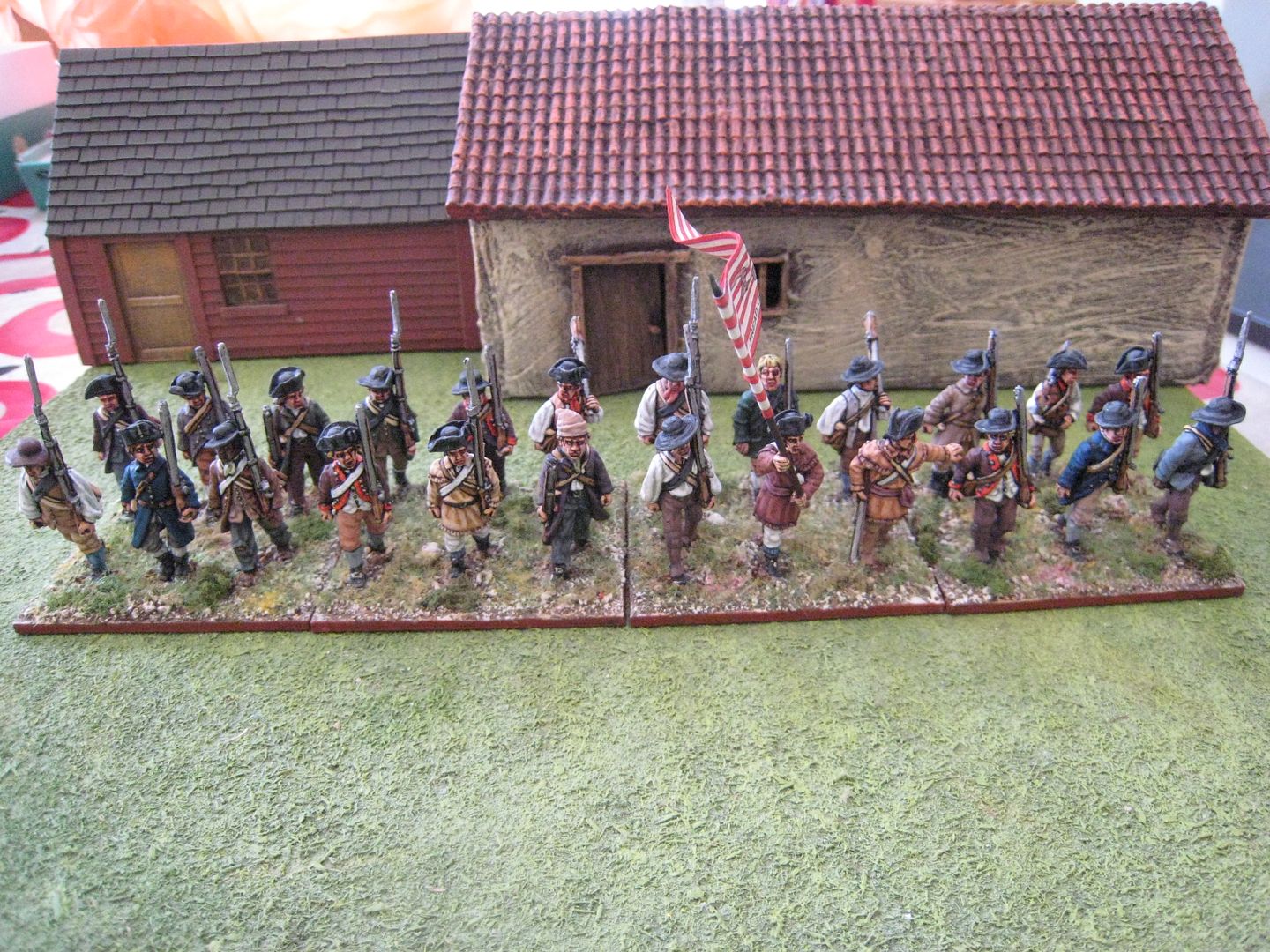
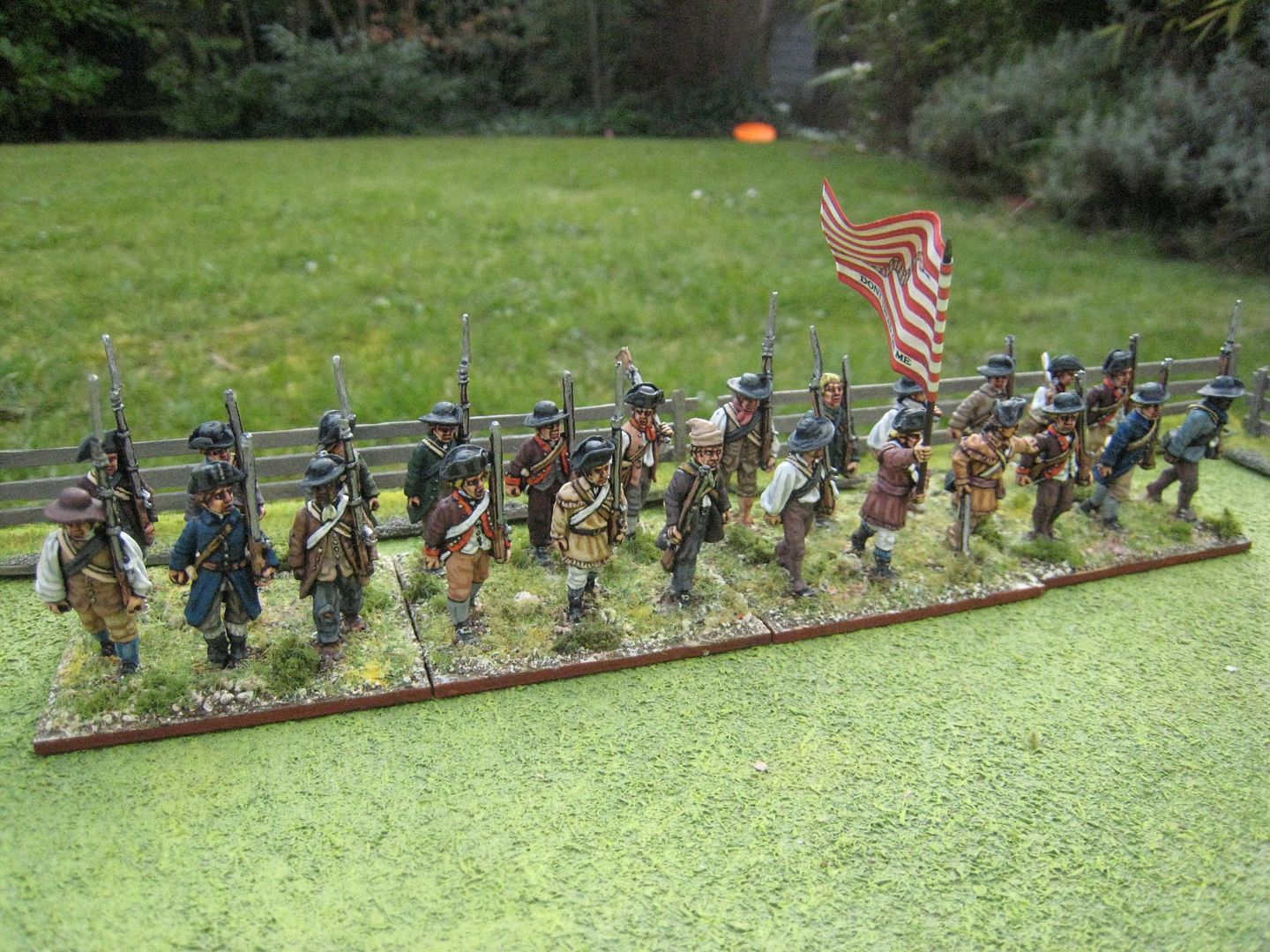
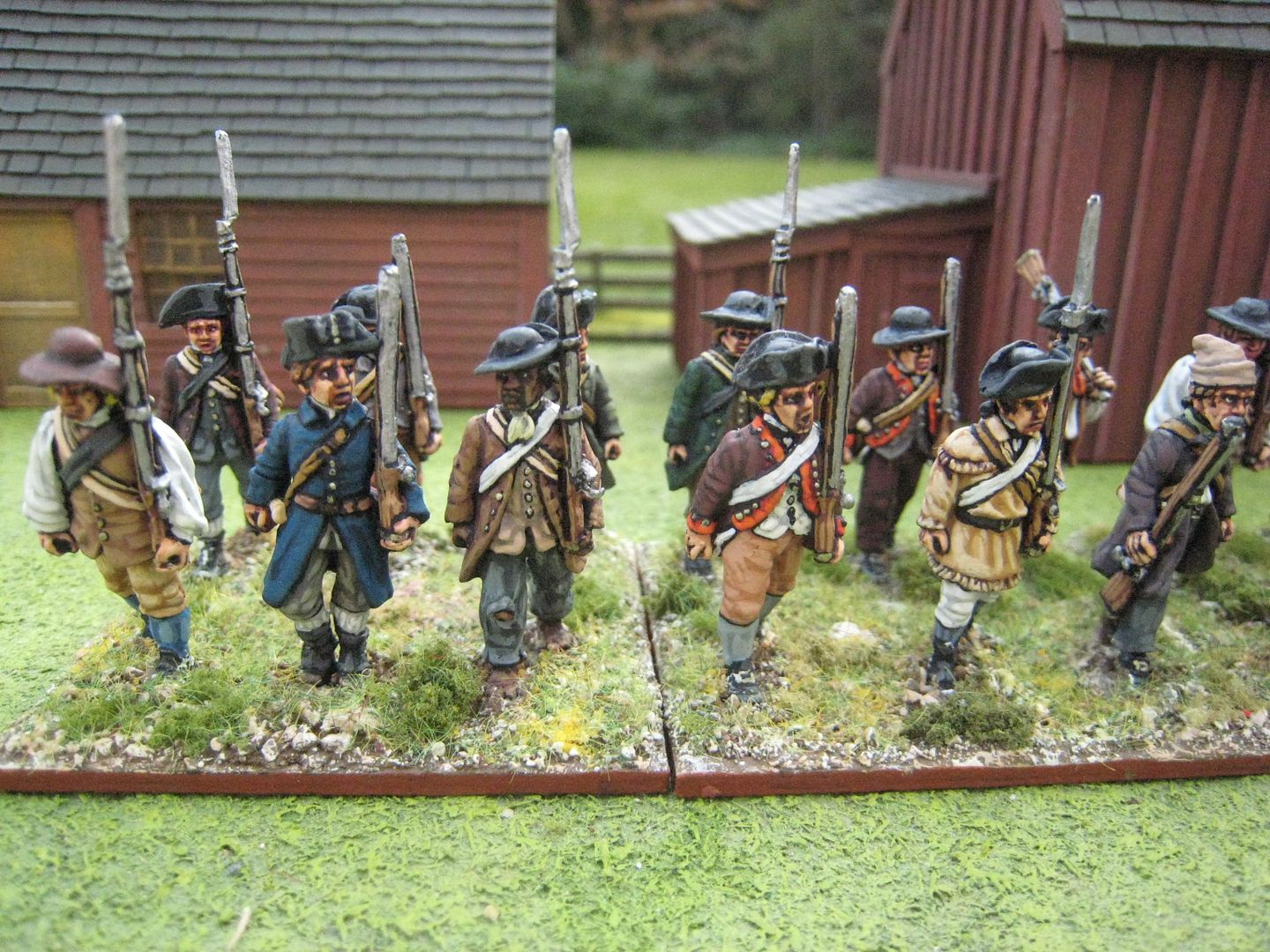
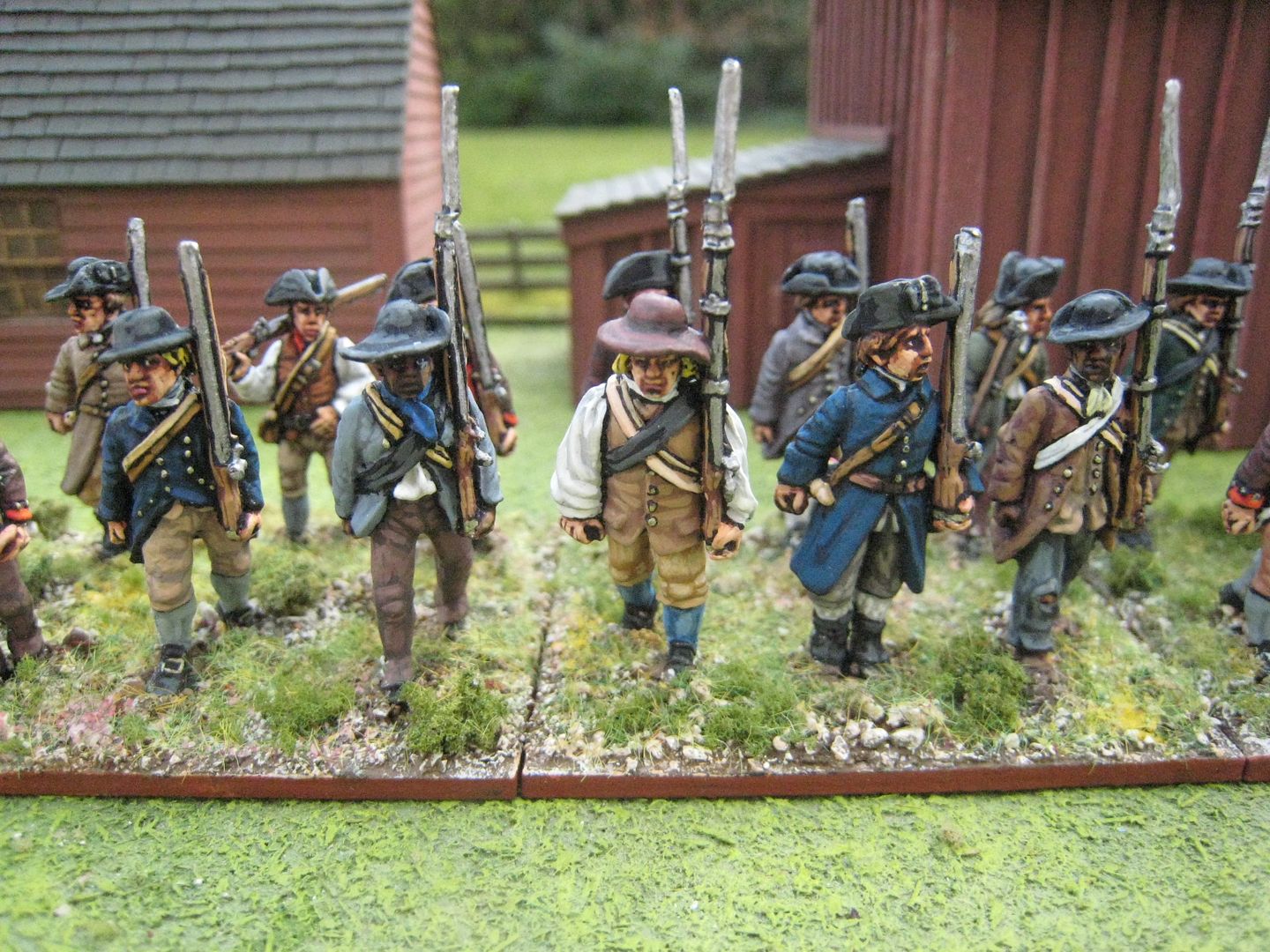
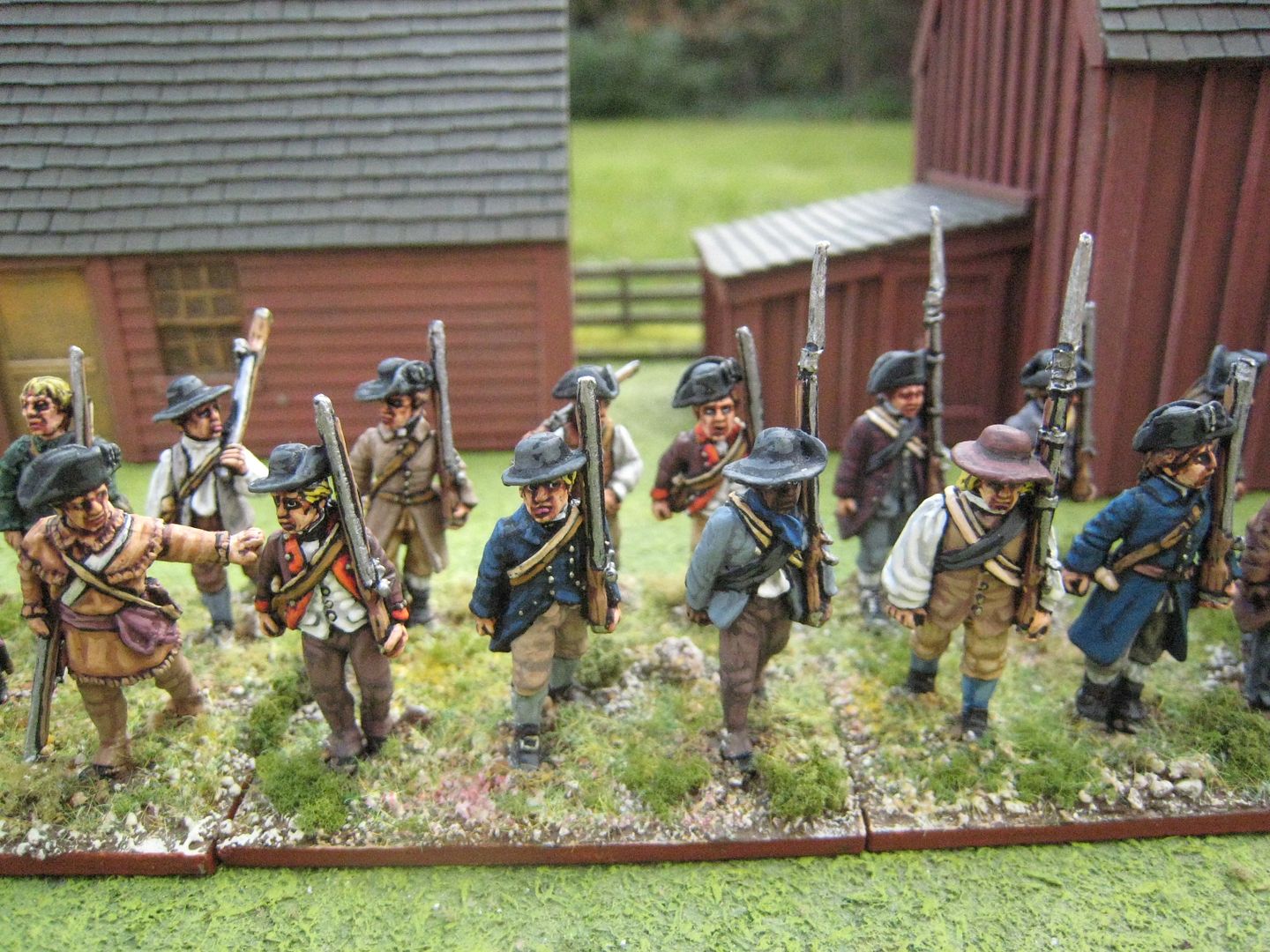
This afternoon I finally took decent (by my standards) photos of all the AWI units that have been hanging around waiting to be photographed.  This is the most orphaned of my hitherto un-photographed regiments.  It's the last unit of American militia which I painted at the end of 2013/early 2014.  I can remember painting it and I really can't believe almost 2 years have elapsed since.  My intention at this time was to use up all my remaining militia-ish figures I had, which I have now by-and-large achieved.  Being the last unit to be painted, this is a real mish-mash of Foundry and Perry figures, with a Eureka "ragged Continental" and one Conquest Miniatures F&IW settler.  Whilst it's labelled as "militia", it could do as a ragged early war Continental or state regiment.  With this unit I'm now pretty much done with militia.

What does "pretty much done" mean?  Well, I have a dozen militia units, of between 16 and 24 figures, and that will do for most scenarios.  I have written before about how I think the scenarios divide more into "cold" and "warm" weather militia units rather than "northern" and "southern" ones (Guilford Courthouse, for example, was fought on a cold and damp day), but with some allowances I reckon I have enough militia now.  These chaps are probably more in the "cold" camp, or at least not "height of summer", dress, although there are some hunting shirt types.  In the rear rank is a Conquest Miniatures settler figure - thinner and smaller than the Perry sculpted figures, he makes a very good "teenager". As I said above, the purpose of this unit was to use up various leftover figures, so it's a bit of a "swings both ways" unit.  I also expect I will combine stands from it with other units to make larger regiments for those 1:10 games that the more recent "British Grenadier!" scenario books tend to feature.    

24 figures.  Painted December 2013-February 2014. Flag by GMB.


Wednesday, 9 September 2015

South Carolina militia cavalry (2)


Work, holiday, more work, bad cold, helping out with the "British Grenadier!" 4th scenario book's final stages etc - the usual excuses explain a gap of a month since my last post.  But I've been busy and have masses of stuff now going through the basing process: French Napoleonic generals, Continental infantry, more French generals, Boston militia, AWI French chasseurs, my Mameluke band and more AWI cavalry.  Eureka's Continental dragoons came out about 5 years ago now, and I've been rather slow at painting up the large number that I have acquired since I first saw them at Eureka's shop in Melbourne.  Since then, of course, Perry Miniatures have released a large number of cavalry packs, with the four regiments of Continental dragoons, Lee's Legion and militian types all covered.  So is the Eureka range redundant now?  Not a bit of it.  I think the Eureka cavalry figures remain an essential component of a serious AWI collection, and that's because of the figures' flexibility and the customisation opportunities afforded by their separate hats and helmets.  I haven't yet tried using some of the hats on the Perry plastic infantry figures, but I intend to create some "legion infantry" types that way.

You don't need much American cavalry for most AWI games, but as it the case with this period there were lots of different units raised during the war and most of them only appear once or twice in the scenario list.  A quick peruse the scenarios shows, for example, that the 1st Continental Dragoons appears at Cowpens (4 figures) and Eutaw Springs (2); the 4th appear at Whitemarsh (4); Armand's Legion appear at Camden (6) and Indian Field (8); and at Gloucester you have Dabney's Virginia Legion (10).   So you could have half a dozen or so dragoons and just use those figures as generic American cavalry for everything.  Or you can try to model some of these particular regiments and that's what I'm intending to do.

I painted a unit of South Carolina cavalry 3 years ago but this is another one, inspired by the picture in the Osprey MAA "General Washington's Army (2)" of a cavalryman from "Giles' troop" of the South Carolina militia light horse.  The text refers to light blue coats with yellow facings and states that other troops had black, blue, red and green facings.  The Osprey makes a distinction between "militia light horse", which includes Giles' troop, and "light dragoons", which includes the units that I painted up earlier, such as Horry's Regiment.  I assume this distinction means that the units listed as "militia" were raised for limited periods while the "dragoons" were full-time state troops. Whether the Osprey has the correct units under the right heading is debateable,  as there are references to a Captain James Giles who served in South Carolina's 1st Regiment of State Dragoons before joining Hill's (5th) Regiment of Light Dragoons, and then to Captain Thomas Giles who served in Horry's Regiment and then the 3rd Regiment of State Dragoons (the Giles family appear to have been prominent landowners in the north-east of the state).  So I think it's possible that the separate units that Osprey list and divide into "militia" and "dragoons" may in some cases be the same, or at least operated together under a common commander, whose name was then given to the "regiment" that he commanded.  The Osprey also distinguises between the "light blue" coats of the "militia" and the darker blue of the "dragoons" such as Horry's Regiment.  But the essay on South Carolina's backcountry cavalry in  Jim Piecuch's Cavalry of the American Revolution quotes an earlier historian as saying that the coat of Horry's Regiment had "a light blue appearance".  But there were two regiments called "Horry", one raised in 1779 by Colonel Daniel Horry and another raised in 1781 by Colonel Peter Horry.  The "light blue" description refers to the latter regiment, which is stated in Piecuch as being "militia" but which is listed as a "dragoon" regiment in the Osprey. 

So who knows?  I may have painted the same unit twice over; or one (or both) of my versions of South Carolina's state dragoons may be completely wrong; or they may both reflect completely different units.  But anyway, following the Osprey we have: Giles' troop (yellow facings), Kolb's troop (green) and McDonald's (red).  I mixed up the head gear a bit to provide a militia-style/irregular look.

6 figures.  Painted August 2015.